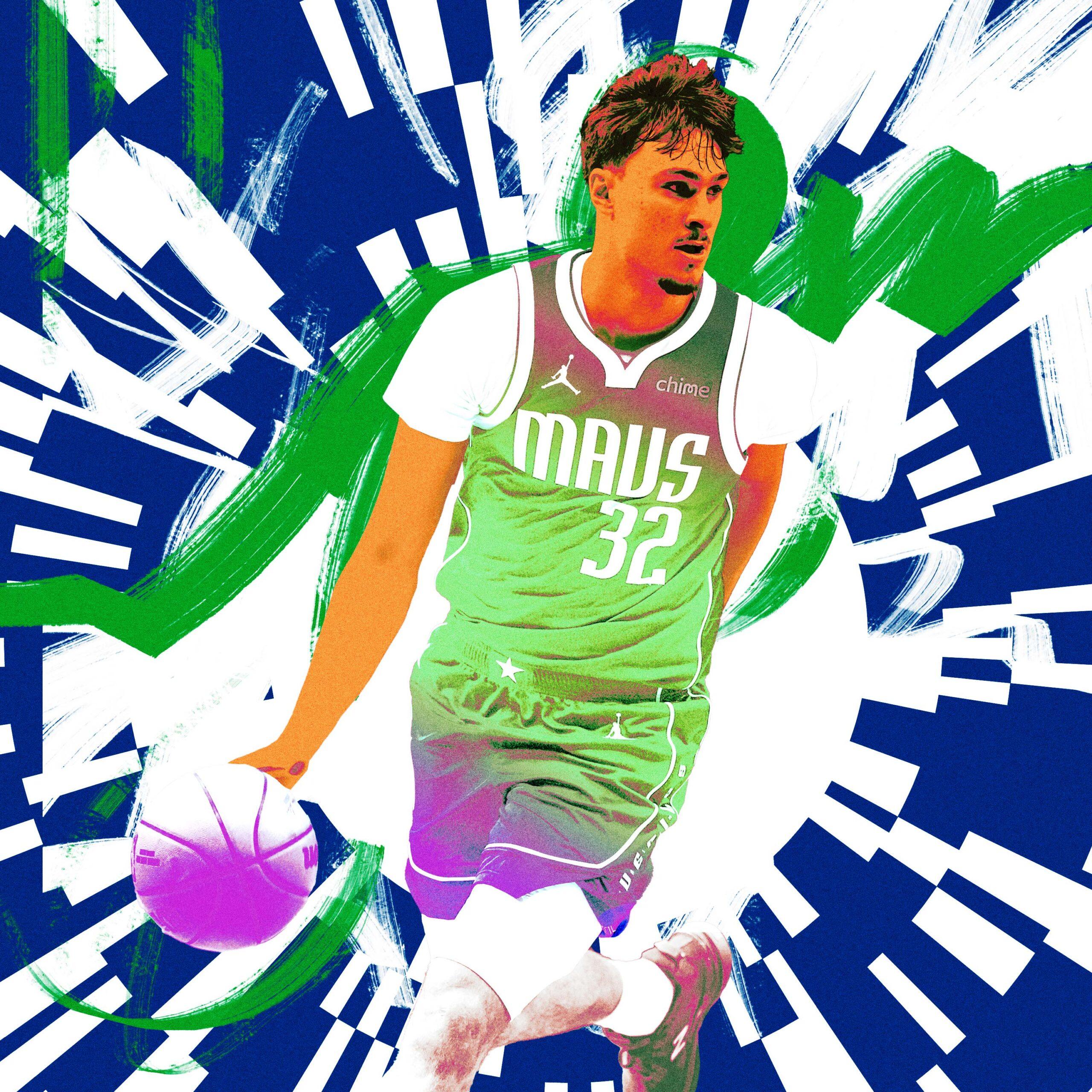

Cooper Flagg knows the move. As he uses a right-handed dribble to sprint around the free throw line, he’s watching Nikola Jokic’s balance. When Flagg arrives at the right elbow, he decelerates, freezing the three-time MVP in his tracks. At this moment, Flagg doesn’t care about Jokic’s trophy case—he just cares that he’s a slower player. The rookie hits the gas, leverages his giant strides to blow past Jokic, and detonates at the rim for an electrifying dunk that delivers an arena of tortured Mavs fans a glimpse of a better future.
The five-second highlight went viral, but it’s Flagg’s full box score from that night against Denver that should get Mavs fans legitimately amped. Just two days after his 19th birthday, the Maine Event had 33 points, nine rebounds, and nine assists. He was the best player on the floor as the Mavs beat Denver. His jumper was falling, his signature drives were working, and he was making everyone around him better.
After the game, Flagg got a phone call from Bangor, Maine. It was Matt Mackenzie, his longtime trainer. He was glowing. “This was by far your most complete game,” Mackenzie told him. “This is exactly how you want to play, night in and night out.”
If Flagg can consistently string together performances like that one, he will be one of the best players in pro basketball. He’s not there yet.
The kid from Newport is fighting to thrive and find consistency inside a wounded basketball environment. His rookie season has been weighed down by a broken roster, injuries to key teammates, and high drama in the front office. And now he's arrived at the dreaded rookie wall, the point in the NBA marathon when a lot of first-year players falter. And as Flagg stares down the second half of his rookie season, he and this organization have a lot of work to do.
Flagg’s Mavericks origin story is instant canon. In February of last year, Dallas had Luka Doncic in his prime alongside Kyrie Irving—one of the league’s most tantalizing backcourts. Then they detonated it, stunning the sports world and alienating their fan base by trading Doncic to the Lakers for Anthony Davis.
It only got worse from there. Davis and Irving both went down with injuries, and by mid-April, the Mavericks’ collapse was complete: Their season ended with a play-in loss to the Grizzlies. Less than a year after their trip to the NBA Finals, a shell-shocked franchise limped toward the draft lottery in Chicago. That’s where the universe intervened—a cosmic lifeline in the form of Cooper Flagg.


In October, Flagg made his NBA debut against Victor Wembanyama and the Spurs, a reinvigorated in-state rival that suddenly boasts one of the league’s best young cores. That night, Flagg became the second-youngest player to start in his NBA debut. He didn't score until the first possession of the second half, finishing with 10 points and 10 rebounds, while the Spurs won in a blowout. The game provided an undeniable early glimpse of a new reality: The Mavs are now the third-best NBA team in Texas, and they must rebuild their roster around Flagg.
The rookie’s ceiling is simple. He can be the league’s ultimate five-tool player, blending athleticism, scoring, playmaking, rebounding, and defense at elite levels. He’s clearly the most well-rounded player in this deep rookie class.
Cooper Flagg’s Ranks Among Rookies This Season
Flagg is also by far the most productive player on the Mavericks. He’s doing it all for Dallas, and at times he’s being asked to do way too much, something that pops out when we look at his scoring numbers. Halfway through his rookie season, there is a glaring red flag (no pun intended, folks) in his stats: his shooting numbers.
Here are the two most disappointing stats of Flagg’s rookie year.
- Among the 48 players who have attempted at least 500 shots this season, Flagg ranks 42nd overall in efficiency.
- Out of 185 players who have attempted 100 3s this season, Flagg ranks 182nd in efficiency.
Drilling deeper, Flagg is just 4-for-24 from the corners and is hovering around 32 percent from above the break, which isn’t great but is closer to respectability. His biggest struggles have been on pure catch-and-shoot tries, the 3-point shots that should be the easiest. On such attempts, Flagg is 16-for-64—that’s 25 percent—a woeful number that has to improve in the coming years.
As he continues to get better—and he has not scratched the surface of what he will become—we will be able to add pieces that make him even better.Mark Cuban
Nobody I spoke to around Flagg’s camp or the Mavs expressed any concern, especially considering his age and his role. Remember, Flagg skipped a year of high school, and his twin brother, Ace, is currently a freshman at the University of Maine. Cooper is the youngest volume scorer in the NBA since a rookie named LeBron James entered the league in 2003. James was perhaps the NBA’s least efficient scorer in his rookie campaign; 23 years later, he’s scored the most points in league history.
Flagg’s mechanics are sound—the exact same ones that powered his stellar shooting at Duke down the stretch of his lone college season. Oh, and history might be repeating itself. A season ago, Flagg’s shooting greatly improved after his 18th birthday, and something similar is happening after his 19th. Since December 21, Flagg has knocked down 43.6 percent of his 39 3-point tries. Things are trending up.
Some of Flagg’s inefficient numbers are a symptom of a youngster being asked to do too much within the catastrophe the Mavs call an offense. There remains a giant Doncic-shaped hole in the design, and too often in his rookie campaign, the teenager from Maine has needed to mimic the Slovenian savant this attack was built around. Any analysis that doesn’t account for this bizarre predicament is simply incomplete.
Flagg is learning to play NBA basketball inside the 28th-ranked offense in the league, on a team that has lacked playmaking prowess and spacing all year long. The team’s primary playmakers, at least until Irving comes back, are both rookies: Flagg and undrafted two-way point guard Ryan Nembhard.
None of this is damning for Flagg’s long-term trajectory. NBA history provides proof that young volume scorers rarely achieve efficient numbers. Consider these three examples.
- At 19, Kevin Durant struggled mightily. In his only year in Seattle, Durant made 29 percent of his 3s and 46 percent of his 2s.
- As a rookie in Cleveland, LeBron made 29 percent of his 3s and 44 percent of his 2s.
- When Kobe Bryant finally became a starter in his third season in the league, he was 20. He made 27 percent of his 3s and 49 percent of his 2s.
Against that context, Flagg's shooting numbers actually point to a signature skill. Yes, he is making just 28 percent of his 3s, but he's making 53 percent of his 2s, better than all three of the player seasons listed above.
Flagg’s driving rim attacks are already at an All-Star level. Just ask Jokic. According to NBA Stats, Flagg is driving the ball more than any other rookie, at 11.5 times per game. And despite the Mavs’ stinky overall spacing, Flagg already ranks seventh in the league in driving layups and dunks made, a top-10 list that includes names like Jaylen Brown, Shai Gilgeous-Alexander, Giannis Antetokounmpo, and Anthony Edwards. That’s phenomenal company for a teenager.
These are the most valuable looks in basketball, and only the best scorers can both effectively penetrate that zone with drives and then convert their attempts. Thanks to his elite combination of size, handle, speed, and touch around the rim, Flagg can do both already. His left-hand finishes are nothing short of stunning for a right-handed player. If he played in a healthier offensive environment where teams couldn’t crowd the interior, these rim-attacking numbers would look even better.
“Right now our challenge is shot creation and spacing,” says Mark Cuban, minority owner of the team. “Both are fixable."
Which brings us to the Mavs’ current predicament.
For Dallas, Flagg is the bright light at the end of the Nico Harrison Memorial Tunnel. Two years after selling his majority stake in the team, and one year after the Luka trade, Cuban is desperate to restore the pride and culture within a wounded Mavs organization. Every team-building decision Dallas makes from here will be made with Flagg in mind.
“As he continues to get better—and he has not scratched the surface of what he will become—we will be able to add pieces that make him even better,” Cuban says.
Cuban adds that there will be changes.
In the eight months since the lottery, Dallas has become one of the most fascinating rebuilds in the NBA. And while some around the Mavericks may not want to accept that characterization, it’s crystal clear to rival executives that reshuffling the deck and starting anew around Flagg is the Mavs’ best option. The question is the best way to do it.
As currently constructed, this roster is operating on two timelines. One is driven by oft-injured vets in Davis and Irving, both currently sidelined. And one is driven by Flagg and a few of his young teammates in Dereck Lively II, Max Christie, and Nembhard.
And at the halfway point of this season, here’s the most compelling part: The 12th-place Mavs own their own pick in the upcoming, talent-rich 2026 draft, which is not the case for the 2027 or 2028 drafts. This next draft provides Dallas with its best chance to land another star prospect and do something its rivals in San Antonio, Houston, and Oklahoma City have already accomplished this decade: assemble a war chest of young, blue-chip prospects.
That’s a really long way of saying, “Bro, tank this thing immediately.”
Flagg is a phenom, but he’s not even the most exciting young prospect in Texas. If the Mavs want to compete with the Spurs, Rockets, and Thunder in the future, they’ll need to surround Flagg with young playmakers in the backcourt, explosive two-way bigs up front, and shooters on the edges.
The combination of the team’s current record (15-25) and the most recent Davis injury—ligament damage in his hand that will keep him out for at least six weeks—provides a clear path back to the lottery room. On Tuesday, Shams Charania reported that the Mavs will still listen to offers for Davis, should some playoff team want to add him for its postseason run. At this point, the return for the oft-unavailable AD is bound to be underwhelming, but Dallas has to consider it, if only to clear up its cap sheet and give itself flexibility as the front office charts the next course. It’s time to prioritize the Flagg timeline, and time to forget the fantasy that a team built around Davis, Irving, and Klay Thompson can compete for a title in the back half of the 2020s.
One complicating factor is that, after firing Harrison in November, the Mavericks have yet to name a new chief architect, let alone establish a clear timeline for reconstruction. The front office is currently being led by “co-interim GMs” Michael Finley and Matt Riccardi, and the ownership is still licking its wounds from botching the biggest trade of the 21st century.
No other first-year player is as central to his team’s present or future as Flagg, and it's not close. Kon Knueppel and V.J. Edgecombe, the two other candidates for Rookie of the Year, are off to great starts, but the breadth of their greatness can’t match Flagg’s. Cooper leads the Mavs in total points, total rebounds, total assists, and total steals. Among all rookies, in what looks like one of the deepest draft classes in recent memory, the youngest man in the NBA stands apart.
Flagg remains a runaway favorite to win the Rookie of the Year award. He has already become the youngest NBA player to ever score 40 points in a game, but he’s much more than just a bucket. He aims to be the most complete player in the NBA.
As he faces the wall, Flagg has already given Dallas the most important thing: a clear direction, and a third opportunity to build a basketball juggernaut around a generational talent. They nailed it with Nowitzki. They fumbled with Doncic. The question now: Can they figure it out with Flagg?