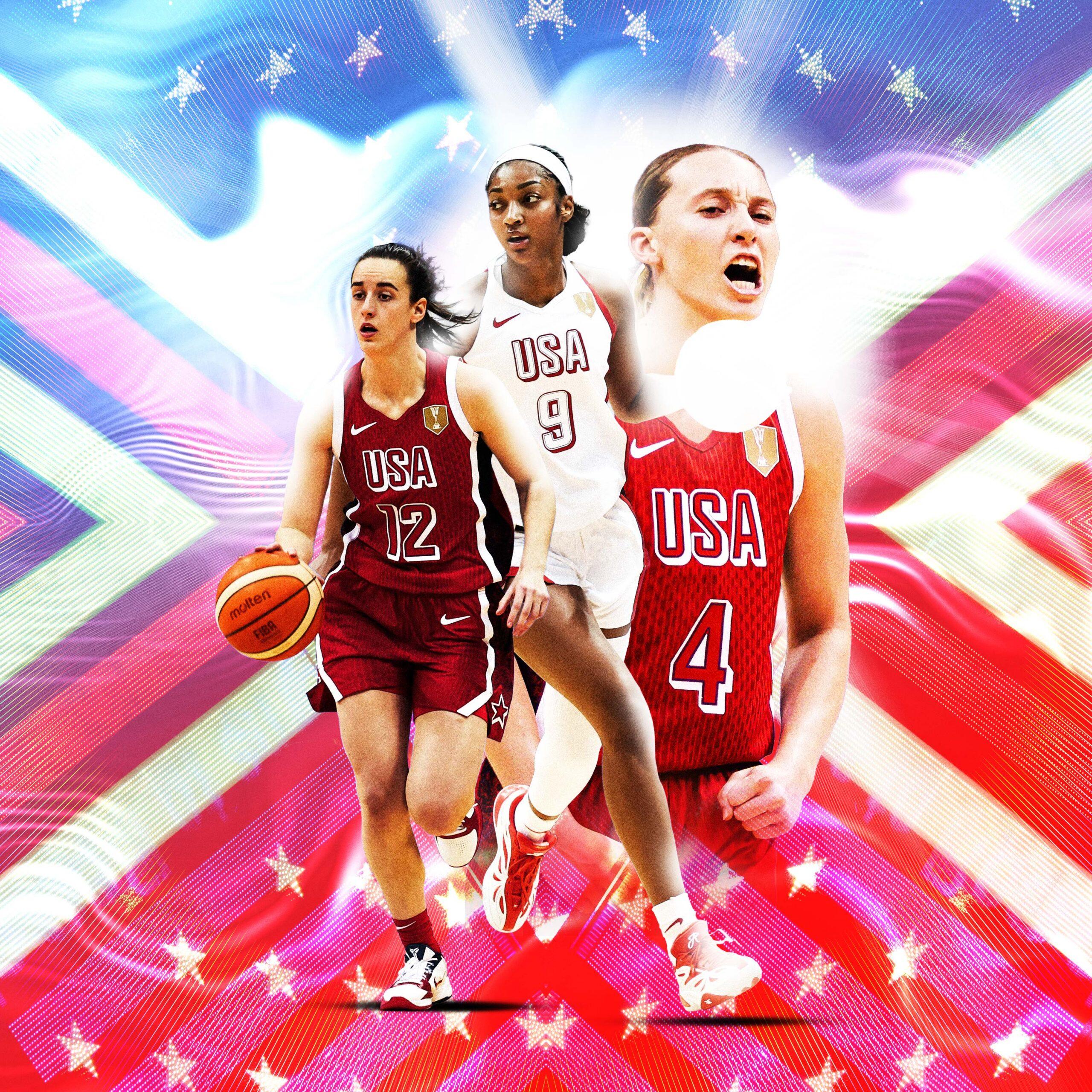

Sue Bird, the managing director of the U.S. women’s national team, has been tasked with building a bridge between the dynasty she helped build and the generation now inheriting it. Team USA’s roster for the FIBA World Cup in Berlin, the first one constructed by Bird, signals a shift to guard play and youth with the addition of Caitlin Clark and Paige Bueckers, who are among seven first-time World Cup participants.
Clark, who has transformed the relevance of women’s basketball in the U.S., is playing across the Atlantic for the first time in her adult career. The league has designs on expanding its global footprint, with plans including its first game outside North America in 2027, and Clark is the WNBA’s perfect vessel to gain international popularity. No one else has her 30-foot range and cultural reach. The results of the FIBA matches will be important, but they'll also have an impact on the growth of women’s basketball, both domestically and abroad.
The relationship between the WNBA and the rest of the world has never been closer. The Toronto Tempo’s inaugural season has been such a rollicking success that it only makes Canada’s failure to qualify for the World Cup sting more. Almost 15 percent of players in the league this year are European, and about a third of its players are participating in the World Cup—which is why the WNBA is going on an official 17-day break during the course of the tournament. For a growing game, this is a rupture, a necessity, and a barnstorming opportunity.
The U.S. women have won gold at every Olympic and World Cup competition since 2008, but a nail-biter against France at the 2024 Paris Olympics might have been a signal that their days as a hegemonic power are drawing to a close. The competition has never been tougher, and the U.S. roster is inexperienced and untested, especially now that Kelsey Plum and A’ja Wilson, the latter of whom is the league’s reigning MVP and Team USA’s frontcourt tentpole, have been ruled out with injuries.
International play, for the U.S. team, has historically been a showcase masquerading as a competition. This year, it could genuinely be both. Ahead of the U.S.’s first group stage game against China on Friday, here are the eight biggest questions Team USA is facing at the World Cup.
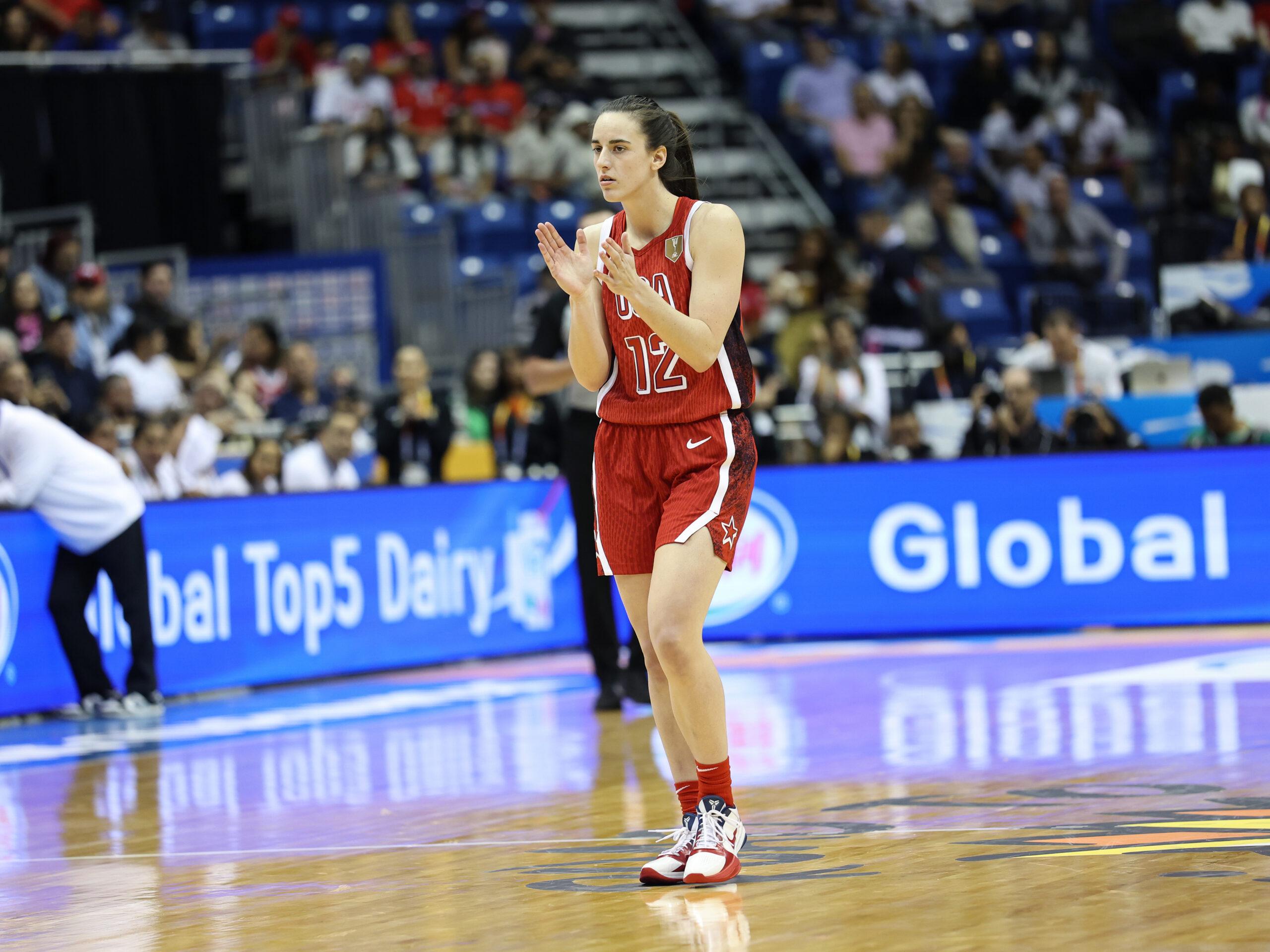
Caitlin Clark during the game against Puerto Rico in the 2026 FIBA qualifiers
Can Team USA export the Caitlin Clark effect?
In the hierarchy of international importance, the FIBA World Cup has always taken a back seat to the Olympics, but Clark’s presence has a way of imbuing previously ho-hum events with relevance and meaning.
TNT became the first major network to air the women’s qualifiers back in March. Over the course of the World Cup, the network and its partners will stream or air every game.
Clark’s performance in Berlin will be of great interest to the basketball world and her cadre of brand builders. She is, with respect to the King of New York, the most important and popular young U.S. basketball player—the unlikely but obvious answer to domestic basketball fans’ existential crisis about the future of the professional game after Steph Curry and LeBron James retire.
Team USA will play against China and its hundreds of millions of Nike-pilled basketball fans on the first day of the tournament. Clark draws fans from all over the world to her games. When the Indiana Fever played Brazil’s national team in the preseason last year, the Brazilian players gushed and asked Clark to sign their jerseys. In Clark’s rookie season, according to Fanatics, her global jersey sales were surpassed only by Shohei Ohtani’s. But until now, she’s been a global phenomenon who has yet to actually tap into being a global phenomenon.
On this particular stage, Clark could be the gateway drug that introduces an international audience to a host of charismatic, propulsive stars that have driven the WNBA’s popularity. In a season that has been marred by off-court story lines, the tournament could also offer a palate cleanser and a window into the levity and awe that defined Clark’s Iowa days, before a dark cloud of discourse began to hang over her every on-court moment. Clark’s WNBA rivals, including Angel Reese and Paige Bueckers, will be her teammates. Before Clark made grown adults cry and throw tantrums, she made them giggle and gasp. Her logo 3s could make awestruck children out of fans all over the world.
Which lineup combinations should we get most excited for?
Just … look at this picture:
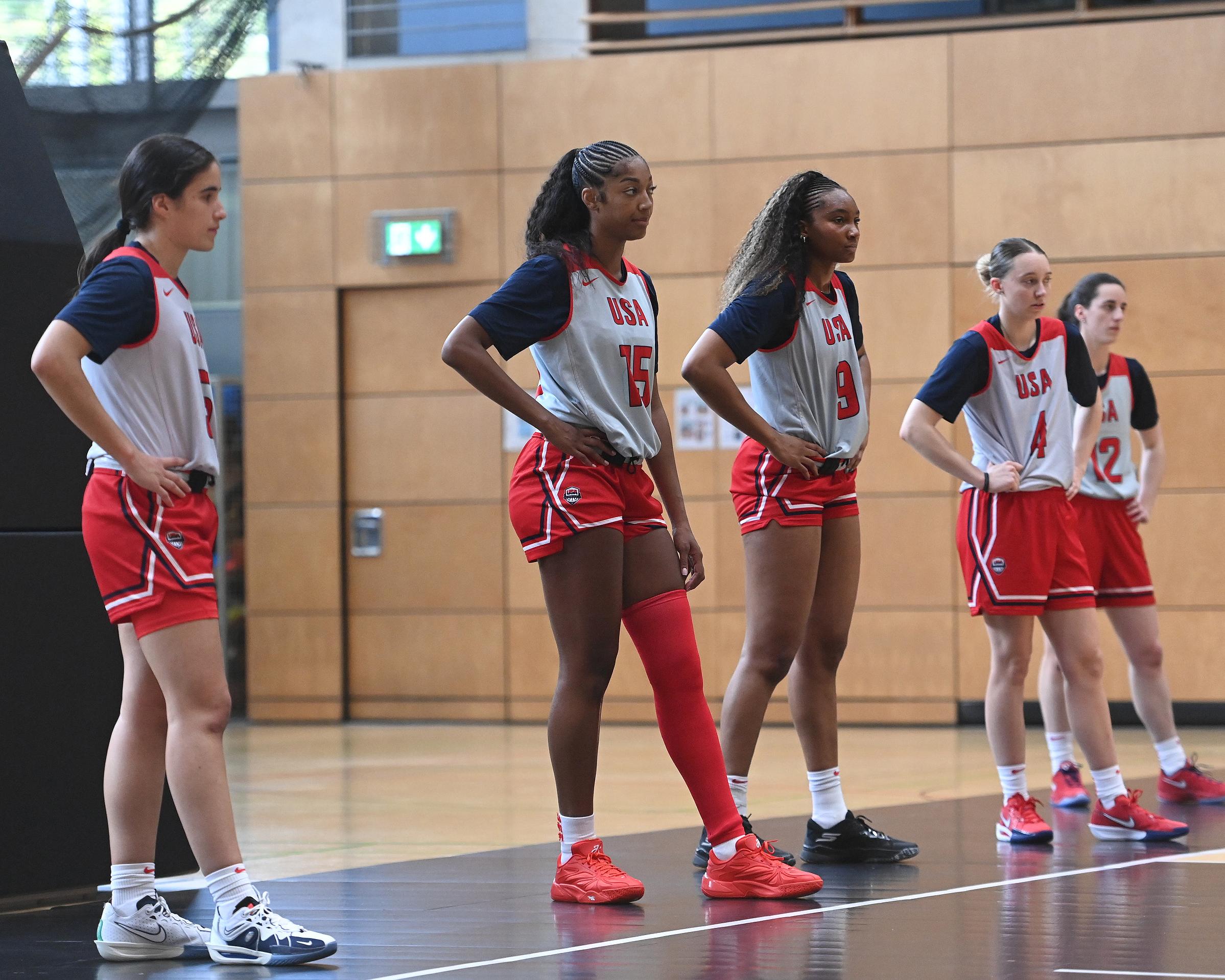
The future of American women’s basketball, lined up, side by side: young, turnt, and ready to rule the world.
The U.S.’s early group stage games will basically be All-Star Games with more competition, and I’m hoping that USA coach Kara Lawson will indulge in some fan service.
After our long national-discourse nightmare, fans deserve healing in the form of Clark finding Reese in transition.
The All-Run-and-Gun first team would probably look like Clark, Sonia Citron, Kahleah Copper, Rhyne Howard, and Reese.
The Let’s Get Some Adults in the Room lineup will be headlined by Breanna Stewart, who has the most international experience on this roster, alongside Chelsea Gray and Napheesa Collier.
Personally, I’d love to see Bueckers playing alongside Stewart and Collier, in the service of answering two bold questions:
- Can you run an offense solely by shooting midrange jumpers with a foot in the paint?
- What if the undefeated 2016 UConn Huskies had also rostered Paige freaking Bueckers?
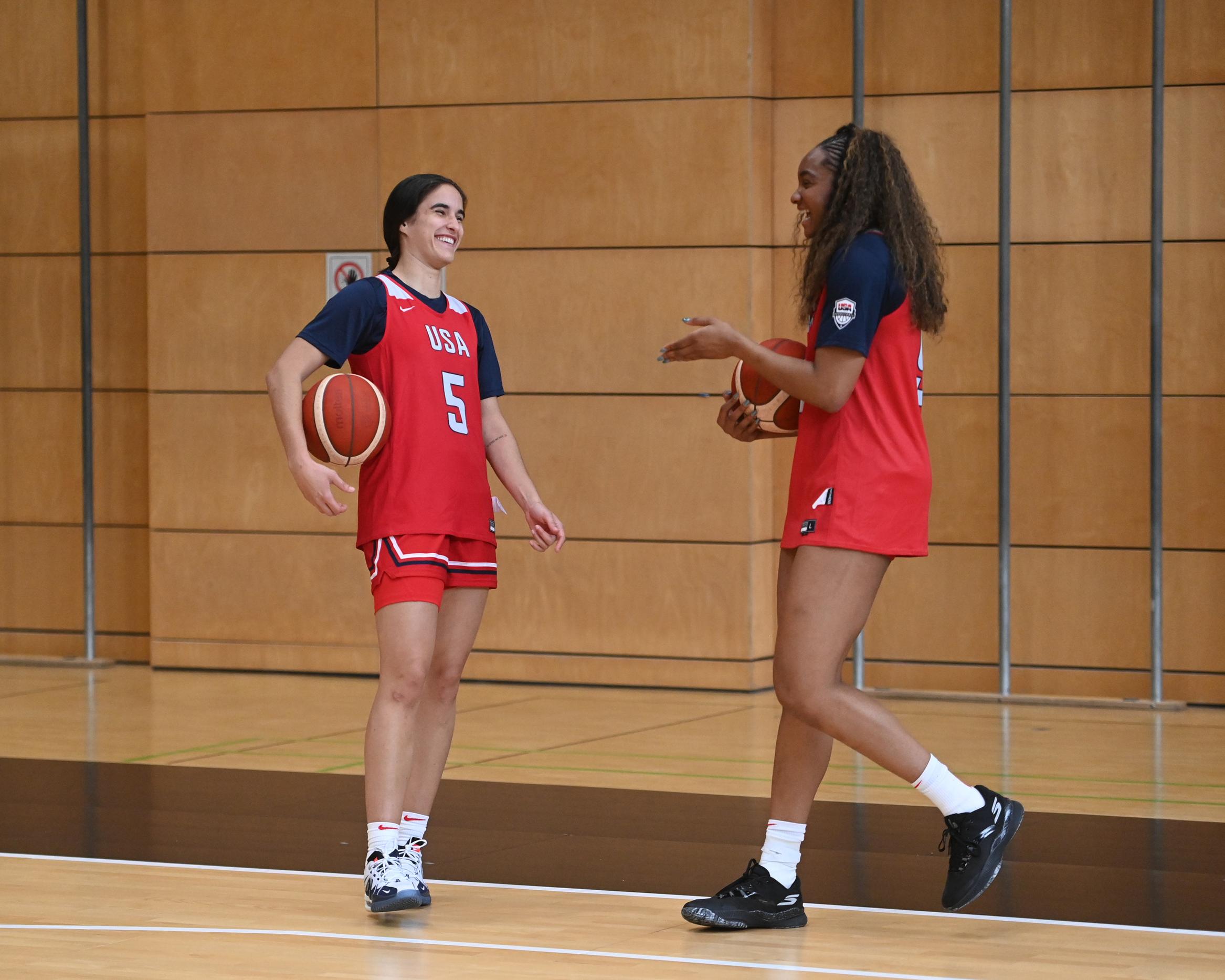
Sonia Citron and Kiki Iriafen at FIBA practice
Who’s replacing A’ja Wilson and Kelsey Plum?
Enter the Mystics’ young stars: Sonia Citron, whose elite two-way play should have guaranteed her a roster spot in the first place, and Kiki Iriafen, a ferocious, high-motor power forward who counts Wilson as an inspiration.
But the hole Wilson leaves will be impossible for one player to fill. In the 2024 gold medal game against France, Wilson anchored Team USA on both ends, finishing with 21 of its 67 points and a team-high 13 rebounds and four blocks. It was one of those clarifying moments: Among a collection of the best players in the world, the burgeoning GOAT shined the brightest.
It’s not all bad news, though: In that same game, guards Chelsea Gray and Sabrina Ionescu combined for zero points, while Diana Taurasi—who would retire at the end of the season—was benched. Clark and Bueckers were already supposed to infuse the guard spots with new life. Wilson’s absence will likely accelerate the arrival of an era of American basketball that will be defined by its guards.


The biggest problem is that Aliyah Boston, the only true center on this roster, might be saddled with an ungodly number of minutes, despite a lingering leg injury.
France has the tournament’s best rim protector in 6-foot-6 All-Star unicorn Dominique Malonga, but she isn’t the only giant the Americans have to worry about. Spain has 6-foot-4 rookie phenom Awa Fam and sharpshooting Portland big Megan DiLeo. Nigeria has the hard-nosed Stephanie Okechukwu, who, at 7-foot-1, is the tallest female player in NCAA history. China’s Zhang Ziyu, a 19-year-old WNBA draft prospect, towers over them all, at 7-foot-3.
Not all of these players are as fluid and fast as Malonga and Fam, though. Team USA is facing a size deficit, but the Americans can overwhelm opponents with their spacing and speed.
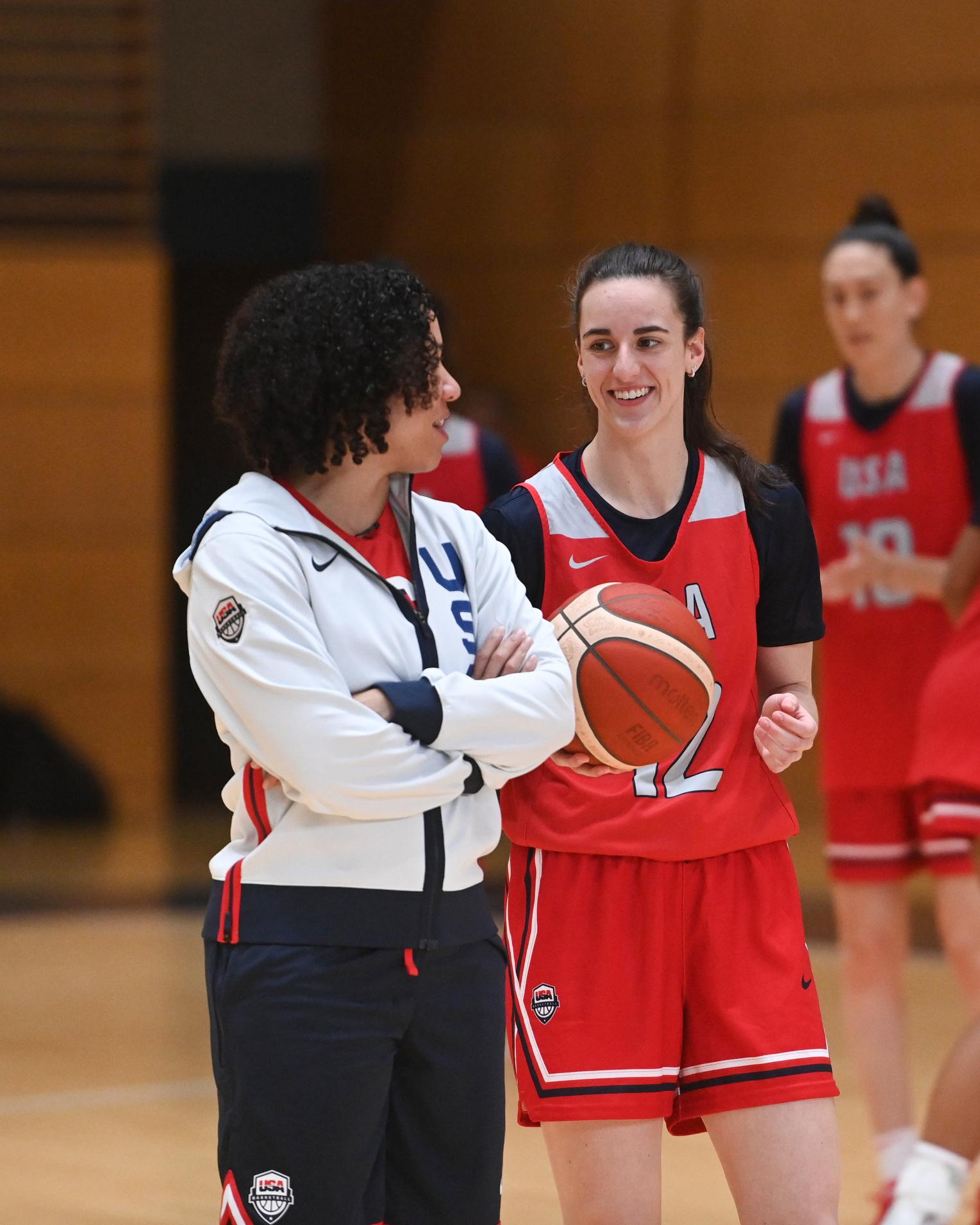
Head coach Kara Lawson and Caitlin Clark
Will Caitlin Clark start and finish games?
There is no perfect lineup that will protect Lawson and the Team USA coaching staff from scrutiny. With so many talented players and so few minutes to distribute, it’ll be hard not to poke holes in the U.S.’s decisions if things go awry. Like she did in the qualifying tournament, I imagine Lawson will shift the starting lineup based on matchups. But as the tournament wears on and the games get tighter, it will also become clearer who she trusts.
Ears perked up around the league when Lawson, who announces WNBA games for Prime Video, critiqued Clark’s end-of-game execution two weeks ago against New York, which included a failed box out and a frustration foul. Lawson is a stickler for defense, execution, and discipline, but she has also been effusive in her praise of Clark as a competitor and an offensive engine.
Lawson and Clark are kindred competitors, and the luxury of playing alongside the world’s best players will likely only bolster Clark’s importance as an elite facilitator. But if she makes some ill-advised turnovers, I could see Lawson making a basketball decision that flies in the face of business imperatives.
One thing is clear: Lawson is not one to be swayed by popularity, public opinion, league agendas, or agency wishes. She is a straightforward, no-nonsense communicator who cracks a smile (a kind of unnerving one, I might add) only when the topic of high-level competition comes up. She had no problem benching Flau’jae Johnson at the 2025 FIBA AmeriCup tournament, even though the wing was probably the team’s most popular player.
It makes sense that she was chosen to lead this era of Team USA: Lawson isn’t particularly moved by star status, which is exactly the temperament you want for someone who’s coaching a team full of stars. And she’s not moved by media criticism, which is exactly the mindset you need when you’re going to be facing a lot of media criticism.
It’s part of what makes Lawson a fascinating talent evaluator. Lawson has never coached any of these players outside of Team USA settings. The Duke coach doesn’t have favorites. I’m genuinely curious about who will stand out to her when she has the luxury of almost all of the world’s best players at her fingertips. It’s all part of the contradictory intrigue of watching Team USA: A union of basketball sickos creates a space for natural camaraderie, but it’s also where you measure yourself against the best in the world and find out where you stand.
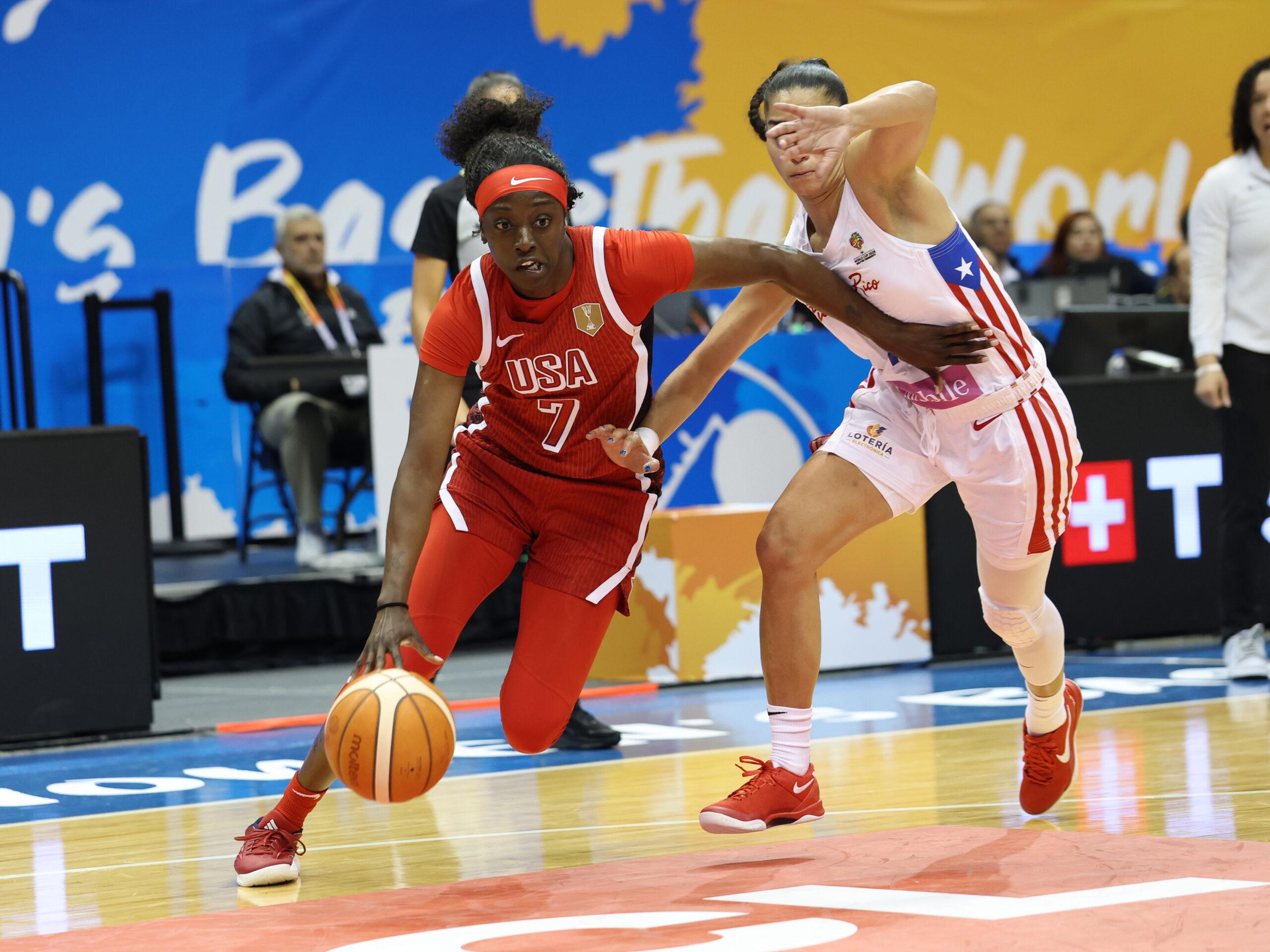
Kahleah Copper in the game against Puerto Rico during the 2026 FIBA qualifiers
Who could be asked to sacrifice playing time?
Some of the WNBA’s biggest stars will have to adjust, and not just Caitlin. A player like Kahleah Copper—whose most vital strength is her north-south driving ability, along with her strength and athleticism—might not even be needed until the Americans face France.
If Reese struggles to make layups, Lawson could also opt to play Kiki Iriafen—who offers a similar motor and a simulacrum of Reese’s rebounding ability but with superior finishing ability—in spots that were originally penciled in for the Dream big.
The less that is asked of Chelsea Gray, the better for the Aces.
Will Lawson have the stomach to play small?
If Lawson is biased toward anything, it’s size and defense. At Duke, she has displayed what can only be described as an allergy to playing small, starting a massive frontcourt despite the spacing constraints it presented. Even in the World Cup qualifiers, the Americans didn’t really lean into small ball until Phoenix Mercury head coach Nate Tibbetts—a disciple of positionless basketball—took over so that Lawson could prepare for March Madness.
Perhaps Bird, by putting only one true center on the roster, is trying to force Lawson’s hand. The coach will simply have to muster the intestinal fortitude to play Reese (who has played the 5 most of the year in Atlanta, with Bri Jones out) at center. Stewart and Rhyne Howard, who developed serious chemistry with Clark during the March qualifiers, can unlock a ton of small-ball combinations. Nobody can beat the Americans if they play to their strengths.
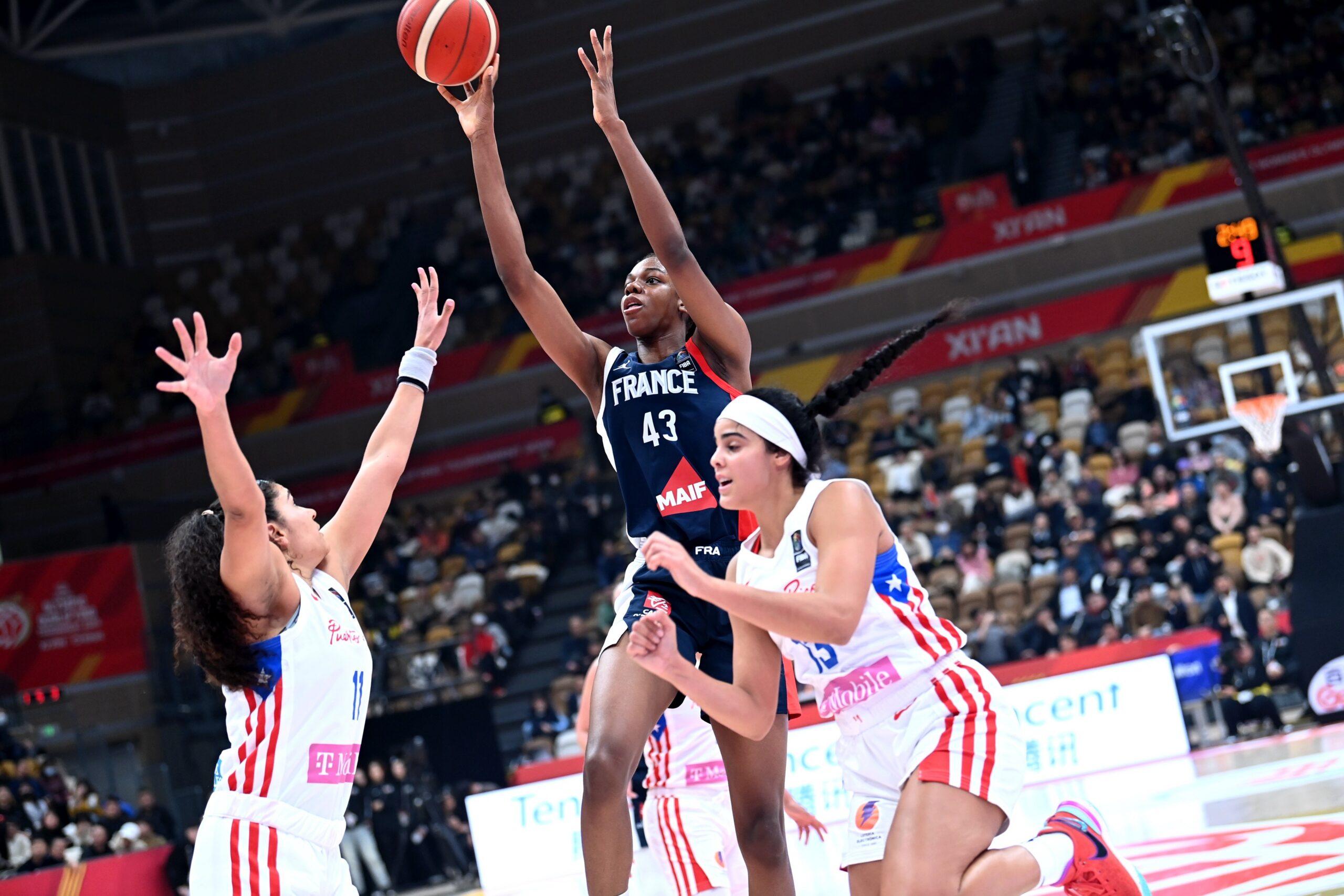
Dominique Malonga during the match between France and Puerto Rico at the 2024 Olympic qualifiers
Who is the biggest threat to the Americans?
In the past, present, and future, it’s France.
France is the rare team that can employ enough elite one-on-one WNBA defenders to prevent the Americans from playing advantage basketball. An athletic, intelligent, defensive-minded team helmed by Gabby Williams, it’s basically the French version of the Golden State Valkyries.
The Americans still have the talent edge, but France has the ingredients to pull off an upset.
It also has Malonga, who played less than three minutes off the bench as a 17-year-old against Team USA in 2024. This time, she’ll be flanked by Williams, Leila Lacan, and Carla Leite, three of the WNBA’s best perimeter defenders.
Leite and Pauline Astier, the Liberty’s likely All-WNBA rookie, are perpetual downhill threats. It’s not hard to picture a Murphy’s law scenario in which Aliyah Boston finds herself in foul trouble, Team USA struggles to find an answer for Malonga, and Marine Johannes and Janelle Salaun, two of the most creative shotmakers in the WNBA, get hot.
The scouting reports they can get from Team USA assistant and Valkyries head coach Natalie Nakase, who has coached a chunk of the French team in the WNBA, will be vital.
Who will win MVP?
It became clear at the FIBA qualifying tournament that Clark, who won MVP, was the best player to run the offense for the Americans. She will certainly rack up a ton of points, and her growth as an isolation player and downhill driver could make her the perfect closer.
But if opponents can slow the Americans down in transition, Bueckers could emerge as the perfect half-court antidote, especially against France. Boston, who will be asked to guard all the biggest matchups while being Team USA’s post-up hub, is another intriguing candidate.
Collier, the WNBA’s MVP runner-up last season, feels more like the unsung hero, but she will be the Americans’ best defender, and a frequent recipient of pick-and-roll passes. She will rebound, push the ball up in transition, helm small-ball lineups, and guard bigs and wings. With Wilson out, she’s also the de facto best player on the team. I’m going with Collier. The cream always rises to the top.