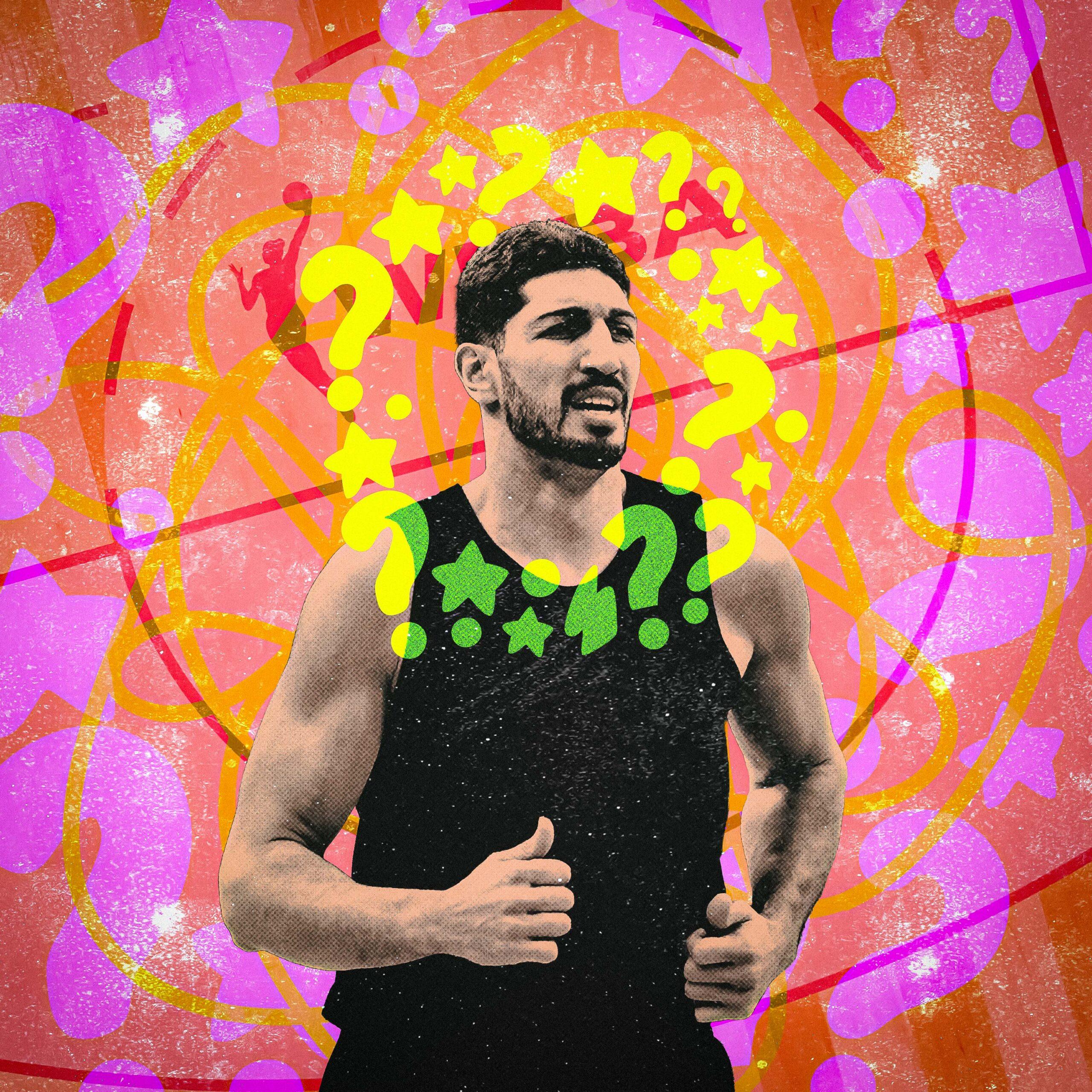

At long last, the voice we didn’t need and certainly didn’t ask for has entered the WNBA culture war chat: Enes Kanter Freedom.
Three (!!!) weeks ago, in a wide-ranging profile, Fever forward Sophie Cunningham told ESPN, “I want to protect young girls in a locker room, or young girls in sport who shouldn’t have to go against biological men.”
As the flames of the anti-trans panic that followed began to flicker, the former NBA center (strangely) reignited the firestorm, announcing his intention to identify as a woman and declare for the 2027 WNBA draft.
Freedom, who will presumably be undergoing a second name change in five years, has already demonstrated a profound commitment to the idea of reinvention and the fluidity of identity. So have Freedom’s supporters, who have referred to the retired-slash-exiled NBA big, who averaged 11.2 points per game over his career, as a superstar.
To be clear, I would much sooner believe Freedom is a woman before I believed he was a superstar—and I don’t believe he’s either. I believe Freedom is mocking trans women and the sheer idea of transitioning itself, a sticking point for a far-right-wing movement that imposes its possibility-shrinking ideology on a league built on expansiveness.
Freedom’s stunt, in the wake of Cunningham’s comments about transgender athletes, has pushed a controversy-avoidant league toward what will be yet another unwanted public crossroads. The league has yet to make a public statement regarding Freedom, but a leaked memo reveals that the topic of transgender participation in the WNBA will be discussed by a task force this week.
“We recognize that this is a complex and nuanced topic, and we will continue to have important conversations with all of you and the Players Association in the weeks and months ahead,” WNBA commissioner Cathy Engelbert said in the memo.
When it comes to the WNBA’s PR failings, there is always plenty of blame to lay at the feet of the commissioner. While the WNBPA has finally responded, emphasizing inclusion and insisting it won’t be used as a political pawn, the league office has maintained its public silence (for now), once again allowing bad-faith actors to hijack the WNBA’s story. In the past 20 days, the league’s public silence has led to coaches and players getting bombarded with questions and trans fans feeling abandoned.
As the task force prepares to meet, what’s at stake is not just a new guideline over trans participation in sports. It’s whether the league will allow a manufactured crisis, designed to shock and test the limits of the WNBA’s inclusivity, to alienate its trans fans and convince people that the most commonsense solution is always the most cynical and exclusionary one.
In the 20 days since the ESPN profile was published, Cunningham has simultaneously flirted with and distanced herself from her original controversial statement, trying to maintain a level of “aw-shucks” plausible deniability while freely offering political opinions that vault her into the spotlight. But the tightrope between being a source of political fascination and becoming an actual political actor is razor-thin—and it usually cuts. Last week, Cunningham, of all people, insisted on refocusing the conversation on basketball.
That didn’t stop Freedom’s announcement, though, or the anti-trans protesters who have followed Cunningham from Seattle to Portland to Minnesota to Chicago. It’s an object lesson in the difference between manufacturing attention and having power over who wields it. None of these people will allow the focus to shift back to basketball because they clearly want the spectacle of politics to overshadow the Spectacle of Olivia Miles. It’s hard to lead the Trojan horse back outside the gates once you’ve invited it in. Cunningham might not be interested in politics, but politics have always been interested in female athletes like her.
As Katie Barnes lays out eloquently in Fair Play: How Sports Shape the Gender Debates, the issue of trans participation in sports has caused heartbreaking rifts within what was once a unified movement, fighting the headwinds of a patriarchal structure that doubted the financial, cultural, and entertainment potential of women’s sports. While some factions sought total exclusion or total inclusion for trans athletes, many were looking for a middle ground where fairness and inclusion could coexist. But these factions struggled to communicate their disagreements to one another. Disagreements turned into mistrust, and mistrust turned into alienation, until the movement was definitively split into two factions—for and against trans participation in sports—fighting for binary solutions to a (dare I say) nonbinary problem.
The right saw a fracture it could take advantage of, and advocates of women’s sports who were skeptical of transgender participation saw a new ally.
While the majority of Americans do not think that trans women should be allowed to play sports alongside cis women, that public opinion wasn’t formed in a vacuum. It was shaped in part by the alliance of Republican legislators with people like Jennifer Sey and Riley Gaines, both of whom Cunningham recently took a picture with. Sey, a former U.S. gymnast who founded the apparel company XX-XY, has a history of contributing to anti-trans media story lines. Gaines, a former Kentucky swimmer, has become a bastion of the far-right movement.
The teenage girls who were berated by the Seattle Storm co-owner (who was suspended for five games because of the confrontation) were sitting courtside wearing XX-XY shirts, in what were reportedly $1,300 seats gifted by a mysterious donor. While I don’t condone the behavior of an adult who berates kids, I am deeply suspicious of anyone who puts children at the tense forefront of a movement that purports to be about protecting them.
It would be one thing if the alliance to ban trans athletes from women's sports were concerned with finding science-backed solutions that balance fairness with inclusivity, but the scope of its mission has been much wider and crueler. Sey has called the use of pronouns “a false reality” and critiqued gender-affirming care for youth.
Gaines has told The New York Times that she sees rolling back transgender rights in sports as the start of the whole “gender ideology movement” crumbling.
The goal is destroying the infrastructure that trans people need to survive and thrive, whether it’s a 10-year-old wanting to play soccer with their friends or a Medicaid recipient finding a hormone clinic within state lines. But it won’t stop at just trans women.
Even though Republican legislators have invoked Title IX to enact transgender bans, they are also trying to scale back its influence. The Heritage Foundation, a powerful conservative think tank with significant legislative influence, recently published a paper titled “Title IX’s Failed Experiment,” which specifically cites a disproportionately high number of scholarships for women’s basketball as a form of social engineering designed to convince girls to be more aggressive. It encourages camping, hiking, swimming, and other moderate forms of exercise that won’t [dusts off early 20th-century playbook] “increase infertility.”
This report was released just five weeks ago, by the same organization that is responsible for Project 2025 and a chunk of the Republican legislative agenda.
The modern conservative project isn’t, by and large, interested in protecting women’s sports. Instead, it seems to be interested in shrinking the lives of women in public and in private, with a vision so constraining that even Cunningham, a black belt in tae kwon do who rose to fame in part by physically clobbering opponents, would suffocate inside it. They don’t want women to believe they can be aggressive and “relational” all at once or that they can be both competitive and family oriented. Of course, the WNBA’s very existence as a hub for working moms is a repudiation of that notion, which is one of the many reasons it is under perpetual attack by the right.


The right's strategy is to use the league as perpetual Woke 1.0 dunkbait, scouring a complicated institution in search of hypocrisies and presenting them as proof of a flawed value system.
This is where Enes Kanter Freedom’s incentives align with the right’s. Freedom was a marginal NBA player, but it’s totally plausible that he got pushed out of the league a year or two early because of his human rights–based critiques of China, with which the NBA—a league that often does embrace political advocacy—has a tenuous and commercially driven relationship. Freedom has a valid axe to grind, but you completely cede the moral high ground when you mock people whom the Human Rights Commission has declared as being under a national state of emergency.
In the past decade, trans rights have been flattened into a discursive political point: a distraction and an electoral thorn in the side. Trans people have been abandoned by nearly every major institution, including the ones they rely on for safety, community, and protection. Blanket bans against transgender participation in sports, often regardless of age, sport, or the use of hormone therapy, have had catastrophic mental health consequences for trans kids and often meet very little political resistance. The NCAA, International Olympic Committee, World Aquatics, and Women’s Tennis Association have all enacted blanket bans. And rather than fight back against the bans, the Center for American Progress, an influential Democratic think tank, has suggested not pushing back against these organizations out of political expediency.
The WNBA doesn’t need to meet in the middle with people who will never accept an answer that allows a trans woman to achieve and be rewarded for her athletic excellence. Trying to avoid the perpetual LibsOfTikTok-ification of the WNBA requires either total capitulation or total moral perfectionism. But inclusion, like any principle, does not have to be perfect to be worthwhile. At a time when other organizations have instituted blanket bans on transgender participation, the WNBA has an opportunity to reintroduce science-based solutions that balance fairness, player safety, and inclusivity.
Trans people have always been a sacrificial offering for progressives, asked to accommodate other people’s discomfort and ignorance. Going all the way back to Stonewall, the queer community itself has repeatedly abandoned the trans people who’d pushed it toward new possibilities, trading their inclusion for mainstream acceptance.
If the WNBA follows that trend, it will lose a defining piece of its identity. Queer and trans lives and the spaces they build and occupy are too often seen as abstractions. WNBA games are one of the few mainstream spaces where they are seen as tangible and multidimensional.
The WNBA is a space where trans people bring their own unique value: an energy that accumulates in a room full of people who have done the work of reinvention, who can identify the limits of conventional thinking, who have had to create new names and languages for their emotions, experiences, and selves. Everyone who enters a WNBA arena experiences this capaciousness, whether they are aware of it or not.
Failing to protect the rights of trans athletes is also a failure to defend the generative life force that trans fans bring to games. It would mean depriving the league of the life-affirming experiences that allow fans to shed long-existing layers of shame and enable them to see the world through a more imaginative lens. It would be a repudiation of what the WNBA—whether its proprietors recognize it or not—has always been about.
For most of its history, women’s basketball and trans self-discovery have been animated by the same guiding principle: imagining the other side of a boundary that had been presented as uncrossable. It is an ambition that is as evident in the W’s trans fan base as it is in Caitlin Clark’s logo 3s.
The historical growth of women’s basketball has taken a pincerlike shape, with ambition and boundary-smashing idealism on one end and fearful pragmatism on the other. Pragmatism, for the WNBA, has often come in the form of trying to appease some apocryphal average fan who would love the league if it were just a little less Black, a little less gay, a little less inviting of gender fluidity.
Forget, for a moment, that every effort the WNBA has made to cater to this perceived fan has backfired. The league is no longer in survival mode. For so long, the WNBA's decision-making was animated by the need to answer anxiety-inducing questions about growth. The growth has happened, and it’s continuing.
A new $200 million media rights deal has kicked in. The new collective bargaining agreement has guaranteed that more than half of the player base will be millionaires—if they aren't already, by way of off-the-court endorsements—by the time their current contracts are over. The wokest WNBA franchise, the Golden State Valkyries, was also the earliest to reach a billion-dollar valuation. Viewership is at all-time highs. More arenas are selling out than ever. It’s time to start listening to the people cheering inside them instead of the picketers outside. That’s what true freedom looks like.