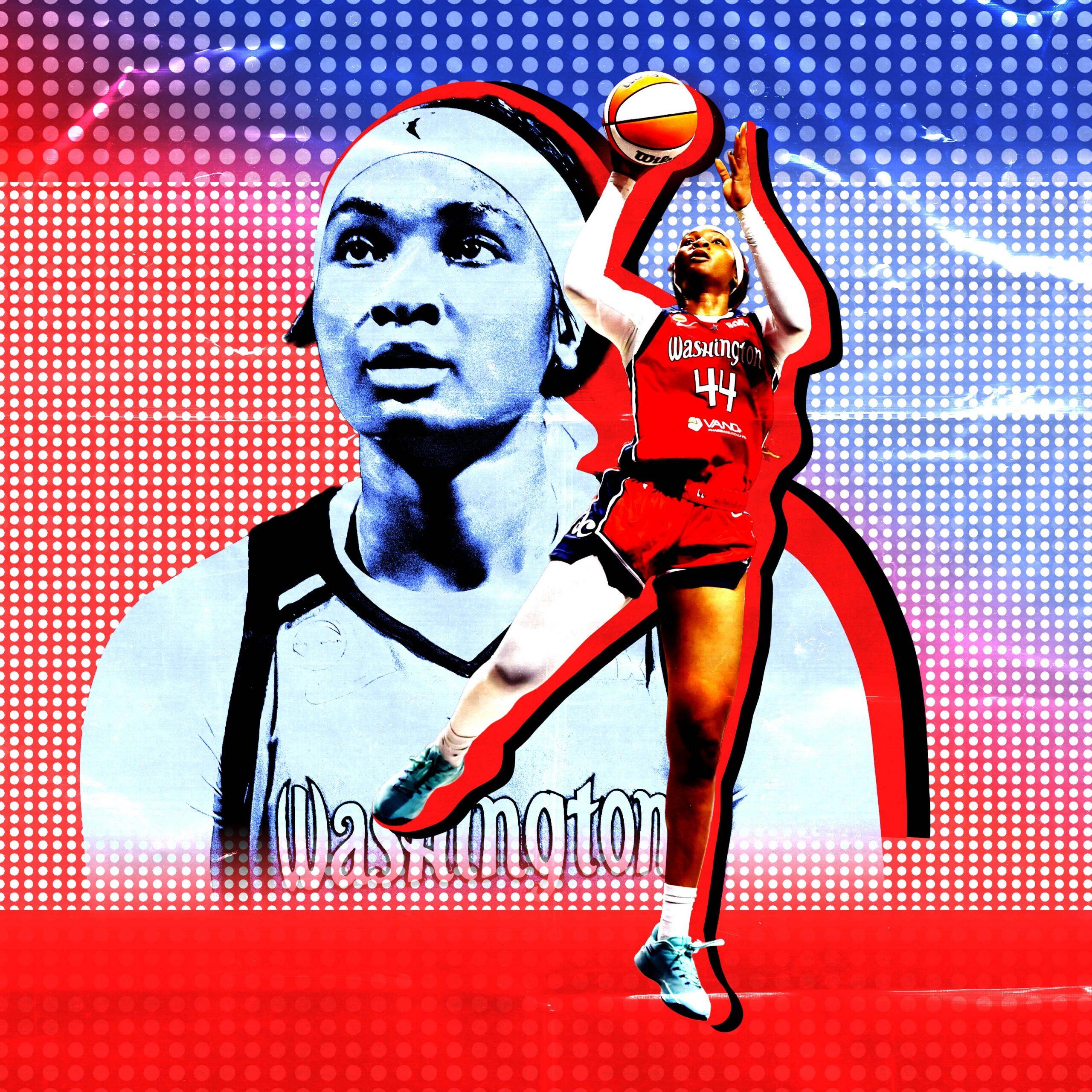

Kiki Iriafen, the young and ferocious power forward for the young and ferocious Washington Mystics, grabs her eighth and final rebound of the night against the Los Angeles Sparks this past Saturday, right before the Mystics secure their eighth win in their past 10 games.
Rebounding in the waning moments of a win is typically treated like a chore—a rudimentary afterthought. But for the hard-nosed Mystics, moments like these are an affirmation of the team they want to become, and this is the kind of task that Iriafen treats with great purpose—boxing out with her head on a swivel between the basket and the player nearest to her.
After struggling with foul trouble against the Aces two nights prior, Iriafen, a second-year two-time All Star, bounced back with a 19-point, 9-for-12 performance against the Sparks. It was the kind of recovery that Iriafen and the Mystics, who haven’t lost more than two games in a row this season, struggled to pull off last season. The once-lovable League Pass darlings have morphed into a clear-eyed, unpunkable machine that no contender will want to face in the playoffs.
“I think it's not getting too high or too low,” Iriafen said after the game. “Watch film, know what I need to adjust, but not getting down on myself. Understanding that there's value I can add to the team when I show up like this.”
Iriafen, 22, is a budding franchise pillar for the youngest team in the WNBA. Like all growing properties, Iriafen and the Mystics have malleable minds. It is the best and worst thing about being young: the ability to find hope in every great game and an indictment of your dreams in every disappointment. But the Mystics are unnervingly grounded for a team full of promising Gen Zers placing their faith in setting an unflashy foundation of defense and rebounding.
“Sometimes, I want to do my flashy turnaround jumper, sidestep,” Iriafen tells The Ringer. “But the easy basket is go to the basket, or get a rebound.”
Iriafen is not a household name buoyed by famed college lore, and she doesn’t have a wingspan that jumps off the page. But she averages more second-chance points per game than any player not named Angel Reese or Dominique Malonga, who’s 6-foot-6.
Iriafen—a 6-foot-3 power forward with quick feet, an explosive first step, and excellent touch around the rim, where she finishes over 65 percent of her shots—isn’t a relic of the past or an avatar for the future. She is a bridge between the two, built for the present.


When Iriafen, the no. 4 pick by way of Stanford and USC, walked the stage at the 2025 WNBA draft, commissioner Cathy Engelbert called her by her full first name, “Okikiola,” which translates from Yoruba roughly to “famous wealth.”
Iriafen, whose parents are Nigerian, shares their lofty vision for her future. “I want to be MVP one day,” she says. “I want to be a world champion, multiple world championships. I want to make the Olympic team for Team USA.”
But before the draft, Iriafen had worried about whether she would live up to her name.
As the 19th-ranked prospect in her high school graduating class, she was far from a mixtape legend. Her astronomical growth in Tara VanderVeer’s disciplined Stanford system drew admiration from the nerds, but not awe from the masses. At USC, where she transferred for her final season to team up with sophomore phenom JuJu Watkins, the spotlight was brighter but the spacing was scarce.
The dream was an endless stream of pick-and-rolls with Watkins. The reality was two stars struggling to find space in tight corridors. When Iriafen missed layups, analysts assumed that her finishing ability was inherently inconsistent. But the bigger culprit was the lack of spacing in the Trojans’ crowded frontcourt—an experience that would prepare her to throw and receive high-low passes through tight corridors with her WNBA frontcourt partner, Shakira Austin, with whom she takes turns leading the Mystics in paint scoring.
Her lack of otherworldly rim protection in college also occluded her excellent perimeter defense, which has made her a linchpin of Mystics coach Sydney Johnson’s system. She has held primary defenders to 34.9 percent shooting from the field, per Synergy, with even stauncher numbers on the pick-and-roll, and she’s one of the best bigs in the league at closing out on 3-point shooters.
In the lead-up to draft time, however, doubt crept into her consciousness.
Her parents reassured her. “My parents were just really great about just speaking life into me,” she says. “They're like, ‘You've worked so hard to get to this moment. One game, one play doesn't define who you are or your career. You have an opportunity to always rewrite your story. It's not set in stone.’”
They also helped her find a performance coach. “Basketball, for me, is like 90, if not 99, percent mental and 10, if not 1, percent physical,” says Iriafen.
Iriafen had a habit of letting one mistake linger and snowball into another.
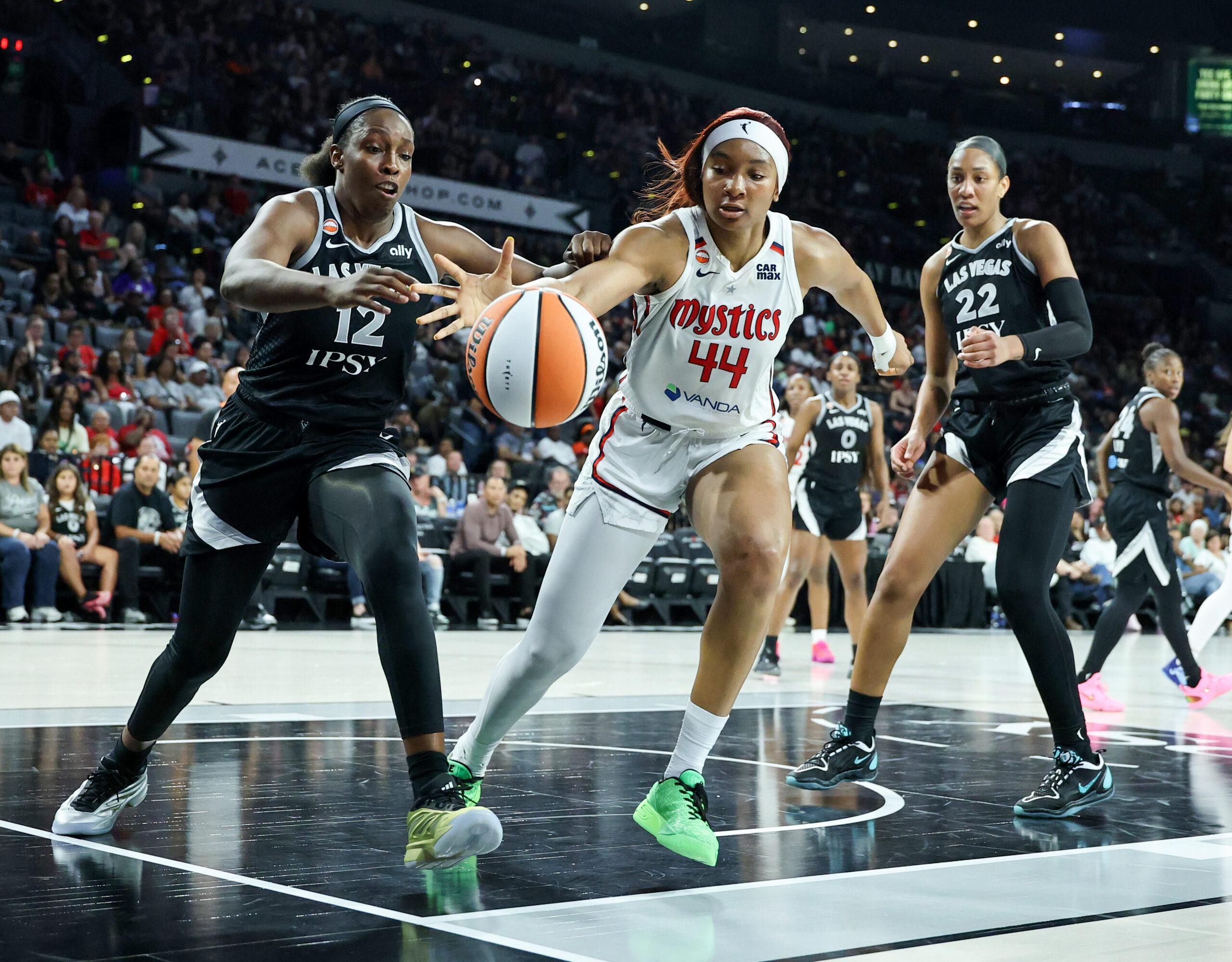
Chelsea Gray and Kiki Iriafen go after a loose ball as A’ja Wilson looks on
“That's something that we work on a lot,” she says. “How can I recenter myself to be where my two feet are? And then we do a lot of breathwork and imagery. Intentionally breathing, that's such a great way to calm down when maybe you're a little frantic or kind of all over the place. Honestly, I'm grateful because when you go to the pros, you're on a bigger stage. Now, when it happens, I'm OK. I don't use Twitter at all. I don't read comments.”
Gratitude turned out to be an animating force of her rookie season.
The Mystics took Notre Dame’s sharpshooting wing Sonia Citron with the no. 3 pick via a draft-day trade and then chose Iriafen at no. 4. The duo clicked in the pick-and-roll immediately. In the 94-by-50 parameters of the WNBA court, Iriafen cut through defenders like a boulder rolling down a hill. A’ja Wilson, her idol, became a rival she sneaked under and pushed out of the way to grab boards. Last season, Iriafen notched 16 double-doubles, more than any other rookie, and made the All-Star team alongside Citron.
“I was like, what is my life? There's so much that happened, and it happened so quickly,” Iriafen reflects. “You dream about it in college, in high school, and it's like stepping into a dream. [It was] like an epiphany, just like, ‘Wow, I can't believe this is my life.’”
The Mystics' foundational duo was right in the playoff hunt until a midseason trade sent veteran guard Brittney Sykes to Seattle. But this season they haven’t missed a beat, largely thanks to the efforts of their young core. Even though Washington is fielding just two vets (including 32-year-old Betnijah Laney-Hamilton, a Liberty fan favorite who was just acquired off waivers), its charmed run of progress has continued mostly unabated.
Iriafen’s confidence has grown with experience. Against New York earlier this season, she single-handedly powered a 6-0 run at the end of the game and notched the first go-ahead bucket of her career, going toe-to-toe against future Hall of Famers Breanna Stewart and Jonquel Jones and securing the Mystics’ first win against the Liberty since the days of Elena Delle Donne. "The New York game was when I was like, ‘OK, I can do this.’”
In the very next game, against Minnesota, she followed up two missed crunch-time layups with two makes, including another go-ahead shot, a post-up that was drawn up for her:
Under the tutelage of Mystics assistant coach Barbara Turner, Iriafen has turned the simple play style that once made her easy to ignore into a guiding principle: production over aesthetics, as she originally put it to Craig Hoffman of Monumental Sports.
“That's something that she really instilled in me this year, and she said it's going to take me very far,” says Iriafen. “Sometimes the little things are more impactful than the flashy things.”
She rebounds, runs the floor hard, develops and holds an early position, finishes with both hands, and makes use of pump fakes and step-throughs. She posts up smaller bigs and blows by slower ones.
The duo has also been working to expand Iriafen’s range to the 3-point line, an area she virtually ignored as a rookie but where she’s now shooting 31.4 percent on 1.1 attempts per game. She references as inspirations Wilson and Aliyah Boston, two bigs who have fused traditional low-post dominance with modern requirements of versatility. The point isn’t necessarily to transform her game, but to keep defenses honest.
“If you have these dreams for your career,” Iriafen recalls Turner telling her, “you have to be able to stretch the floor.”
The WNBA’s last decade was defined by the power forward position. Seventeen of the past 20 teams to make the WNBA Finals have featured one of Wilson, Napheesa Collier, Stewart, Alyssa Thomas, Nneka Ogwumike, Delle Donne, or Candace Parker.
With the league shifting toward pace, space, and guard play, its requirements have changed. In a basketball era obsessed with novelty, Iriafen flies under the radar because she represents the same kind of prototype we've seen before. She does not defy positional conventions, and she can’t be classified as a WNBA unicorn. But she has nearly the exact same dimensions and many of the same offensive characteristics as a young Wilson, who became the greatest to ever play the game.



More on the WNBA
Even as the league is being rewritten by a golden generation of guards who are whipping flashy passes all over the floor and going jumper for jumper, bigs who can dominate by way of rebounding, getting stops, and scoring in the paint remain vital. Iriafen has been able to evolve with the position's new requirements while being elite at all the things it has historically required.
Johnson—who has daughters around the age of most of his players—drills down at practice with complex defensive schemes before lightening the mood with TikTok dances that, performed by anyone above the age of 35, could only be described as cringe. “We do not teach him any of that stuff,” laughs Iriafen, who is the embodiment of Washington’s seemingly contradictory qualities of toughness and joy.
Washington raised eyebrows this offseason when it used the draft and free agency to double down on defense, rebounding, and toughness. The experiment has worked so far. Washington has a 99 percent likelihood of making the postseason. Its stylistic zag toward defense could make it a fascinating X factor.
When the game slows down, will Washington remain rooted in its identity while its high-octane opponents scramble? At the very least, whoever the Mystics face in the first round will be the worse for wear.
Okikiola is traditionally a masculine name. But Iriafen’s father was determined to give it to his first child, whether it was a boy or a girl. It’s a name that can contain the magnitude of the life they imagined for her. Iriafen, it turns out, has always had a knack for breaking big ambitions into small steps.
When she was a kid, she would search up do-it-yourself projects she could work on. One time, she drove to Home Depot, bought the equipment for a human-sized Operation game, and built it at home—a hint, perhaps, that she was on her way to becoming a doctor, her plan at the time. At Stanford, she fell in love with design and mechanical engineering, which she majored in (later getting her master’s in entrepreneurship and innovation from USC).
For now, she’s setting the foundation for a different blueprint: a game that prizes function over flash, grounded in the workaday present and built for the future. Her name was a manifestation. Her daily work of becoming is its practice.