
So, What Exactly Is Mark Walter’s Deal?
And why is he selling the Lakers now? Suddenly, everyone has questions.So, What Exactly Is Mark Walter’s Deal?
And why is he selling the Lakers now? Suddenly, everyone has questions.
Your network is your net worth, which is what made Mark Walter so rich. He was in his late 30s, in the late ’90s, when he met the man who introduced him to the man who introduced him to a bunch of old family money and, in doing so, to a whole new world. It had been cool and all to be a self-made cofounder, as Walter previously was, of a Chicagoland financial concern called the Liberty Hampshire Company that specialized in asset-backed securitization—a sign that he might know a little something about something. But becoming the cofounder and CEO of megabillion-dollar investment firm Guggenheim Partners, the way Walter did in 2000? Well, that was a real hot ticket, one signaling: Hey, this guy right here? He definitely knows someone.
The person with all the family money was Peter Lawson-Johnston II, the grandson of art collector Solomon Guggenheim and great-grandson of the pioneering “MEYER GUGGENHEIM, SMELTER KING” (as the headline to the mining baron’s 1905 New York Times obituary read). The fella who introduced them was J. Todd Morley, another Guggenheim Partners cofounder with an ’80s movie villain name who was described at the time in his Vows column as “a man who made a bucket of money on Wall Street, and it has not gone to his head” and also “the kind of guy where, if you stay at his house, you better be prepared to hear Mick Jagger at 4 in the morning.”
As for Walter, he would become influential enough to head up Guggenheim Partners for a couple of decades and powerful enough to lead a successful, then-record $2.15 billion ownership bid for the Los Angeles Dodgers in 2012. And he would also, critically, stay circumspect enough to seemingly know everyone without anyone knowing much about him.
Walter was raised in Iowa, the son of a concrete manufacturing plant worker as opposed to a Guggenheim. When he became the Dodgers’ new owner in 2012, the main reaction from most people who don’t have a subscription to Barron’s was “... who?,” a question that really never went away even as it was being answered. The Chicago Tribune called him “successful but very low-profile.” An article from his hometown newspaper in Cedar Rapids described him as “mov[ing] quietly and effectively” and interviewed a high school classmate who said that right up until someone posted an article about Walter buying the Dodgers to their Class of 1978 Facebook group, “nobody seemed to know where he was.” In 2013, a piece in Fortune really leaned into the mystique: “Trim and silver-haired,” it said, “Walter, 52, is the picture of Midwestern diffidence, the sort of dependable guy you'd imagine running your local bank if Frank Capra were making movies today.” (Foreshadowing alert!)
Even a few years later, in 2015, LA Weekly was wondering: “Who is Dodgers Owner Mark Walter and Where Did He Get All That Money?” The article quoted Walter talking about himself, from a line in Molly Knight’s 2015 book, The Best Team Money Can Buy: “I’m nothing special,” he says. “Just the king of common sense.” Last summer, when Walter also became the majority owner of the Los Angeles Lakers in a blockbuster deal that valued the franchise at $10 billion, little had changed: a Wall Street Journal headline referred to him as “The Shy Billionaire Who Built an Empire of Superteams.”


But recently, the conversation around Walter has finally broadened, with new questions emerging. Like “... huh?” when it was reported last month that FBI agents had boarded his private plane at Midway Airport in September 2025 and seized his laptop and phone. And “... how?” when it came out that thanks to a whistleblower, Walter was under investigation for structuring and shrouding improper loans from insurance companies under his control. Or “Wait, what?!” upon learning that one part of shyboy’s sporting empire is the Professional Women’s Hockey League—the whole league, not a team—where top athletes vie to win a Tiffany-made championship trophy called the Walter Cup. (OK, that last one might be less of “the conversation” and more just a snapshot of me bugging out while compiling this dossier.)
On the heels of all that, when more news broke on Wednesday morning that Walter had abruptly sold the Lakers after only 14 months of ownership to former Disney CEO Bob Iger and tapped-in VC star Joshua Kushner, the question on many blown minds wasn’t necessarily about why this was happening. The real question was: “Why is this happening NOW?”
Walter’s tenure atop the Lakers lasted one lone season, putting him somewhere between “back-to-back-to-back-to-back Portsmouth FC owners circa 2009-10” and “classic NHL fraudsters” in the embarrassing annals of truncated pro sports ownership history. On the bright side, he made good money in that time, flipping the newly sans-LeBron team for more than $2 billion more than he bought it for. Yet the transaction feels excruciatingly costly for him, considering how it has inspired a lot of people to start paying attention to the various shady ways that Walter has long been moving his and other people’s money around.
So what exactly is this dude’s deal? The short answer is that it just seems to be Deals, like the way Ken’s job is Beach. Walter owns insurance companies and holds holding companies and accumulates big stakes in enterprises like Carvana (huge red flag!) and Beyond Meat. He has purchased a frankly absurd number of buildings and businesses in Crested Butte, Colorado. He and one of his Dodgers ownership group associates, a Texas oilman named Bobby Patton, have snapped up so many plots of land up in Dunster, British Columbia, that the locals are stressed. In 2012, he bought a wildlife sanctuary. In 2014, he bought the Los Angeles Sparks. He has a stake in Chelsea football and helped launch the Cadillac (née Andretti) Formula One team. Last spring, through his holding company TWG Global—which he began in 2024 with a guy named Thomas Tull, who founded Legendary Pictures and thinks we might have a shot at resurrecting the dodo bird—he partnered with Palantir to explore opportunities in the realm of AI.
Walter is, in other words, a man who loves nothing more than to wire funds through an intermediary, or to sign a document forming a new corporate entity and/or offshore limited partnership. “Through his ventures,” explained the Wall Street Journal recently, Walter had already been “a pioneer in using insurance capital to invest in private credit, a form of nonbank lending to businesses that has grown rapidly.” But lately, that’s been the whole problem. As Walter and his ventures are being investigated by various authorities for possible loan fraud and fiduciary self-dealing, it’s looking as though he’s been overrelying on his vast network—of business associates and shell accounts alike—to boost his net worth far too much. In a sense, the way Walter operates has a lot in common with the 2026 Dodgers roster: When you already have it all, that means it’s time to acquire more.


It all provides context for why the Department of Justice and the SEC have been poking around lately to find out “how around $16 billion in loans extended to companies tied to Walter or his conglomerate, TWG Global, wound up on the books of insurance companies he owns after passing through a third entity,” as the WSJ put it last month. (Subsequent calculations since then have suggested it could be billions more.) One such insurer, Delaware Life, filed amended financials in June 2026 showing that the combined amount of those Spider-Man-pointing-at-Spider-Man-ass loans, previously thought to total around a billion bucks or around 3 percent of its loan portfolio, were actually way, way more than that: something like 42 percent.
What’s interesting is that none of this is a surprise, per se. When Walter led the consortium that bought the Dodgers in 2012, beating out the likes of Stevie Cohen, financial journalist Andrew Ross Sorkin—who had recently written a book about the global financial crisis and had developed a pretty good nose for when something or someone didn’t pass the smell test in the process—called bullshit. “When the numbers don’t seem to add up, it’s worth asking some questions,” Sorkin warned about the delta between Walter’s actual liquid assets and the purchase price. “Using insurance money—which is typically supposed to be invested in simple, safe assets—to buy a baseball team, the ultimate toy for the ultrarich, seems like a lawsuit waiting to happen.” A chunk of the money used to buy the Dodgers, he explained, was being sourced from a handful of insurance companies controlled by Walter. “Mr. Walter, along with his colleague Todd Boehly,” Sorkin wrote, “appear to be living out a childhood fantasy using other people’s money, some of whom may not even realize it.”
Boehly, like Morley and Walter, was a Guggenheim Partners guy who liked having a hand in everything. He ultimately would assemble a holding company of his own, called Eldridge Industries; it is difficult to overstate how many businesses and sectors it contains. The Beverly Hilton! The Golden Globes! Flexjet! (Here is just one representative sentence from the fund’s Wikipedia: “In 2021, Eldridge Industries participated in multiple funding rounds for digital delivery service Gopuff, including the company's $1.1 billion financing round, and a $475 million financing round for artificial intelligence company Dataminr.”) In addition to being one of the Dodgers’ owners, Boehly is also the chairman of movie house A24.
In 2015, Boehly was investigated by the SEC for taking an improper $50 million personal loan from a client, one Michael Milken, who had been infamously banned from the securities industry for his role in a 1980s Wall Street scandal. (Guggenheim Partners agreed to pay a $20 million settlement without admitting wrongdoing.) Ten years later, the English Premier League raised eyebrows at Boehly for having a stake in the banned-in-the-U.K. secondary ticket company Vivid Seats, although he was ultimately cleared of a conflict of interest. Meanwhile, Walter was being eyed by authorities for his business practices, too.
Like, for example, the sus nine-figure December 2015 loan to an LLC controlled by an Argentine businessman (and Walter associate) that was done against the express wishes of Guggenheim’s compliance office and was “collateralized by interests in 17 limited-liability companies, most of which were created days before the funding was requested.” Or the complaint from a whistleblower in 2017 that Walter had entrenched a broad culture of this kind of rule breaking and self-dealing at Guggenheim writ large. That same year, it did not go over well when Walter, in conjunction with a different Argentine businessman—this guy was the other guy’s brother, and he also once worked at Guggenheim, natch—started buying Malibu mansions. One had belonged to David Geffen, cost $85 million, and later burned down in the Palisades fire. The other cost a cool $13 million and was immediately occupied by a woman whom Walter had favored so much that he’d waaay overpromoted her at Guggenheim Partners, with disastrous and almost mutinous results. (“CEO swears he didn't buy hot exec a $13M mansion,” was the A+ headline in the New York Post.)
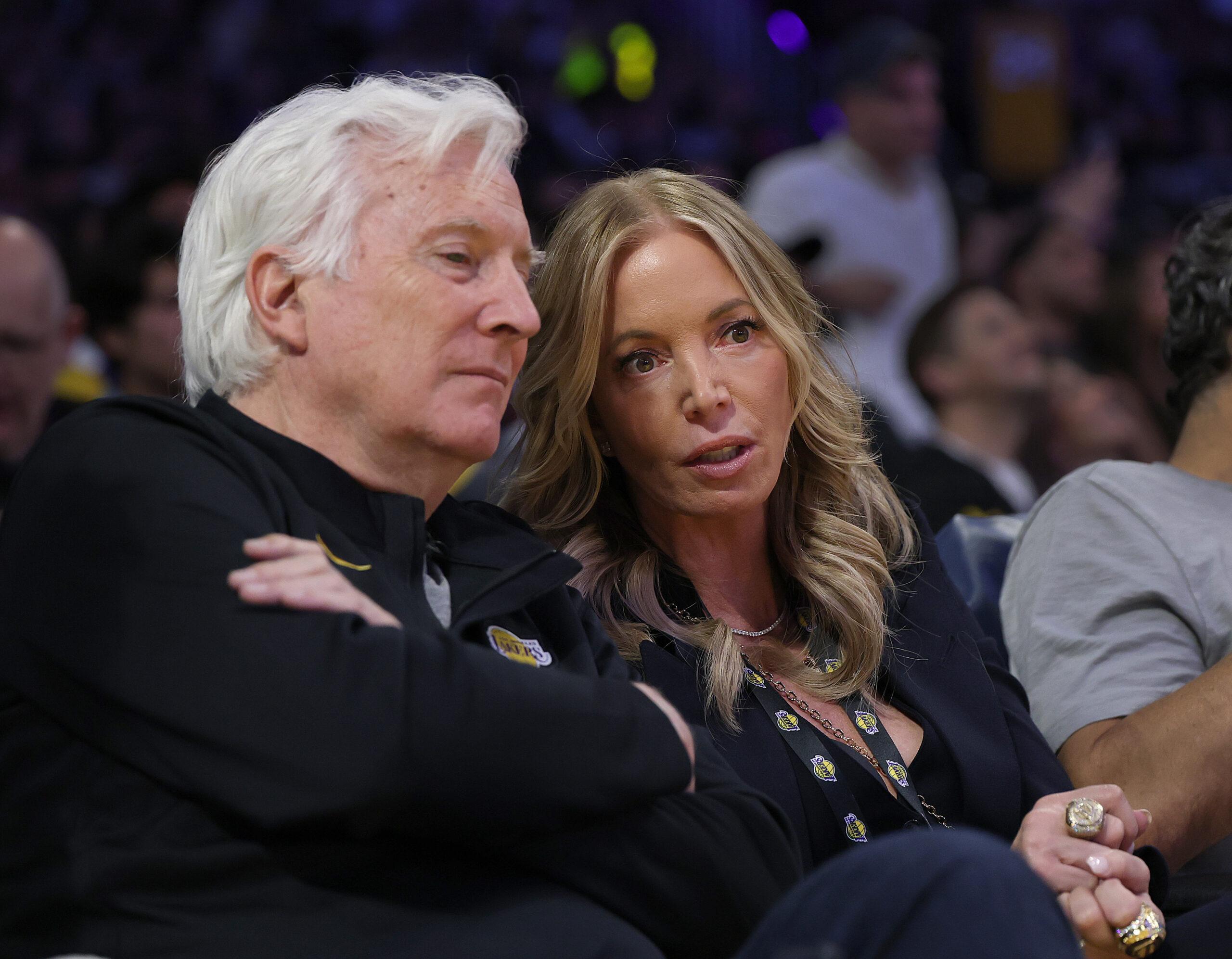
Mark Walter and Jeanie Buss at a Lakers game
The sale of the Lakers on Wednesday was enough of a sudden jolt that my esteemed colleague Danny Chau coined it, impeccably: “The Luka Doncic trade of ownership changes.” (By the way, what’s that guy thinking right now?!) Its jarring nature—combined with the enormousness of the price tag, the boldness and intrigue of the names Iger and Kushner, and the reporting that the whole thing had supposedly come together in, like, 72 hours—all revved up speculation about what series of events had actually forced Walter’s hand.
Yeah, yeah, he was under investigation for fraud, but that was kinda old news, ya know? True, it’s been suggested that Walter has been in tricky health ever since a reported stroke during the Dodgers’ World Series run in 2024, but that hasn’t caused him to off-load his ownership interests anywhere else. And so, in the absence of information, the conspiracy theories have taken on a galaxy brain meme escalation:
… Maybe he just couldn’t live without LeBron! :)
… Maybe he needed the money to get his ducks in a row! :) Relatable, amirite?
… Maybe he needed the money because he had undisclosed Middle Eastern financial backers who needed their money back!
… Maybe he made a back-room agreement with the feds to pay down all those insurance loans and they’ll get off his case!
… Maybe he made a back-room agreement with the president—either to tell the feds to turn down the heat or to promise Walter an eventual pardon—in return for dealing one of the NBA’s most prized possessions to Donald Trump’s son-in-law Jared Kushner’s little brother!
… Maybe the president was the one who told the feds to turn UP the heat on Walter in the first place, in order to compel him to sell right now!
In a statement issued through ESPN’s Ramona Shelburne, Walter clarified none of this, mostly just thanking the Lakers for having been “an extraordinary investment.” On Wednesday, asked about the sale, Dodgers president and part-owner Stan Kasten deflected: “This is a Laker story, not really a Dodger story,” he said. “It really has nothing to do with the Dodgers. They’re completely separate.” (This would be an easier line to buy if Walter hadn’t demonstrated such a propensity for commingling assets.)
So what now? Reports thus far suggest that Walter has no immediate plans to extricate himself from the Dodgers, the reigning World Series champions and the focal point of MLB’s looming 2027 labor war. Which could get dicey, because it’s safe to assume that the team’s outlandish payroll, with its billion-plus bucks parked in majorly deferred contracts, will be quite the point of contention during upcoming CBA negotiations. And probably so will the unreal sweetheart terms of the team’s most recent broadcast deal, which—because of a whole bankruptcy-court rigamarole related to previous owners Frank and Jamie McCourt, whose divorce is a whole ’nother can of brain worms—somehow doesn’t have to share the majority of its SportsNet LA earnings with the other MLB teams.
When Walter bought the Dodgers in 2012, it was with the assistance of a lot of money that didn’t originate from his personal bank account. Still, he spoke as though it were his own family legacy on the line. (I guess with lenders like these, who needs friends?) The purchase of the franchise, he told the Los Angeles Times, was “a multigenerational thing my daughter’s granddaughters will own.” Which is an interesting thing to say when your victory was derived from the spoils of someone else’s great-grandfather, when you built your own house of cards on the foundation of another last name.
In Growing Up Guggenheim, a 2005 memoir by Lawson-Johnston about the life and times of him and his ancestors, the author tells a cherished family story about old man Meyer Guggenheim, smelting king, which one of his daughters later recounted at a historical society function.
One day, he handed each son a single stick and asked them to break it in half. Each one did so with ease. Meyer then handed them a bundle of seven sticks tied together and asked each of them to try to break them again. They couldn’t do it. “You see, singly the sticks are easily broken, together they cannot be broken,” Meyer told his kids. “So it is with you. Stay together, my sons, and the world will be yours. Break up, and you will lose everything.”
In a way, this is how Walter has always conducted his business: instead of operating at arm’s length, he’d rather throw his arms around everything, tie it all together, and hold on tight. But now that the Lakers deal has cracked in half and hit the ground, it might only be a matter of time until the rest of the bundle starts to come apart. It’s pretty hard to maintain a sure grip on all that you have when you’re always busy playing around with shell games.