The Best Way for the WNBA to Solve Its Sophie Cunningham Problem Was to Ignore It
The league has long been a lightning rod for the culture wars, and Cunningham’s recent comments about transgender women in sports seemed poised to ignite another controversy. Then the WNBA did something different.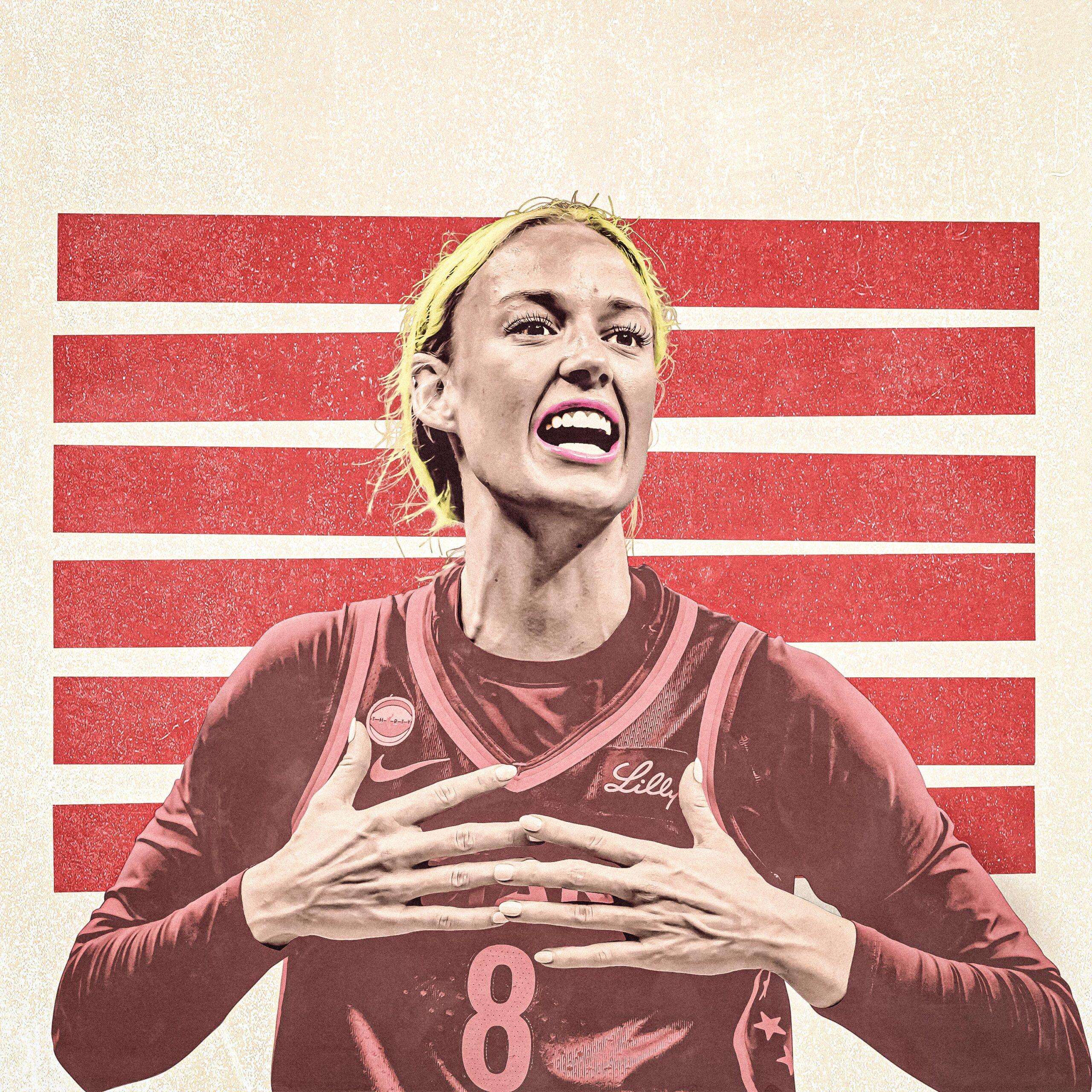

Cover the WNBA for long, and you get used to bracing for the impact of the culture wars. In the hours before the Indiana Fever’s game against the Seattle Storm on Tuesday evening, I was stricken with that familiar sense of foreboding.
Last week, Sophie Cunningham, Indiana’s controversial, outspoken 3-and-D spark plug, set the internet ablaze when she shared her opinion on transgender women and girls participating in women’s sports.
“I want to protect young girls in a locker room,” she told ESPN last week in a wide-ranging profile. “Or young girls in sport who shouldn’t have to go against biological men.”
After those comments, a coalition against transgender athletes’ participation in women’s sports organized a rally outside Climate Pledge Arena in support of Cunningham. A counterprotest was quickly organized. The moment felt ripe for an unsettling clash, with Fever and Storm players, including the politically anodyne Caitlin Clark, being forced to chime in, setting the news cycle in motion again.
None of this should have been surprising. For the past three years, the WNBA has hosted proxy wars for nearly every modern American anxiety, including race, gender and sexuality, DEI policies, and the pros and cons of liberal institutions. It was only a matter of time before this particular political bomb—one that has caused fissures on college campuses, within the Democratic National Committee, and in women’s sports itself—would land at the league’s doorstep. What’s surprising is that the WNBA might have successfully defused it.


While the online world was energized by Cunningham’s comments, the offline reverberations were minimal. All-Star Weekend remained a three-day advertisement for the WNBA, dominated by coverage of the StudBudz, Azzi Fudd’s win in the 3-point competition, Clark’s logo 3s, and former president Barack Obama’s summit with the stars. Only two WNBA players engaged in the discourse, one with a Twitter thread and the other with a shirt.
The Storm released a tepid statement before the game. Fever PR released its own statement during a press conference in which coach Stephanie White was asked about the rally, rather than allowing White to answer. “Neither our organization nor Sophie had any knowledge of this demonstration and no contact with its organizers,” the Fever statement reads. “Our only goal as a team, whether at home or away, is to win basketball games and make Fever fans for life, and we are united in that mission.”
When Cunningham checked in, some people cheered and some booed. But most were there to watch basketball, and that’s what they got.
For a league with a history of being overreactive to discourse, there might be a lesson here. The WNBA’s relationship with social media cuts to the heart of the kinds of questions often pondered by anyone who regularly toggles between both worlds: How much impact does harmful online speech have offline? If what happens online affects how I feel offline, which world is really the real world? How much power do famous athletes actually have to change what people believe? How much responsibility should we accept for consequences we can’t always measure or control? And is telling someone to “touch grass” a minimizing insult or sage advice?
The WNBA has a history of rooting its importance in the power of the athlete-activist. The league’s players helped flip a vital Senate seat in 2020. If there’s any league that has reason to believe that intangible influence can translate to tangible political change, it’s the WNBA. But it’s also why the league is just about always in a negative feedback loop longer than it needs to be.
The rally itself, which I watched through a livestream, feels instructive. Last week, Cunningham’s words had seemingly set the entirety of the identitarian right and the activist core of the anti-trans-women-in-sports movement in motion. But in real life, the rally was very small—at most 40 people you’d hate to be stuck in an elevator with. It ended without much circumstance, which was probably a bit disappointing for some people, considering what felt like a 5-to-1 ratio of content creators to pure participants. Between discussions of camera gear, attendees talked about following the Fever to Portland while lamenting local police failing to protect people from antifa.
I understand why some fans may be upset that the Storm, the Fever, and the WNBA didn't make a more forceful rebuttal. Trans people have watched their rights volleyed around in the culture wars for long enough, and the WNBA’s trans fans deserve better than wondering whether they’re still welcomed by a league that has long been a source of community and joy.

But these anti-trans rally goers are LARPing as revolutionaries. They are leveraging the emotions of teenage girls to manufacture pathos and purpose. They are treating the stairway that Climate Pledge Arena security prevented them from protesting on (forcing them to the sidewalk) like the gates of the Bastille. Confrontation is the oxygen their spectacle needs. The less attention they get, the more the focus stays on basketball.
Cunningham, who knows how to generate and extend a content cycle, seemed to make the active decision to give them nothing to work with before, during, or after the game—aside from a spate of accurate but decidedly uncontroversial 3-pointers. No meet-and-greet. No high fives or pictures. No likes or engagement. It took collective restraint from all the potential actors involved to keep the content ball from rolling, and no nonparticipant was more important than Cunningham.
We don’t need to throw her a parade for this, but I do think it points to the idea that she probably doesn’t want to be the savior the right is hoping for and probably isn’t the malevolent grifter her enemies think she is. The Turning Point USA crowd is probably watching Sophie Cunningham like NBA scouts salivating over Victor Wembanyama’s game tape. If Cunningham really wanted to be “MAGA Barbie,” MAGA Barbies would be on shelves by now.
“I agree with things on both sides, disagree with things on both sides,” she told ESPN. “And that’s all I’ve ever said about my political beliefs. But people love to assume.”
Culture warriors on both sides have a tendency to overindex on the importance of celebrity influence, while most people are going “haha, funny pointing meme” and “The Odyssey looks incredible in 70 mm” before moving on with their day, especially at a time when Americans’ biggest political concerns are making ends meet and spending less on endless wars. We also underestimate the media savvy of the average consumer and assume influence moves fluidly across industries. With respect to Cunningham, I don’t think anybody who was undecided on the issue of transgender women in sports was waiting for her to chime in. The reality is, Sophie sells shirts, not political views, and most people understand that.
When Cunningham says that she doesn’t hate trans people but doesn’t think trans women should be playing sports alongside cis women, she sounds a lot like a coveted demographic that advertisers, politicians, networks, and leagues salivate over: the average American. Sixty-nine percent of Americans agree with her. What’s popular isn’t always what’s right, but my point is this: Cunningham is tapping into a worldview that already exists, not creating one with her influence.
The average American likely judges your moral character more through whether you return your shopping cart than through your political beliefs, especially in an era when so many celebrities have cynically peddled progressive values in public while living by different values in private. In our politically oversaturated culture, it’s easy to appreciate a performance that isn’t performative.
That’s part of what draws people to Cunningham. She employs none of the staid, focus-tested platitudes that are common among athletes. Her podcast is basically Fever Straight Talk radio. Race, pretty privilege, and politics have had an obvious and disproportionate impact on her notoriety, relevant to her talent. But to take only the cynical view of her fame, to reduce it to a purely demographic and political phenomenon, is to risk missing that she is just one of those people: irresistible to the camera, a born influencer meeting a particularly solipsistic moment.
When it comes to seeking fame, if you don’t know what you want, you’ll say yes to anything. The world will offer you money, attention, and even purpose. It will offer you followers and endorsements. It will make you feel chosen. Cunningham is in the liminal space where influence is no longer something she hustles for but something she is responsible for wielding. She can’t always control what people project onto her, but she is responsible for whether she cultivates it.
She doesn’t need the culture wars to maintain her status as a force in the attention economy. Neither does the WNBA, which is in the midst of its most watched season ever.
I’m not saying our long national nightmare is over. The usual suspects will still try to make their gripes break containment, and some of them will succeed. But for once, the WNBA is marked safe from unnecessarily feeding the algorithm.