

You’re probably wondering how Olivia Miles ended up in this situation:
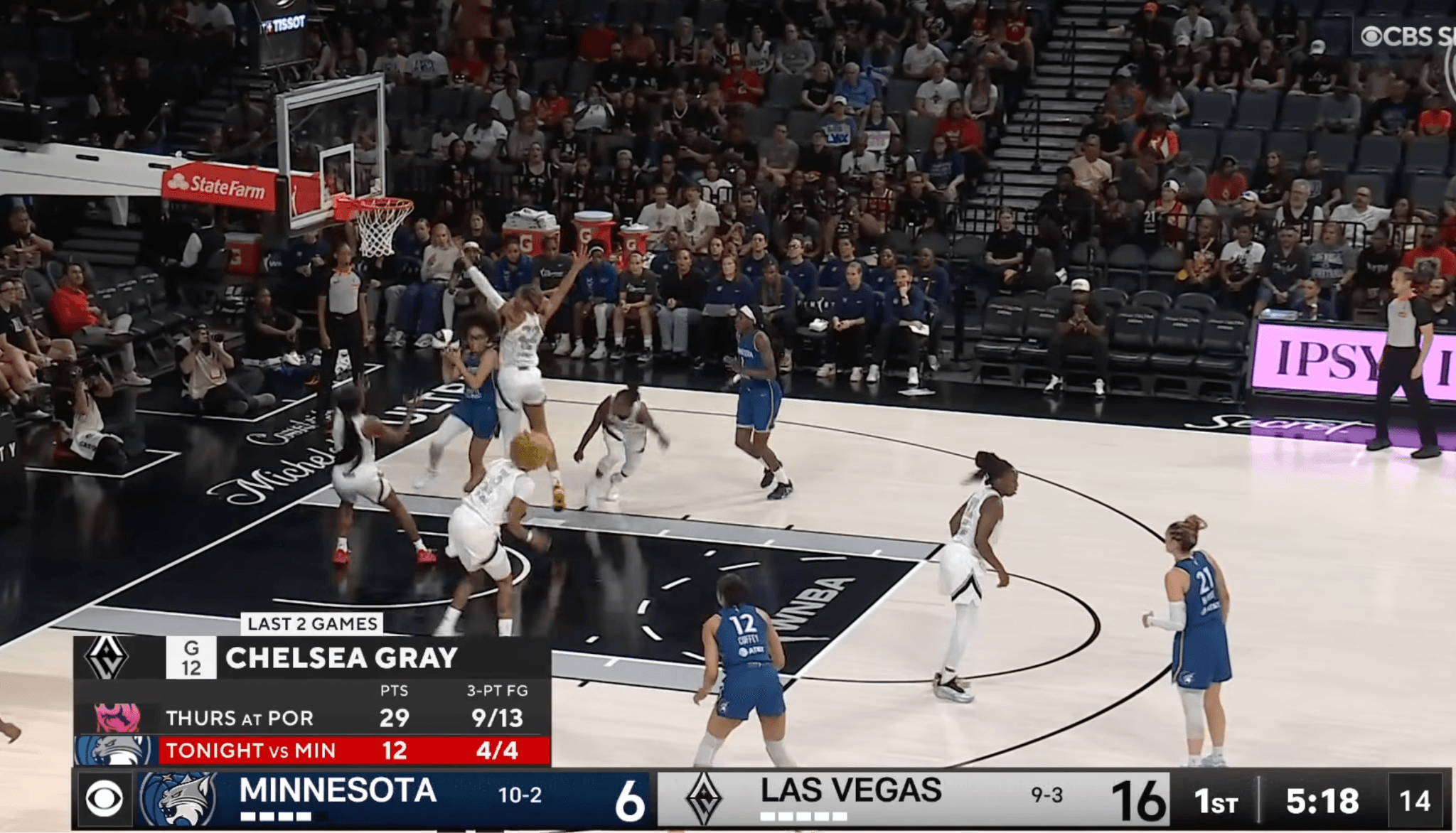
It happened about two weeks ago against the Las Vegas Aces. The Minnesota Lynx’s supernova of a rookie dusted her idol Chelsea Gray, only to end up in midair with her afro wedged in the armpit of the reigning Defensive Player of the Year, A’ja Wilson, and two Las Vegas defenders encroaching. Essentially, the basketball version of being stuck between a rock and a hard place.
For most first-year players, attempting to meet the league’s leading shot blocker at the rim would be an overzealous mistake. But Miles, the no. 2 pick in the 2026 draft, consistently puts herself in situations that would get most players in trouble—dribbling into crowds, picking up her dribble inside the arc, jumping in the air without a plan—because she has options other players don’t. It allows her to weaponize her greatest tool—deception—to its extreme.
In the play above, it’s only when her opponent is convinced she has no other move but to force an ill-fated layup that Miles torques her body to the sideline and makes a split-second calculation: Instead of passing the ball directly to her teammate Courtney Williams, Miles bounces the ball off the hardwood to evade the help, creating another beat of space and finding Williams for an open 3.
Before this season, there were questions about whether Miles, a freewheeling playmaker, would jibe with Cheryl Reeve’s strict, detail-oriented disposition. But that reading underestimated the Lynx president of basketball operations and coach’s flexibility and vision, as well as Miles’s intelligence. The curious child of two engineers, Miles is a magician and a mathematician at once. While she plays with the joie de vivre of youth, she also excels at all the little things that young players can struggle with: pacing, patience, control, knowing when to slow down and when to speed up. Reeve, instead of sanding off Miles’s edges, has surrounded her with floor spacers and rollers, unleashing a player who can make complex reads in a simplified system.
Two months into her WNBA career, Miles is already one of the game’s great improvisers, putting a spotlight on a team that, even though it’s tied for the most titles in WNBA history, has struggled to draw in casual fans. Her trademark goggles—inspiring the nickname “The Spectacle”—hearken back to the past and help her see into the future. As she told Sue Bird a few weeks ago, “I think I’m bringing back the retro point guard vibes.”
Miles, who’s averaging 18.7 points, 4.8 rebounds, and 5.7 assists per game, is not only the runaway favorite to win Rookie of the Year but also a legitimate fringe MVP candidate, with the fourth-best odds behind only Wilson, Caitlin Clark, and Paige Bueckers. Miles’s torrid start to the season is among the best for any rookie in WNBA history, putting her alongside Caitlin and Paige as part of a golden age of point guards who will define what the future of the position looks like.
Miles scored 356 points in her first 19 games, putting her in the top 10 of all time for any rookie, ahead of names like Diana Taurasi, Candace Parker, Clark, and Bueckers. She has also been the most efficient of the bunch. The Lynx rookie also boasts the best plus-minus for any WNBA player in history through their first 19 games:
Olivia's First 19 Games vs. the Past Four No. 1 Picks
In a league where rookies—especially guards—tend to stumble out of the gate, Miles has been dominant, rendering the scouting report irrelevant and processing adjustments in real time. Regardless of opponent or strategy, she’s tearing the league apart.
Earlier this month, the Golden State Valkyries became the first team to consistently go under the picks set for Miles, only to watch her drain a rookie-record eight 3s:
When the Los Angeles Sparks spent the game forcing her to use her nondominant left hand, she turned the game into a layup line—and let the Sparks know about it:
And against the Aces, who tried to turn Miles into a scorer to neutralize her playmaking, she nearly led a comeback by repeatedly challenging Wilson—the staunchest isolation defender in the league—at the rim:
It’s astounding to watch her work after she picks up her dribble. She’s a great actor, using look-aways, head fakes, and hesitations to tilt defenders. The trick is never the pass itself. It's getting you to look somewhere else first.
Take this possession against the Washington Mystics two weeks ago: Miles puts Georgia Amoore in a cage, gets her in the air with a pump fake, and momentarily convinces Angela Dugalic that she’s going to pass the ball to Nia Coffey on the wing before firing off a laser to Teaira McCowan for an easy layup:
Good playmakers take what the defense gives them. Great playmakers dictate what the defense gives them.
Miles’s scoring ability demands just as much attention as her passing, allowing Reeve to put her in the middle of what may be the WNBA’s first truly heliocentric offense.
Since 2011 (as far back as Synergy’s database goes), Miles has logged more possessions per game as a pick-and-roll ball handler than anyone in the league aside from Chennedy Carter in 2020, when she played just 16 games.
A heliocentric offense has built-in advantages; it puts the ball in the hands of the team’s best scorer and decision-maker, simplifying and hyper-charging an offense at once. Roles become streamlined and specific. When Miles (who leads the league in made layups) drives, Natasha Howard (who is second in made layups) rolls and Coffey and Kayla McBride space the floor.
But this is a Reeve offense, so it’s never going to be that simple.
In the same interview with Bird, Miles defined being a point guard as “being a general, understanding momentum swings, who has a hot hand, reading plays before they even happen, staying patient through your progressions, and being a leader.” When asked to define the job of a modern point guard, she chose one word: “scorer.”



More on the WNBA
Miles, who counts Bird, Maya Moore, Steph Curry, and Luka Doncic as her biggest basketball influences, plays with a mix of new-school bucket getting and old-school table setting. She can be your offense and she can run your offense, identifying mismatches, finding McBride off screens, and even using her own pick-and-roll exploits as a decoy to tilt the defense and allow Williams—who has been able to slide back to her natural position of shooting guard—to run her own pick-and-rolls.
With Miles in the Lynx’s system, the dream is to harness all of heliocentrism’s advantages—control, efficiency, consistency—without conceding to its weaknesses, like predictability and fatigue.
Minnesota is where heliocentrism meets movement, which is why the return of two-time MVP runner-up Napheesa Collier, whose 2025 campaign was famously cut short due to injuries to both of her ankles, should be relatively seamless. The Lynx won’t rush her, but Collier returned to practice on Wednesday and will begin ramping up soon. Reeve has built this system with both of them in mind, and she has a point guard who is smart enough to toggle between philosophies on the fly.
This era of the WNBA has been defined by its guard-big duos, from Gray and Wilson to Bird and Breanna Stewart. Miles and Collier could be the next in that lineage. Minnesota, in the Collier era, has thrived by being greater than the sum of its parts and heeding Reeve’s ethos of ruthless competence. But in the 2024 WNBA Finals, the Lynx eventually lost to the talent-stacked New York Liberty squad. Miles’s emergence evens the playing field and raises Minnesota’s ceiling, all because the system was built around her imagination and fuses her artistry with Reeve’s ruthless efficiency.