
When Christopher Nolan directed his micro-budget debut, Following, for $6,000 in 1998, he was Nobody, and he knew it. The film was an ingenious, noir-tinged parable about stifled ambitions, with the director splitting himself between a pair of disparate yet strangely sympatico protagonists: a struggling, socially inept cipher living vicariously through the lives of others, and a smooth operator with a gift for the long con.
The archetypes of the manipulator and mark have endured, to varying degrees and in different configurations, in Nolan’s work ever since. To paraphrase a certain Gotham City supervillain, they complete each other. Lately, he’s been fusing them together under the sign of hubris—his great theme, and increasingly resonant in light of his maturation from anonymous craftsman into above-the-title auteur. The potent pulp of Nolan’s salad days has been steadily transubstantiated into prestige; from Batman and 2001: A Space Odyssey to Operation Dynamo and the Manhattan Project, there’s nothing he can’t remake in his own idiosyncratic, IMAX-sized image.
The self-reflexive subtext has gotten thicker as the films have gotten bigger. Both Leonardo DiCaprio in Inception and Robert Pattinson in Tenet were legible as floppy-haired stand-ins for their creator, while the read of Oppenheimer as a parable about the collaborative nature of filmmaking—including the devil’s bargains of financing and owning intellectual property—was very much there for the taking. The stakes felt higher than portrait-of-the-artist vamping, however. The sobering power of Oppenheimer lay in its shift away from the James Bond–style intrigue of Tenet, in which the fate of the planet hung outlandishly in the balance, and toward a very real world in the process of watching itself burn. Not that Nolan’s adaptation of American Prometheus left myth behind, exactly. The film’s processional-procedural structure barely belies a tragic, allegorical design; Cillian Murphy’s expression in the coda suggests a genius reckoning with the carelessness of leaving Pandora’s box ajar.
Whatever its flaws, Oppenheimer met and exceeded its paradoxical mandate as an apocalyptic period piece: a flashback to the beginning of the end. With The Odyssey, Nolan’s reach is even broader, extending for the first time beyond a modern frame. The opening title card places us in the Bronze Age, described as a “time of apparent magic”—a designation recalling the agnostic backdrop of The Prestige, whose dueling illusionists were caught, along with their audience, in a double bind between science and superstition.

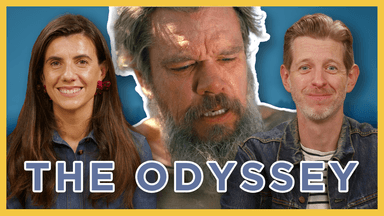
Nolan hasn’t secularized The Odyssey, exactly: There are malign sorcerers and slimy sea creatures and a voracious, dinosaur-sized Cyclops who gnaws the heads of Ithacan infantrymen like pitted green olives. Like any good theme park mogul, Nolan has spared no expense. But even as the filmmaker makes his first plunge into all-out fantasy—including an extended and stomach-churning foray into body horror on the isle of Aeaea, whose witchy proprietress (a stellar Samantha Morton as Circe) has a you-are-what-you-eat policy—there’s a sense of judiciousness, or even austerity. There’s a wariness of spectacle for its own sake.
Is this a nice way of saying that The Odyssey, which arrives as this summer’s designated big-budget auteur de force, isn’t that much fun? Maybe. Nolan isn’t the guy we go to for weightless excitement, anyway, the time-travel high jinks of Tenet notwithstanding. There’s always a lecture on the docket, delivered with a deep voice and a furrowed brow by some British thespian or other. “Theatricality and deception are powerful agents to the uninitiated,” caterwauled Bane through his BiPAP in The Dark Knight Rises. Nolan, who’s obsessed with sleight of hand—and good at it in his nimblest pictures—sees that rhetoric and raises it interestingly in The Odyssey. He’s fascinated and mortified by the power of self-deception and the massive collateral damage that comes from playing with fire.
Exhibit A: the promise made by Matt Damon’s genius military strategist–slash–homecoming king Odysseus to return to his family no matter the cost. And why wouldn’t he want to? His wife, Penelope (Anne Hathaway), is a model of competency and constancy who has sworn to reject the advances of any and all suitors in her husband’s absence. That includes denying the sexily leering Antinous (Robert Pattinson), who’s not above strutting around the castle like he owns the place. And then there’s Odysseus’s staunch and solid son, Telemachus (Tom Holland)—a chip off the old marble block, if not exactly a commanding personality. The latter’s desire to find out whether his wayward dad is still alive after a decade at sea, which involves confabbing with the brutish king Menelaus (Jon Bernthal) in Sparta, drives one side of the narrative. Odysseus’s harrowing journey in the company of his stalwart—though steadily dwindling—crew after their successful siege of Troy drives the other. When our man isn’t battling monsters or staving off mutiny, he’s visited by visions of goddess of wisdom Athena (Zendaya), a morosely beautiful avatar of female judgment in the best Nolan tradition (and another link to Oppenheimer, although it’s not worth spoiling the conceptual twist behind her role).
“I will defy the gods,” mutters Odysseus when he’s informed by his spirit guide that Zeus and Co. aren’t likely to grant him and his men safe passage. His obstinacy toward the powers that be is pure arrogance; it also belies the fact that he’s already done their dirty work as a destroyer of worlds. Suffice it to say that this version of The Odyssey is interested in heroism only so far as it can deconstruct it; its namesake’s sense of barely sublimated guilt—the moral stain that means no amount of ocean spray will wash the blood off his hands—provides a baseline for Damon’s commanding lead performance. There have been some famous screen Odysseuses, including Kirk Douglas, who led with his broad, bare chest; there’s a tendency for alpha-male movie stars to cultivate vanity when in sword-and-sandal mode. Damon’s wilier than that, though, and despite looking rather ripped, he never seems to be posing for his own bronze bust (or lobbying for an Oscar). Having long since ceded the action-hero territory he briefly cornered as Jason Bourne, he opts instead for a brawny melancholy, which serves well to anchor a movie leveraging escapist thrills against the rough-hewn realism of a physically demanding location shoot.


“Every single location on this movie would’ve been the hardest location on any other movie I’ve ever done,” Damon told GQ, which is standard-issue stuff for the PR circuit. Stories about battling the elements and pushing bodies to the limit helped Leo score his Oscar for The Revenant. Nevertheless, the bruised-and-battered anecdotes line up with the tactile physicality of the on-screen product, which mostly achieves the desired grandeur. The Mediterranean skies and seas in The Odyssey serve as naturally occurring special effects, with hills and valleys that feel uncanny by their own account. Pictorially speaking, this is probably Nolan’s most purely beautiful movie, shot by Hoyte van Hoytema as a series of vast yet startlingly granular panoramas; for every composition that recalls one of the director’s earlier films—beachfront military formations straight out of Dunkirk, a decapitated marble head rolling to rest like one of the top hats from The Prestige—there are images and sequences that feel conjured out of thin air.
Of course, for $250 million, you’d expect The Odyssey to look good. Operating with the Olympian resources to ship a boatload of A-listers to the Peloponnese for thunderbolt practice, Nolan indulges his usual showmanship while also weaponizing it, the same way he did in Oppenheimer. There’s a difference between the grueling, wholly unintentional sloggery of Nolan’s Batman movies and the calculated alienation effects of Oppenheimer and The Odyssey, which are grim in ways that imperil their respective price tags—the trade-off, perhaps, being the same inflated critical currency that Steven Spielberg or Quentin Tarantino started accruing when they decided to grow up and get serious.
Nolan has always been pretentious, and he hasn’t always made this quality sing for him. The Odyssey, though, answers the rhetorical question “Why so serious?” with a straight face and a bleeding heart on the sleeve of its carefully embroidered tunic. It’s about as angsty and anxious as a movie made at its industrial level can be, and its concerns, however obliquely expressed, lie in the present tense. Nolan has taken his studio’s money and put it where his mind is: a good strategy for being taken seriously. Like Spielberg in Disclosure Day, he’s gesturing toward certain geopolitical realities without directly naming them. Take your pick whether that's subtlety or reticence. The Odyssey isn’t moving, exactly, but it is powerful as a by-product of a filmmaker choosing to stick to his guns (or his crossbow). It gives us one of the greatest stories ever told reimagined as a cautionary tale, the blockbuster as a dark-hued Trojan horse.
Speaking of which: That equine vessel works wonderfully as an iconographic set piece, introduced half buried in the surf like the Statue of Liberty in Planet of the Apes. (When we get a look inside, it’s basically a chamber of horrors—an iron maiden flooding from the sand up.) The casting of Elliot Page as Sinon—Odysseus’s most loyal soldier, famous for adopting the guise of a deserter to convince the Trojans to accept his boss’s booby-trapped offering—is smartly pressurized by the actor’s earlier appearance in Inception. Here, Page becomes an anguished emblem of sacrifice instead of a dream weaver. The word is that Nolan used UPenn scholar Emily Wilson’s controversial 2017 translation of The Odyssey—the first ever written by a woman in English verse—as a scaffolding for his screenplay, but he’s no more reverential to Wilson (or Homer) than he was to Bob Kane. “Feel free to add things,” says Sinon to Odysseus by way of granting him posthumous poetic license over their life and deeds; between the colloquialness of the language and the permissiveness of the sentiment, this throwaway line could well be Nolan’s skeleton key.
“No one in history has ever done anything this clever,” said another Homer once while proffering a suspicious peace offering of his own to his enemies. Suffice it to say that at 172 minutes, The Odyssey lacks the satirical compression of “Lemon of Troy,” and it similarly isn’t trying for the wiseacre pastiche of O Brother, Where Art Thou?, still the gold standard, along with its spiritual sequel Inside Llewyn Davis, of imaginative Odyssey iterations. Nolan is not exactly a cutup even when his movies are funny (i.e., Guy Pearce forgetting who’s chasing whom in Memento or John David Washington getting impatient over hot sauce in Tenet), and he’s tamped down on the bawdy, proto-picaresque tone of the source material. The film is mostly sexless and bereft of jokes, even as Pattinson’s mealy-mouthed cowardice grows pretty amusing by the end. Talking with Jon Stewart the other night, Nolan balefully explained that he excised a crucial exchange between Odysseus and the Cyclops in which the latter is informed that his captive’s name is “Nobody” and ends up making a fool of himself when trying to identify the guy who’s blinded him with a stick—a bit of shtick that might have made for a hilarious set piece. Stewart relayed the frustrations of his viewing companion, whom he described as a stickler for details. “He was very upset that [the joke] was not in the movie.” “Puns in translation are tough,” Nolan replied. “I tried.”
He did. It’s probably somewhere between a compliment and a critique to say that The Odyssey reeks of effort—honest exertion rather than flop sweat, but redolent all the same. When Nolan is at his very best—like in Memento and The Prestige, or the most pressurized passages of Dunkirk or Tenet—he works up an intense but ineffable sense of convergence; Inception’s indelible image of a metropolis implacably folding in on itself summarizes his gift for stratifying narrative across multiple planes of time and space. The Odyssey is edited by Oscar winner Jennifer Lame, who sutured together Oppenheimer’s color-coded plotlines, yet it moves only in fits and starts, slacking noticeably when it’s focused on Holland’s sullen teen who would be king act or Charlize Theron’s soporific Calypso. (The scenes of Odysseus’s lotus eating are so close tonally to the amnesiac metaphysics of Memento that you can feel Nolan’s delight in using Homer as an excuse to take a victory lap.) For all the (idiotic) online furor over Lupita Nyong’o’s Helen of Troy, she’s a marginal presence, introduced with her ship-launching features already disfigured by her jealous husband; as for Benny Safdie’s Agamemnon, he’s barely visible behind his iron mask.
There’s a brief moment at the outset of The Odyssey, set during a kind of Grecian slam poetry reading, where it appears we might get a truly digressive, multifaceted retelling of Homer’s story: an impressionistic amalgam of perspectives creating Odysseus in unreliable aggregate per the oral tradition. Nolan feints in that direction—he does love his elliptical insert shots—but mostly keeps his point of view reliable and the pacing conventional, functional choices that become ironic insofar as he finally styles the whole enterprise as a meditation on storytelling. The last sequence finds Odysseus reflecting on his legacy and how he’ll be remembered by later generations; he tells Penelope that one day, people will be listening to songs about them. Cue “When I’m Home,” by Travis Scott and James Blake. Sing, o Muse!