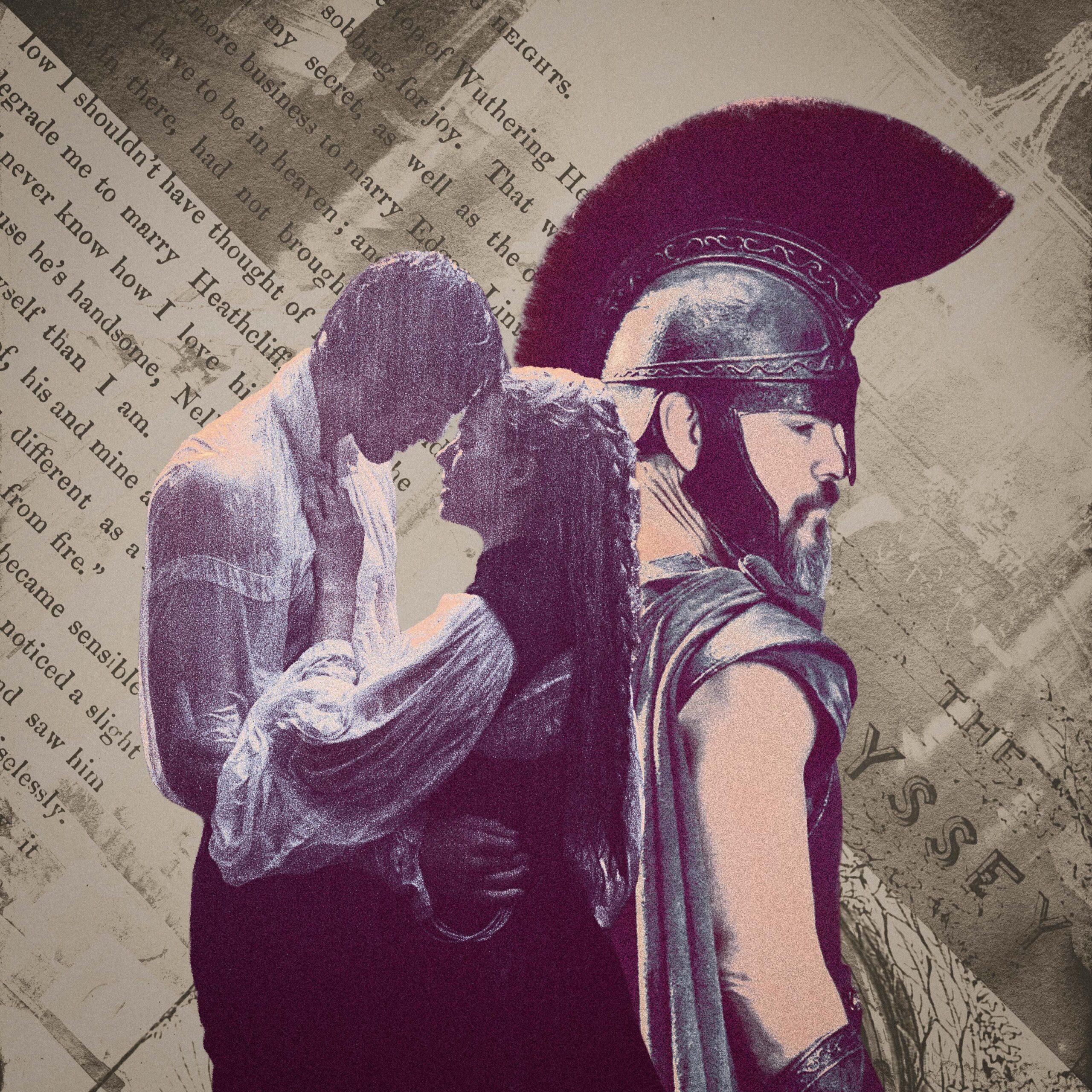

If grown men think about the Roman Empire every day, their fond reminiscences must also extend a thousand years deeper into the past, all the way back to the Mycenaean age. Because in February of last year, when the first photos were released from Christopher Nolan’s The Odyssey—showing Matt Damon as Odysseus, armored up, sprinkled in ancient dust, and wearing a mightily bristled helmet—a large swath of internet denizens (not necessarily all men, although I have my suspicions about the gender breakdown here) erupted with their objections:
These protests seemed more like a game of academic one-upmanship (or a drawing contest) than anything motivated by love for the original text or genuine concern for the cinematic output. As the trailer and more photos were released over the subsequent months, the cries mounted higher, distant echoes of keens from an ancient battlefield: That’s a Viking ship, not a trireme, they bellowed. Agamemnon’s armor would look better on Batman than on the lord of men, they called. Why can’t Nolan be more like Family Guy and add some spice to all the bland, white architecture? And why, for the love of the gray-eyed goddess Athena, are they wearing pants?
As fellow internet combatants have astutely pointed out, though, the Iliad and the Odyssey themselves were written about four centuries after the events they describe, collected from oral poetry that had long been circulating, doubtless picking up a few historical inaccuracies along the way. A faction of scholars has concluded that the armor and weaponry described by Homer are extremely embellished, and not even close to what Mycenaean warriors would have actually had. (A little like Nolan using a Batman costume for Agamemnon, huh?) Whether there was a Trojan War at all is still up for historical debate—and that’s not to mention all those meddling gods and monsters, who are just as essential to the Iliad and the Odyssey as heroes like Odysseus or Achilles, Troy erasure notwithstanding. I can’t wait for first-look photos of Polyphemus to drop to see what furies arise from Nolan’s undoubtedly inaccurate portrayal of the one-eyed, man-craving son of Poseidon.
Emerald Fennell’s upcoming adaptation of Emily Brontë’s Wuthering Heights kicked up similar ire as soon as Margot Robbie and Jacob Elordi were announced as the (supposedly teenage) leads. While criticisms about Robbie as Catherine generally fixated on her age and Barbie-esque, she’s-definitely-seen-an-iPhone qualities, Heathcliff is explicitly described as “dark-skinned” in the novel, leading to very fair criticism that Elordi isn’t right for the part. Fennell and her casting director, Kharmel Cochrane, pushed back, the latter sending the internet into a tizzy by saying, “You really don’t need to be accurate. It’s just a book. That is not based on real life. It’s all art.” The anger mounted when photos were released of Robbie in a wedding gown that looks more like Princess Diana’s than anything from the late 18th century. And, of course, the Charli XCX–backed trailer upped the ante even more, showing Cathy wearing pleather and some Lennon-esque sunnies, sweat dripping lasciviously on the famously chilly Yorkshire moors, and, to top it all off, Robbie sporting a blond dye job fresh out of a Beverly Hills salon.

More on the Adaptation Conundrum
Despite any general distaste for the frothing-at-the-mouth internet discourse about these historical and textual liberties, it’s not hard to see the point behind all the passion. A book is never just a book. Words do, after all, mean something—as does historical context. Director Robert Eggers, whose finickiness about historical detail extends to the saw used to build a Puritan farmhouse or the heels on a crusty vampire’s shoes, has been invoked as a kind of savior of Nolan’s sins, summoned like one of his own daemons to remake The Odyssey and save us from the horrors of desaturated armor. But as easy as it is to knock it as film-bro pretension, Eggers’s faithfulness has a purpose beyond object fetishism or hypermasculine daydreams about building a lighthouse from scratch. By making history not seem dusty and faded but instead stinking and alive and immediate, his movies paradoxically show us how bizarre and alien the past really is. Vampires and demon goats make more sense in a world where everything’s illuminated by candlelight, there’s no Google Maps to get you out of the woods, and rats could crawl up on you in bed on any given night.
That’s the alien feeling a lot of people apparently want from The Odyssey, whose costumes seem to be influenced by the relatively generic swords and sandals of Ray Harryhausen’s epics more than by the gaudier getups of the Bronze Age. But Nolan has explicitly mentioned his debt to the Harryhausen genre, saying that he wants to revive it and give it the heft of a blockbuster budget. His version of the Odyssey owes as much to those cinematic precedents—and to the realities and constraints of moviemaking in 2026—as it does to life in the Mycenaean age. What exactly Nolan wants to say with The Odyssey, we don’t know yet because, again, we’ve only seen the trailer. But the Iliad and the Odyssey are perhaps the most fundamental—and malleable—texts in the Western canon, living on not just in straightforward adaptations like Troy or modernized ones like O Brother, Where Art Thou? but in pretty much any other story about war and/or hero’s journeys, from Saving Private Ryan (Damon really was built for this) to The Lord of the Rings to Finding Nemo. Frankly, the first version of the Odyssey that got me hooked on the story was Wishbone, which managed to capture the spirit of the Ithacan king and his long-ass journey home even though Odysseus was played by a Jack Russell terrier. Seen this way, the enduring part of the Odyssey is not necessarily its historical particulars. What it says about honor and hospitality and duty and temptation—plus the thrills of Scylla and Charybdis, men turning into pigs, siren songs, and finally making it home to kick some ass—comes through no matter what costume the hero is wearing.


Every period piece or adaptation (even one made by Eggers—do you really think Viking queens looked like Nicole Kidman?) is a reflection of when it was made as much as it is an attempt to capture a different time and place. The 1939 Laurence Olivier Wuthering Heights always felt too clean and mannerly to capture the difficult novel. It lopped off the entire second half of the book and with it some of Heathcliff’s darker tendencies, sanitizing the story and making it more palatably romantic. It wasn’t until Andrea Arnold’s 2011 version that something approaching the raw weirdness of Brontë’s version was captured. Finally, characters were banging their heads against walls and wandering gusty moors like hungry ghosts. And, of course, Arnold’s was the first version to honor Brontë’s vision of Heathcliff—and capture, accurately, why he was such an outsider in his society. But even that movie, as faithful as it seems, is just a product of its time; it feels more right to me in part because its spare style and language and beauty standards are straight out of 2011, and Arnold’s angsty, introspective sensibilities are what I prefer to the lavish melodrama of the ’30s.
As the cinematic visionary who brought you bathtub slurping and grave fucking, Fennell is naturally dialing up the book’s perversions: Per horrified reports from the screening room, her version features an ejaculation at a hanging, Fifty Shades of Grey–style horse rein sex, and goo all over the place. None of that’s in the book, and most of it probably wasn’t a big part of 1780s life, either (except the goo). I, along with many, might not have much interest in Fennell’s winking-provocateur visions of cocks and cum, but you can’t begrudge her attempts to bring Wuthering Heights into 2026, or deny the idea that history is now adapted by the edgelords. Either way, the book will survive her depredations, and Brontë’s rich text may even elevate Fennell’s house style beyond shallow class criticism and leering provocation.
That’s the wonderful thing about adaptations: The books and their pleasures still exist. There’s a reason directors like Nolan and Fennell keep going back to these wells. They still haven’t run dry, and no number of retreads or rereads will sap them of their delights. Hopefully the undoubtedly, inevitably anachronistic versions of the Odyssey and Wuthering Heights will send more readers back to that well, to taste the wine-dark Aegean Sea or the mists of Yorkshire. If Christopher Nolan or Emerald Fennell pisses you off, you can always just read the book yourself and picture the characters however you want.