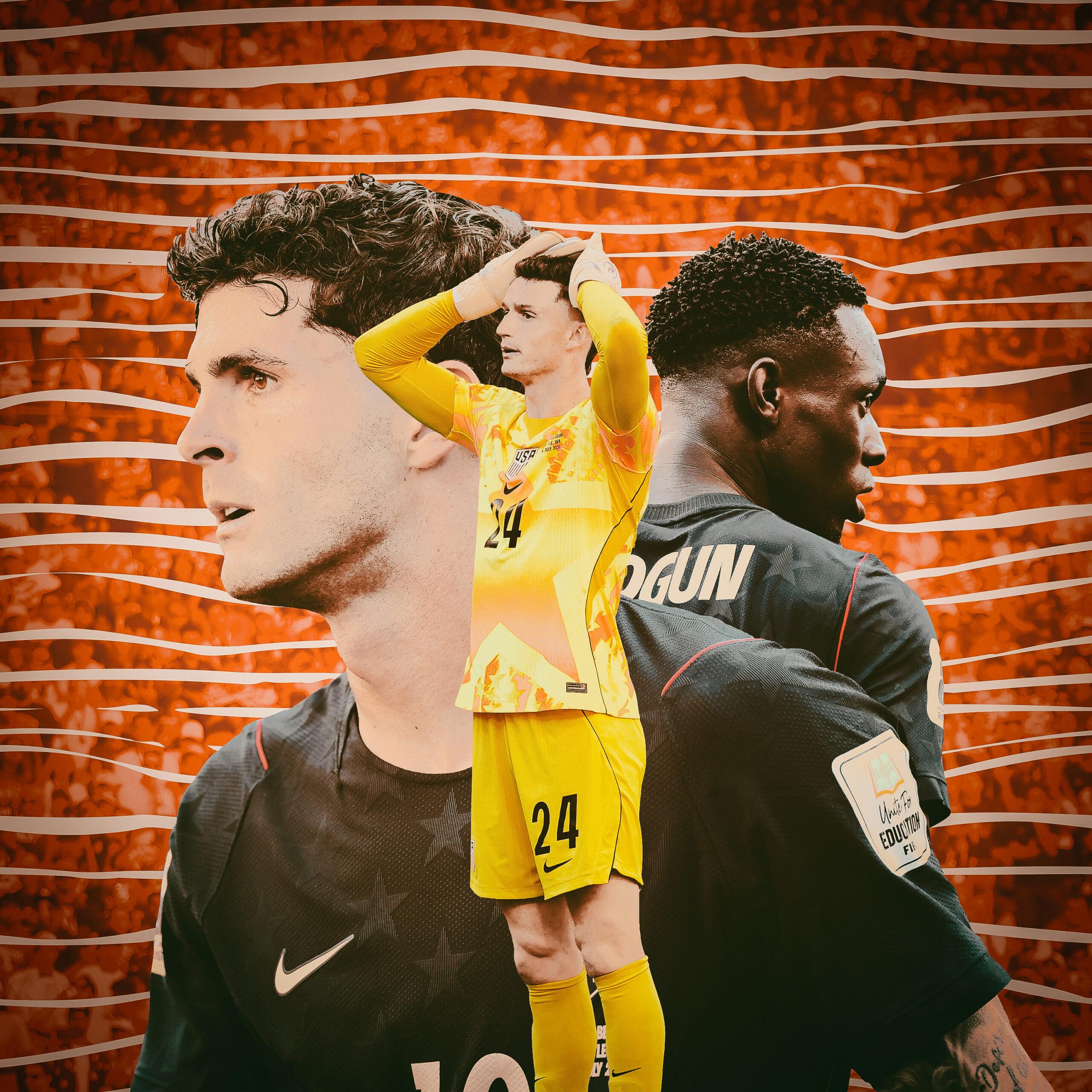

What fools we were, in retrospect. What children! We let ourselves be seduced by the almost unbelievably good vibes of this World Cup—this astonishing World Cup, easily the best since the last one—and we lost sight of the fact that Donald Trump was, at some point, bound to make it all about himself. The octogenarian president of the United States may have noticeably lost a step over the past few months, but he’s still hell-bent on being the main character of reality, and the World Cup is the biggest sporting stage there is; of course he’d cannonball into the proceedings before it was over. And once he did—we'll talk about the how and why of it in a minute, though chances are you already know—it was basically inevitable that the mood around the U.S. men’s team would sour and the joy would evaporate. On Monday, in its first match since Trump inserted himself into the narrative, the U.S. crashed out against Belgium, losing 4-1 on a night that felt weird and ominous from the beginning—a night when a puffy, sleepy, mysteriously bruised orange asteroid seemed to be looming in the sky.
It’s objectively false to say that Trump’s phone call to FIFA president Gianni Infantino about Folarin Balogun’s red card caused the U.S. to lose. No one at the White House ordered the U.S. defense to go to sleep during both of Charles De Ketelaere’s early goals, one of which came barely a minute after Malik Tillman’s second amazing free kick of the tournament had leveled the match at 1-1 in the 31st minute. Stephen Miller did not make Christian Pulisic play like an ex-phenom running on fumes of hype. Marco Rubio did not parachute in to direct the series of slapstick miscommunications that led to Belgium’s third goal, which Hans Vanaken fired in from long range after U.S. goalkeeper Matt Freese came charging, uselessly, about a mile out of net. (If Rubio had directed this sequence, it’s hard to imagine how it could have gone much worse.) The U.S. was outplayed on a level that transcended politics. There are matches that make you want to write whole dissertations on sociology and aesthetics, and then there are matches that make you want to go “derp.” This one was a “derp.”
Still, the U.S. loss kinda felt like Trump’s fault. Sports teams seem to wither under the president’s touch. (Remember when he went to the NBA Finals and fell asleep? That was the only game the Knicks, his team, dropped in that series.) The vibes had been so immaculate when we were romping 3-1 past Paraguay—a pretty good team, as it turned out!—and shutting out Australia 2-0 and winning our group. The conversation had been so euphoric when we hung on with 10 men to beat Bosnia-Herzegovina 2-0 in the round of 32, the match that featured the first of those miraculous Tillman free kicks. And then, in two minutes, the president turned the USMNT’s all-time run into a hotbed of shouting and controversy. While it may simply be a coincidence, the gang certainly played on Monday like a team surrounded by shouting and controversy rather than by happiness. They played tense. They played like a team that felt utterly engulfed in the discourse. Being engulfed in discourse can sometimes be an advantage in sports—us against the world, stick it to the haters, etc.—but it’s hard to switch to defiance on a dime when you’ve spent four straight games having flowers strewn at your feet.
How did it all go so wrong? If you’re reading this, I’ll assume you’re more or less up to speed on the Balogun incident. Here are the basics: On July 1, after scoring the team’s first goal just before halftime against Bosnia-Herzegovina, Balogun, a 25-year-old striker who’s been the team’s breakout star of the summer, was sent off for a second-half tackle that crumpled the Bosnian defender Tarik Muharemovic’s ankle. The referee, Brazil’s Raphael Claus, did not initially reach for a red card after the tackle but changed his mind after VAR—FIFA’s video review booth—intervened. In this case, however, Claus’s first instincts were correct; the foul looked gruesome in still images, but video footage showed it was clearly accidental, well short of soccer’s (admittedly sort of subjective) threshold for automatic ejection. Nevertheless, after being sent off, Balogun was suspended for the U.S.’s next match. According to FIFA’s customary protocols—it feels excessive to use the word “rules” for anything associated with FIFA—the U.S. wouldn’t be able to appeal.
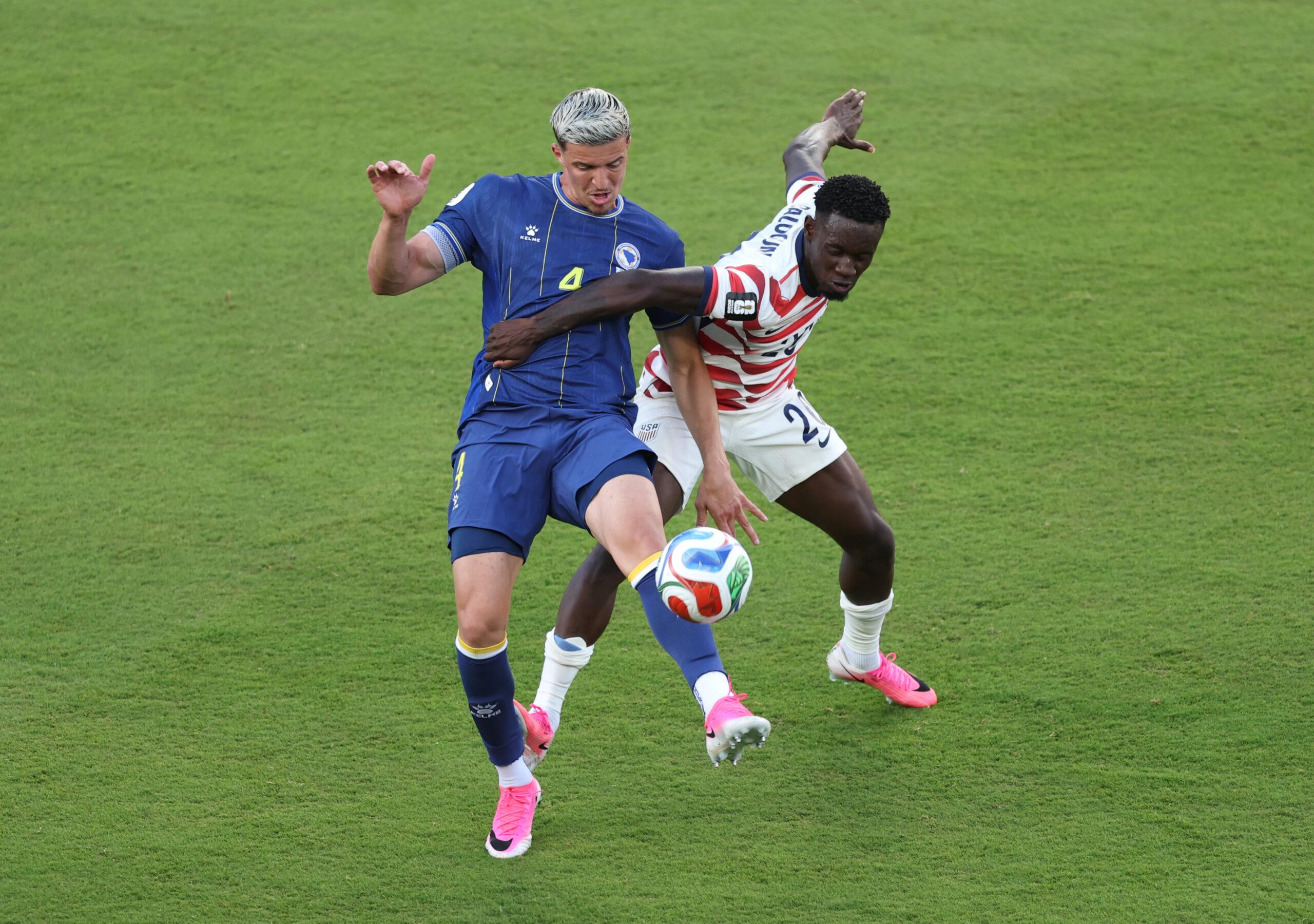
Then, on Sunday, the day before the quarterfinal against Belgium, several pieces of news broke almost all at once. Trump, we learned, had spoken to FIFA president Infantino on the phone and asked him to look into Balogun’s red card. I’d be extremely surprised if this were the first time a FIFA president had fielded such a call from a political leader, but they normally don’t lead to suspensions being overturned, and they normally aren’t leaked to the press. In this case, though, the press also reported that FIFA’s nominally independent disciplinary committee had indeed looked into the incident and, in an absurd bit of circular jurisprudence, had chosen to suspend Balogun’s suspension. He’d be allowed to play against Belgium but could, after a yearlong probationary period, be required to sit out a game in the future—presumably a far less important one.
In reaching this decision, the committee invoked Article 27 of the FIFA Disciplinary Code. Article 27 is a vaguely worded provision that basically allows soccer’s governing body to delay a player’s punishment for more or less any reason it likes. Given that FIFA used the same provision to keep aging Portuguese superstar Cristiano Ronaldo from missing the start of his last-ever World Cup—Ronaldo was shown a wholly deserved red card during Portugal’s penultimate qualifying match against Ireland, the three-game suspension for which would naturally have eaten into the beginning of this tournament—Article 27 is starting to look like FIFA’s Big Ratings Protection Clause. Look, justice is nice, but those Kalshi ads aren’t going to brainwash themselves.
Everyone, and I mean everyone, got mad about this. Even the American fans who were happy about the development got mad at the other people who were mad. Infantino insisted that the suspension’s suspension—the suspension squared?—had nothing to do with Trump’s phone call, but the fact remains that FIFA hasn’t done anything like this during the World Cup since 1962, when the great Brazilian player Garrincha was allowed to play in the final after being red-carded in the semifinal. More than 170 red cards have been shown in the tournament in the intervening 64 years, and no FIFA committees have done anything to mitigate any of them. Add to that Infantino’s years of servile groveling to Trump, and the inescapable implication was that Trump had gotten Balogun out of his ban in the same way the mayor might get the mayor’s brother out of a parking ticket. Which, it should go without saying, is a miserable look, and a transparently crooked way to run the world’s biggest sporting event.


The outcome wasn’t really unfair, since Balogun never should have been suspended in the first place, but in terms of process and perception, FIFA’s move was an unholy nightmare from beyond the valley of the damned. The vibes surrounding the U.S. team suddenly became insufferable, in ways I could probably best describe by repeating the word “Trump” from here to the end of this paragraph. You can tell a lot about people from the way they respond to an unfair development that benefits them. Some American fans declared they would root for Belgium rather than be party to dishonor. (I pictured them all putting on tuxedos before they said this.) Some pointed out the irony in Trump intervening to help a player who qualified for the team only through birthright citizenship. (Balogun was born to English parents visiting the U.S. and was raised in England; he’s played most of his best soccer in France.) Some refused to believe the obvious narrative, arguing that the White House was probably lying when it took credit for the reprieve. (In fairness, that would be in character for this White House.) Some—probably most—did a lady-doth-protest-too-much song and dance trying to convince themselves that Balogun’s reinstatement was actually not problematic at all, mostly on the unassailable grounds that corruption also exists in other sports. “Brother, let me assure you that the NCAA does shit like this all the time,” they posted. Brother, that is not the dunk you think it is.
In the end, Balogun played, but his impact on the game was so minimal that the debate around his presence remained confined to the realm of abstract principle. (Don’t get me wrong, abstract principle is important, but it doesn’t score goals.) He had one really good moment, a slithering run down the left side in the 82nd minute, followed by a hard shot that forced the first save of the match from Belgian goalkeeper Thibaut Courtois. If the shot had gone in, the score would have been 3-2, and the next few minutes might have been interesting. As it was, though, Courtois blocked the ball, Romelu Lukaku scored Belgium’s fourth, and the next few minutes were largely taken up with the American announcers pleading with their audience not to stop watching the World Cup just because the U.S. had been knocked out of it. Derp!
My own, correct take on all this comes in two parts, and I’m confident that if all American fans had followed my precepts, we would have won, probably by a lot, like 10-0. The first part is don’t be a hypocrite. If, like most soccer fans, you’ve spent years criticizing FIFA corruption, don’t suddenly act like it’s fine just because you think it gives your team an edge against Belgium. Did you mock Infantino when he awarded Trump the “inaugural FIFA Peace Prize” last year? Then don’t take to social media and start posting about how Trump directly intervening in disciplinary decisions is perfectly OK because cycling is even more corrupt, actually. Of course cycling is corrupt! There are also no Chuck E. Cheeses on the moons of Jupiter. Neither of these facts has anything to do with whether the right thing was done in this case.
My second precept, however, is this: You can cheer for your team without being a D&D paladin about it! Life is 70 percent chaos, and you’re allowed to go on supporting the squad you love even while admitting that something kind of fucked up just happened to benefit them. We’re all sitting around watching a children’s game here. Perfect virtue is not required, and you can hold two ideas in your mind at the same time. (Unless you were an American defender in the first half against Belgium. Then maybe you can’t.) On a structural level, please support broad FIFA reform. On a Sitting Down With a Beer to Watch the Match level, be honest with yourself, and follow your heart.
What’s next for U.S. soccer? God, please don’t make me talk about it. The entire American soccer internet is currently neck-deep in a take cycle about the arguable superiority of the European youth-academy system, and I would rather give a cat a bath than weigh in on this. The good news, for those of us whose team just got batted into outer space by a group of men who dip their fries in mayonnaise, is that there’s a lot of soccer left to play in this World Cup, and the mood of the tournament can absolutely recover now that Trump’s big moment is past. Did you see England’s win over Mexico the other night? That was some of the most brain-melting soccer I’ve ever watched. France looks like an unstoppable force, and Spain looks like an immovable object (literally, it sometimes seems like the team is not moving). Fun is infectious, and Erling Haaland might currently be having more of it than anyone else in history. (In second place: the entire Norwegian fan base and its delightful Viking row.)
It’s too soon to think about the future. Enjoying what’s left of the circus along with the rest of the world might not restore FIFA’s integrity, but FIFA’s integrity wasn’t what drew us to the tournament in the first place. We came for the joy.