
There’s no mistaking a Danny McBride project for anything else. His work is always filled with a proprietary blend of ’80s movie references, scatological humor, martial arts, bursts of violence, and laughably arrogant (but somehow kinda likable) Southern shitheads.
His newest endeavor, thank God, is no exception. But it’s still different from anything he’s ever done. After almost three decades in television and film, McBride has written a book. Thrilling Tales of Modern Men, a collection of short stories, comes out Tuesday. If you’ve seen Eastbound & Down, Vice Principals, or The Righteous Gemstones, the first-time author’s style will feel familiar.
“When I was even just trying to get my head around how to do this or why to do it, part of me was like, ‘Well, it would be interesting if I could convince people that have followed my shows to come and read a book,’” McBride says. “And so maybe I could create this as a way that these stories feel like extensions of the stories I’ve told in TV.”
If you don’t know McBride’s fictional world, the book is a good introduction to it. Among other curiosities, there are runaway teenagers, a bloodthirsty tiger, a mythical Civil War sword, and a guy who rage-pees all over someone else’s boat.
McBride recently spoke to The Ringer about his literary pursuits—although he’d probably laugh in my face if he heard me use that phrase to describe what he’s been up to. His motivations are a little less pretentious than that. As he puts it in the book’s acknowledgments: “Stories keep me happy and alive and always excited about the world around me.”

More on Danny McBride
I remember when Gemstones was ending, I talked to David Gordon Green, and I said, “What’s something you would like to see Danny do in the future?” And he said, “Has he told you about the book?” And I said, “No, I didn’t know about the book.”
I’ve written over 80 episodes of TV. It’s a massive amount of work. Gemstones I was on from beginning to end. It was almost seven years. I loved writing on it. But I was so tired when it was done that I just wanted to do something different. But weirdly, my only hobby is writing. I knew I needed to take a break, but what am I going to do for fun?
When you write for television, every episode is kind of like its own chapter, and you have to present a story that you wrap up. But at the same time, you have to also be telling this larger story. So there’s this level of intricacy and puzzle work that goes into it.
It’s fun when you crack it, but I was like, “I would love to just create something where I could start something and finish it.” And then do lots of different things and not have to just commit to one story that I’m on for seven years.
You could have written a memoir, you could have written a novel, but what about the short story form interests you?
I just wanted to tell a lot of different stories. It was too hard to commit to just one. And I felt like the short story was the perfect antidote to what I was feeling, which was that I was just feeling kind of forced into a lane and telling stories about these same characters every season. And I really just wanted to be a little bit more scattered with it.
When did you have this idea, and who did you go to first?
The first inklings of this came about when I was writing Vice Principals. We wrote both of those seasons before we shot the show. So it was a year solid of writing. And I think we were all still learning how to write at that point. Every day in the writers room was like 9 in the morning to like 9 o’clock at night. If we got stuck, we would just stare at each other and sit there longer and longer, and we didn’t realize that sometimes backing away from it when you’re stuck can unlock things.
The thing about TV that’s stressful is that you’re not just writing the television show in a vacuum. You’ve sold people that it’s going to be good, and then you’ve got to get the shit done before the cameras roll.
I needed to have an outlet for how to just get my brain off of Vice Principals every now and then. So I started this thing where every morning I would just freehand write whatever I wanted to. It could be an inkling of a story. It could be a scene with some random character. I didn’t have any expectations on whatever it would be. It was just a way to brain-dump and to get my mind working. And then usually I would have some sort of clarity about Vice Principals when I was done doing that. I filled up, I think, four or five big sketchbooks. All of this random shit. And I just put them away. I never touched them.
And then during COVID, I was just bored around the house. We had already written the second season of Gemstones, and we started shooting, and then we got shut down the second day. So I had nothing to write, and we were just waiting to go back to work. I pulled out those books and just started going through them, seeing if there was anything there. Most of [the stories] sucked, but a few of them did elicit something for me. “Oh, I’d like to play with this one more,” or, “Maybe if I put these two together, this is actually a story.” And so I pieced together about six or seven things that I felt like could have potential, and that’s what I kind of shopped around to see if I could get someone to say that they would make this book.
And then weirdly, once I did that, I don’t even think any of those stories even made it in. The more that I committed to it, the more I just wanted to write new stuff. I wasn’t interested in just going back to this old shit. But after Gemstones, I just felt supercharged.
I was like, “I would love to just create something where I could start something and finish it.” And then do lots of different things and not have to just commit to one story that I’m on for seven years.
It’s funny; I wrote a book. I have friends who have written books. And one said when he was writing his, he wanted to make a T-shirt that said, “Ask me how my book is doing.” And on the back it would say, “Don’t fucking ask me how my book is doing.” It’s a solitary process. What was it like for you, who’s used to collaborating?
I love the collaboration. It definitely is fun to write something for film or television and kind of know that the script is just the beginning. You’re going to hire all these really talented people to make what you wrote better. It’s definitely scary when you’re just the one writing it, and you’re like, “Oh, I will not have the benefit of Richard Wright’s production design or Joey Stephens’s music or Edi Patterson’s line delivery. This is just on me.” It was definitely daunting, but there was also something that was really fun about writing something that when it was done, it was done.
How was the editing process? Was the book pretty fully formed once you filed the draft?
I worked with Ben Greenberg at Penguin, and I had a blast. I approached it very much the same way I would like editing one of our shows. I would look at the stories and I would figure out: “How do we tell this story in the most efficient way? Let’s pay attention to the space in between the scenes. What stories are we telling that are not even on the page?”
That was a way for me to get my brain around how to do it. To rewrite an episode of a show is like 30 pages. You could get through that in a day. When you’re looking at a document and it’s almost 400 pages, you’re like, “I don’t even know if I can fucking read this thing in the next two weeks, let alone rewrite the whole thing.”
Did you have buddies read it? People you trusted?
I did. I pulled on my buddies Jeff Fradley and John Carcieri, who I wrote a lot of Gemstones with. And it was really funny because we read each other’s shit all the time. I mean, every day we’re rewriting each other’s work on Gemstones. But there was something about this. I was so nervous to show it to them.
And you know what? They were awesome. They were helpful and gave great ideas. Anytime you try something new, it’s just about you getting the confidence to be strong enough to present it and to be OK with however people like it or don’t like it. It’s the same way in movies and TV; you don’t have any control of how people will receive it. And I knew that, but for some reason with presenting this, I was more apprehensive about it than I normally would be.
I remember we talked once about the movies you liked as a kid. But what did you read when you were an adolescent?
I got onto Stephen King very young. I think it might have been even in fifth grade. That was the first time I had read something where I was really invested in finding out what was going to happen. At 12 years old, 13 years old, 14 years old, reading It and The Stand. I just liked reading horror and suspense. I would read Dean Koontz and Clive Barker and even The Three Investigators. That was my shit. I liked The Three Investigators more than The Hardy Boys. Michael Crichton. A lot of that sort of summer beach reading.
Reading has always been something for me that comes and goes in my life. There’ll be times where I’ll be reading all the time, and then I’ll turn around and be like, “Wow, it’s been like a year since I’ve read a book.” It’s strange. As my career started to go, I would always find comfort in bringing a book to set. You’re sitting in the trailer, bored. But then around 2020, everyone’s just on their phones. It was all a bunch of noise.
And I kind of got on this kick where every time I felt like I needed to pick my phone up, I’d just pick a book up instead. I set this goal for myself to read 50 books that year, and I did it. I fucking read 52, I think. It was awesome. I loved it. And once I got some momentum, it was so much fun, and I read so much shit that I always had wanted to read that I’d always pushed off. I felt like my mental health was the best it had ever been. I have not hit 50 again in a year. I’m averaging now around 12 or 13 a year, which still isn’t bad.
What are a couple of those that you really liked?
A lot. I knocked out Lonesome Dove and Blood Meridian, which were just two books that I always had heard about from people that I respected. And for whatever reason, I just always pushed those two off. I don’t know why. I thought they were going to be homework, and both of them have just become two of my favorite stories ever.
When I talked to Walton Goggins for a Gemstones story that I did, he mentioned you recommended Lincoln in the Bardo to him.
I love George Saunders. Lincoln in the Bardo, I remember I started reading it on the Kindle, and I was so confused. The formatting was so fucked up on the Kindle. I’m like, “I have to read this for real.” And then that book just does something to your brain as you start seeing how the story unfolds. It’s in that narrative structure where it’s all spoken word. By the end of it, I just felt like my brain was operating at a higher level. Even just understanding how that story was told, it was so unique, so awesome.
It’s kind of like a lot of Saunders’s work. I like that his stories can be funny and then impactful at the same time. I remember the first time I read CivilWarLand in Bad Decline. I felt like, “Oh man, this is exactly where my mind goes.” This idea of a defunct amusement park and this vigilante on a mission. When you read something like that, it challenges you to think about what you can tell stories about. It doesn’t have to be typical heroes and typical villains, and you can just set oddball stories with oddball characters and not always know where it’s going to go. It doesn’t always have to wrap itself up in a nice bow.
That’s a great segue to what I was going to ask next. So what is a Danny McBride character to you? Maybe that’s a high-minded question. I can explain what I think one is, but how would you describe it?
When I was first coming up and starting to write, you would always get these notes about how characters needed to be likable, and that was part of the essence to survive in the early 2000s in Hollywood storytelling. I just always thought that was such bullshit. If a character is interesting, that’s all that you need. They don’t have to be a good guy. They don’t have to have all the right answers. They don’t even have to be heroic.
I’ve always sort of gravitated toward stories that play with that concept, where it’s an unexpected narrator, an unexpected protagonist. And I think what ends up happening is the story just kind of ends up being more interesting. You don’t really know where it’s going to go if you don’t fully want the main character to win. I just think it keeps the storytelling more interesting when you’re unsure of what you want to happen.
With a lot of the characters that I’ve written about, I think their morals and their values and how they see themselves [are questionable]. But I also think their biggest advocates are themselves. They have some sort of understanding of who they think they are that doesn’t usually align with the way others see them. There’s always this constant sort of need to prove oneself or to step over the line of what’s decent in order to get you to where you need to be.
A theme of your work that I love, and obviously think is very funny, is men who have lost their mojo who are trying to reclaim it in very stupid ways. And I’m curious, what about that is interesting to you?
When people—guys, especially—feel insecure, it’s funny to see how that’s translated. Some people, when they’re insecure, go into a shell. And then some people do the opposite and get louder and try to overcompensate.
And I just think that that’s just a funny thing to explore. I feel the same way about when characters are jealous. It’s just a fun thing to write about because when someone’s jealous, it’s so telling how they operate, because you can kind of see what it is that they want, and then you also see where their perceived shortcomings are because they feel like they need this other thing. For the kind of comedy I like to do, it just is a great starting point.
If a character is interesting, that’s all that you need. They don’t have to be a good guy. They don’t have to have all the right answers. They don’t even have to be heroic.
Over the last five years, we’ve heard a lot about male loneliness, male friendship issues, and masculinity. Your book is called Thrilling Tales of Modern Men. I mean, are these topics that you’ve always thought about?
I always think about being a kid who grew up in the ’80s on cable TV and movies. I mean, in my lifetime, you went from only seeing movies in the movie theater to suddenly being able to watch them as much as you wanted in your living room.
I just think a lot of my opinions about what it was to be a man or what it was to be in the world were influenced by movies, and I didn’t really get at the time when I was a kid that those were just movies. I was like, “Oh, this is what it is. If you want to be a cool guy, you dress like Burt Reynolds; you fucking fly away from the cops and smuggle beer. That’s what you’ve got to do if you want to be a cool guy. You’ve got to learn martial arts. You’ve got to learn to fight people.” It’s all these sorts of ideas.
Luckily I figured it out before I was too old. But I think that the idea that has always kind of tickled me is a whole generation of men that came up watching Rambo ended up working at GEICO. That sort of irony is just fucking funny to me.
I feel like you just described several of the characters in your book.
Yeah.
Do you see yourself as the narrator of these stories? I ask that because—in a good way—I would kind of get lost in the story and then a character would say, “I have to do diarrhea.” And I’d be like, “It’s a Danny McBride book.”
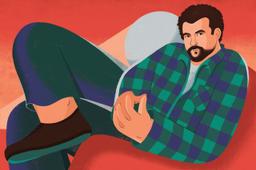
There’s no escaping me. You know what, all of that was done by choice. Some of it was just that I really did want it to feel like you were getting one of my shows. Even just those fucking illustrations my buddy did where he drew me as some of these characters. I just felt like that was part of what the assignment was this time.
I wanted that sort of voice that I’ve established to be present here, but then also at the same time not be limited by it. The scope of what I’m talking about doesn’t have to be just purely dictated by that. You can have a story about two teenage runaways, and if they seem like they have my voice, you don’t have to suffer through me playing both of them.
There’s a story in the book about a guy who loses his hair and resorts to a very extreme treatment. Now, I admit when I was reading it, I thought of you, and I wondered if your hair was a big part of your identity. What would it be like for you if you lost that?
I’ve been blessed. I still have my hair. I feel grateful for that, but we don’t know. I’m not going to be cocky. We don’t know how long it’s going to stick around for. I could easily be this guy in the story. Stereotypically, [men] think being obsessed with one’s appearance is something feminine, but there’s all sorts of things that men get in their fucking own head about. How they look or their insecurities. People have so many complexes. It just felt like the right place to tell a story about how far somebody would go to fix a perceived thing that maybe isn’t a problem at all.
When you’re writing these scenes, do you reflexively or naturally think, “Oh wow, how could I film this?”
I thought that I would, but I really didn’t. Once I got deeper into these stories, I really did just see them as these stories. Now, that’s not to say that something couldn’t happen with them in the future, but in the process, I really was just sort of embracing this format.
Is it a different feeling launching a book into the world versus a TV show?
It feels calmer. Gemstones is so pedal-to-the-metal that, usually, when it comes out, I’m still finishing the show and I haven’t slept in a year, and I’m so exhausted and scared and damaged that I’m just like, “Get this thing out of here. Let me get some rest.”
But this has been a very quiet experience. You’re doing it on your own. You’re fucking communicating with the editor through email. There’s nobody yelling. There’s no ticking time. Everything has just been very chill. It doesn’t have the usual noise that’s surrounding something coming out, and I kind of like it. It feels like it’s better for my soul.
I just think a lot of my opinions about what it was to be a man or what it was to be in the world were influenced by movies, and I didn’t really get at the time when I was a kid that those were just movies.
Is this the most distilled version of your voice, you think?
I don’t know. I mean, I feel like all the stuff I’ve done, I’ve put in the same amount of energy and kind of made sure that my taste and my point of view was present in all of it.
I guess at the end of the day, there was less interference on this than the other stuff. And maybe people will read it and be like, “We need that interference, man. Don’t be doing this shit again.” We’ll see.
This interview was edited for clarity.