
On the morning of May 9, the Chicago Cubs seemed unconquerable. They were riding their second 10-game winning streak of the young season. They boasted the best record in the National League (tied for the best in the majors). They led the NL Central—a division then composed of five winning teams—by 3.5 games. Everything was coming up Cubs.
A little more than a month later, the NL Central is down to three winning teams—and the Cubs barely belong in that club. At 37-35, they’re in third place, 7.5 games behind the first-place Milwaukee Brewers.
In the intervening time, the Cubs earned the fewest wins in the majors, while the Brewers amassed the most. Just about everything went wrong for the Cubs, who gave their fans whiplash with a historic 10-game losing streak. But among their many flaws was terrible timing. “The confusing part,” said left fielder Ian Happ, “is that we’re still getting guys on base and not finding a way to get guys in.” Entering Sunday, the Cubs had batted .180/.293/.311 (75 wRC+) in more than 300 plate appearances with runners in scoring position over that span, one of the worst marks in the majors. Happ continued, “We don’t want to leave guys on base, but the fact that we’re getting guys on and giving ourselves opportunities, we’re going to cash in on it at some point. And we’ve got to keep believing that.”
The Brewers have no trouble believing that: During the same period, they had batted .273/.364/.437 (123 wRC+) with runners in scoring position, one of the best marks in the majors. That was actually worse than their full-season split with runners in scoring position, which was easily the best in the majors: .284/.382/.449 (131 wRC+). “I think it’s contagious,” says Brewers leading hitting coach Eric Theisen. “Each time we succeed in those situations, they’re good examples that we can … say, ‘Hey, this is a priority, and this is what a guy was able to do.’ And maybe let that guy talk his way through it a little bit. Everybody can learn from it.”
In terms of record and run differential, the unclutch Cubs are getting mogged by the crosstown White Sox. Meanwhile, only the Braves and Dodgers have higher winning percentages than the clutch Brewers’ .623, and only L.A. has a higher run differential than Milwaukee’s plus-112. A dramatic disparity in performance with runners in scoring position helps explain why despite similar overall rate stats (separated by two points of wRC+) and similar offensive parks, the Brewers have outscored the Cubs by 0.79 runs per game.
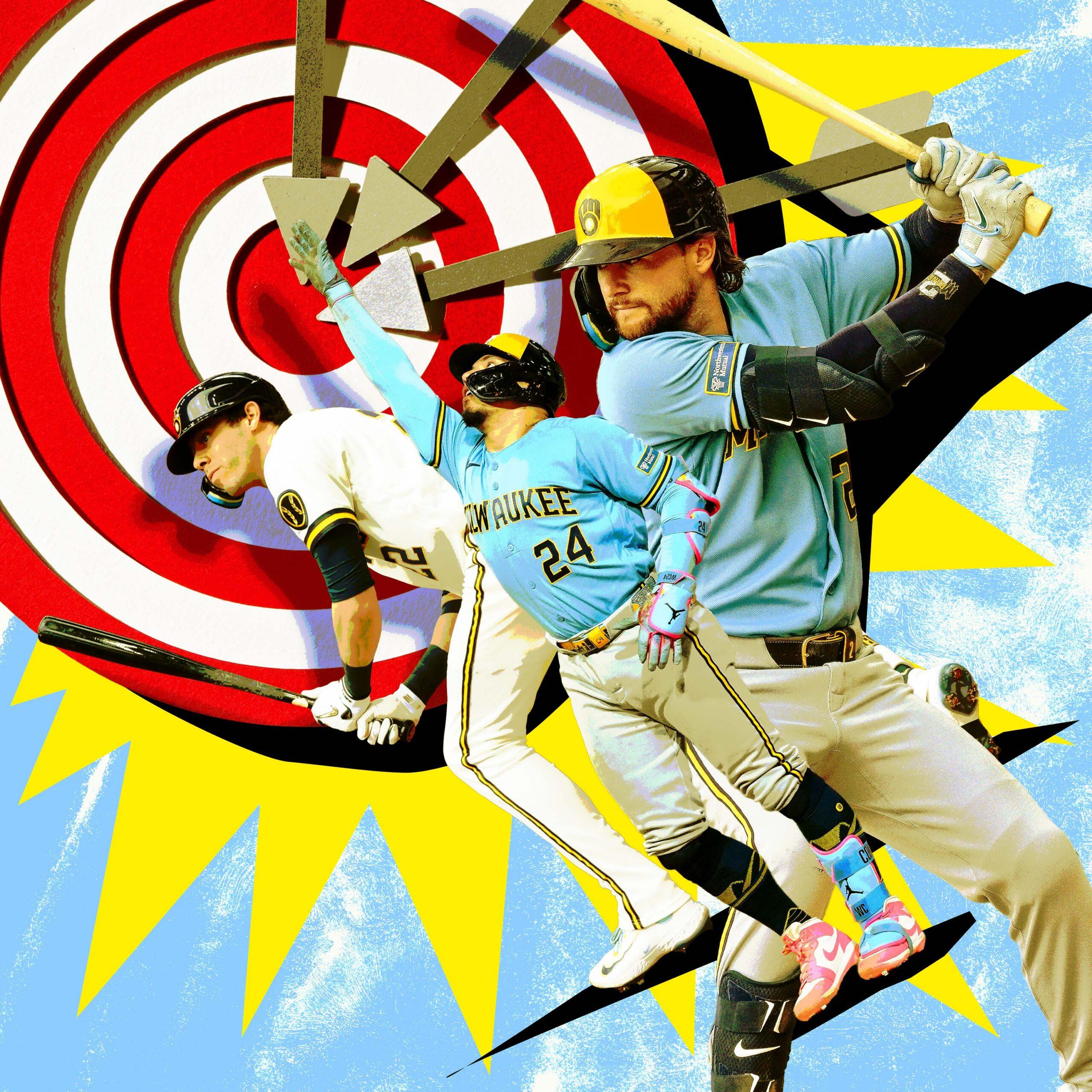
That’s right: The Brewers are at it again. “It” being any number of things: leading the NL Central; defying preseason projections; making much bigger spenders (Cubs included) look lousy by comparison. But also, crucially, coming up clutch—and not for the first, second, or even sixth time. Is it possible that the Brewers have cracked the clutchness code?
“Hitting in leverage spots isn’t a skill over and above hitting,” baseball writer Joe Sheehan asserted last month. “No players, and certainly no teams, have an ability to map their performance to situations. However, performance with runners in scoring position, especially in close games, goes a long way towards winning baseball games.”
Technically, some studies have identified clutch-hitting skill—but typically the magnitude is so small that it takes ages to detect in individual players, and isn’t worth planning around anyway. Thus, the belief that clutch production—however important to a team’s fortunes—isn’t really replicable has been sabermetric dogma since long before Sheehan cofounded Baseball Prospectus three decades ago. (“Is clutch hitting real?” is the greatest thread in the history of baseball forums.) And not without good reason: A 2018 BP study that reinforced that finding observed that “clutch performance for players often swings wildly from one season to the next,” even among many players (such as David Ortiz or Derek Jeter) who cultivated reputations for delivering in huge moments. That’s true at the team level, too: The year-to-year correlation in tOPS+ with runners in scoring position (that is, a team’s OPS with runners in scoring position relative to its overall OPS) is essentially nonexistent (to be precise, .038, on a scale where 0 signifies no correlation and 1 signifies a perfect correlation).
But the Brewers are testing that contention. “Once the momentum starts, it gets contagious, and you can definitely feel it in the dugout,” says offense and strategy coordinator Jason Lane. For Milwaukee, the momentum got going more than six years ago and still hasn’t slowed.
There’s more than one way to quantify clutchness: We could look at “close and late” splits (which are especially prone to sample-size problems), or breakdowns based on leverage (which can be subject to certain biases). Situations with runners in scoring position (that is, on second and/or third base) represent roughly one quarter of all plate appearances, which gives us a sizable sample (even though some PA with runners in scoring position aren’t that important to the team).
The table below shows the Brewers’ year-by-year tOPS+ (an MLB-best 126 this year) with runners in scoring position compared to the MLB average tOPS+ in those situations. (The league as a whole hits well with runners in scoring position, partly because the presence of runners may affect defensive alignments, distract pitchers, and force them to pitch out of the stretch—though they often do that these days even with the bases empty—and partly because worse pitchers tend to get into jams more often, which skews the sample.)
tOPS+ w/RISP, Brewers vs. MLB Avg.
For seven straight seasons starting in 2020—a stretch during which the Brewers have missed the playoffs only once, by one game in 2022—Milwaukee has outhit the league with runners in scoring position. That’s not quite a record for length: The 1915-22 Brooklyn Robins (the future Dodgers), 1958-65 Yankees, and 2008-15 Phillies did it eight years in a row. But those teams surpassed the league by small margins in most seasons, whereas the Brewers have routinely blown the league away. In fact, the 2020-26 Brewers’ tOPS+ with runners in scoring position is easily the highest in MLB history, dating back to 1910. The gap between the Brewers’ figure (119.2) and the second-place 1916-22 Robins’ (116.2) is as big as the gap between those Robins and the 28th-place team.
Highest tOPS+ w/RISP, Seven-Year Span
Granted, not all seven-season spans are created equal: The Brewers played 60 games in 2020 and are up to 69 this year, so those two seasons combined amount to fewer games than one full-length season (or a few more than the 1918 Robins played during a previous pandemic). But the Brewers’ high ranking doesn’t seem like a standard small-sample fluke. Even if we start the clock with the last season in which Brewers batters were below average with runners in scoring position, 2019, Milwaukee’s 2019-25 runners-in-scoring-position production would be the best ever aside from the Robins’ spree of more than a century ago. Among five-season spans, the Brewers’ 2020-24, 2022-26, and 2021-25 marks rank first, second, and fourth all time. And among three-season spans, the Brewers’ 2022-24 and 2021-23 periods rank first and fourth.
Milwaukee’s great timing on offense accounts for a significant portion of the team’s very well-documented tendency to surpass the expectations of public, preseason forecasts. Through Saturday’s games, the 2020-26 Brewers had exceeded their projected win totals, per the FanGraphs depth charts, by a combined total of 47.3 wins, second only to the Dodgers’ 70.6.
The Biggest Preseason-Projection Beaters, 2020-26
Relatedly, the Brewers have scored more runs, relative to estimates derived from their underlying offensive stats, than any other team. The table below lists the biggest offensive overperformers from 2020 through Saturday’s games, according to both BP cofounder Clay Davenport’s Unadjusted Equivalent Runs and FanGraphs’ calculation of BaseRuns. The two methods agree on the same top five teams—and on the Brewers being first by a lot—though they differ slightly on the rest of the order.
Teams That Scored More Runs Than Estimated, 2020-26
The Brewers’ 120-plus-run surplus probably isn’t entirely attributable to performance with runners in scoring position; BaseRuns, for instance, can underestimate the scoring of teams whose runners excel at advancing on balls in play. Then again, the strength of Brewers runners over the past several seasons has been basestealing (second in steals, third in basestealing runs) much more so than advancing on batted balls or staying out of double plays. So the fact that the Brewers rank eighth in runs scored since 2020, with only the 17th-best wRC+ (100, or dead average), owes a fair amount to the way they’ve made their hits count. Only the Dodgers have hit better with runners in scoring position, and for them, raking is pretty par for the course.
Using the sabermetric shorthand that it takes 10 runs to add a win, the Brewers’ ability to score more runs than their baseline offensive metrics would indicate—with a big assist from clutchitude—has resulted in about 12 extra wins since 2020, which explains roughly a quarter of the difference between their projected and actual win totals. The Brewers do a lot of other things well: They’ve been among baseball’s best pitching-and-defense teams (you may have noticed that MLB pitching WAR leader Jacob Misiorowski has achieved escape velocity and stopped allowing runs); they evaluate and develop players well; and, like a lot of perennial contenders, they tend to make (modest) additions at the trade deadline instead of subtracting, a tendency that preseason forecasts don’t try to capture. But clutch hitting has helped fortify the offense, which has otherwise been the Brewers’ bugaboo. Perhaps it’s also helped Milwaukee claim the majors’ best record since 2020 in one-run games, another aspect of team performance that, for most teams, tends to fluctuate from year to year.
It’s quite unlikely for such extreme, persistent success with runners in scoring position to happen by chance. If we fit a normal distribution based on every seven-year span of tOPS+ performance, the 2020-26 Brewers rate as an outlier to the tune of 3.99 standard deviations above the mean, which would imply a roughly 1-in-30,000 probability of their clutchness occurring by chance. Normal distributions can break down a bit at the extremes, so we can also evaluate the unlikelihood of this pattern using a statistical tool called the Gumbel distribution. Instead of quantifying how likely it is that the Brewers would have had a 119.2 tOPS+ over this seven-season span, the Gumbel distribution determines how likely it is that the best seven-year span would be as extreme as the Brewers’. The verdict: There’s a 0.94 percent probability of it being that high by chance, which rises to 1.62 percent if we account for the fact that the league has been a bit better than usual with runners in scoring position lately.
All of which suggests that the Brewers might be doing … something to beat the odds. But what could it be?
The Brewers coaches and front-office officials I spoke to expressed surprise about just how great their batters have been with runners in scoring position. Which is, of course, exactly what they would say if they were perpetrating a grand conspiracy to keep Milwaukee’s clutch secrets safe. If they are, though, they’re good bluffers—and their classified formula is difficult to decode.
The fundamental problem with the notion that clutch performance reflects a special, sustainable skill is this: If some players could will themselves to better performance in clutch situations, why wouldn’t they just will themselves to hit that well all the time? As Theisen says, “Good ball flight is good ball flight regardless of how the defense is positioned, and getting good pitches to hit remains the same regardless of how the defense is positioned.”
We could concoct explanations for why clutch powers would be accessible only at particular times. Maybe it’s more about maintaining one’s normal performance in high-pressure situations, while other players fall apart. (Though the players who truly can’t handle high pressure presumably wash out long before they make the majors.) Maybe clutchness requires extraordinary effort that a player can tap into only in short bursts. Or maybe there’s something about clutch situations that lends itself to certain skill sets. Nate Silver once argued that clutchness is equivalent to “smart situational hitting,” and that a player who had “the ability to adjust his hitting approach in different situations—slapping a single or blasting a home run as the situation required” might be “better able to take advantage of clutch situations as well.” But even he concluded that such a trait would explain only 2 percent of “producing wins at the plate.”
Some research has suggested that power hitters are more likely than non-power hitters to choke in the clutch. Other research hasn’t. Some analysis hints that left-handed and switch-hitters might be at an advantage in the clutch, but the Brewers are only 12th since 2020 in percentage of PA taken by non-righties. Rightly or wrongly, fans tend to trust high-contact hitters in clutch situations. As analyst Tom Tango concluded based on polling of baseball-blog readers, “The Fans have a clear bias as to what they think is clutch: put the g-dd-mn bat on the g-dd-mn ball.” The Brewers haven’t been gifted in the power department of late—they’re 18th in homers and 20th in isolated power dating back to 2020—but despite their reputation for small ball (fifth in bunt hits), they haven’t really been a high-contact team either (18th in strikeout rate over the same span). They do rank third in walk and chase rate; one might imagine that in situations where defenses are extra incentivized to keep balls out of play, they’d be especially resistant to pitchers’ inducements to expand the zone. But there’s no dramatic difference there: Since 2020, they’re ninth and second in whiff rate and chase rate with runners in scoring position, and 12th and third without runners in scoring position.
Further complicating matters is the Brewers’ high turnover during the stretch in question. Only two players (Christian Yelich and Brandon Woodruff) have been with the club throughout this seven-season run, thanks to a well-executed youth movement that has helped the team punch above its payroll. Former president of baseball operations David Stearns and manager Craig Counsell left for other organizations after 2023. Yet when it comes to clutchness, the Brewers haven’t missed a beat.
Lane has been a constant on the club’s coaching staff since the 2016 season—first as an assistant hitting coach, then as a first- (and, later) third-base coach, and, as of this season, as offense and strategy coordinator. Might the key to clutchness be his coaching? “Oh, certainly it’s not that,” Lane says.
His best guess boils down to some amalgamation of all of the above:
It would be the style of offense that we talk about. [Manager Pat Murphy] always speaks about playing offense, not just hitting, and there’s so much that’s involved with that. It’s our ball-strike awareness, meeting the game halfway, taking what the game gives you, and then the pressure we create with the ability to steal a base and also the ability to bunt. Having the ability to bunt tightens up the defense and gives us more holes. Having the threat to steal a base keeps the pitchers on edge [with] divided attention, and maybe rushing at times trying to be quicker to the plate, which in turn hopefully buys us maybe a few more mistakes or better pitches to hit in those situations. And then as an offense, we’ve always tried to preach to the guys, not thinking so much mechanically but really seeing the baseball and attacking it the right way, which opens up the whole field.
If there is some secret clutchness sauce, it may have to do with balls in play. The Brewers’ actual production, as measured by weighted on-base average (wOBA), has been much better with runners in scoring position than without (second in MLB vs. 18th, a gap of 30 points). But the difference in expected weighted on-base average (xwOBA), which is based on exit velocity and vertical launch angle—but not horizontal, or spray, angle—hasn’t been so stark (seventh vs. 20th, a gap of 15 points). It’s not as if the Brewers are crushing the ball with runners in scoring position, but their batted balls are more often falling for hits. With runners in scoring position, they’ve managed an MLB-best .310 batting average on balls in play. Without, their BABIP has ranked 20th, at .288. That’s essentially the whole difference in their performance with and without runners on. And with 9,300 runners-on plate appearances since 2020, there’s ample reason to believe that BABIP boost is real.
“I think a lot of times with other teams, guys maybe are guessing or hoping for what they want instead of what they’re gonna get,” Lane says. “We try to talk about what pitchers do with guys on third base and the infield in, and the general attack and not giving into that, and what their traps are, and try to stay away from their traps. And guys seem to understand it and do the best they can to not fall into that, and make the pitcher beat them a different way than what the report has shown how they get guys.”
To trot out another couple of clichés, the Brewers do seem to “stay within themselves” and avoid “trying to do too much” with runners in scoring position. In an era when the average four-seam fastball is sitting almost 95 mph, aiming batted balls à la “Wee Willie” Keeler is, as Lane says, “not really a thing.” However, he adds, “Using the whole field and the back side of the field definitely is.” And, he notes, “If you attack the ball properly, from the inside half, it opens up the whole field. So if you’re slightly late, you can get an opposite-field hit. If you’re dead on time, you’ll hit it hard through the middle. If you’re a little bit early and you attack the right part of it, it should go in the air to the pull side and give you the best chance of getting a hit foul pole to foul pole.”
Lane and Theisen both preach the virtues of letting the ball travel deep in the zone. “In theory, we want to see the ball maybe a touch longer to be more accurate with our barrel, our eyes, and our hands,” Lane says. “Balls tend to get deeper on us, so they would go the other way. And then, especially on a lower ball flight plan on the back side of the field, there’s less defenders over there. Everyone’s still shifted to the pull side as much as they can without being able to cross over second base, so there’s a lot less coverage on the back side. ... We certainly want guys to pull the ball in the air when it presents itself, but in our experience, guys trying to just pull the ball in the air leads to early decisions, which lead to terrible pitch selection and swing decisions.”
The Brewers and Dodgers are the only two teams this season whose average bat-ball intercept point is behind the front of home plate. And maybe because the Brewers aren’t pull-conscious, they’ve been late on four-seam fastballs and sinkers more frequently than any team except the Pirates. With runners in scoring position, however, they see less heat than they do at other times, and perhaps that helps them get their bats around. With no runners in scoring position, the Brewers have placed 28th in pull percentage since 2020; with runners in scoring position, their rank rises to 14th. And pulled batted balls tend to have a higher BABIP.
Maybe your mind is going to the time-disgraced tradition of sign-stealing. At the peak of the paranoia surrounding electronic sign-stealing at the end of last decade, some smoke (but no fire) made it Milwaukee’s way. But the Brewers’ wOBAs with runners in scoring position are only one point apart at home and on the road, so it’s not as if they’ve done all their raking in the clutch at American Family Field, which could conjure suspicions of some sort of Astros-style banging scheme. Of course, one form of electronic sign-stealing, via the video replay room, was exploited by certain teams both at home and on the road. Regardless, PitchCom has all but eliminated the catcher signals that the Astros and Red Sox illicitly stole several years ago (though some teams now use signs to call pitches from the dugout). “The sign thing's sort of gone away,” Lane says. “There’s no way to do it that way. So it’s sort of pitcher tells and things like that.”
Teams do use legal technology, and their own naked-eye wiles, to pick up on tipped pitches. In some cases, a runner on second can identify a pitch type based on how a pitcher is gripping the ball in his glove, and send a signal to the batter. “We’re certainly trying,” Lane says about legal sign-stealing in general, but he notes that the practice is challenging, and often undependable. Theisen says, “It’s getting more and more difficult. At the end of the day, you've got to be able to hit without knowing what's coming. That's what the game is. That's what hitting is. You can't rely on anything like that. It's not sustainable. … It’s not something that we would point to as a reason for our success, more often than not.” Lane echoes, “I wouldn’t say our success is based on that.”
Which, again, is what someone might say if they were pitch-tipping savants. Late last month, Cardinals manager Oliver Marmol accused the Brewers of relaying stolen signs from the bench, so this isn’t solely the stuff of fan conspiracies. But the Brewers have hit just as well with a runner only on third as they have with a runner only on second. And if the Brewers were benefiting from knowing what was coming with runners in scoring position, one would expect to see that advantage reflected in their quality of contact or swing decisions, which doesn’t seem to be the case. As Brewers president of baseball operations and GM Matt Arnold said in response to Marmol’s accusation, “If we were stealing signs, we’d probably have more homers.”
Whatever the explanation(s), the Brewers have laughed in the face of regression. I first remarked on the Brewers’ unparalleled record with runners in scoring position after the 2024 season, and though I fully expected their magic touch to wear off, it’s stubbornly endured. “There’s some sort of sense, you feel like when we do get guys on base, getting the leadoff guy on, getting him to third, that you can feel it start to build, the pressure,” Lane says. “And you can sense the other team’s feeling it, and we’ve been able to capitalize quite a bit.”
Can they keep capitalizing? It’s tough to tell without a definitive explanation of how they’ve done it to date. For what it’s worth, their pitchers haven’t been similarly extraordinary with runners in scoring position; if the Brewers have figured out how to hit in the clutch, they haven’t mastered how to stifle their opponents in the same situations. (Though if you think Misiorowski has been hard to hit overall—.140/.216/.194—check out how he’s pitched when runners have reached scoring position: .095/.188/.119.) And as with Billy Beane in days of old, their shit hasn’t worked in the playoffs; the Brewers have been about equally abysmal at the plate in the playoffs with runners in scoring position (.269 wOBA) and without (.274).
Maybe their newfound star power will prepare them for the playoffs better than their depth-based rosters from former failed runs. But before October, at least, they’ve been beating the odds, even as they’ve cycled in, and assimilated, newly minted Milwaukee bats.
“Some of that can be attributed to an identity as an offense, as a team,” Theisen says. “So when we get new players, they kinda come in, ‘Hey, this is what we expect.’ Standards are high, expectations are high, and I think those high standards and expectations go a long way in what guys expect out of themselves. It’s kind of the culture they walk into.” A culture of clutchness, where examples are set by stalwarts such as Brice Turang, William Contreras, and Yelich, all of whom have hit a good deal better with runners in scoring position over the past few years than they have overall.
Maybe they’re born with it. Maybe it’s Brewers. Lane offers, semi-seriously, “It could just be we have unique players that are very competitive and are clutch.” If so, the Brewers’ rivals—like those skeptical projection systems—are in trouble. Brewers batters have been uniquely clutch, and true uniqueness is copy-proof. Best of luck to the league.
Thanks to Ryan Nelson for research assistance.