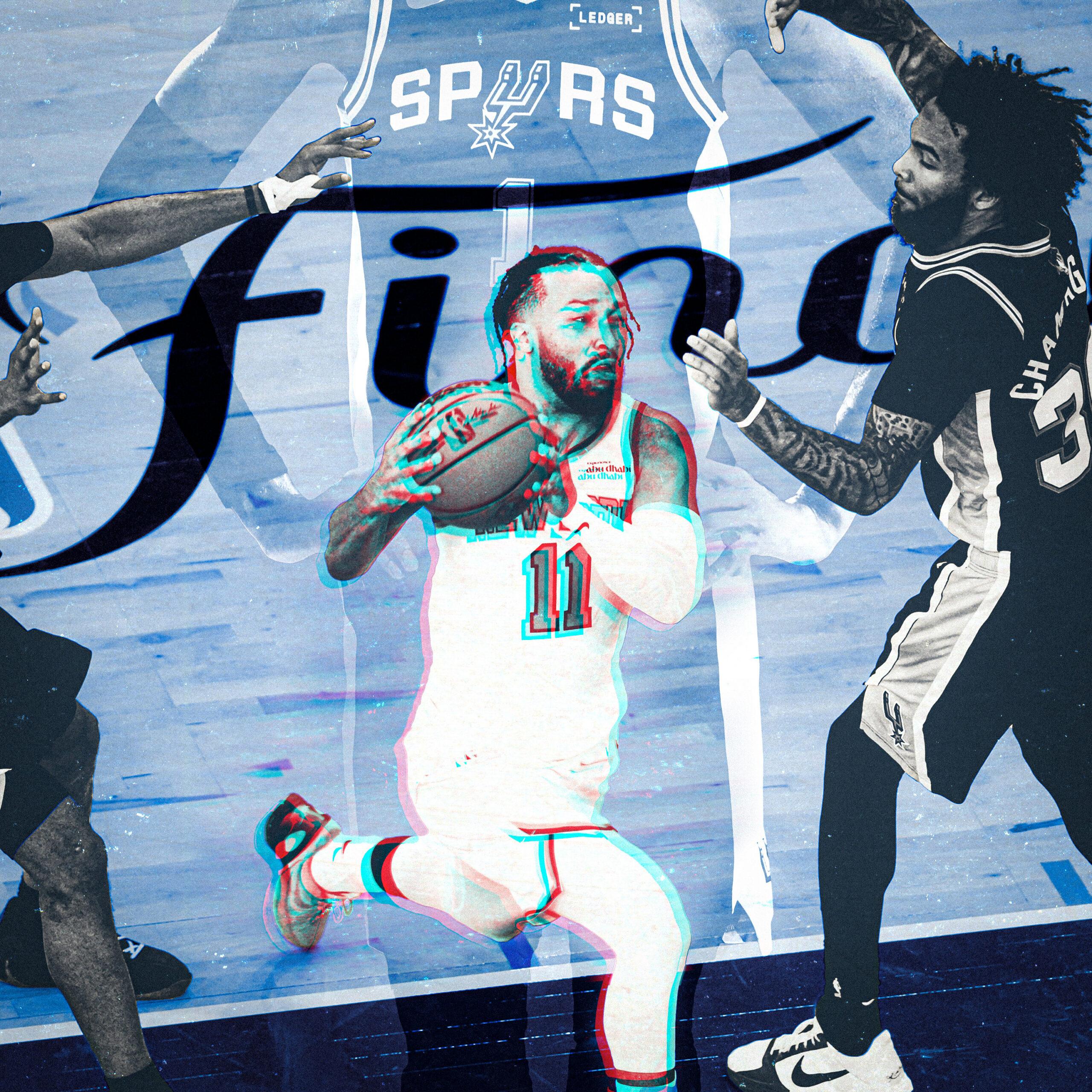

The New York Knicks fumbled a golden opportunity to go up 3-0 in the NBA Finals on Monday night, losing to a San Antonio Spurs team that finally got its offense rolling. A sizable free throw disparity, a 3-point drought in the fourth quarter, and a consistent inability to prevent Victor Wembanyama from finishing many (many) lobs all contributed to the loss. It was close, though.
A grand total of seven points now separate these two teams through three games, with Monday delivering an epic back-and-forth struggle that could’ve easily gone either way. With Game 4 on Wednesday night, New York still has plenty of reasons to feel confident about its chances. It should also feel on edge. Jalen Brunson’s play, both in San Antonio and during extended stretches from the biggest game Madison Square Garden has hosted in a quarter century, help summarize both sides of that coin.
Brunson scored 32 points on 25 shots in Game 3—just shy of sensational. His last bucket was a tough-as-nails 3 over Dylan Harper with 33 seconds left that cut San Antonio’s lead down to one possession. Everyone in the building knew it was going in the second he let it go, because Brunson, more than just about anyone in the league right now, personifies optimism. No deficit is insurmountable when he’s on the court. No defensive game plan can unnerve him. The arena might as well have been empty when he curled around a handoff moments before the shot-clock buzzer went off late in the fourth quarter:
But there were some defects, too. Brunson was at the center of New York’s stagnant offense, committed five turnovers, picked up his fourth foul with 4:29 left in the third quarter, and was repeatedly targeted by Spurs guards who were able to exploit the undersized Knick in a variety of ways. The Knicks finished minus-9 with Brunson on the court and were plus-5 when he sat. I’m not a big believer in any individual game’s plus/minus. But for the entire Finals, New York’s offense and defense are significantly better without the team’s top player, and the Knicks are getting outscored when he’s in the game. Brunson has 13 assists and 13 turnovers. Not ideal.



The Spurs were more urgent about repeatedly putting him in actions. Sometimes he did a good job hedging and recovering back to his man. And other times, De’Aaron Fox, Stephon Castle, Keldon Johnson, or Harper made him pay:
The defensive issues will always be there. New York has obviously found ways to mitigate them, often with help from an opponent that either loses the plot or doesn’t want to infect its attack with tunnel vision. The Spurs didn’t care about any of that in Game 3. Making Brunson play defense was clearly a meaningful part of their game plan:
On the other end, Brunson definitely wasn’t the only reason New York’s offense stalled at inopportune times, but there were several plays when he pounded the air out of the ball and either took a tough shot late in the clock or turned it over.
A defense as disciplined, long, and physical as San Antonio’s will make you do things you don’t want to do. Beating the Spurs requires a ton of movement, snappy passes, and purposeful screens. Cuts must be hard and well timed. When none of that happens—that is, when Brunson dribbles up the floor and doesn’t pass the ball—San Antonio’s job is infinitely less complicated.
“We were about as stagnant as I’ve seen us all year. … We just wanted to stand and watch one guy dribble a ton,” Knicks coach Mike Brown said. “We were just coming down and just basically playing drag. We’d get the first screen, and then we literally just stood and watched. There was no movement … they are junking the game up by just putting Vic in one of the two corners. So if they junk the game up, I can call a play. But sometimes you’re going to have to just move and cut and pass the ball quicker and drive the ball quicker, because it’s almost a zone that they are in to a certain degree, and we didn’t do a good job of attacking it.”
Going forward, the Knicks can’t rely on a white-hot shooting performance from Brunson, and they technically don’t need one to win in this series (as they showed in Game 2). That’s life against Wembanyama. Everything is tougher than it otherwise would be:
But missed jumpers are harder to swallow when they blend in with some rough defense, costly turnovers, and possessions that don’t involve anyone else.
New York’s offense will try to move faster in Game 4. It’ll likely shift more playmaking responsibilities to Karl-Anthony Towns and Mikal Bridges while working in Brunson more off the ball. This team needs his production, but the Knicks shine when it comes unforced, within the flow of a more evenly calibrated attack. So many of their most successful offensive possessions in Game 3 saw the ball ping around San Antonio’s rotating defense before someone hit a late-clock 3.
To be clear, this review isn’t a 50/50 proposition. Brunson is New York’s best player, a singular source of confidence with a brilliantly irrepressible jump shot. He’s unflustered in crunch time and regularly drills contested shots from crude angles. On his best days, in his finest moments, no game plan can disrupt his rhythm.
But in these Finals, his high-usage attack has, at times, played right into San Antonio’s hands. That’s kind of what this stage is all about: discomfort, self-discovery, adaptation. Brunson’s job will not be any less taxing the rest of the way. He’s getting mauled by a pack of strong safeties who spring into action knowing the most secure safety blanket in NBA history has their back.
Success doesn’t come easy; the road to claiming basketball’s ultimate prize is no exception. But hardship is Brunson’s happy place. He thrives taking a beating and makes the impossible look routine. If anyone alive is suited to overcome the various challenges these Spurs present, it’s him.