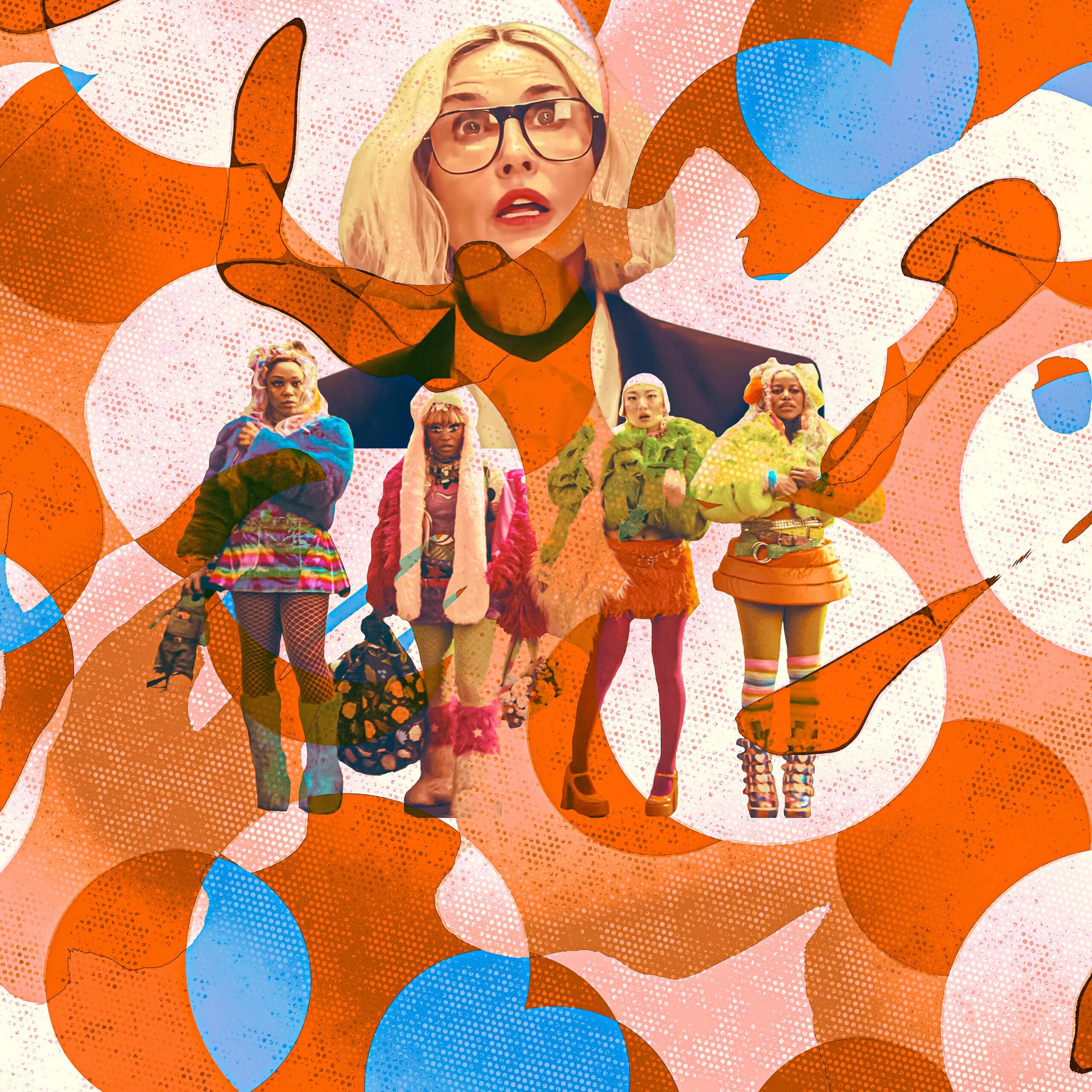
The plot of Boots Riley’s characteristically chaotic new comedy, I Love Boosters, pivots on its heroines’ acquisition of a sci-fi-style MacGuffin called a “magic bag,” which materializes in the Bay Area by way of a Chinese sweatshop as part of a larger international scheme to do an end-around global shipping costs. It proves useful indeed for aspiring designer turned five-finger-discount specialist Corvette (Keke Palmer) and her Velvet Gang confederates as they set out to humble the arrogant fast-fashion magnate Christie Smith (Demi Moore), who knows that her wares command a good price on the black market and takes pride in the thieves’ unconventional form of patronage.
"The boosters take my clothes because they're low-class urban bitches,” says Moore’s haughty haute couture–monger; shoplifting, it would seem, is the sincerest form of flattery. But is it activism? The Velvet Gang likes to think so, or at least that’s what they tell themselves whenever necessary. “I call it FFF: fashion-forward filanthropy,” proclaims Mariah (Taylour Paige), who, along with single mom Sade (Naomi Ackie), is a charter member of the group. “I know how to spell ‘philanthropy,’” Mariah adds. “Branding, though.”
Speaking of which: It’s instructive to contrast the tangy, spiked genre cocktail of I Love Boosters with the aspartame-sweetened Diet Coke sponcon of The Devil Wears Prada 2, currently $500 million and change into its worldwide box office run. Both are satirical comedies that attempt to take the social and aesthetic dimensions of clothing—and the realities of fashion-industry production—as seriously as possible. Where one raises the specter of underpaid labor to briefly make Meryl Streep sweat, the other proposes a Chinese sweatshop as a potential locus of resistance. The difference is not just style but substance, the disparity between a crowd-pleaser that’s content to keep up appearances—to rail politely against the encroaching enshittification of all things—and a vibrant, opinionated piece of pop agitprop that wears its politics, and its heart, on its flared Day-Glo sleeves.
I Love Boosters opens with the Velvet Gang as media darlings; they're planning a big-time inside job, securing low-paying gigs at one of Smith’s Metro Designer superstores (where their wages are garnished to pay for off-the-rack uniforms) to more efficiently make off with the merchandise. This scheme gets upended—and then abetted—by the arrival of an interloper, Jianhu (Poppy Liu), who has brought the magic bag with her for reasons of her own. As it turns out, the machine can be used not simply to transport objects, but to transform them as well. Depending on the setting, it functions as either a “situational accelerator”—zapping its target with enough energy to transform it temporarily into a heightened, hyperbolic version of itself—or a “deconstructor,” which entails reducing its subject to its barest essence (i.e., briefly replacing a person caught in the crossfire with their own parents, pounding away naked together at the moment of conception).
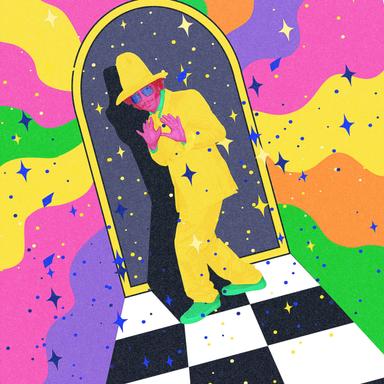
The latter is a great R-rated sight gag, and Riley is the sort of shock tactician who tries to set his phasers to stun at all times. He’s a brash, flamboyant iconoclast whose polarizing reputation and neo-bohemian fashion sense—and evident fixation on social media name searching—precede him like parade floats. Ditto his political commitments: A recent profile in The New Yorker described the 55-year-old rapper turned filmmaker aptly enough as a “Marx brother,” and the allusion works equally well to evoke Groucho or Karl, whose sensibilities converge in his work under the sign of Black radicalism. (On a recent visit to the Criterion Closet, he selected box sets of films by Ousmane Sembène and Melvin Van Peebles; I would have bet anything on him taking The Battle of Algiers, but maybe he owned it already.)
Riley’s staunchly prolabor proclamations make for an instructive contrast with a large contingent of cosplaying Hollywood activists; they also inflect his artistic output across multiple platforms, from music to film to prestige television. Back in the early ’90s, his Oakland-based rap collective, the Coup, tossed off sardonic allusions to Saturday Night Live (“Kill My Landlord”) and Doggystyle (“Genocide and Juice”) in the service of leftist agitprop. On 2001’s Party Music, Riley flipped the lyrical conceit of a well-loved boomer classic—Paul Simon’s “50 Ways to Leave Your Lover”—into a tongue-in-cheek(ish) revenge fantasy against the 1 percent: “We’ve got five million ways to kill a CEO.” “A stomach-turning example of anti-Americanism disguised as highbrow intellectual expression" was the verdict of Fox commentator Michelle Malkin; Riley liked the review so much that he says he put it at the top of his bio.
Riley’s fluency in the lingua franca of pop culture is real, and so is his determination to use that syntax to speak truth to power. 2018’s Sorry to Bother You was, like its Trump-era spiritual siblings Get Out and Atlanta, a wily and stylized exercise in horror comedy concerned with brutal euphemism and rituals of code-switching featuring Lakeith Stanfield. Its title slyly italicized its maker’s gadfly-in-the-ointment persona; the phrase proffered a knowingly false apology for a film that unfolded as a withering critique of corporatized slave labor. “They're turning human beings into monstrosities, and nobody gives a fuck,” exclaims Stanfield’s disarmed class warrior Cash after stumbling across a servile cohort of genetically modified, half-human, half-horse “equisapiens” chained up in his boss’s headquarters, a grotesque twist that placed Riley’s debut in conversation with Jonathan Swift.
There was a similar magical-realist tinge to Riley’s 2023 Prime Video miniseries, I’m a Virgo, about a 13-foot-tall teenager named Cootie (Jharrel Jerome) whose size makes him a conversation piece—and a rallying point for activists and organizers in an alternate-reality Oakland patrolled by superheroes. “It started with the contradiction: What ripples does being a giant Black man cause in the world that we know?” Riley told Vulture. “In the show, [Cootie] kind of becomes the villain. There are people cheering him on and people who are not, and that’s what happens in real life. We watch shows about bank robberies and we love them because we know who’s the bad guy in that, and it’s not the characters robbing the banks.”
The magic bag in I Love Boosters exists on the same uncanny continuum as Cootie’s gigantism and the equisapiens’ interspecies engineering; its existence emblematizes Riley’s modest proposal in his sophomore follow-up. The goal here seems to be leveraging the aesthetics of acceleration, in the form of even more outrageously stylized sets and special effects, against the principles of deconstruction, to send a distaff heist thriller premise à la Set It Off or Widows spiraling vertiginously over the top while breaking it down into its component parts. What’s at stake in the process is whether one of America’s most dialectically minded filmmakers can wrangle, if not fully reconcile, the tonal and stylistic contradictions of surrealism and social realism—and, for an even higher degree of difficulty, those of mainstream commercial filmmaking at large.
Riley’s desire to have his cake and also consume it ethically has predictably invited scrutiny by purity testers. Such turnabout is fair play for a filmmaker unafraid to criticize his peers for their perceived compromises—as in his attack on Spike Lee circa BlacKkKlansman—yet willing to put other people’s money where his mouth is. After I Love Boosters bowed at South by Southwest, Riley spent several days in his mentions waging one battle after another about the fact that I Love Boosters was financed with the help of Megan Ellison—daughter of Oracle founder and Trump associate and apparatchik Larry, although also a black sheep in contrast to the rest of her family, ideologically speaking. “Wonder if this person knows how capitalism works,” Riley quote-tweeted one of his critics, a gotcha moment even if it wasn’t necessarily clear who was being trapped by that bit of rhetoric.
Cue the “We Should Improve Society Somewhat” memes, and if I Love Boosters has a thesis, it’s that things can indeed get better, if only because they’re already probably worse than they look. One of Riley’s gifts as a director is to locate—and accentuate—the dystopian within the quotidian, and the cinematography by Natasha Braier is almost hyperbolically glossy, even as its protagonists occupy the lower rungs of the local socioeconomic ladder. Corvette and Mariah are both broke and squatting in a disused fried-chicken shop, while Sade tries to earn cash via a comically disingenuous pyramid scheme fronted by a phony motivational speaker (a prosthetically altered, unrecognizable Don Cheadle). Their struggle for upward mobility is visualized via the Terry Gilliam–ish production design of Christie’s office, which exists at a 45-degree tilt. The anxious, tactile metaphors extend also to the giant ball of bills and parking tickets that keeps materializing out of thin air to chase Corvette like she’s Harrison Ford in the opening of Raiders of the Lost Ark.
The vibes are bad, but the tone—crucially—is buoyant, with Palmer serving as a sort of human flotation device; she flails away gracefully with the aplomb of a great physical comedian. Riley’s dialogue is hit-and-miss, and he doesn’t exactly sketch detailed characters—he’s more of a cartoonist than a dramatist, and the protagonists all mostly stay in their respective lanes. His actors are all on the right wavelength, though, with Moore doing a villainous victory lap around her comeback role in The Substance and Eiza González leaning into her expository monologues as the most class conscious of the conspirators. Stanfield also pops up cameo-style as a distractingly handsome activist whose eyes seem to hold Corvette in hypnotic thrall. (The reveal behind his powers is not worth spoiling here; suffice it to say that the punch line sees Sinners’ centerpiece sex sequence and raises it.)
The question of whether Riley piles on these and other slightly epic bacon–flavored absurdities—skinless, gun-wielding stop-motion influencer ghouls; flagrantly miniaturized car chases—as a means of smoothing over his militant themes or intelligently stratifying his analysis is worth asking. Are the carnivalesque aesthetics on display purely expressive or a case of calculated auteur branding? It’s telling, perhaps, that the dominant visual motif in I Love Boosters, a movie bursting at the seams with striking sets, costumes, and props, is that of artificial surfaces being stripped away—occasionally down to the bone, as if Riley were reassuring us that he’s still a confrontational, counterpunching provocateur beneath his relatively luxurious resources. This is one of the most expensive films ever produced by Neon, with a cost estimated around $20 million; to paraphrase the old saying, you have to spend money to make a movie about how some things are more important than making money. Riley knows how capitalism works, and if he’s not equipped to dismantle the system he’s working within—that’d take an actual magic bag—he’s used his tools to suture the seams between escapist fantasy and stand-your-ground solidarity as snugly as he can.