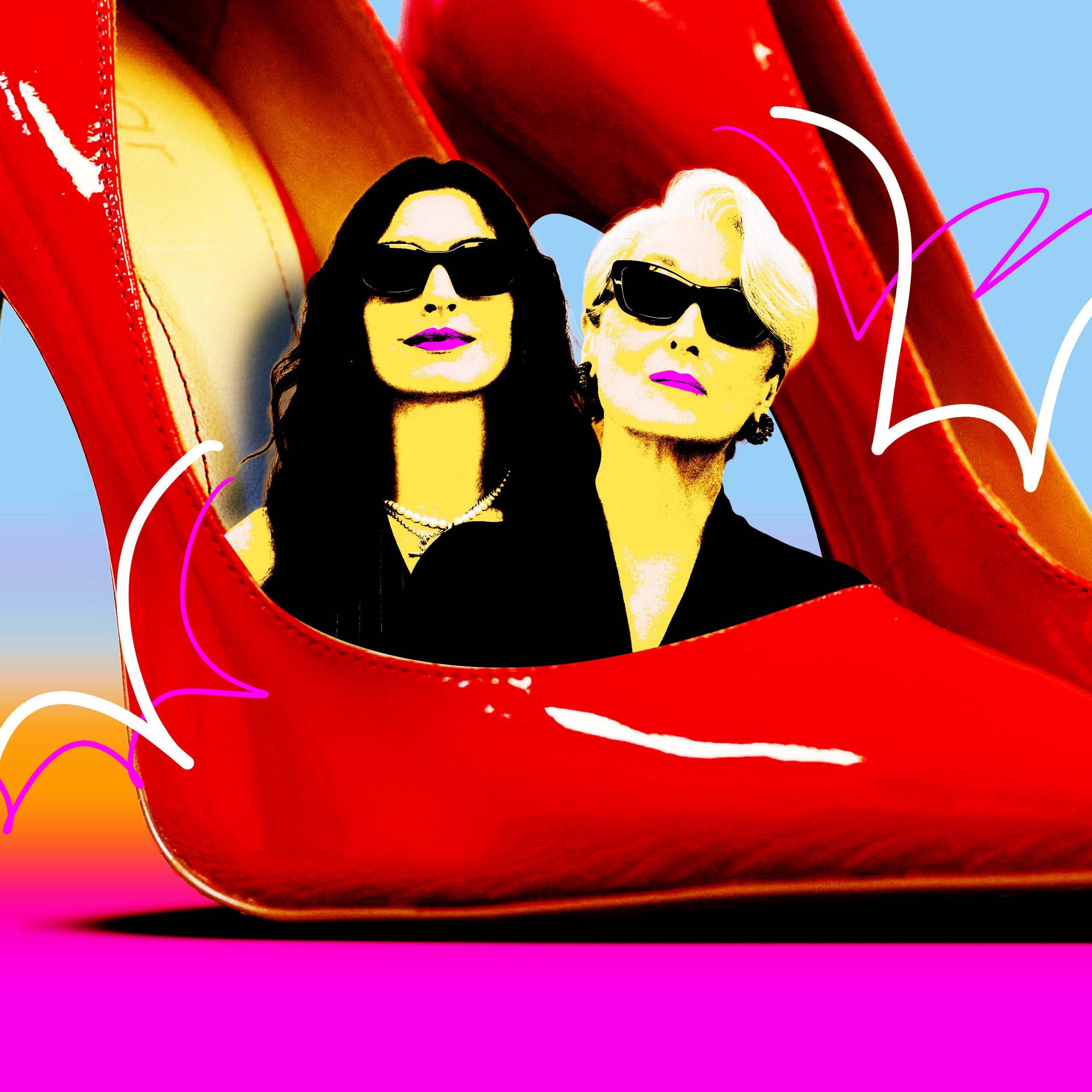

In The Devil Wears Prada 2, we catch up with Andy Sachs (Anne Hathaway) while she’s on her way to the podium to accept an award for her work as an investigative journalist at a respected print magazine. It’s a gig she’s apparently been killing since lobbing her cellphone into the Fontaines de la Concorde at the conclusion of the 2006 original, a gesture signaling her emancipation from her Horrible Boss Miranda Priestly (Meryl Streep). Now Andy’s iPhone is blowing up, but not with messages of congratulations. Rather, it’s a notification that she’s been fired, along with the rest of her lead-chasing, beer-swilling, word-slinging colleagues at the New York Vanguard. Apparently, the publication’s new ownership has found a way to put a price on journalistic excellence; they just refuse to pay it.
“The early scenes of The Devil Wears Prada 2 appear to have been designed in a lab to make critics and journalists break out in stress hives,” writes Bilge Ebiri in Vulture, and there’s no denying that David Frankel’s film—scripted, like its predecessor, by Aline Brosh McKenna—has its finger on an anxious pulse. The story unfolds against a backdrop of cutbacks, belt-tightening, and literal and figurative renovations; there’s an entire subplot about the process—and philosophy—of repurposing historical buildings into chic condo units. Judging by the sheer number of righteous speeches woven into the action, The Devil Wears Prada 2 means to be a modern parable about the encroaching enshittification of all things, a call to honor ancient standards of beauty and craftsmanship dating back to the Renaissance, a tribute to skulking around industriously under the noses of corporate overlords and humbling track-suited tech bros in need of a glow-up.
The images tell a different story, though. They suggest that what The Devil Wears Prada 2 really is is a movie about Diet Coke.
You could make a pretty good drinking game out of forcing viewers to take a sip of something every time the camera spies a can of Diet Coke during The Devil Wears Prada 2; if the players were actually sucking down Diet Coke, they’d be experiencing kidney failure long before Donatella Versace and Lady Gaga show up. (Sadly not in the same scene, which would have been pretty funny.) There are silver cans of the stuff stowed everywhere around the offices of the legendary New York–based fashion magazine Runway, where Miranda remains 20 years later, entrenched in her role as editor in chief and imperial-grade tastemaker, and to which Andy has returned as a features editor after her impassioned acceptance speech about ethics and independence goes viral.
The omnipresence of a beverage not usually associated with speaking truth to power is intentional and, as the film’s own story suggests, grimly inevitable as well. It’s part of a larger activation tie-in campaign featuring such reliable high-end items as Samsung, Starbucks, and Kendall Jenner (a pretty good get, considering her widely publicized allegiance to the political efficacy and delicious flavor of Diet Pepsi). To Streep’s great speech in The Devil Wears Prada—the one about how Hathaway’s cerulean-blue sweater “represents millions of dollars of countless jobs”—we can now add the Instagram Reel advertising the “Canny Pack,” a silver clutch designed to conceal refreshments from your office’s resident Miranda Priestly. “This bespoke leather pack ensures your Diet Coke break is always chic,” it reads. “In today’s world, taking a break is the most stylish thing you can do.”
So much for vigilance: Let’s take a break, and maybe teach the world to sing in perfect harmony while we’re at it. There is, or should be, a perceptible difference between deploying logos and celebrities as signifiers of authenticity and showcasing sponsors as stars in their own right; last year, F1 blurred those lines all the way to a Best Picture nomination. The Devil Wears Prada 2 is a wittier and better-engineered movie than F1, yet for all the intelligence bristling around its edges about the shifting vicissitudes of high-end fashion and the present-tense struggles of print and digital media—subjects at least as relevant for a mainstream Hollywood movie as cars that vroom really fast—it’s frustratingly myopic about its own operations. It’s as if the filmmakers are trying to have their Diet Coke and gulp it, too.
To paraphrase a world-famous soft drink connoisseur, it’s unlikely that most viewers will care enough about the implicit contradictions of The Devil Wears Prada 2’s tongue-in-cheek brand building to stop drinking that garbage. Not when it goes down so easily and hits its desirably artificially sweet spots along the way. That smoothness and palatability is mainly a matter of alchemical casting and ensemble acting: not just Hathaway and Streep but also Stanley Tucci and Emily Blunt, who both return as, respectively, Runway’s long-tenured, perpetually loin-girded art director Nigel and Andy’s posh frenemy Emily. Nigel, it seems, hasn’t moved an inch in two decades, toiling away dutifully in Miranda’s shadow; Emily, meanwhile, has been installed at Dior, where she’s cultivated an above-it-all persona not dissimilar to the one Miranda used to lord over her in the old days. The scene where the quartet first reunites, with Emily threatening to pull her company’s advertising from Runway, is a miniature master class of passive-aggressive interplay—a reminder of the mild but real pleasure of unapologetically glossy comedy.
It’s a testament to Hathaway’s skill set that she can come off as equally credible as the ethereal, quasi-Gaga pop star of David Lowery’s Mother Mary—a movie with a fair amount of The Devil Wears Prada in it, combined with Phantom Thread, Persona, and The Moment—and as the perennially awkward Andy. The character’s ostensibly increased poise and confidence after two decades in the trenches are a point that Brosh McKenna’s screenplay keeps poking, over and over. It does this to set up the joke—a good one—that our heroine more or less reverts to doormat status the moment she’s in Miranda’s presence; she still craves the wicked stepmother’s validation. “Stockholm called—they want their syndrome back,” snarks Andy’s skeptical book-agent pal (Rachel Bloom, who worked closely with McKenna on the great, underrated musical sitcom Crazy Ex-Girlfriend).
It’s hard to play second fiddle to a symphony, of course. “Truth is, nobody can do what I do,” said Miranda in The Devil Wears Prada, a line that made sense in the context of both the character’s Anna Wintour–esque haughteur—the Vogue honcho having been the obvious model for Lauren Weisberger’s source novel—and Streep’s position as her own craft’s reigning GOAT. It’s true that nobody can do what Streep does (except, apparently, James Austin Johnson). Miranda Priestly remains an ace comic creation, like Cruella de Vil sketched by a New Yorker cartoonist (there’s a bit of Clint Eastwood in there, too, apparently). Supposedly, Streep lobbied the filmmakers to lean into Miranda’s monstrosity the first time around, to let it inform her humanity instead of being easily redeemed by it. The memorable scene in the original film in which Miranda accidentally lets her guard down to Andy—barefaced and teary-eyed, surveying a set of divorce papers in sweatpants—worked as well as it did because it was so brief; it suggested nothing less than blood from a stone. Here, though, Miranda has been positioned as a proud relic of a bygone—and, it's implied, better—era; her attempts at political correctness (“There’s a lot of body … positivity,” she says, describing an upcoming crop of models) are played gently, as signs of a sacred monster trying to do the right thing. The ultimate recession indicator: She has to travel in coach, where she gallantly accepts the offer for a free “snack pack.”


Miranda’s vulnerability in an extremely online zeitgeist is signaled by her uncharacteristically having the (cashmere) wool pulled over her eyes by a fast-fashion start-up concealing sweatshop practices. It’s telling of the film’s conflicting imperatives of social commentary and intellectual property maintenance that the emphasis is on the gilded multimillionaire’s shame and humiliation rather than on the exploitation of workers. Another tell: that McKenna—a very funny writer—doesn’t frame Andy’s attempts to use Runway as a platform for earnest social commentary in satirical terms. Rather, she’s painted as an authentic crusader bumping up against shortened attention spans and fighting the good fight along the way. (One essay entered into the CMS seems to be about global warming.) With this in mind, her first on-the-job coup—securing an interview with the world-famous, recently reclusive, and biblically rich designer Sasha Barnes (Lucy Liu)—is treated as if she’s covering the Watergate break-in. Her reward is a visit to the Hamptons, where she rubs shoulders with Tina Brown and Karl-Anthony Towns, whom real-life Knick fan Hathaway seems delighted to be acting against (even if he’s not OG Anonuby).
It’s hard to truly buy into the idea that The Devil Wears Prada 2 is a genuinely bleak or melancholic vision of the end of an era—“kind of like The Leopard, but for fashion magazines,” per Time—when it (lip)glosses over every narrative or philosophical crisis as decorously as possible. For instance: The plot turns on the possibility that Runway will be purchased by glib, nouveau riche billionaires determined to gut its masthead and strip every department for scraps; the choice of villains is apt and au courant. The script’s solution to this dilemma involves surreptitiously maneuvering a different, slightly more benevolent—or oblivious—billionaire to step in with a more hands-off offer. There’s a sliver of truth to this patron ex machina, but also a sense of cynicism masquerading as principle, not to mention gears grinding away. (The prevailing mental image is of an assembly line rather than something lovingly hand-stitched.) Even more mechanical: the aforementioned rehabilitation of Miranda, which feels oddly reminiscent of the later Hannibal Lecter novels and films—a case of excessive and fan-servicing sympathy for the devil. (You’ll recall that Dr. Lecter also prefers to fly first class and smuggles his own gourmet treats aboard.) The final act of The Devil Wears Prada 2 is crammed with noble sacrifices and teary-eyed speeches about the importance of forgiveness; the catfight-slash-catwalk metaphysics of the original have been thoroughly declawed.
“People need to know that there’s a cost,” Miranda tells Andy sagely near the end, effectively signing off on a potential boss-from-hell tell-all written by her protégé. (A book that would be the series’ in-universe equivalent of The Devil Wears Prada.) Miranda is talking about how she’s paid to get where she is—in the back seat of a luxury car in Milan—but once again, Streep’s delivery cuts two ways, underlining the luxurious passivity of a movie where the money is on-screen, suspended weightlessly between satire and supplication to lifestyles-of-the-rich-and-famous fantasies. Things are bad all over, says The Devil Wears Prada 2, but for Andy, Miranda, et al., there’s a silver lining: With God as their witness, they’ll never fly economy again.