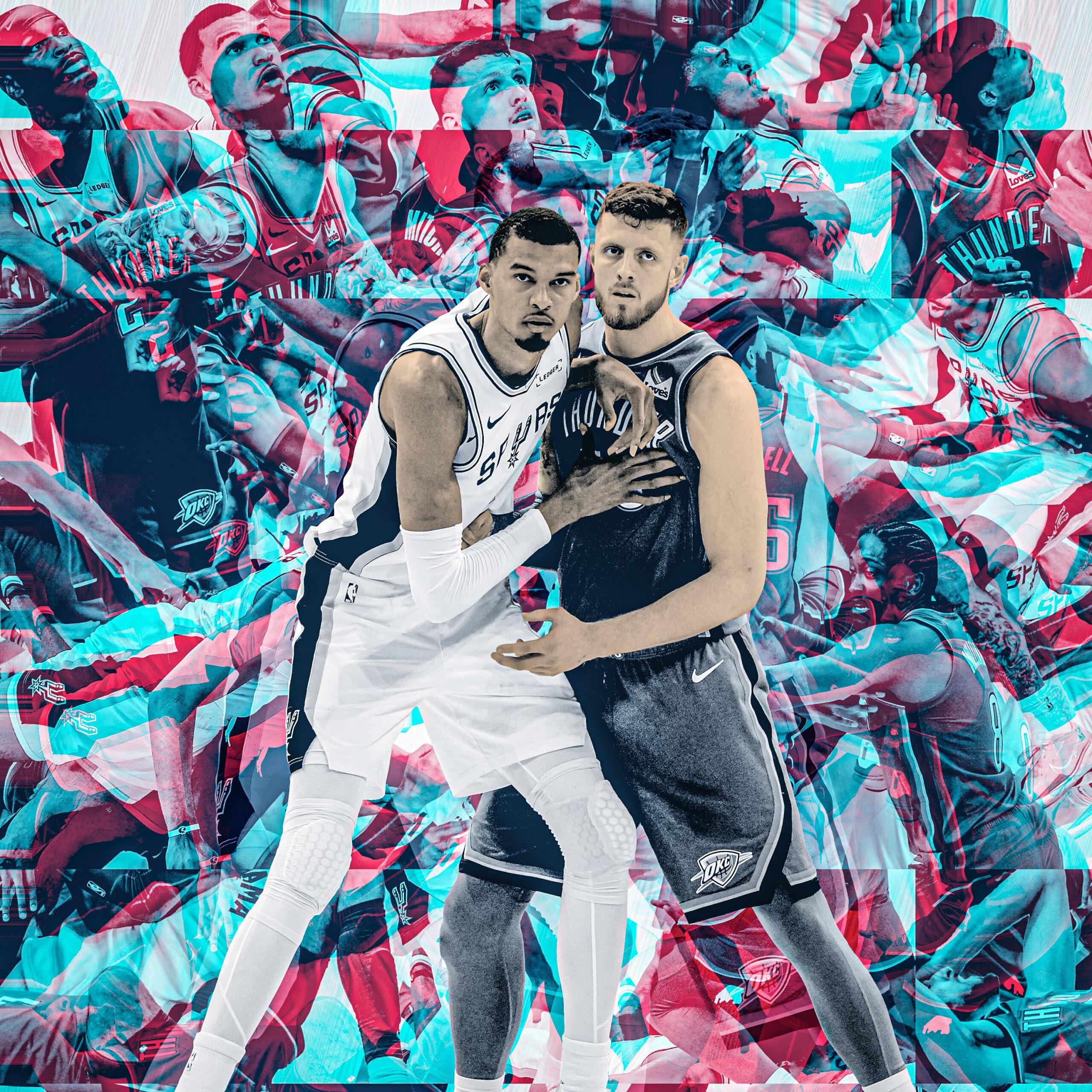

Last summer, Victor Wembanyama and a group of Shaolin monks did a walking meditation, under cover of darkness, up to the cave near the Shaolin monastery where the founder of Zen Buddhism famously sat and stared at a wall for nine years on end. Wemby practiced kung fu at the temple and trained with a Shaolin master to control his preposterously high center of gravity in times of duress. All that training has been put to great use in the postseason, but he might need to train with some sumo wrestlers this summer. If Game 1 was a gleaming transmission from the future of basketball, Game 2 was the pushback—literally. Thunder center Isaiah Hartenstein, who looked unplayable on Monday night, more than doubled his minutes total on Wednesday, introducing the kind of overt physicality and underhanded tactics that coerced Wembanyama into losing his cool and earning an ejection in the previous round.
All’s fair in love and war—which is probably why Hartenstein seemed to take cues from offensive and defensive line play in the NFL, a closer proxy to combat dynamics. On offense, Hartenstein dutifully played his role by fighting for second chances on the glass—he finished with eight offensive rebounds, more than the rest of the Thunder combined—and with Gortat screens to free up OKC’s downhill drivers, much in the way a hook block helps open an outside run play in football. On defense, he latched on to Wemby, hooking and grabbing, pushing and pulling. It was ugly, and a lot of it ought to have been illegal. But this is part of the life cycle of a generational talent. The entire world has to calibrate itself to Victor Wembanyama’s presence. Everyone’s figuring it out in real time.
Game 2, in all its messiness, broke right for OKC, enough for the Thunder to come away with a 122-113 victory to even the series at 1-1. Wednesday night yielded the fruits that come from bending the rules a little just before they’re reinforced. Because for most teams, facing a paradigm-shifting talent who's poised to take over the league means figuring out what you can get away with, figuring out what he can withstand, and figuring out what you can live without.
On the broadcast, Mike Tirico mentioned the Jordan Rules as a parallel to the physicality that Wemby is battling through in these playoffs, but it’s reminded me more of the cottage industry that Shaquille O’Neal created from the late ’90s through the mid-aughts: a decade-long procession of 7-foot mammoths who earned good money on the slim likelihood that they’d develop into usable players, because, at the very least, they were good for six hard fouls on the biggest physical anomaly the league had ever seen. Shout-out to Evan Eschmeyer. Shout-out to Mr. Big Snacks himself, Jerome James.


I’ve thought about what a low-budget Wemby Sentinel might look like. Strong and stout, to maximize leverage against Wembanyama’s high center of gravity; physical, to erase any vertical or horizontal airspace he might be able to create; and with enough idgaf to get banned from playing professional basketball in multiple countries. (Yes, I am describing Ivan Johnson, who Jeff Teague once said was so intimidating that the Atlanta Hawks were too scared to kick him out of the gym the day after he got cut from the team.)
Watch, listen, or scroll long enough, and you’ll come across a common refrain: The basketball being played in Thunder-Spurs is at another level. And part of that is because each team understands the ramifications of this series, now tied at a game apiece in the Western Conference finals, but 5-2 in favor of San Antonio for the season. Who gets to control the future? Which team will the rest of the league spend the next half decade trying to neutralize? There is a palpable intensity that is pushing the Spurs and Thunder to the very edge of competition. Hartenstein’s tactics won them the battle in Game 2, but for all of the outside noise complaining about how the game was played, there were few complaints from the actual competitors in the postgame comments. (Shai Gilgeous-Alexander may have played it off as mishearing the question, but it sure seemed as though he was conflicted about Hartenstein’s actions in his NBC postgame interview with Zora Stephenson.) Perhaps Wemby learned his lesson in the last round; perhaps his threshold for shenanigans and mind games has increased significantly as a result. The series has entered a psychological realm where endurance will prove just as essential as the physical deadlock the two teams find themselves in. Maybe even more so, given the fallout from Wednesday night.
Jalen Williams and Dylan Harper both left Game 2 with lower-body injuries. De’Aaron Fox has yet to play. Ajay Mitchell was hit in the thigh late in the fourth quarter and needed medical assistance. He claimed to be fine after the game, but in any case, attrition is hitting both teams, and it’s affecting some of the most essential supporting players in the series. The Thunder will have to adjust should they be forced to go without J-Dub like they did against the Lakers in the previous series, but that also hinges on Mitchell not losing any of his form while playing through his own bumps and bruises. The task of creating inside-out advantages around the force field that Wemby casts in the paint was already a Herculean one, and it’s about to get a lot harder.
On the other side, the biggest reason the Spurs folded on Wednesday night wasn’t the extralegal grappling on Wembanyama (who still managed to drop a cool 21-17-6-1-4 stat line), but the lack of options against the Thunder’s obscene on-ball pressure. No postseason player in almost 50 years has turned the ball over more often in consecutive games than Stephon Castle, who has been tormented by Cason Wallace because there isn’t really anyone else on the Spurs who has the requisite ballhandling ability. San Antonio was questioned in the summer for entering the season with three on-ball creators before making a resounding argument that having that level of multiplicity on offense is exactly how you challenge OKC’s defensive tidal waves. Now, somehow, it seems as though the Spurs might not have enough creators on the team. A whole lot hinges on Fox’s availability. There was no postgame update on the matter, but Spurs coach Mitch Johnson made it clear that, even if Fox does return to play, it’d be in a compromised state. “He’s just trying to play every day,” Johnson said. “It’s a tough injury that he wouldn’t be playing with in the regular season, so he’s trying to tough it out.”
The pressure and intensity are whittling each team down to its purest essence. The winning path forward may come down to a matter of philosophy. As the number of on-ball creators dwindles on both sides, what becomes more vital: Arguably the greatest scorer of his generation, or a heliocentric defender who might just be the most impactful defender of the modern age? Hartenstein may have engaged in a bit of football in Game 2, but in this 1-1 series heading to San Antonio for Games 3 and 4, the tenets of this clash have shifted closer to those of fútbol, which asks its players what magic they can create when their most skilled instruments—their hands—are taken away. The Thunder and Spurs have built something special in this rivalry of theirs, something we haven’t seen in years. It’s basketball played at the highest caliber, yes, but it’s also a psychodrama burrowing deeper and deeper into the collective basketball consciousness. All’s fair in love and basketball. A great line in a great romance. I think that’s exactly what this series is.