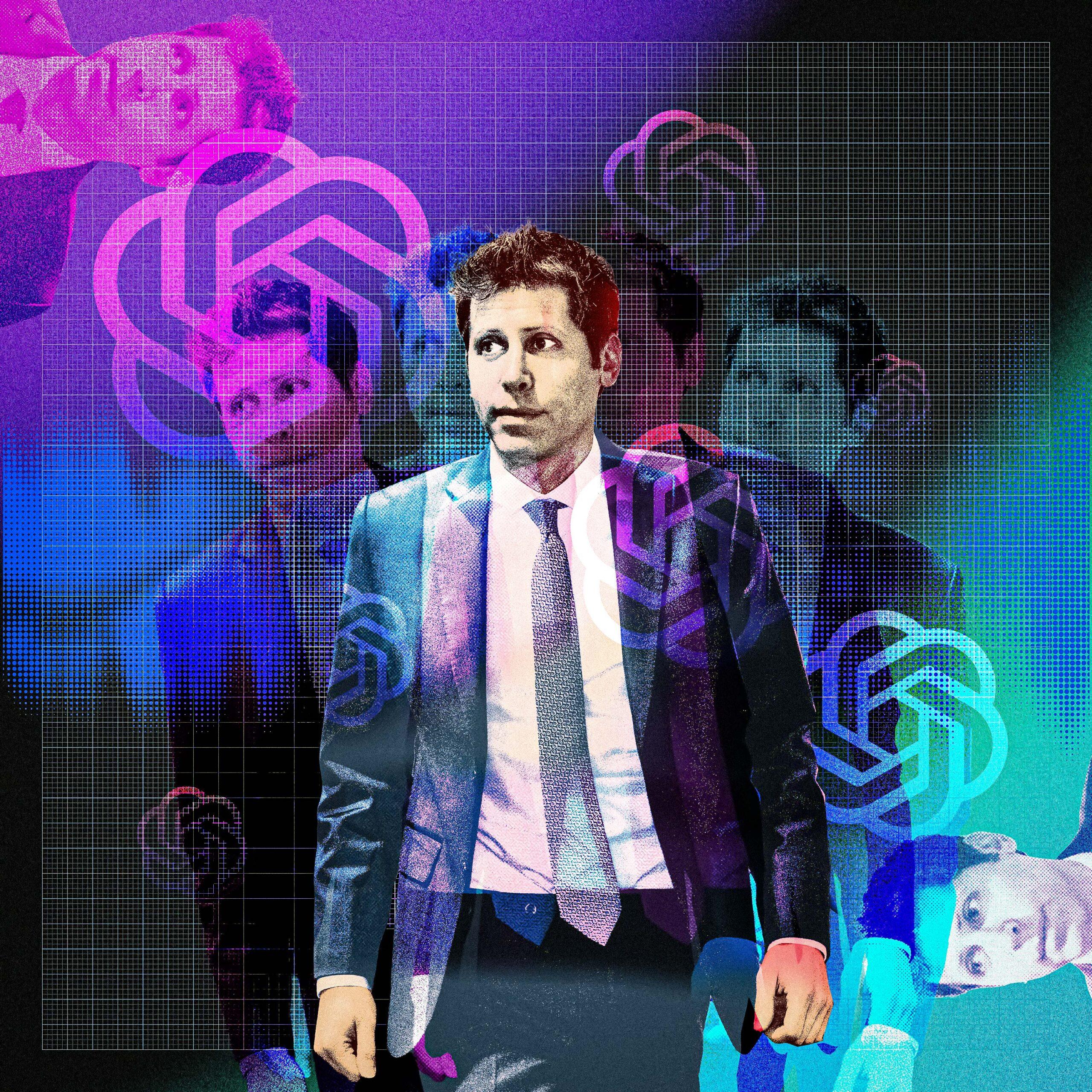

This week, OpenAI cofounder and CEO Sam Altman sat on the witness stand in a federal courtroom in Oakland, California, and reminisced about a night he once had with Elon Musk. The year was 2018, and the dueling visionaries were, fleetingly, getting along. “Unlike a lot of other meetings with Mr. Musk, this was, like, a good-vibes meeting,” Altman told the court with a small smile. Musk “was excited about the progress in the company”—meaning OpenAI, into which Musk had invested tens of millions of dollars. “He was excited about the plans for the fundraiser. And then—this was like, a pretty late-night meeting—it was a long conversation of him showing us memes on his phone.”
Here, the court stenographer interjected, asking Altman whether he could repeat that last part for her transcript.
“Memes … on … his … phone,” Altman enunciated.
Once upon a time, Altman and Musk had teamed up to get OpenAI, an artificial intelligence frontier lab, off the ground. This month, though, they’ve been seeing each other in court. In Elon Musk et al. v. Sam Altman et al., Musk is alleging that Altman (and Greg Brockman, another OpenAI cofounder) corrupted the company’s original nonprofit mission by building up its for-profit enterprise and ultimately enriching themselves. After three weeks of testimony, the jury heard closing arguments on Thursday, and they’ll return Monday to deliberate.
Witnesses called by the defense team over the past few days included Microsoft CEO Satya Nadella, Bret “Forrest Gump of Silicon Valley” Taylor, and an OpenAI chief futurist whom Musk once called a jackass. But the centerpiece of the defense’s case was Altman’s testimony, which sought to paint Musk as self-interested and erratic and Altman as exhausted and wise. Whereas Musk has claimed that Altman “stole a charity” and “bait and switched” Musk for capital infusions, Altman’s narrative was that the company evolved to better compete with the well-resourced big dogs at places like Google’s DeepMind.
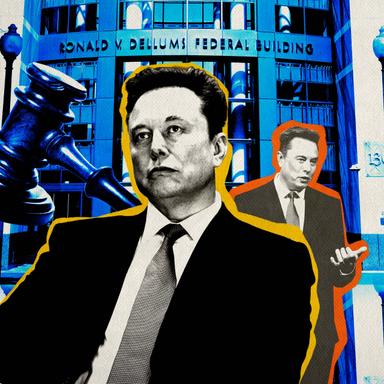
On Tuesday, Altman told the jury another Musk-related story that was decidedly not about a good-vibes meeting. In 2020, a few years after Musk had departed OpenAI, he sent out a social media post denigrating the company—and wounding Altman in the process. So Altman sought outside counsel, so to speak.
“I had gotten some advice from Shivon [Zilis, Musk’s close adviser and co-parent of four of his children] about how to hopefully engage him in a way where he wouldn't bash us on Twitter as much,” Altman said—and again, the court reporter asked him to repeat himself.
“Bash … us … on … Twitter,” Altman reiterated slowly.
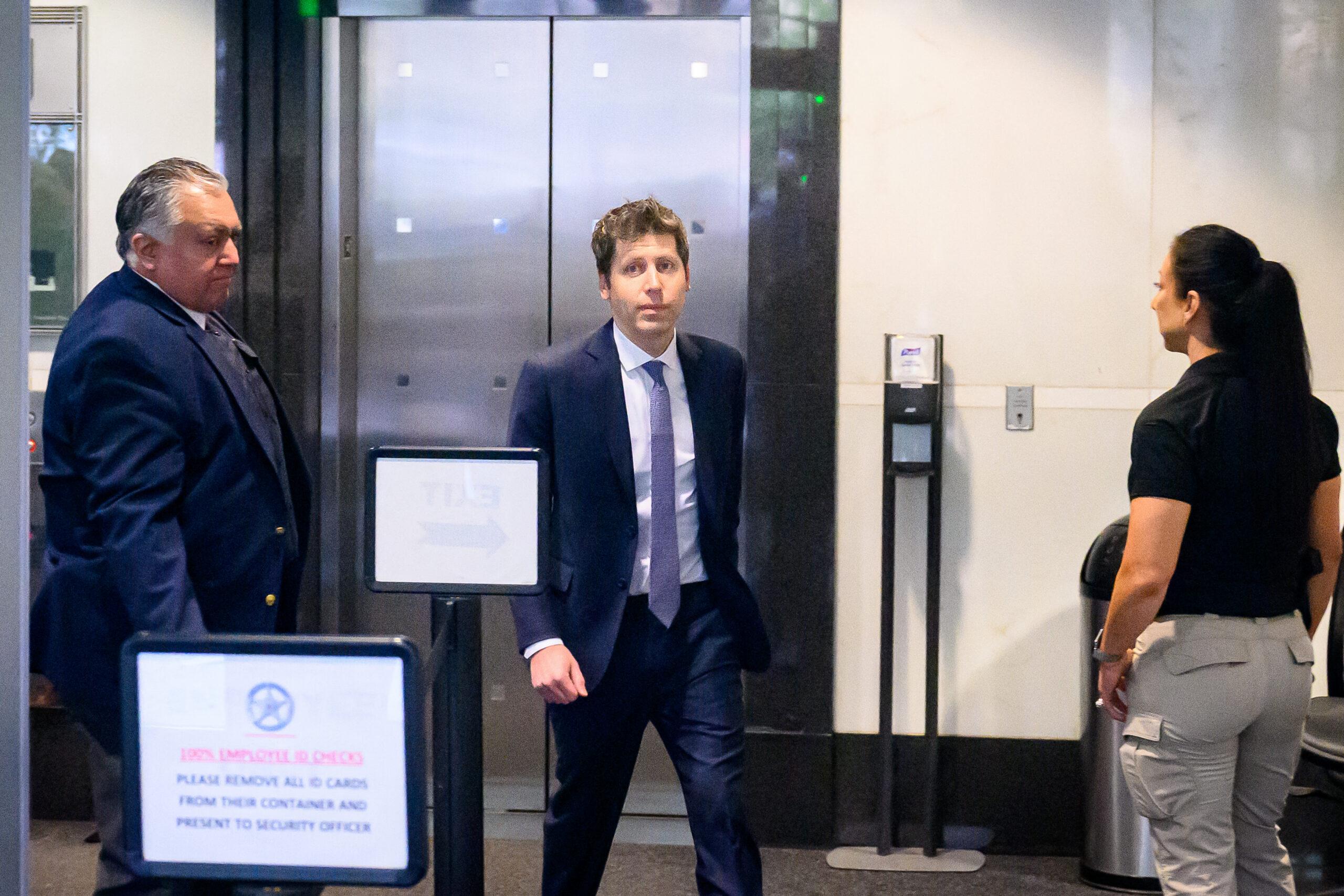
Sam Altman arrives at the federal courthouse in Oakland, California, on May 12
When the jury for Musk v. Altman was selected at the end of April, nearly every person who filled out the juror questionnaire knew of (and had strong opinions about) Musk. By contrast, only a small handful were familiar with Altman. It was not uncommon for a prospective juror to say that yes, they used ChatGPT, but no, they’d never heard Altman’s name.
This was probably good news for Altman, given that many people who do know him—friends, foes, colleagues—say he can’t always be trusted. Even those who have supported or collaborated with Altman in his business endeavors are well aware of his savvy and, when it suits him, his ruthlessness. "You could parachute [Sam] into an island full of cannibals and come back in 5 years and he'd be the king,” wrote Altman’s former Y Combinator compatriot Paul Graham in 2008. (Late last month, as the trial began, Graham tweeted that “Sam is not qualitatively different from other powerful people in SV. I don't think he's less honest than Elon.”) In a recent Ronan Farrow New Yorker article titled “Sam Altman May Control Our Future: Can He Be Trusted?,” a Microsoft executive is quoted as saying: “Small but real chance he’s eventually remembered as a Bernie Madoff- or Sam Bankman-Fried-level scammer.”
By the time Altman testified earlier this week, however, his reputation had started to precede him. For weeks, discussion of Altman’s actions and intentions was a daily happening in court. His own words—“i remain enthusiastic about the non-profit structure!” and “I agree this feels bad”—routinely flashed on TV screens or were read aloud by witnesses. Former OpenAI board member Helen Toner described Altman as someone with “a habit of putting words in other people's mouths to get people where he wanted them to go.” Another board member, Tasha McCauley, said he’d presided over “a toxic culture of lying.”
And several witnesses chatted about the bananas five-day stretch just before Thanksgiving in 2023 when Altman was unceremoniously fired by OpenAI’s board of directors, accused of not being “consistently candid in his communication”—and then, following a counter-mutiny at the company, was hired back by a freshly selected and Altman-friendly new board. (OpenAI employees coined this whole thing “The Blip.”)
Because of Musk’s lawsuit, thousands of text messages and email chains and diary entries and sworn depositions have been entered into the public record for all to see and Control-F to their hearts' content. And one of the evidentiary exhibits from that time period—a series of text messages between Altman and former OpenAI CFO Mira Murati, sent at the height of the uncertain chaos—has become the trial’s dankest meme, its most viral artifact.
“can you indicate directionally good or bad” Altman wrote to Murati in his all-lowercase style during a tense meeting about his fate, which he was not allowed to attend. “satya and others anxious,” he added, referring to Nadella, the Microsoft CEO and Altman ally who had billions of company dollars (and his own reputation) invested in a partnership with OpenAI.
Murati texted back: “Directionally very bad,” she said, and a catchphrase was born.
During his testimony on Tuesday, Altman recalled that rigmarole. “I was in this fog of war,” he said. “I didn’t know what was going on.” Glancing occasionally at the jury, he said he’d fretted that all the uncertainty surrounding OpenAI’s leadership would “cause chaos for a thing that I love very much” and that “everything I had worked so hard to build was going to get destroyed.” He referred to having to “clean up a mess I didn’t make.” He spoke of being confused, angry, annoyed. Still, “I was willing to run back into a burning building to try to save it,” Altman declared. In the courtroom, the plaintiffs played a video clip of Altman on Lex Fridman’s podcast in early 2024, reflecting on The Blip. “As many people have observed,” he said, eyes blazing, “although the board had the legal ability to fire me, in practice, it didn't quite work. And that is its own kind of governance failure.” If you come at the king, as they say, you best not miss.
Back in 1978, a professor of mathematical logic (and professional magician) named Raymond Smullyan published a whimsical book of logic puzzles and thought experiments titled What Is the Name of This Book? In its opening chapter, titled “Was I Fooled?,” the author reminisces on his very own introduction to logic: an exchange with his older brother, Emile, on April Fool’s Day in 1925, when Raymond was 6 years old.
Emile: So, you expected me to fool you, didn’t you?
Raymond: Yes.
Emile: But I didn’t, did I?
Raymond: No.
Emile: But you expected me to, didn’t you?
Raymond: Yes.
Emile: So I fooled you, didn’t I?
One hundred and one years after that conversation, during his testimony in the early days of this trial, Musk told the courtroom: “I was a fool.” He argued that the $38 million he’d put into OpenAI was meant to support a starry-eyed nonprofit that obsessed over its founding mission—“to benefit humanity as a whole, unconstrained by a need to generate financial return”—not a hotshot for-profit behemoth that’s reportedly eyeing a trillion-dollar IPO in late 2026. On Tuesday, Altman countered that he didn’t really understand this line of thinking.
“It feels difficult to even wrap my head around that framing,” Altman said. “As Bret [Taylor] just testified, we created one of the largest charities in the world.” Altman also rattled off a number of stories about his adversary—that Musk once suggested his kids should inherit control over any future superintelligence in the event of his death; that Zilis told Altman if he didn’t remind Musk of conversations, Musk would probably forget them—intended to call Musk’s judgment and reliability into question.
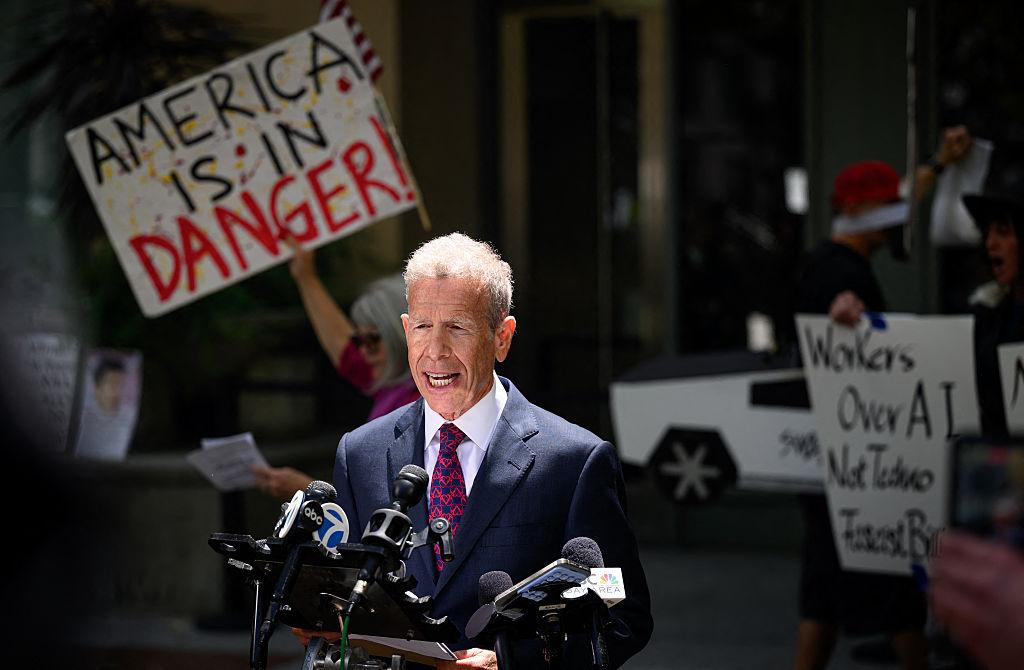
Attorney Marc Toberoff, representing Elon Musk, speaks during a press conference outside the Oakland federal courthouse on May 12
And when Altman’s cross-examination started, it sounded a lot like he was hanging out with Emile and Raymond Smullyan on April Fool’s.
“Good morning, Mr. Altman,” said Steven Molo, Musk’s attorney, before launching into his first line of questions:
MOLO: Are you completely trustworthy?
ALTMAN: I believe so.
MOLO: But you don't know whether you're completely trustworthy?
ALTMAN: I'll just amend my answer to yes.
MOLO: Should the jury believe your testimony?
ALTMAN: I think that's up to them, but I believe so.
MOLO: You believe so, or they should?
ALTMAN: Sir, I’m not gonna tell the jury what to think.
MOLO: Do you always tell the truth?
ALTMAN: I believe I’m a truthful person.
MOLO: That wasn’t my question, sir. Do you always tell the truth?
ALTMAN: I’m sure there is some time in my life when I have not.
And that was just, like, the first minute. (All this talk about telling the truth or not reminded me of another section in What Is the Name of This Book? called “Knights, Knaves and Normals,” which features variations of a classic logic puzzle premise in which knights can only tell the truth, knaves can only lie, and normals sometimes tell the truth and sometimes don’t—an eminently normal thing to do.)
When Musk was on the stand a couple of weeks ago, he behaved a lot like an internet edgelord: provoking lawyers, being pedantic, loudly interrupting. Altman’s demeanor, on the other hand, seemed more like that of a concern troll in some online comment section. He often had a furrowed brow; he’d feign confusion; he attempted to give off “friendly” vibes. This Is Your Li(f)e! I wrote in my notes as Molo ticked through a litany of all the people and institutions over the years that have credibly accused Altman of being deceptive.
OpenAI’s former chief scientist Ilya Sutskever, for example, told the company’s board that Altman was “consistently exhibiting a pattern of lying.” According to Molo, colleagues at Altman’s first aughts-era startup, Loopt, tried twice to boot him for “deceptive behavior.” (I was bummed that no one entered the famous double-collar photo into evidence.) Molo gave so many examples that Judge Yvonne Gonzalez Rogers finally told him that he could stop; he’d made his point.
MOLO: Do you tell lies to advance your business interests?
ALTMAN: N—no.
MOLO: Have you misled people with whom you do business?
ALTMAN: I believe I am an honest and trustworthy businessperson.
MOLO: OK. That wasn't my question about what you believe. My question was, have you misled people with whom you do business?
ALTMAN: I do not think so.
MOLO: Would they think so?
ALTMAN: I can’t answer that for other people.
Shivon Zilis, former board member of OpenAI, exits the federal court in Oakland on May 6
When the trial first started, Judge Gonzalez Rogers explained to the freshly seated jury that believing a witness’s testimony doesn’t have to be an all-or-nothing thing. Reading from the California Civil Jury Instructions, she noted that credibility is in the eye of the beholder. A juror can choose to disregard everything a witness says if they think that any one thing isn’t true. But they don’t have to! They can also decide to only ignore that one sus (that’s a legal term) detail and accept the rest.
Molo’s recounting of Altman’s reputation for dishonesty was a useful line of attack, especially for any jurors who weren’t already familiar with Altman’s various shenanigans. But I do wonder if, in the end, it will move the needle much. For me, what resonated most during Altman’s testimony weren’t the things he was saying, but rather all the exhibits we kept seeing for ourselves. Like Altman and Zilis constantly strategizing about how to handle Musk as if he’s some sort of infant monarch. Or all the emails in which Musk caused commotions or denigrated OpenAI’s prospects or made demands.
After court adjourned on Tuesday, attorneys from each camp held respective press conferences on the plaza outside, as they have on most days these past few weeks. I couldn’t make out what Musk’s lawyer, Marc Toberoff—a Hollywood guy whom I keep mistaking for Robert Kraft and whose buddy Ari Emanuel has attended the trial a bunch—was saying. That’s because behind him, a group of anti-AI protestors who have been showing up since the trial’s first day had ramped up their production: “We’ll stop AI, hallelujah!” they trilled to the tune of “Battle Hymn of the Republic” as a giant inflatable Elon Musk made problematic gestures toward the crowd. “The humans will sing on.”
Defense attorney Savitt I could hear a little bit better, enough to know that he considered Altman’s cross-examination to have been “character assasination” and that he described Molo’s questioning of Altman as someone “barking at you like a rabid dog.”
Now that closing arguments have concluded, the jury will soon deliberate over questions like: Who’s the knight here, and who’s the knave? and Who ya gonna believe: me or your lyin’ AI? OK, OK, the questions technically sound more like (extremely Peanuts grown-up voice):
Did Microsoft knowingly aid or abet a breach of charitable trust …
Did the defendant communicate an intention to impose an enforceable obligation?
… and the like. But they’re similar in spirit.
At the same time, there are enough seats for everyone in the court of public opinion. On Monday night, The Wall Street Journal reported that a congressional committee was looking into Altman’s conduct and investments. Farrow’s exposé was published last month; not long after, Altman’s San Francisco home was the target of two different scary acts of violence.
Back during the first week of the trial, reports emerged that not long before jury selection began, Musk had made a late overture to settle things out of court. When Altman and Brockman refused, Musk reportedly seethed that they’d soon become “the most hated men in America.” (A few hours after Altman testified, it was reported that Musk was on board Air Force One en route to China with President Donald Trump, even though he technically hadn’t yet been released as a witness in the trial.)
On Thursday morning, during the plaintiff’s closing argument, Musk’s attorney Molo asked jurors to consider a little thought experiment. “Imagine that you're on a hike, and you come upon one of those wooden bridges that you see on a trail, and it's over a gorge,” he said. “There's a river that's 100 feet below. It looks a little scary, but a woman standing by the entry to the bridge says: ‘Don't worry! The bridge is built on Sam Altman's version of the truth.’” I heard chuckles in the courtroom, but Molo continued: “Would you walk across that bridge?”
Here’s my truth: I don’t think I would, but it’s not about the structural integrity of the bridge. I’m more worried about who might be waiting for me on the other side. Musk might be there, for example. And even in the best-case scenario—like that good-vibes meeting Altman testified to—I really would rather not get roped into watching memes all night on that knave’s phone.