

The 2026 NBA playoffs are 10 days old, and the first round is all over the place. The top seed in the East is on the ropes, and three other high seeds have found themselves in knockdown, drag-out battles. As the first round hits the homestretch, here are the biggest leaguewide trends and story lines that are jumping out to me.
Offense Is Way Down, Even by Playoff Standards
We just watched the highest-scoring regular season since 1969-70, but suddenly nobody can score the ball. Teams have gone from scoring an average of 115.6 points per game in the regular season down to 106.8 points per game so far in Round 1 of the playoffs. Now, I know what you’re thinking—“This is the playoffs, it’s always like this”—and, well, while that’s kind of true, it’s also not. The scoring drop-off this year is the biggest we’ve seen in the modern era. Check it out.
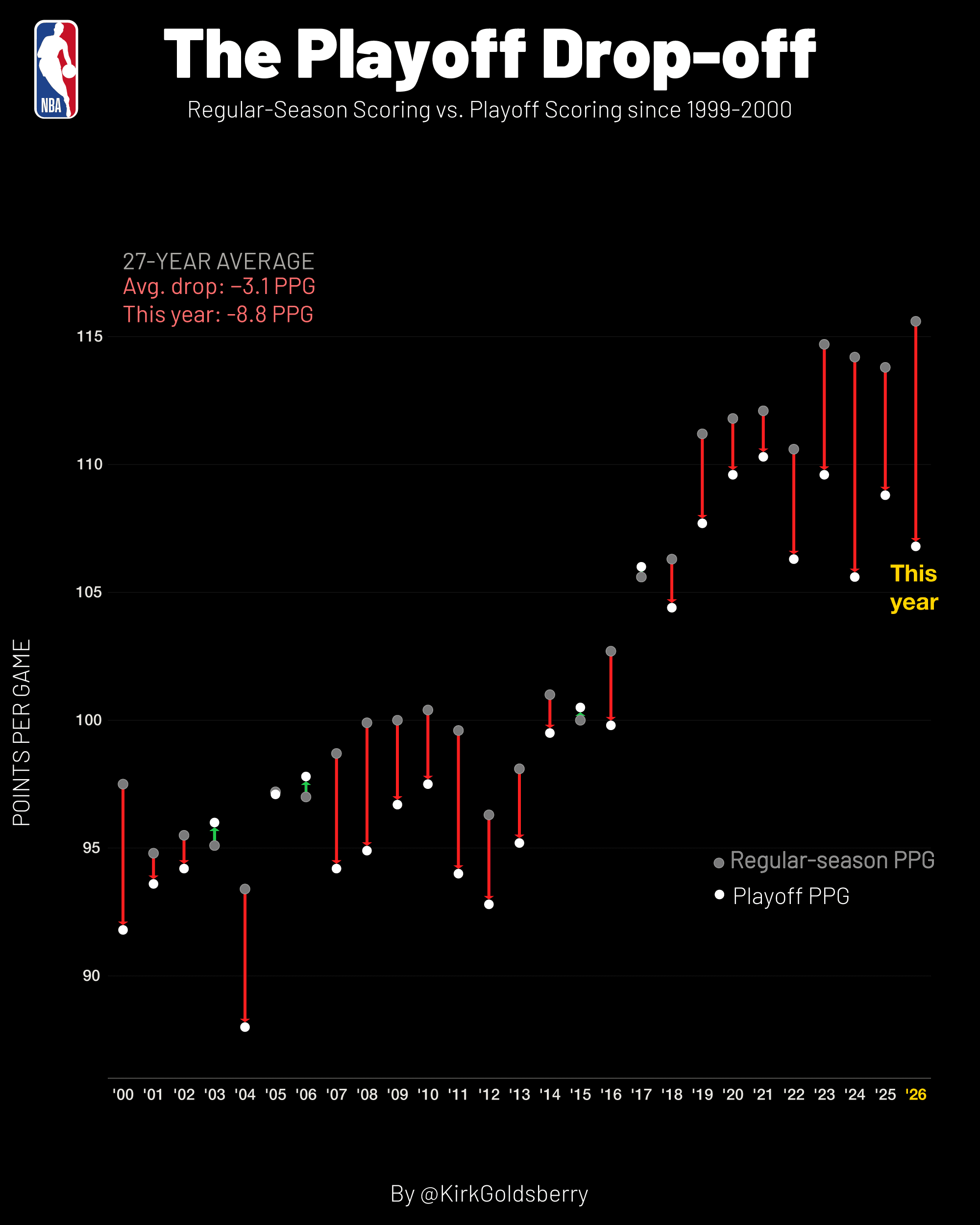
Those red lines seem to be getting longer and longer over time, meaning that the disconnect between our 82-game marathon and our two-month postseason sprint is also widening. Watching Orlando beat Detroit 94-88 on Monday night felt like seeing Ben Wallace and Tayshaun Prince smother Kobe Bryant in the 2004 Finals, a series so brutal that the NBA curbed hand-checking rules immediately afterward and ended up changing the league forever.
On the chart above, check out the scoring increase that started in 2005.
On Monday, Orlando won even though it made only 32.6 percent of its shots. On Sunday, Toronto beat Cleveland 93-89, despite shooting 32.0 percent from the floor.
So what is happening? Well, we haven’t been transported back to 2004. I can tell because I’ve logged seven hours of screen time on my phone already today. But in the playoffs, pace is down, transition offense is way down, and games are simply slower. We’re also seeing a meaningful decline in 3-pointers. All told, teams are getting fewer shots per game and making a smaller share of them.
But part of this story has more to do with the regular season and the unprecedented amount of tanking we just endured. There were more bad defenses than ever this year, which elevated the value of an average possession to artificial levels. But those teams are all in Cancún now, and nobody gets to play the Wizards or Kings in May.
NBA Offensive Rating in the Regular Season vs. Playoffs
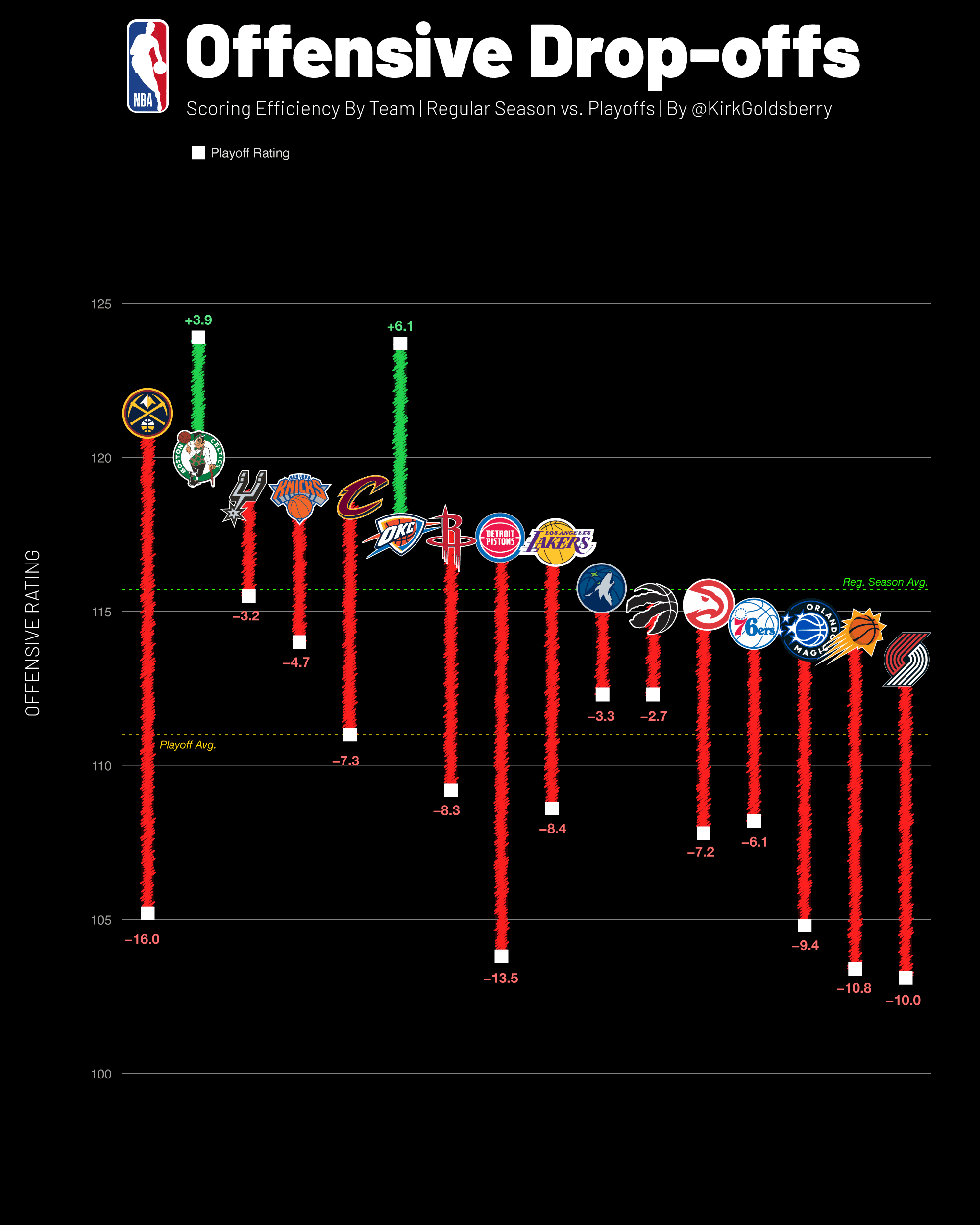
But here’s the thing: The great offensive depression is affecting some teams more than others, and no teams have been dragged down more than Denver and Detroit, two squads that were favored to advance out of Round 1 but are now on the verge of elimination.
The Detroit Pistons’ Jump-Shooting Dilemma
No team epitomizes the great scoring drop-off more than the top seed in the Eastern Conference. The Pistons won 60 games this season because they were great on both ends of the court, pairing the league’s second-ranked defense with its ninth-ranked offense. But that competent offense has simply disappeared against Orlando, which is the biggest reason Detroit is on the brink right now.
The Pistons currently rank 16th (that’s last) in these playoffs in offensive rating. Woof. Their offense is producing 17 fewer points per 100 possessions in Round 1 than in the regular season—and it may prove to be this team’s fatal flaw.
The woes have been particularly obvious from beyond the arc. Among all 16 playoff teams, Detroit currently ranks last in 3-point production; it ranks last in 3-point percentage and 14th in 3-point volume. In layman’s terms, the Pistons don’t shoot many 3s, and when they do, they don’t make them. Last night, in a six-point defeat, they shot 6-of-30 from downtown.
It’s hard to see this team advancing very far when it’s yielding only 27 points per game on average from beyond the arc, while teams like Boston are more than doubling that figure.
We used to wonder whether a jump-shooting team would ever win a title. Then the Warriors put those questions to bed. Ten years later, the question going forward is whether a poor shooting team will ever win a championship. The early results from this year’s Detroit squad might be all the answer we need.

Rudy Gobert Is Stifling the Denver Nuggets
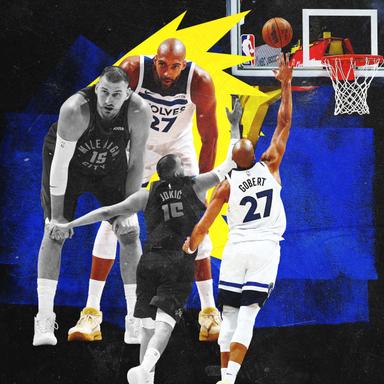
Here’s the defining stat of the Wolves-Nuggets series. Nikola Jokic has made only 22-of-54 when guarded by Rudy Gobert this series. In the second halves, it’s been even crazier—Jokic has now gone a stunning 8-of-30 against Gobert in the third and fourth quarters of these games.
Minnesota’s ability to slow down the NBA’s best offense thus far in this series has everything to do with Gobert’s ability to slow down the best offensive player in the world, while almost exclusively guarding him in single coverage.
Unfortunately, injuries to Anthony Edwards and Donte DiVincenzo have damaged the Wolves’ chances of advancing, and the Nuggets cruised to a double-digit win in Game 5. But Gobert’s master class in defending Jokic should not be forgotten, regardless of how the series plays out. He has been one of the top two French defenders in these playoffs, and we'll get to the other Stifle Tower later on.
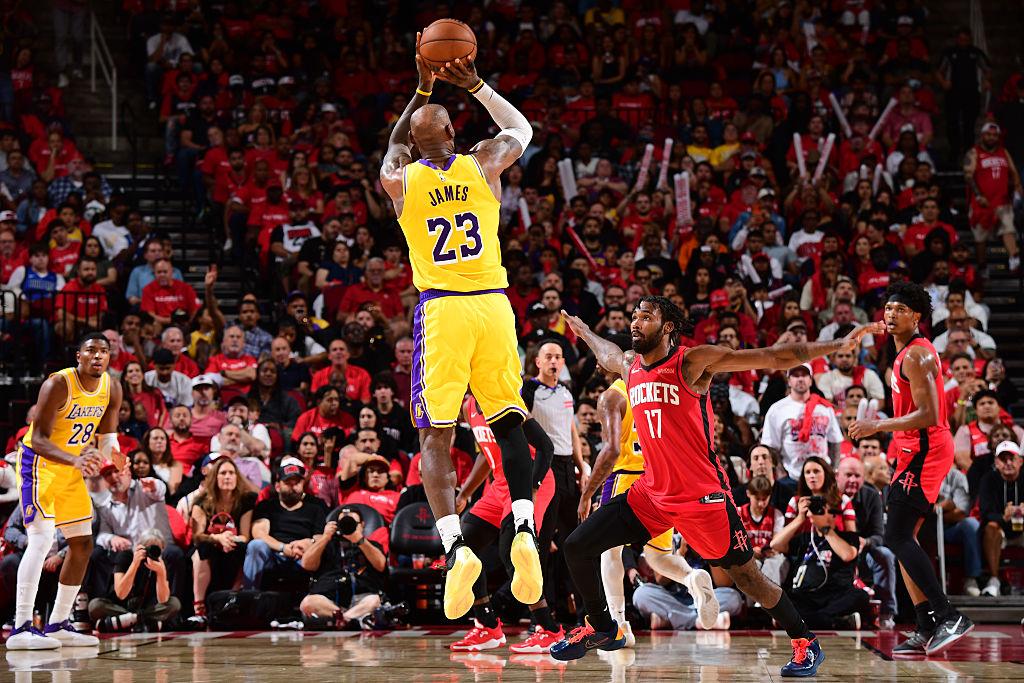
LeBron James shoots during Game 3 against the Rockets
The NBA’s Only 200-Hour Man
Rockets vs. Lakers features two of the greatest players ever—and two of the league’s most experienced postseason legends. Kevin Durant ranks second among all active players in total minutes of playoff action, with a staggering 6,934 minutes over his 18-year career. But here is the crazy part. After Game 4 of this first-round series, James has now tallied an absurd 12,218 total playoff minutes. That’s 200 frickin’ hours, man.
That’s 8.5 days of playoff action.
That’s not normal. We’ve run out of adjectives to describe LeBron’s ridiculous career, so let’s look at a chart instead.
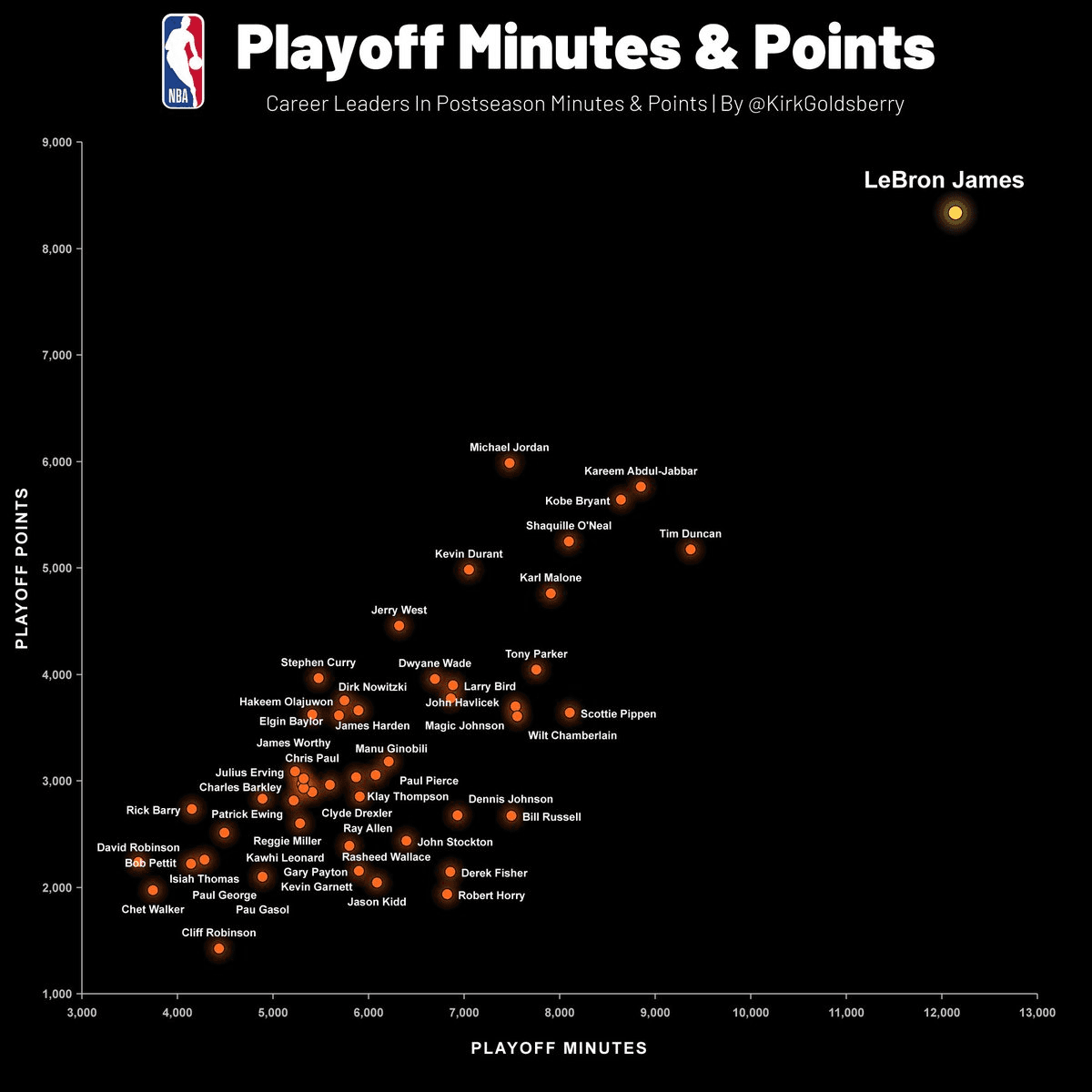
Holy King James. This plot shows the all-time NBA leaders in playoff minutes and playoff points. As you can see, James is in his own galaxy, far away from the constellation of Hall of Famers. He isn’t just leaving his legendary contemporaries in the dust—he’s also making the postseason totals of legends like Jordan, Kareem, and Duncan look downright normal.
The kid from Akron has now accrued the most staggering postseason résumé in NBA history—and before the ring counters get in here and start yelling about how those players won more titles, just consider these tidbits:
- James has now won 187 total playoff games. That’s more playoff wins than 21 NBA franchises have.
- He’s 41-14 in playoff series.
- He has won 79 percent of his closeout games, the highest mark in NBA history among players with a minimum of 25 games.
- His career playoff averages of 28.3 points, 9.0 rebounds, and 7.2 assists are better than his regular-season splits, and they’re sustained over the equivalent of more than three full 82-game seasons, against playoff defenses and coaching staffs laser focused on slowing him down.
- He’s got more postseason assists than John Stockton and more postseason rebounds than Karl Malone.
But James isn’t really thinking about this right now. He’s turning back the clock, carrying the Lakers to a 3-1 lead over the Rockets, and trying to bide some time so his banged-up colleagues Luka Doncic and Austin Reaves can get back on the floor. If the Lakers can win one more game against Houston this week, LeBron and the Lakers will face the Thunder in Round 2, and James will just keep adding to his already incomparable playoff résumé.


The Wemby Effect Hits the Playoffs
Victor Wembanyama’s playoff debut has been slowed—but not derailed—by the concussion he suffered in Game 2 of the Spurs’ first-round series against the Trail Blazers. But after missing Game 3 in Portland, Wemby’s back in the fold, and a few defensive numbers prove that the young Frenchman is already one of the most impactful players in the postseason.
Yes, he leads the postseason in blocks per game, which is impressive, but Wemby’s defensive impacts go far beyond that simple counting metric.
In his 79 minutes of action, the Spurs have had a ridiculous 95.8 defensive rating. For context, the Thunder’s league-best mark in that metric was 106.5 during the regular season. Of course, the Blazers don’t exactly have the league’s most dynamic offense, but that doesn’t make these numbers any less impressive, especially when we look at a few paint stats that capture the Wemby effect in a nutshell.
When Wembanyama is off the floor, the Blazers have won the paint battle, outscoring San Antonio 45.9 to 43.3 points per 100 possessions in the lane.
But with Wemby in the game, the Spurs score 49.1 paint points per 100, while Portland manages only a measly 36.8.
It’s a familiar concept for Spurs fans. The team’s legendary run began when David Robinson controlled this neighborhood. Then Mr. Robinson teamed up with Tim Duncan, launching a dynastic run that featured some of the most dominant rim protection the NBA has ever seen. I’m not sure how to say déjà vu in French, but this updated version of Spurs dominance seems awfully familiar.


The East Is Breaking for Boston
Before the playoffs began, we explored what historical trends can teach us about this year’s crop of playoff teams. The takeaway was simple: OKC, Boston, and San Antonio are in a tier above everyone else. Nothing we’ve seen over the past 10 days has changed that, especially in the East, where only one team has breezed through Round 1 so far.
The East is breaking in Boston’s favor. Detroit is struggling. New York and Cleveland are mired in first-round fights. Meanwhile, Boston is torching Philly with a brutal blend of rebounding and long-range shooting. The Celtics rank first in rebounding share this postseason, thanks in large part to their leading rebounder—Jayson freaking Tatum—who is averaging more than nine boards a game to go with his nine assists and 25 points per game. Sheesh.
Look for Boston to put the Sixers away on Tuesday night and then put their feet up and await the winner of Hawks-Knicks.