
Back when my boss Bill Simmons’s fingers worked, he gave us many seminal internet columns. One of my favorites was his NFL Playoff Manifesto, which was essentially a list of rules, based on historical lessons, that helped frame a good look-ahead for football’s grand postseason tournament.
With his permission, I’m importing this concept to the NBA for the 2026 playoffs, but I’m putting a nerdier spin on it. For this version, I reviewed tons of team-level data for all the regular seasons and playoffs since 2000 to uncover a few golden rules that can help us better predict what might happen in the months to come. Here are the biggest takeaways.
Net Rating Is the Crystal Ball
Regular-season net rating—a team’s plus-minus per 100 possessions—is the single strongest predictor of postseason success. Nine NBA champs since 2000 ranked first in the league in this category, including our past two champions, the 2023-24 Celtics and last season’s Thunder, and 20 of this century’s 26 NBA champs ranked in the top four. That’s 77 percent!
This year, the four teams with the best net rating are OKC, San Antonio, Detroit, and Boston. That feels right—not coincidentally, they also happen to be the top four seeds in the whole bracket. History tells us that one of this quartet will win it all, and all of them are likely to advance multiple rounds.
Since 2000, teams that have ranked in the top four in net rating have won their first-round series 88.1 percent of the time, and a majority of them have advanced to the conference finals.
Average Net Rating by Playoff Outcome, 2000-2025
The lessons of net rating bode especially well for Oklahoma City, whose absurd mark of 11.1 points per 100 possessions is worth special attention. That figure is among the best in NBA history, and while some of that might be due to the unprecedented levels of tanking the league has endured this year, consider this: Of the five previous teams that finished the regular season with a net rating of 11 or higher, four of them won it all.
The lone exception is the 2015-16 Spurs (a team I worked for), in Tim Duncan’s final season. That squad lost to the Thunder in Round 2. Bad memories, you guys.
But the lessons of net rating don’t stop there—on the other end of the continuum, regular-season net rating is also a good eliminator. No champion since 2000 has finished with a regular-season net rating rank worse than eighth. Not one!
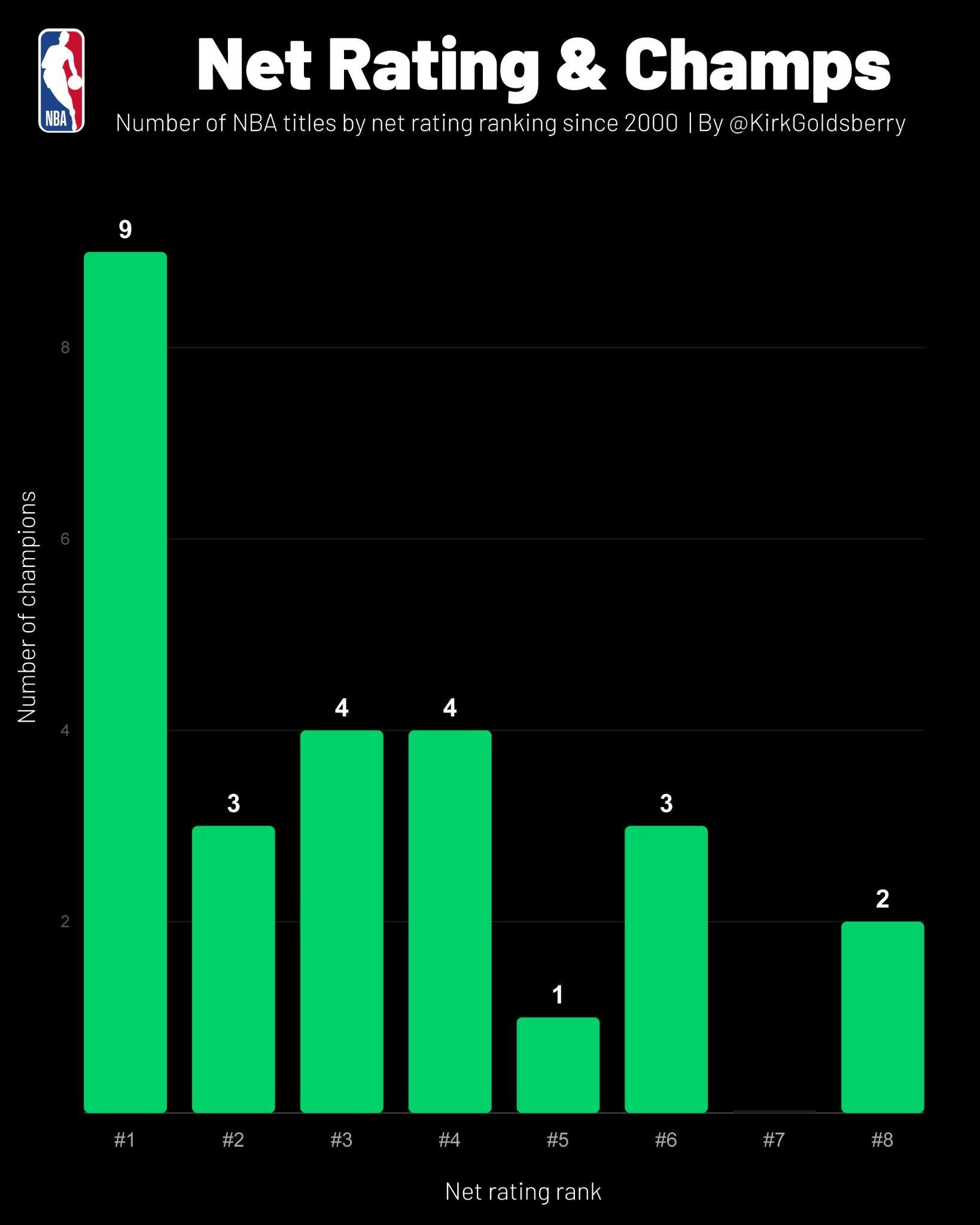
This is bad news for the long-shot title hopes of the Cavs, Wolves, and Lakers, who rank ninth, 10th, and 14th, respectively, this season.




Get Ready for the NBA Playoffs
The Periodic Table of the NBA Playoffs
Let’s dig deeper into the historical record by plotting all 775 team seasons in the NBA since 2000 on what I’m calling the Periodic Table of the NBA Playoffs. This approach goes beyond just net rating, exploring both offensive and defensive elements, and visualizes the eventual outcomes for every team this century.
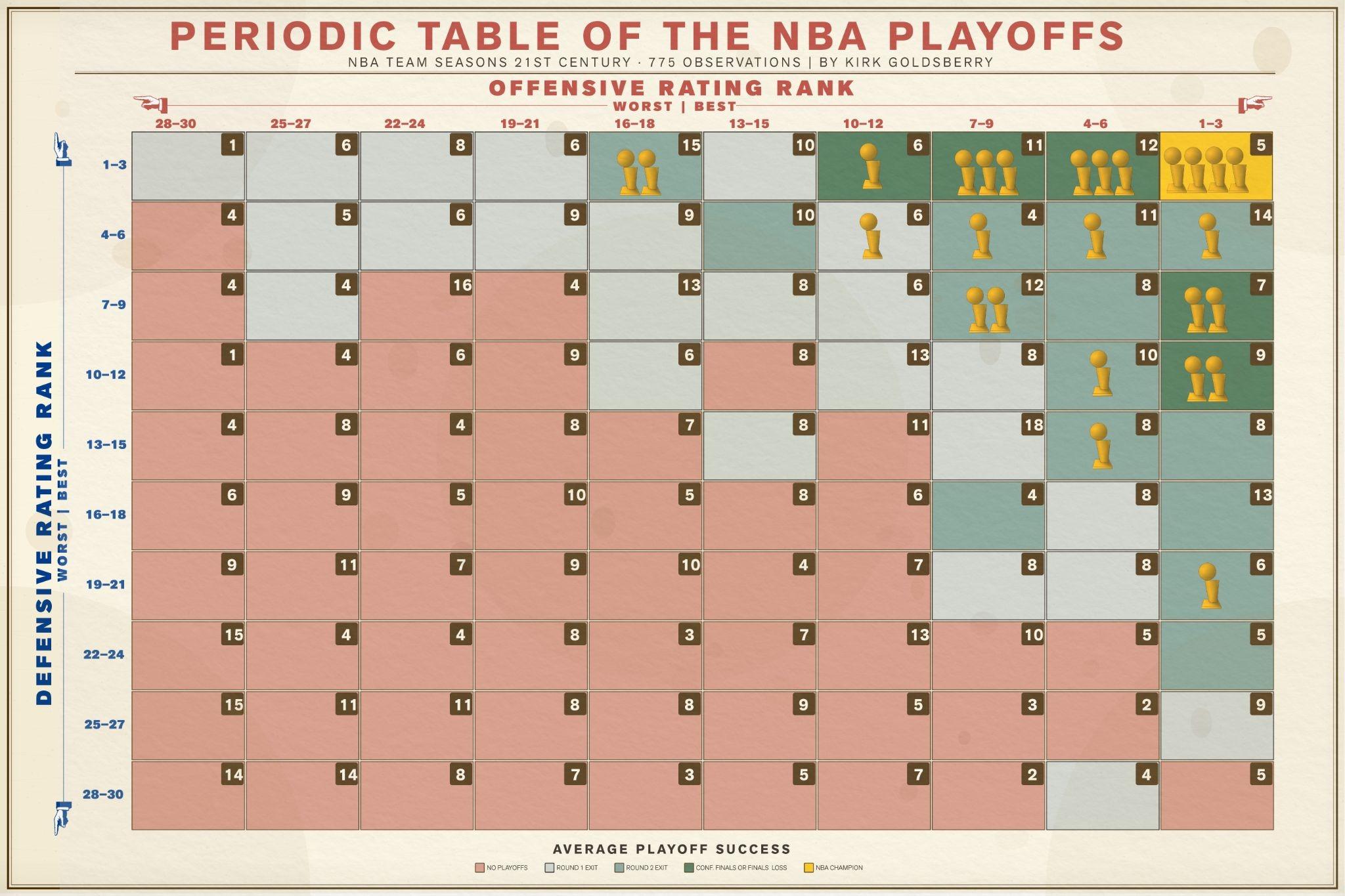
The chart includes 10 rows and 10 columns. Better defenses land at the top; better offenses land at the right. The teams in the top row had great defenses that all ranked first, second, or third during their regular seasons. The second row ranked fourth through sixth, and so on down the chart. The columns represent offense. The teams in the far right column are the noble offenses that finished top three in offensive rating. The best teams—those that combine elite offense and defense—are clustered in the top right corner. The worst teams are in the lower left.
The numbers in the upper-right corner of each square indicate how many unique teams since 2000 fall into that statistical profile. So, for example, the no. 5 in the corner of the upper right-most box means we’ve had five teams since 2000 finish the regular season as a top-three offense and a top-four defense. Four of them won it all. Hence the four trophies.
That reflects an obvious yet fundamental rule about basketball, which is that all players play both offense and defense. (Even James Harden.) And thanks to Dean Oliver, who changed basketball forever by designing possession-based metrics, we’ve gotten much better at measuring what teams are most or least effective on both ends of the floor. Recent history affirms that teams that excel on both ends of the floor during the regular season are the most likely to win it all. The five teams to finish top three in both offense and defense this century are compiled in the table below.
Blending an elite offense with an elite defense is the best formula for a surefire champion, but this season gave us no such two-way juggernaut. Even the mighty Thunder have fallen off relative to last season—their defense is ranked first once again, but their offense fell to seventh best in the association.
So let’s overlay this season’s playoff teams onto the Periodic Table of the NBA Playoffs to see how this crop measures up historically.
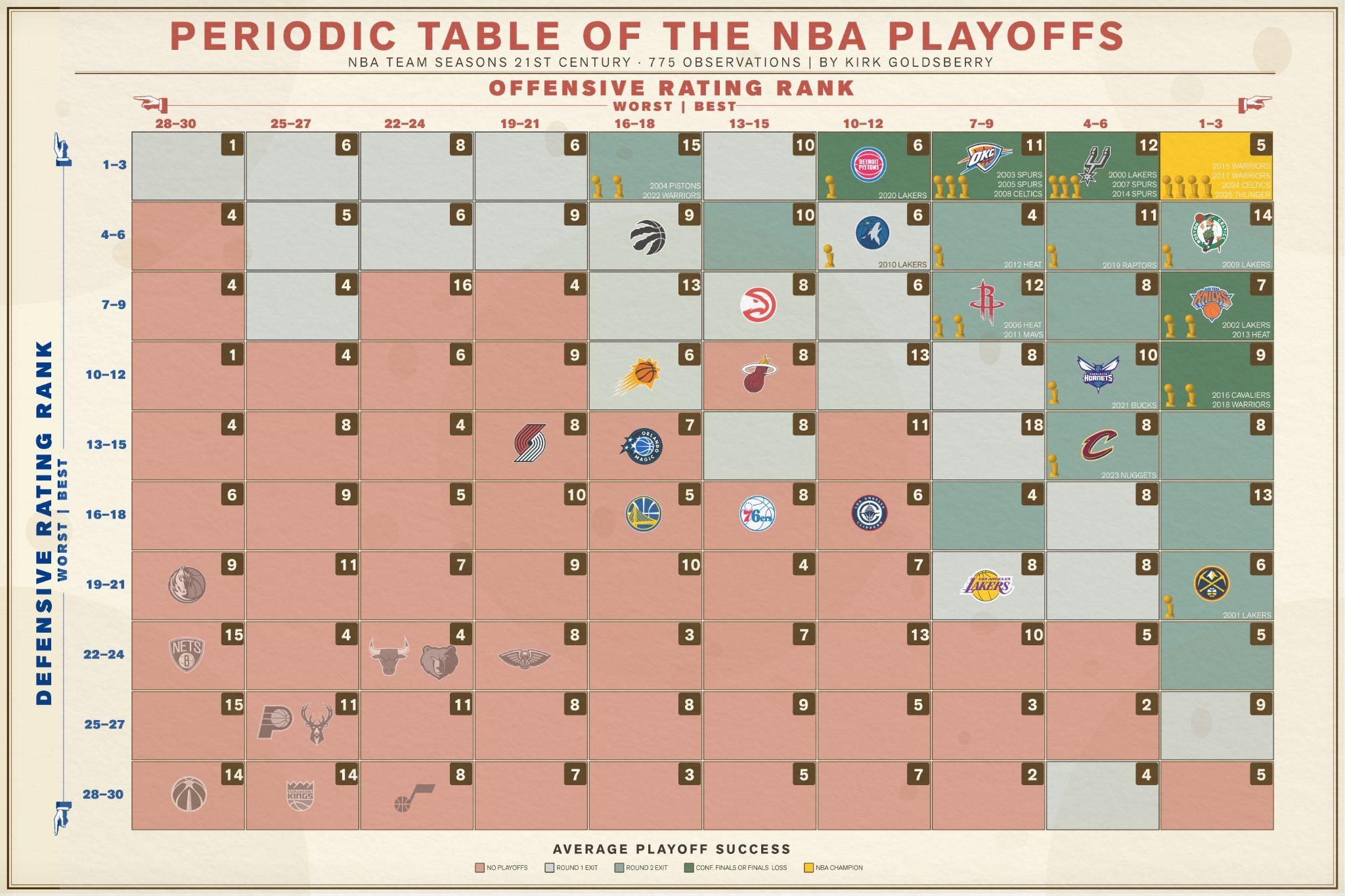
One cool thing this lets us do is map out the championship comps for this season’s playoff teams. It’s like an inspo album for contenders. For example, the 2025-26 Spurs have a profile that is a lot like the last Spurs team that won it all back in 2014, blending a top-three defense with an offense that ranks fourth overall.
The Nuggets, who feature the worst defense in this year’s postseason field, can look to the legendary 2001 Lakers for inspiration. That famous Shaq-Kobe team also entered the postseason with a top-three offense and the 21st-ranked defense in the league, before going 15-1 in the playoffs and winning the title.
Meanwhile, the Knicks and Rockets can both point to two championship role models. New York shares the statistical profile of the 2001-2 Lakers and the 2012-13 Heat, but unlike those squads, the Knicks lack an all-time great playing in his prime. That Lakers title came during the middle of their three-peat and featured peak Shaq and an ascendant Kobe Bryant. And the 2013 Heat featured LeBron James, who was far and away the most dominant player in the 2013 playoffs. With all due respect to Jalen Brunson, he’s not like that.
For the Rockets, they can find inspiration in the Dwyane Wade–era Heat and the Dirk-era Mavs. Unfortunately, unlike those squads, the face of this Rockets squad—Kevin Durant—is much older than 2006 Wade and even 2011 Dirk, while the rest of the Western Conference is loaded with other megastars surrounded by more complete rosters.
OK, Maybe Defense Does Win Championships
A vast majority of recent title winners have had either a top-three offense or a top-three defense, but if you had to choose one to lean on more, it would be an elite defense.
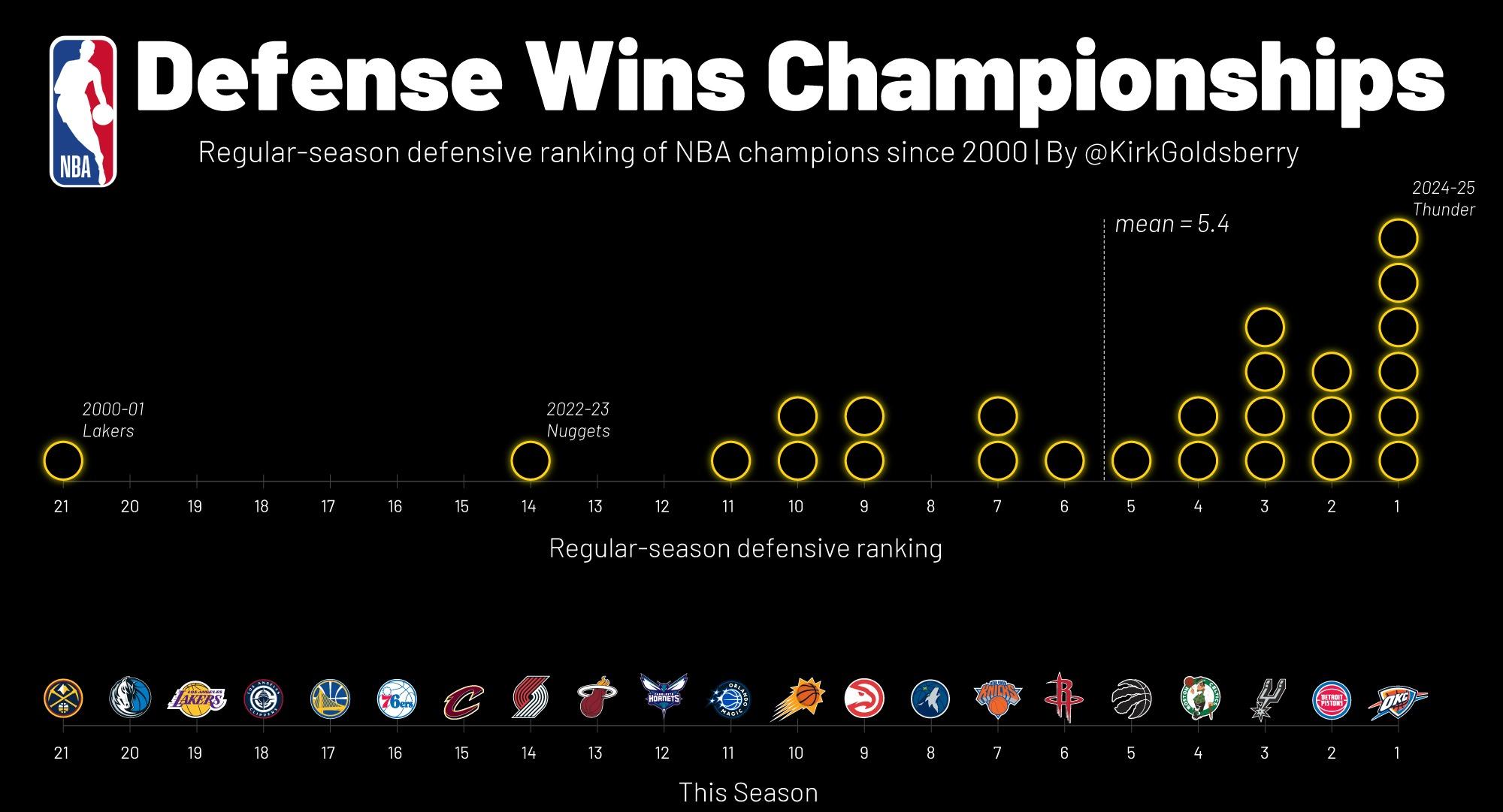
Twenty-three of the past 26 champions have brought a top-10-ranked defense into the NBA postseason, and a majority of the league’s 21st-century title winners, including both of our past two champs, have ranked inside the top four. The three big betting favorites this season—Oklahoma City, San Antonio, and Boston—all check that top-four box, too, but then there is Denver. FanDuel currently has the Nuggets with the fourth-best odds to win the title, despite the fact that their defense kind of sucks.
So are the Nuggets legit contenders or not? It’s the most interesting question in the Western Conference right now, and your answer depends on whether you view Jokic as akin to a modern-day Shaq. The shoe fits. Of course, Jokic is not the same overwhelming physical force, but as was the case with O’Neal, just having the Joker on the floor makes Denver a threat to win any game against any team in any gym. When the Nuggets won it all in 2023, Jokic became the first player in postseason history to lead the playoffs in total points, total rebounds, and total assists. That’s an absurd feat, but it speaks to the breadth of his dominance. Plus, when you consider the fact that many of Denver’s key metrics this regular season were thrown off by the team’s rash of injuries, it’s easy to talk yourself into the idea that a healthy Nuggets team can win this tournament.
If You Can’t Shoot, You Won’t Win
Shooting has always been important in the NBA, but it’s never been this important. In a league that now takes over 40 percent of its shots from beyond the arc, the best offenses now require above-average shotmaking both inside and outside the 3-point line.
Almost every champion of the 21st century was a good shooting squad. Twenty-one of the past 26 champs have ranked in the top five in effective field goal percentage during the regular season, and all but three have been in the top seven. This spells trouble for both Eastern Conference favorites this season.
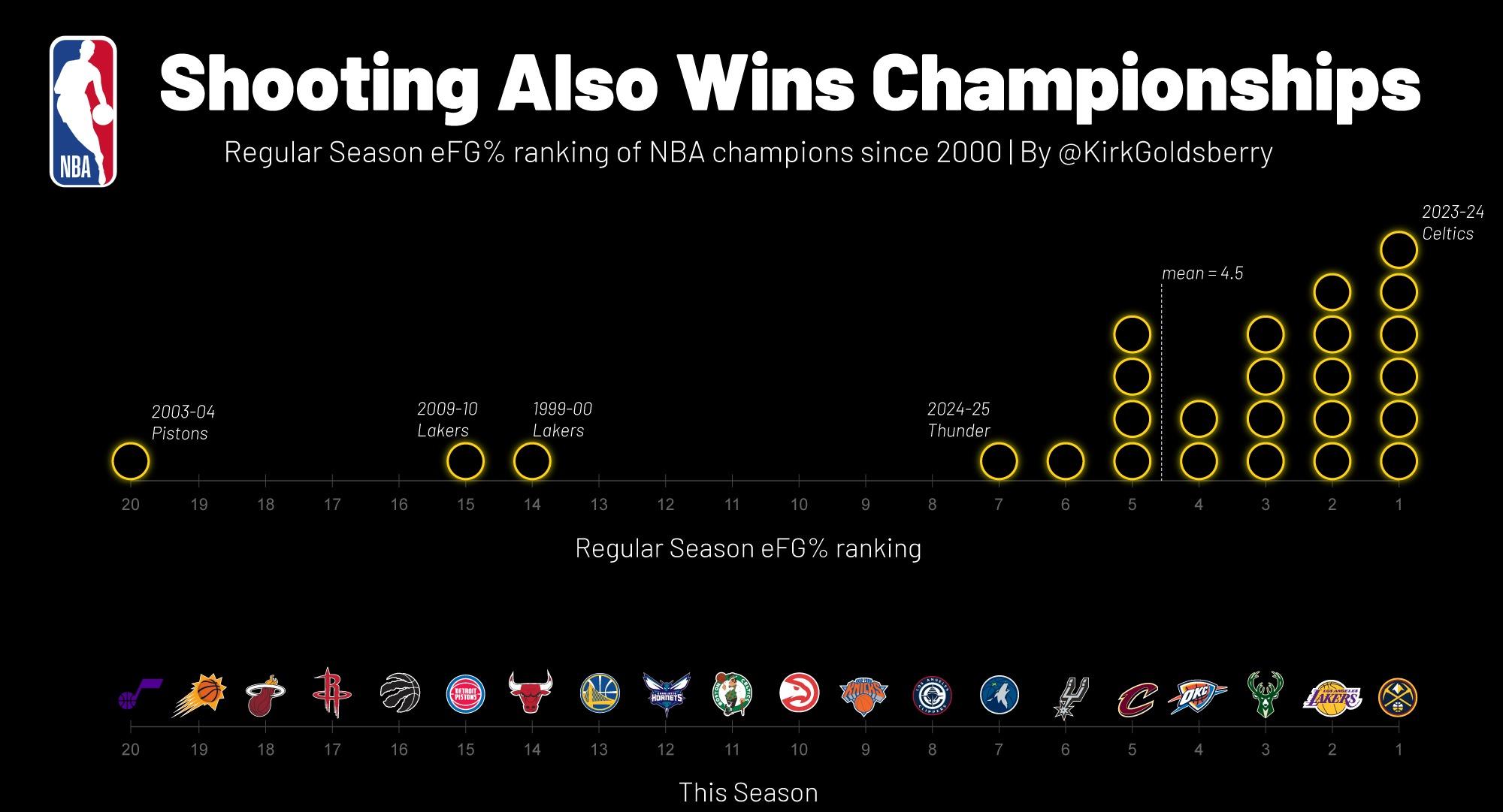
Both the Celtics and Pistons logged average numbers from the field this season. Each compensated with very strong offensive rebounding numbers, and both ranked in the top five in second-chance points per game, although it’s fair to wonder whether those second chances will decrease against other top teams.
Boston’s regular-season numbers are impressive but also misleading. The return of Jayson Tatum, who played only 16 games this season, obviously changes their shooting profile—not to mention their title hopes—immensely. Detroit, on the other hand, has a lot to prove in the shooting department. The Pistons ranked 29th in 3-pointers made per game this season, which would make them a notable outlier among modern championship teams.
Still, underestimate whoever comes out of the Eastern Conference at your own risk; if last season’s Pacers taught us anything, it’s that any team that wins three rounds is a real threat to win the fourth round, too.
On the other side of the bracket, this shooting criterion gives us another reason to trust OKC, which ranked fourth in 2-point percentage and ninth in 3-point percentage this season. It also bodes particularly well for Denver, who ranked fifth in 2-point percentage and first in 3-point percentage en route to having the best offense in the league.
Know Your Era
If there’s one trend that is pointing away from a Thunder repeat, it’s this one. For the first time in NBA history, the league has crowned seven unique champions in the past seven years. No repeats. No dynasties.
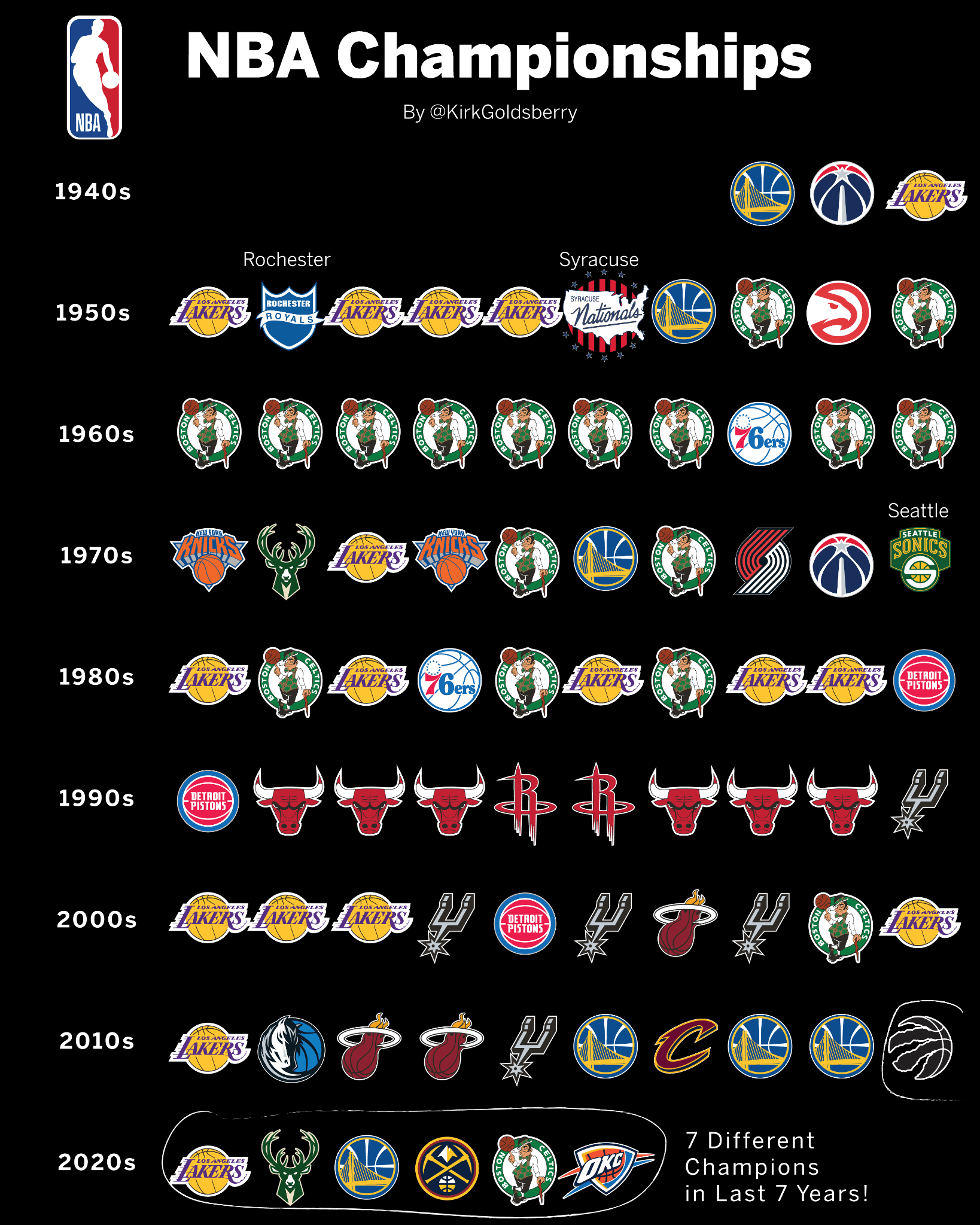
In the 2020s, the exact kinds of dynastic runs that defined the association for eight decades have evaporated. Some of that is organic. Some of it has been engineered by the league office.
The current collective bargaining agreement was designed in part to ensure a more even distribution of superstar talent. The last team to repeat—the Warriors in 2017 and 2018—included Stephen Curry, Klay Thompson, Draymond Green, and Kevin Durant, not to mention a stable full of great role-playing vets.
Assembling that kind of superstar talent is impossible now. The penalties associated with the dreaded second apron are so dang punitive that we are seeing teams like the Celtics off-load beloved vets, while teams like Phoenix and Milwaukee are making historically expensive buyout plays to avoid tax penalties. The Clippers, meanwhile … well, that’s another story.
It’s possible that the Thunder and Spurs may have hacked the apron era by loading up on core talent that’s still playing on rookie-scale deals, but that remains to be seen. This postseason will give us another data point in what it takes to win in the modern NBA.
But among all the rules in this manifesto, this one seems flimsiest. Give me the Thunder.