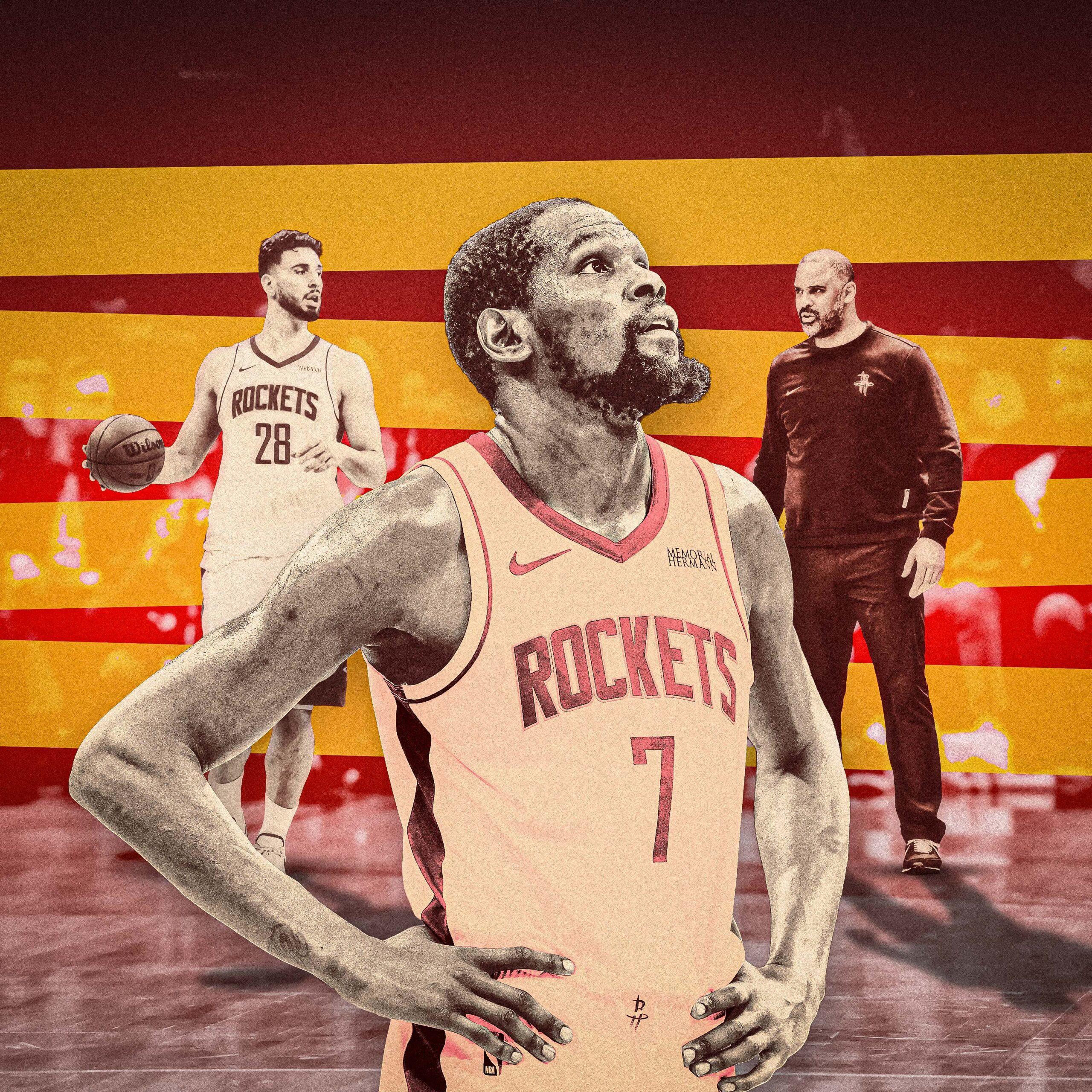

It took falling into a 0-3 hole, suffering an all-time meltdown, and generally looking like they never want to see one another again for the Houston Rockets to finally beat a Los Angeles Lakers team that does not have Luka Doncic or Austin Reaves.
But does Houston’s dominant Game 4 win on Sunday night actually mean anything? Does it provide any reason to believe that the Rockets can overcome a deficit that no team in NBA playoff history has before? Can they force 17 live-ball turnovers and hold the Lakers to 5-for-22 shooting behind the arc again?
Despite incredible, season-saving performances by Amen Thompson and Tari Eason—coupled with arguably the worst playoff game of LeBron James’s career—Houston is almost certainly not about to engineer the NBA’s greatest comeback ever. And, regardless of when this team gets eliminated, no franchise is shaping up to have a more interesting and consequential offseason than the Rockets.
Before we look too far ahead to what may or may not happen over the next few months, allow me to play devil’s advocate and make a case against the impending demand for firings and trades in Houston: Everything bad that’s befallen this team can be explained by injuries. No real analysis is necessary. They’re simply unlucky! The three most irreplaceable players on Houston’s roster—Fred VanVleet, Steven Adams, and Kevin Durant—have not been healthy enough to compete in this series; the trickle-down effect from their absence has placed an immense strain on everybody else, including (and especially) head coach Ime Udoka.
Thus, the Rockets should head into the summer embracing patience. Their level of young talent, when combined with better health, must provide cover against a course-correcting overreaction. Simply wait for the gang to be whole next year and see what happens!
[Vigorously shakes self back to reality.]
OK, now let’s be serious: Something is rotten at Houston’s core that goes beyond its need for a steady point guard, a glass-mashing center, and a healthy primary option. There is no excuse for what we’ve seen throughout this humiliating first-round series—a level of mismanagement and disregard that’s compounded the seemingly dozens of crunch-time collapses endured during the regular season.
Change must be imminent, and the decision not to be more proactive at February’s trade deadline should be acknowledged for the defeatism it was. Here’s what I wrote at the time:
One day after Rockets assistant coach Royal Ivey used the word “selfishness” to describe his team’s play in the first half of a devastating beatdown against the “Maine” Celtics, Houston has all but admitted that it’s not a championship contender right now. Despite having five tradable first-round picks and some significant areas in need of improvement—on a roster that’s down Steven Adams and Fred VanVleet for the season—the Rockets were whisper quiet at the trade deadline. If/when they flame out in the postseason, there won’t be a more unpredictable offseason wild card in the league. Would Houston, feeling the pain of defeat, give Milwaukee whatever it wants for Giannis? Is there another star on the horizon who could be had at a lower price? (Kawhi, anyone?) Who knows? But the Rockets have a ton of draft capital and more than one young star on their roster. How committed will they be to maximizing what’s left of Kevin Durant’s career? Do they go the other way and see what they can get for KD? I’m admittedly a little over my skis right now, but the point stands: Keep an eye on Houston.
Nearly three months later, all of that holds up. But before we get into what comes next, I have to discuss what’s still happening—and why the status quo isn’t a solution. On a regular basis in this series, the Rockets just haven’t played like a team. There is no trust or effort to dig deep at the slightest sign of adversity. There’s no interest in helping one another on defense, and there are no creative solutions to mask their structural deficiencies. They had no response to the constant double-teams that baffled Durant in Game 2, and curious lineup combinations made a bad situation worse. And against the Lakers, who have no actual point guard, the regular season’s sixth-best defense has been stumped by this new, highly complex action called a “pick-and-roll.”
A group that made its bones on physicality and toughness during the regular season has been transparently fragile and inherently selfish in the postseason. Here’s one of countless examples: Eason ended a 4-on-1 fast break with a decision that appeared to break Alperen Sengun’s will in real time:
VanVleet’s torn ACL might’ve doomed this season before it started, but it’s hard not to see how pretty much everyone involved failed to step up and make the most of a challenging situation. Injuries are part of the NBA. But the players who step in as replacements, the coaches who design the game plans, and the front offices that make supportive personnel decisions should all be the best in the world at what they do.
Houston entered the year with one of the deepest rosters in the NBA. Yet in Game 3, its entire bench scored two fewer points than Bronny James. It didn’t bother with imaginative counters and used lineup combinations that somewhat understandably (but not really) prioritized the defense, which hadn’t looked right for weeks.
Now seismic decisions lie ahead, and literally no job is safe. No player is untradable, no coach unexpendable.
This takes us to Udoka, someone who knows how to inject winning traits into a basketball team. Houston was pitiful when he was first hired in 2023, and the steady improvement it’s shown since his arrival has been enough to lure names like FVV and Durant. The Rockets have established a defense-first, accountability-always identity after finishing 27th, 30th, and 29th in defensive rating for three straight seasons under Stephen Silas.
But Udoka can also be ruthless, hawking tough love without the love part. This Titanic-meets-iceberg playoff series against L.A.—in combination with his blunt criticisms and increasingly primitive playbook—may be the final straw for Udoka. (It did not help when he threw his players under the bus after Game 3—and then climbed into the driver’s seat to back over their dead bodies.)
Whether it keeps Udoka or goes in a different direction, the next question Houston must ask is very simple: How close is it to winning a championship? This isn’t a simple exercise. The Rockets look broken, but they also won 52 games this season and had the sixth-highest net rating in the league. They were competent on both sides of the ball and had a foundational identity, even though they addressed their point guard problem with Band-Aids and bubblegum.
If the honest answer is that they're still pretty far from a championship, then it makes sense to trade Durant, who’s still playing at an All-NBA level and just logged his most regular-season minutes since he won MVP in 2013-14.
How many teams would be willing to part with something valuable to get him? KD will be 38 years old, with $90 million left on his contract, heading into next season. He leaves behind a trail of lethargy wherever he goes, along with strange layers of passive-aggressiveness; it honestly can’t be said enough times how childish his burner boy persona really is. It’s not my place to psychoanalyze or explain that behavior, but I do know that it’s not exactly fostering a healthy workplace environment.


More on the NBA Playoffs
In all three of his latest stops—Brooklyn, Phoenix, and now Houston—Durant has ultimately symbolized a lesson each team has had to learn from and move past to reach the next step of its life cycle. He is a blessing by way of a curse, and as his Hall of Fame career nears its end, you could drive an 18-wheeler through the space between Durant’s talent and how said talent positively affects his surroundings. The Rockets thought that KD was their missing piece, and instead, there’s a chance they’ll turn him into a stepping stone this summer. It turns out that your best player shouldn’t also be a mercenary. But despite that, the Heat, Timberwolves, Blazers, Mavericks, Pistons, Knicks, Raptors, Hawks, Magic, Lakers, Nuggets, Hornets, Bulls, Wizards, Warriors, Pacers, Jazz, Sixers, Celtics, Cavaliers, Bucks, and Clippers would all have varying degrees of interest—pending how the rest of these playoffs go.
The last three teams on that hypothetical list are the most interesting: If the Rockets go the other way, keep Durant, and believe they’re not that far from making the Finals, Giannis Antetokounmpo, Kawhi Leonard, or Donovan Mitchell would presumably be on their radar. (A few other names who could squeeze into this conversation: Karl-Anthony Towns, Darius Garland, and Joel Embiid.)
It’s hard to picture the Rockets trading Durant for a facsimile of the package they gave up to get him. Instead, I think they’ll keep KD and pivot skyward with an even bigger blockbuster move. And even if he slashes their runway in half, Leonard, to me, is the most interesting name worth pursuing.
Would the Rockets give up Sengun, Dorian Finney-Smith, and two first-round picks for a 34-year-old on an expiring contract—who’s coming off the best offensive season of his career? I don’t see why not. Sengun is 11 years younger than Kawhi. He’s a two-time All-Star who averaged 20.9 points, 8.9 rebounds, and 6.2 assists per game this season. There’s inherent risk in swapping him out for a mercurial, injury-prone forward who’s on an expiring contract. But—even though I’m a big fan of Houston’s center—there are long-term fit issues and defensive concerns that make it harder and harder to envision him playing huge minutes on a team that can win three straight playoff series.
The Rockets shouldn’t sob if he’s still on their team next year, but in an alternate world where they’re entering 2026-27 with VanVleet, Adams, Durant, Leonard, Thompson, Jabari Smith Jr., Reed Sheppard, Clint Capela, and another role-playing big man to be named later, their ceiling would go up several levels. (Depending on what happens with Eason’s restricted free agency, they could possibly even duck the tax.)
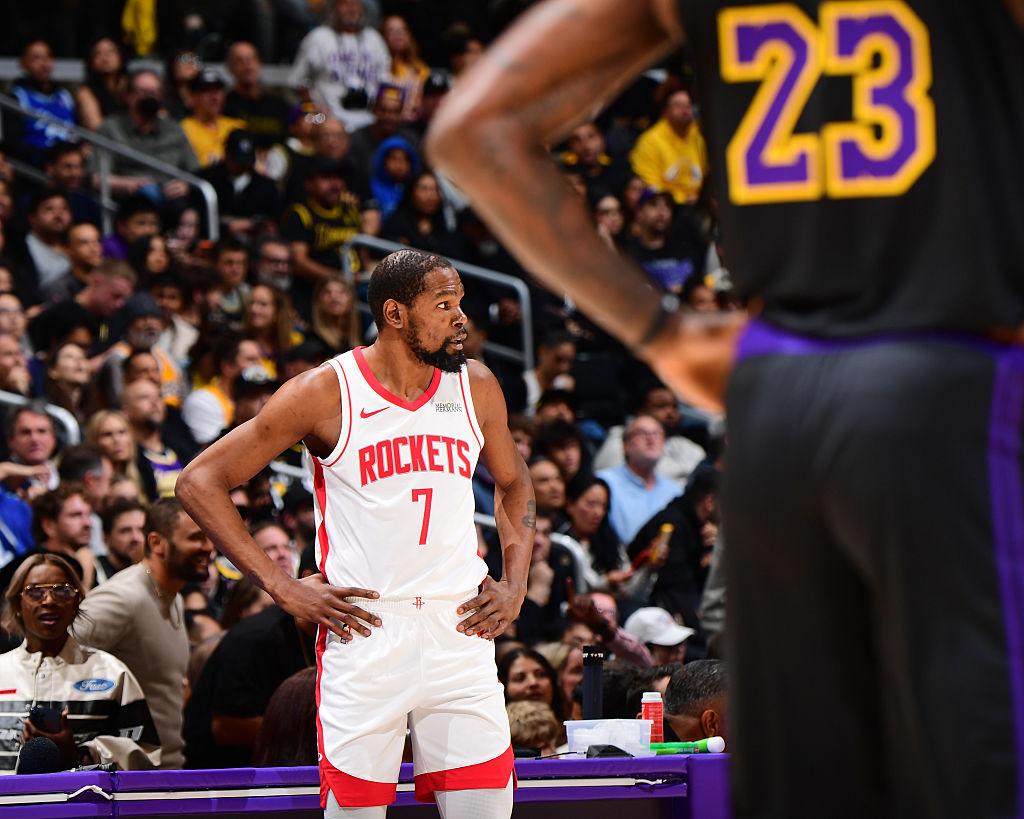
Kevin Durant during Game 2 against the Los Angeles Lakers
Acquiring Antetokounmpo would be a little more complicated. I do wonder how thrilled general manager Rafael Stone would be about having that as the endgame of such an admirably executed rebuild. Giannis is an extremely expensive injury risk (even riskier than Kawhi), and the trade package going out to Milwaukee would also probably be more costly than the one for Leonard. What about Sengun, Smith, and three or four first-round picks?
It sounds weird to say that trading for Giannis Antetokounmpo is a contingency plan, but you could have said the same thing when Houston initially acquired Durant. The big difference between then and now is that this time the Rockets won’t be shaking up their roster from a position of strength. Last season, they could’ve kept Dillon Brooks, Jalen Green, and the 10th pick in the draft; bet on their continuity and internal development; and ended up fine.
But after puking all over themselves in the first three games of his series—and functionally taking a step backward from where they were a year ago—the Rockets should absolutely be considered the clubhouse favorite to get Antetokounmpo.
They aren’t the most desperate team in the league—the Rockets can still trade as many as six picks on draft night, and Thompson’s upside is still incredibly high—but running things back is almost certainly not worth considering.