

The brand-new MLB season has already brought brand-new sights. The automated ball-strike challenge system. High-profile rookies (Kevin McGonigle, JJ Wetherholt, Chase DeLauter, Carson Benge, Justin Crawford, Munetaka Murakami) starring in their big league debuts. Paul Skenes being staked to a two-run lead before he took the mound … and then failing to finish the first inning. A Phillies reliever recording a save in a home game on Opening Day.
But the young season has also reminded us of something we’re used to seeing: The American League East is good.
It’s appropriate that the regular season started on Wednesday with the Yankees’ 7-0 trouncing of the Giants because it has long been a baseball tradition for AL East teams to pick on clubs outside the division. In interdivision competition, the AL East has been a powerhouse for decades: Since 1998, when the division’s lineup solidified as the Tigers shifted to the AL Central to make room for the expansion (Devil) Rays, the East has owned a .530 winning percentage against all other divisions combined. The Devil Rays led the majors in losses over their first 10 seasons; if we start the clock in 2008, when the Florida franchise dropped the “Devil” and posted its first winning campaign, the East’s cumulative clip is .543.
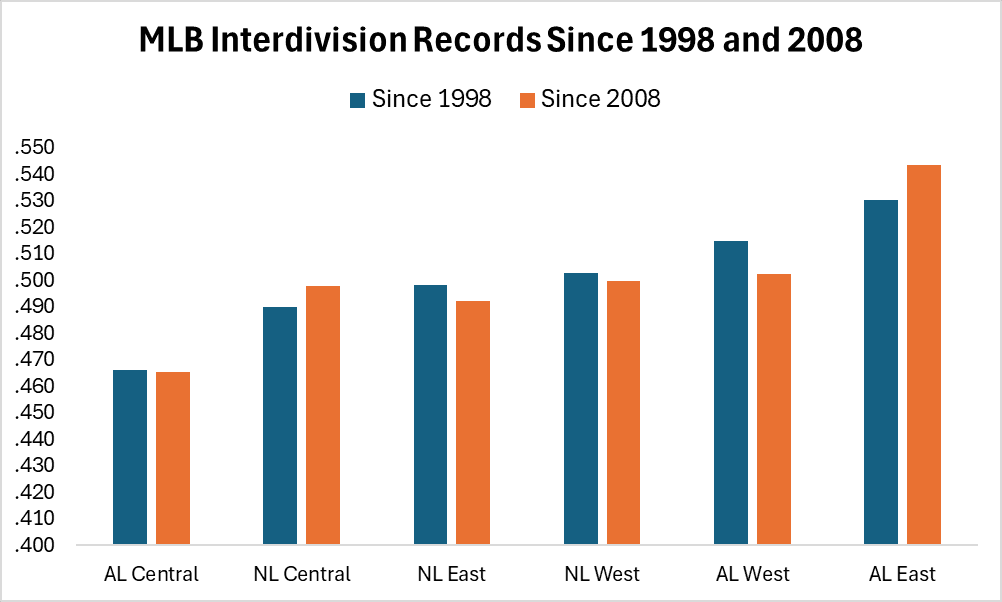
Last season was more of the same: The East’s winning percentage against everyone else was .544. And most of its teams were busy getting better between the last pitch of 2025 and the first pitch of 2026 (both of which were thrown to AL East batters). Which, as is often the case, places the AL East race among the season’s most compelling story lines. This year’s battle of the beasts of the East has been hailed as especially heated, which raises a question: Could this be the best, most competitive AL East ever?
Every AL East team has made the playoffs in at least one of the past three seasons and two of the past five, although as Ken Rosenthal recently noted, the specific configuration of AL East playoff qualifiers has varied with each season in that span.
AL East Playoff Teams
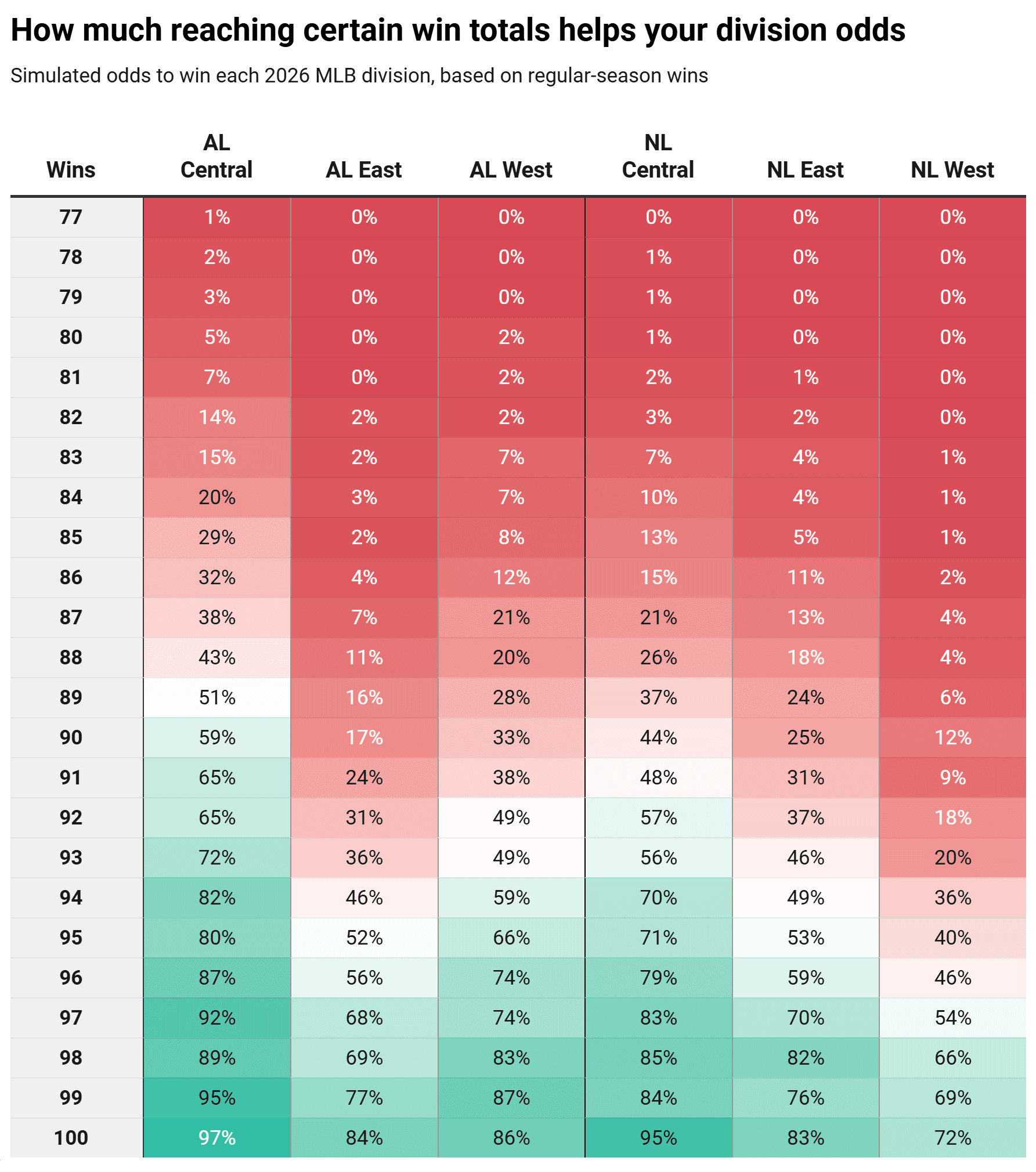
The downside of this intense competition is that the intra-division competition can be brutal. AL East teams accounted for five of the eight highest strength of schedule figures last season, according to ESPN, and they also take five of the top eight spots in projected strength of schedule this season, per FanGraphs. And as Neil Paine showed this week, the wins threshold at which one can expect to win the division is higher in the AL East than in any other division besides the NL West, where the Dodgers will presumably set the bar high.
Even with its assorted contenders tearing one another down, this year’s East has a chance to be the first division to send four teams to the postseason (excluding the NL Central in 2020, when the regular season was shortened to 60 games and the playoffs were expanded to 16 teams). As of Thursday morning, FanGraphs’ playoff odds assigned 284.2 of the American League’s 600 points of playoff probability to AL East teams, which suggests that the baseline expectation should be for the East to hog half of the AL’s playoff slots. But taking two-thirds of them is a possibility. Obviously, every team’s playoff aspirations are dependent on its division rivals’ fortunes, but as of now, each of the top four AL East teams—in order, the Yankees, Red Sox, Blue Jays, and Orioles—has at least a coin flip’s chance of making the playoffs, and even the Rays have roughly a one-in-four shot.
It’s not hard to see how we got here. Three AL East teams made the playoffs last year, and all of them have subsequently retained or added to the talent that got them there. The Jays and Yankees tied atop the East at 94-68; Toronto won the division via tiebreaker and went on to top New York in four games in the ALDS en route to an agonizing, scintillating seven-game World Series loss. Galvanized by their near victory (and, perhaps, motivated by the knowledge that only Cleveland exceeded its own BaseRuns record by more than Toronto did last year), the Jays added Dylan Cease, Kazuma Okamoto, Tyler Rogers, and Cody Ponce, among others, although they also lost Bo Bichette and lost out on Kyle Tucker (to the World Series–winning Dodgers, who weren’t complacent, either).




More in MLB
Much as GM Brian Cashman quibbled with this contention, the Yankees did largely run back their roster from 2025, re-signing Cody Bellinger, Trent Grisham, Paul Goldschmidt, and other free agents and acquiring only one prominent new player, Ryan Weathers, via trade. Fortunately for the Yankees, running it back is pretty darn defensible when you just led the league in run differential, Aaron Judge remains on your roster, and Gerrit Cole is coming back. The Bombers may not lead the East’s teams in excitement, but they could be the best of the bunch.
The Red Sox, who won the AL’s second wild card last year, ranked second in the league in run differential and also probably played a bit better than their record suggested. Not that they just banked on better luck heading into 2026: Although they bid goodbye to Alex Bregman, they also signed Ranger Suarez and traded for Willson Contreras, Sonny Gray, Caleb Durbin, and Johan Oviedo. With MLB’s best projected rotation and the prospect of a full season from budding superstar Roman Anthony, the Sox are set up to challenge last year’s tied titans of the East.
The fourth-place Rays’ 77-85 record last year was even less reflective of their underlying performance than the Yankees’ or Red Sox’s 94- or 89-win tallies; the Rays outscored their opponents by 31 runs and undershot their expected record by about seven wins. As usual, the Rays had a full ledger of winter transactions, although their moves didn’t seem to amount to much in terms of projected short-term improvement.
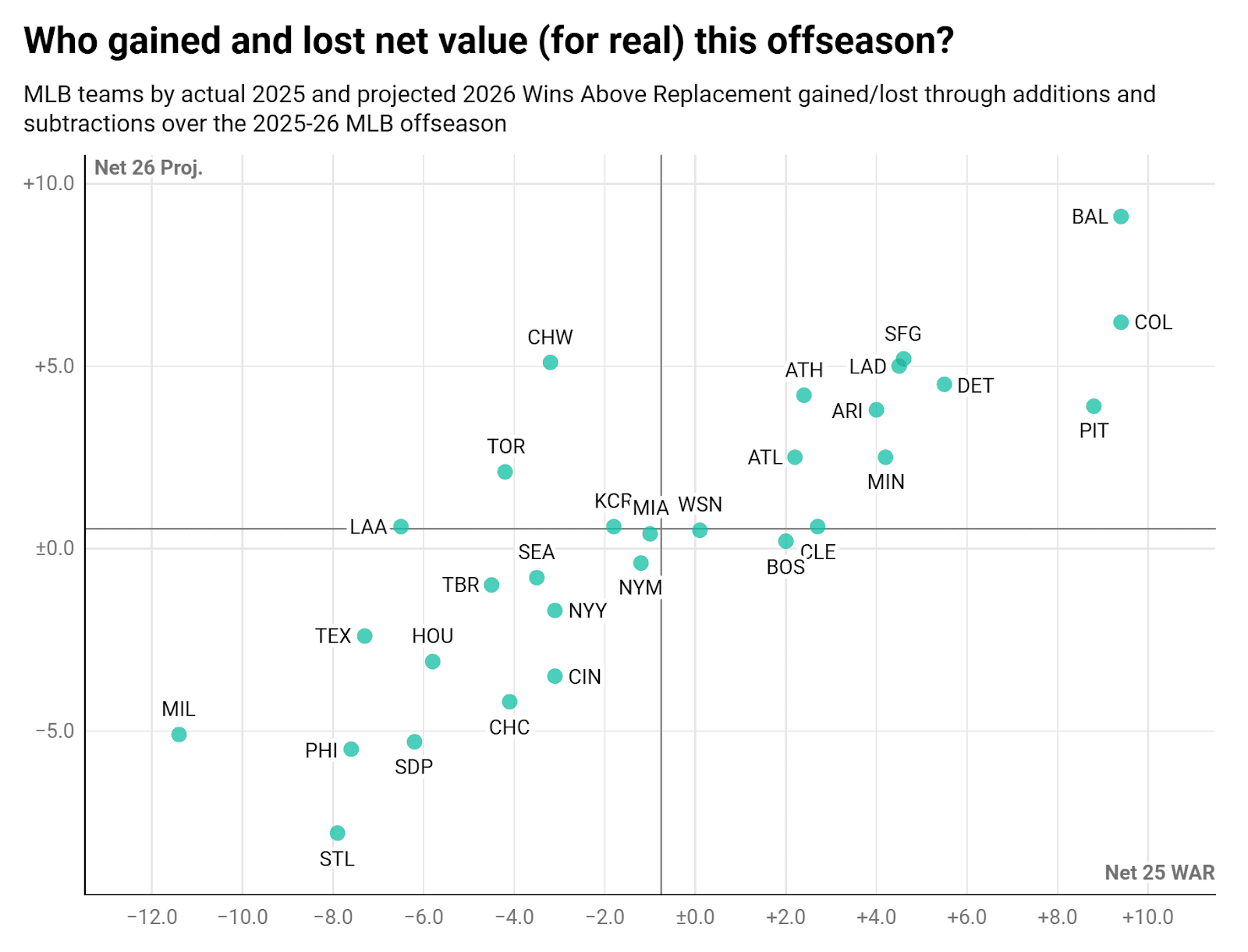
We can’t say the same about Baltimore, which brought up the rear last year in a crushing 75-win campaign dragged down by poor planning coupled with injuries and unexpected declines. In addition to hoping for more innings from Trevor Rogers and Kyle Bradish, more productive plate appearances from Samuel Basallo and Dylan Beavers, and rebounds at bat by Adley Rutschman, Colton Cowser, and Tyler O’Neill, the O’s have tried to make up for their past inactivity—belatedly, but better late than never—by signing Pete Alonso, Chris Bassitt, and Ryan Helsley and trading for Taylor Ward and Shane Baz. As Paine showed this week, the result was the league’s largest net pickup of 2025 and projected 2026 WAR this winter.
All in all, the Blue Jays and Orioles ranked second and fifth, respectively, in money committed to free agents this offseason (and third and fifth in total offseason spending); the Yankees and Red Sox also cracked the top 10 in free-agent outlays. The Yankees and Jays rank third and fourth in player payroll, too. It’s not an accident that the East has been so good for so long; its three big-market, historically high-spending teams have put pressure on their rivals to keep up, even if in Tampa Bay’s case that tends to be with smarts instead of dollars.
So start with a division of closely clustered teams, keep the talent on the best ones, and splurge to improve the worst one: That’s a formula for a free-for-all. On Opening Day, Baseball Prospectus’s PECOTA system projected all five AL East teams to have winning records, which has never happened in any division. (Only twice has a division featured no losing teams, and in both cases, one team finished at .500.) The Red Sox, Orioles, and Rays were all projected to finish 83-79, with the top team (the Jays) at 89. That’s almost literally too close to call, in that the range from best to worst—only six wins—is smaller than the margin of error of a theoretically perfect projection.
BP has been publishing preseason PECOTA projections since 2003. So how does this year’s crop compare with past years?
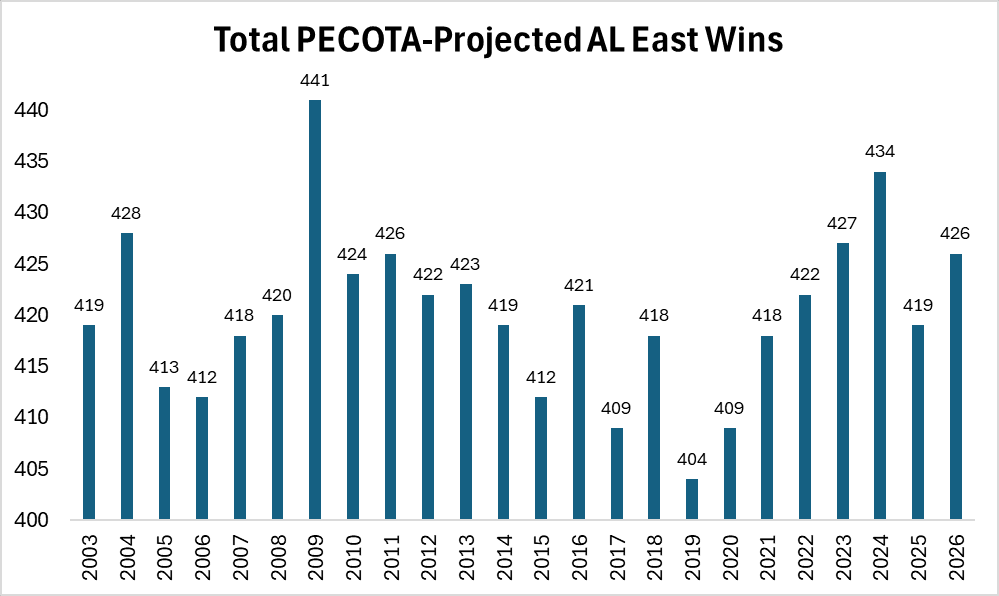
The combined 426 wins PECOTA apportioned to the East is a lot—but this division has been a meat grinder for a very long time, so it’s not the most. In fact, it’s tied for the fifth-highest wins projection in this 24-season span, with 2009’s 441 leading the pack. (The figure from 2020 is from March of that year, before the season was shortened.)
Although there’s no weak link in this year’s AL East projections, there’s no standout team, either. That’s partly a product of an MLB era marked by mediocrity (or perhaps, to put a positive spin on it, parity). Not for the first time, PECOTA loved the Dodgers, projecting 103 wins for L.A.. But most of this year’s projections were more muted, which makes sense considering that no team has won more than 98 games since 2023. The expanded playoffs encourage competence more than excellence.
So if this isn’t the most stacked AL East ever, per PECOTA, might it be the tightest? Actually, yes. That six-win range between the highest and lowest projections is, unsurprisingly, the smallest on record, and the standard deviation—a measurement of how widely dispersed around the average the individual values are—is the second smallest, after last year’s.
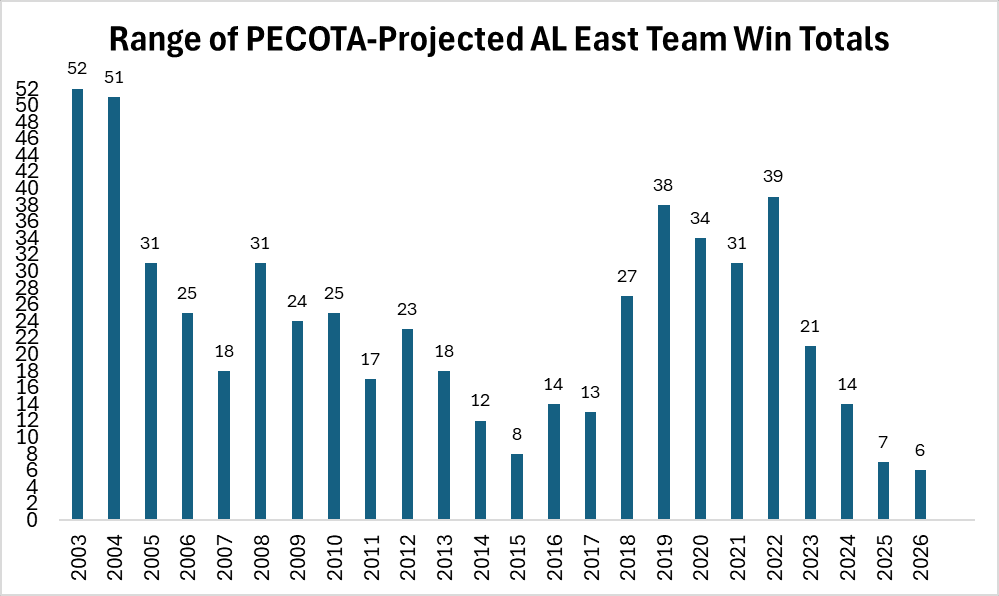
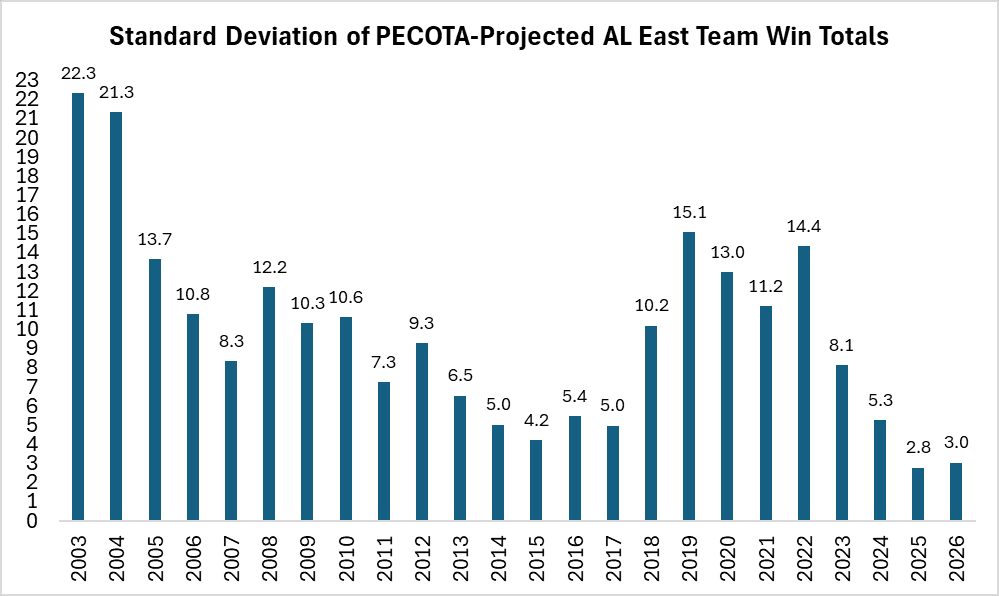
If you’re wondering about those inflated values for the first two years on the chart—well, PECOTA was a little overexuberant in its youth. As a rookie, PECOTA projected the 2003 Yankees for 109 wins and the Sox for 104; the next year, the system foresaw 106 wins for both teams. That was the thick of the Yankees–Red Sox rivalry, but those teams weren’t quite that good. After that, PECOTA learned its way around the league and started acting like it had been there before. Even relative to later years’ preseason pictures, though, the current AL East outlook is intense. And while last year’s AL East didn’t wind up being a four- or five-way race, there was a tie at the top.
PECOTA is only one system, but it’s not wildly out of line with its peers. FanGraphs forecasted a different division winner this year (the Yankees), but a similar range of wins (80 to 89). (Last year’s FanGraphs projections for the AL East were more tightly clustered than this year’s at BP.) Covers.com keeps an archive of preseason Vegas win totals for MLB teams dating back to the ’90s, drawn from newspaper archives before 2009, offshore sportsbooks from 2009 to 2020, and BetMGM from 2021 on. In the 29 seasons since 1998, this year’s Vegas totals are tied for sixth in total wins and smallest maximum-minus-minimum range and seventh in standard deviation.
To this point, we’ve been dealing with projections, but I’ll leave you with a look at actual results. The three charts below display the total wins, ranges of team win totals, and standard deviations of team win totals in the AL East in each season dating back to the beginning of its modern makeup (excluding 2020).
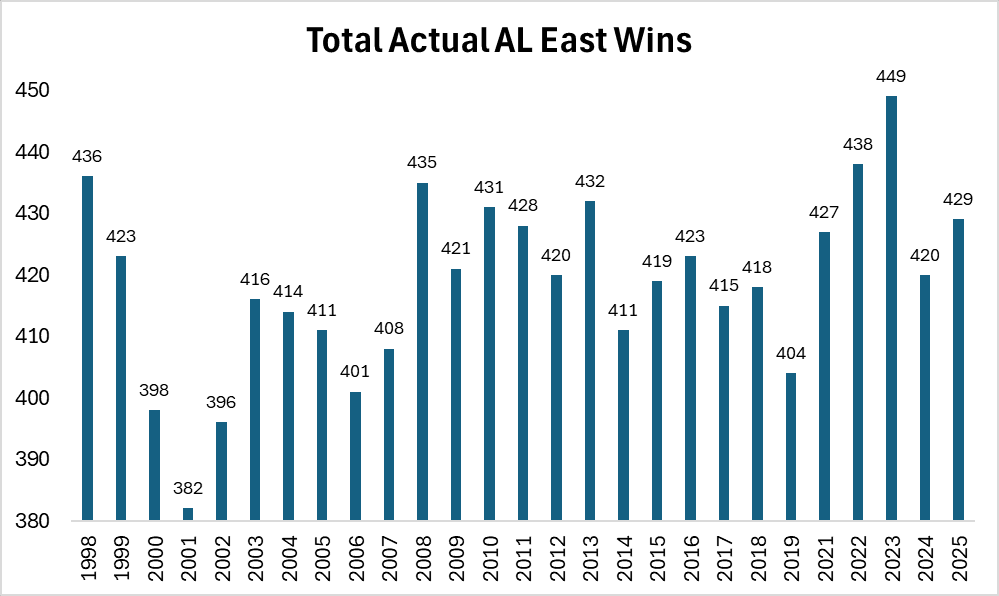
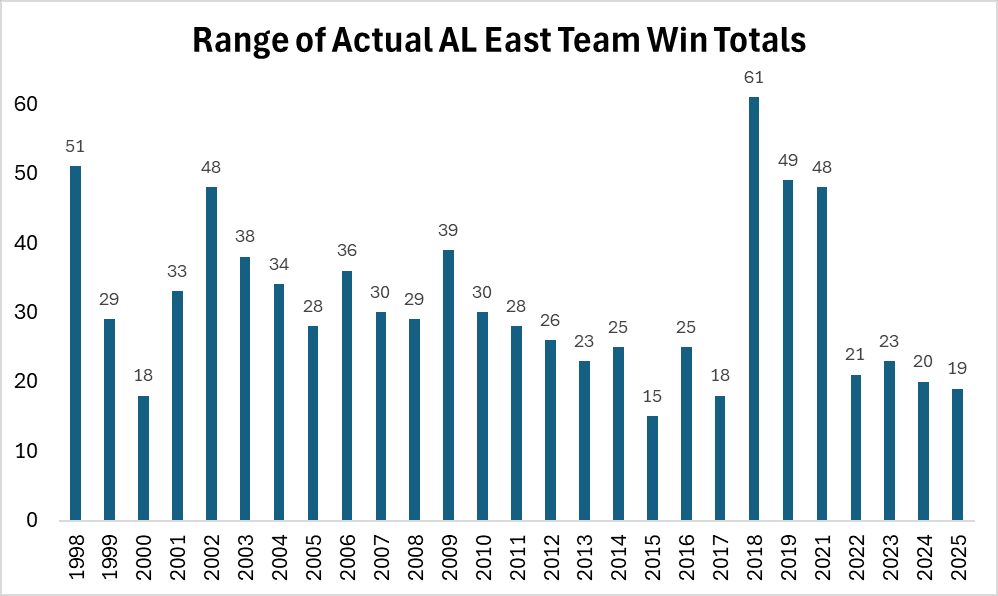
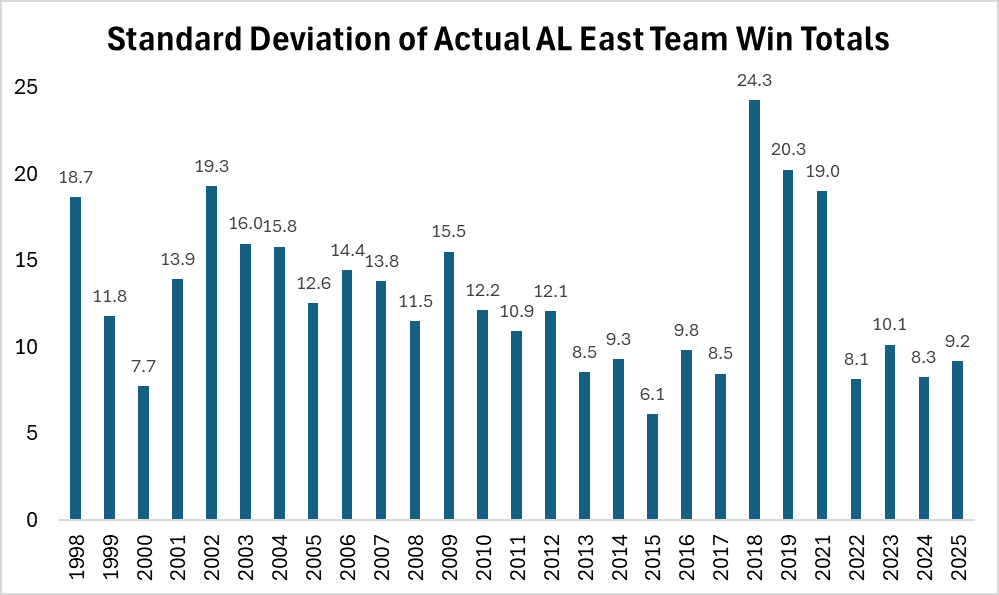
The most combined wins by AL East teams: 449, in 2023, when the Orioles led with 101 and no team won fewer than Boston’s 78. The smallest range of win totals and the smallest standard deviation: 15 and 6.1, respectively, in 2015, when the Jays won the division with 93 wins and the Sox finished last with 78. Those are the numbers to beat.We can’t yet extend those charts to 2026. That is, as they say, why they play the games. What we can say with some confidence, at this early stage of the season, is that the AL East won’t be quite as close from top to bottom as PECOTA would have us believe; no projection survives first contact with the enemy. But we can also surmise that MLB’s perennial juggernaut of a division isn’t done giving us great races to anticipate—and, as usual, laying waste to the rest of the league in the process.