
On Wednesday evening in San Francisco, a computer will call balls and strikes in a Major League Baseball game. Not all of the pitches, not most of them, not even many of them. But one is all it will take to make history. At some point in the contest, some catcher, hitter, or (possibly) pitcher on the Yankees or Giants will issue the first challenge and become the eternal answer to a trivia question, the Ron Blomberg of the automated ball-strike system (ABS). And with that one ruling—confirmed or overturned—more than a century of sci-fi automated-umpire dreams will be fulfilled.
Sort of. Because a human umpire will still be making all the calls. He’ll just have to stand (or crouch) corrected, should a player find fault with one of his rulings and the Hawk-Eye cameras and computers concur.
That caveat doesn’t invalidate the moment’s trivia potential. But it does leave open the possibility that the player who initiates the first challenge this week will one day be joined in the annals of pitch-calling firsts by the player on the receiving end of the inaugural call issued solely by a computer. Because as fascinating as the short-term questions surrounding the challenge system are—How will teams use their challenges? Which players will be best at challenging? How will the new system affect offense and catcher defense?—the medium-to-long-term question intrigues me more. Is the challenge system the final form of pitch adjudication? Or is it just a significant step along the path to full ABS and automatic computerized calls?
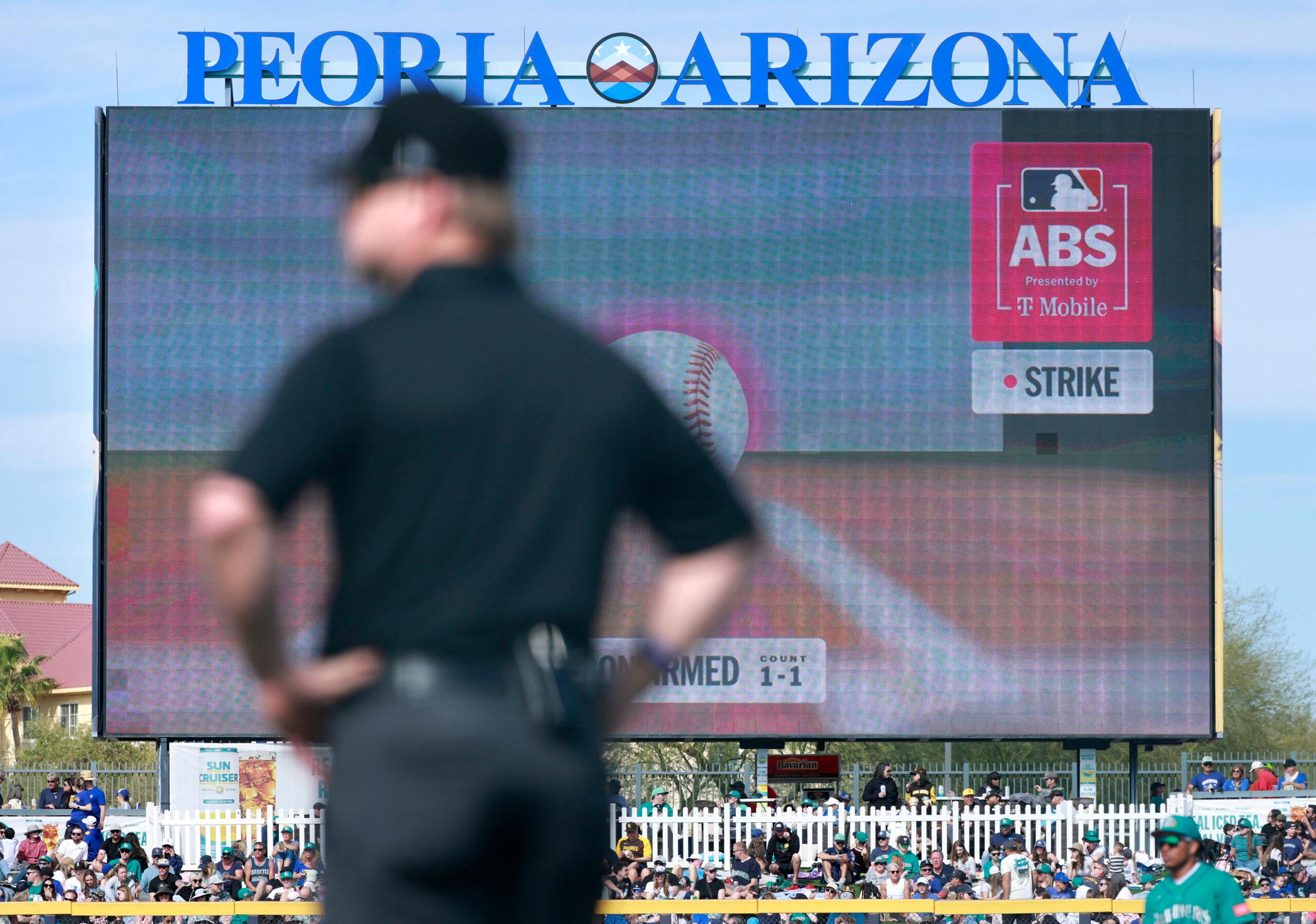
As a refresher: In the current incarnation of the challenge system, each team begins the game with two challenges. Correct challenges don’t diminish that allotment, and extra challenges are granted should the game go to extra innings. Batters, catchers, and pitchers are eligible to challenge; they must make the decision to do so on their own, within two seconds after the pitch, and tap their cap or helmet to signal for a review. A brief animation of the pitch trajectory on the TV broadcast and the ballpark video board reveals the pitch’s location and the ball/strike call. Challenges average approximately 14 seconds apiece, and on average, roughly four are requested per game. There are other wrinkles, but that’s the gist. Per The Athletic, MLB is “95 percent confident that a pitch would be within 0.39 inches” and “99 percent confident that [a pitch] would be within 0.48 inches” of its ABS-specified location. The system is still fallible, but less so than one with human umps on their own.
For the purposes of the challenge system, the ABS zone is 17 inches wide, just like home plate. The top and bottom borders of the zone are set at 53.5 and 27 percent, respectively, of the hitter’s (precisely measured) height. (The zone doesn’t account for hitters’ stances.) Pitches are measured at the midpoint between the front and back of the plate. The rule book zone is three-dimensional, but challenge-system testing with 3D zones yielded unwanted strikes on unhittable pitches (such as low-breaking balls that nicked a sliver of the zone) that human umps would have invariably called balls.
Although we don’t have data on how the challenge system will function in meaningful major league games, several seasons of minor league games and back-to-back big league spring trainings are a pretty good guide. It certainly looks like leaguewide overturn rates won’t be much better than a coin flip and that catchers will have higher success rates than hitters. (Pitchers are easily the least accurate challengers and will be strongly discouraged from trying it often, if at all; eventually, some hitters or even catchers could have more license to challenge than others, based on their challenging skill.) Very short hitters might benefit from fairer, personalized zones more than very tall hitters. Offense will probably benefit a bit from a reduction in strikeouts and an uptick in walks. Catcher framing will still matter, both because not every pitch can be challenged and because catchers could deke hitters into challenging pitches they shouldn’t. Catchers’ challenging acumen matters, too, so if anything, catchers could become more crucial, instead of losing a lot of defensive value as they would with full ABS. Manager ejections may be scarce.
Teams and public analysts have poured plenty of time into determining when to challenge. Unless a call is egregious, challenges should be reserved for higher-leverage moments: those with deep or decisive counts, especially late in the game and with runners on base. It makes sense to save challenges for high-stakes moments, but hoard them too long, and you might never get to use them at all. On a team level, having a high success rate means that you might not be questioning calls often enough. For those who enjoy digging deep into tactics, strategy, and value, challenges are a rich text: Already, leaderboards and dashboards abound.
The last time MLB introduced a long-anticipated, technological solution—the pitch clock—for a rule that had proved impossible for humans to enforce, MLB executive VP of baseball operations Morgan Sword called it “probably the biggest change that’s been made to baseball in most of our lifetimes.” The implementation of the challenge system is comparably momentous and conceptually similar. Before the pitch clock, MLB had rules on the books about the time between pitches, but they were all but impossible to police. Before ABS, MLB had a strike zone, but it was all but impossible to call perfectly according to the rule book dimensions. (Although umpires have improved dramatically in that respect.)
The two landmark measures share other commonalities. For one thing, MLB tested both the pitch clock and ABS carefully, across several seasons and professional levels. (The league began testing full ABS in the minors in 2021 and the challenge system the following season.) Not only did that gradual introduction give players time to acclimate to the idea, but it also allowed MLB to fine-tune the details. Just as various time allotments on the clock were tested in various environments, many permutations of the ABS zone had auditions: different plate widths, different top and bottom borders batted on percentages of hitter height, different depths relative to the front of the plate, different numbers of challenges, and so on. MLB learned from those painstaking experiments and went with the least troublesome configurations when the systems were deemed ready for prime time.
The challenge system is in some respects as big a break with baseball tradition as the pitch clock was, but aesthetically speaking, it won’t be as impactful. The clock affected every pitch, or at least the time between every two pitches, whereas only about 1 percent of pitches (or 7 percent of borderline takes) produce challenges. MLB’s pitch clock era felt distinctly different from the period that preceded it: After the clock debuted in the big leagues, the pace of the game was so transformed that viewers were always aware of the change, even when the clock wasn’t visible. By contrast, MLB in the ABS era will largely look and feel like it did before.
The other potential difference between MLB’s biggest triumph of the 2020s and its latest innovation—well, aside from the fact that ABS relies on highly advanced cameras and computers, whereas the pitch clock is literally just a low-tech countdown clock that could’ve been used decades earlier—is that the pitch clock conclusively solved the problem it targeted right away. Games got dramatically shorter and more predictable in length, and most doubters became converts as soon as they saw it in action. MLB has tweaked the specifics slightly since the clock debuted in the big leagues to prevent backsliding and circumvention—in 2024, the permitted time with runners on was trimmed from 20 seconds to 18—but basically, the pitch clock arrived in the majors as a fully formed, finished product.



More on MLB
The challenge system might also be close to its ideal form—but the challenge system is, fundamentally, a compromise plan. It’s a means of correcting egregious calls while still preserving some of the old-time “human element.” As such, it’s either a “half measure” (complimentary) or a “half measure” (derogatory), depending on one’s preference for tactical complexity versus simply maximizing the number of correct calls.
Assuming that the system doesn’t suddenly go haywire—which seems quite unlikely considering how smoothly the rollout has gone in consecutive major league spring trainings, not to mention the years of testing that preceded them—there seem to be three potential ways this could play out, two of which would lead to the same outcome.
First: Everyone loves the challenge system, much like everyone loves the pitch clock, and it becomes a permanent, unquestioned fixture—even selling point—of the league. At most, a minor tweak from time to time might be in order. On balance, the baseball community collectively says, “No notes,” and that’s that. All talk of full ABS—or, for that matter, reverting to only human umps—subsides.
Some evidence suggests that such wholehearted acceptance could be in store. In an MLB survey of Triple-A players and coaches conducted in May 2023, 60 percent said that they preferred to play with the challenge system in place, compared with only 24 percent in favor of human umps and only 16 percent in favor of full ABS. And in an MLB survey of fans during spring training in 2025, 72 percent said that ABS had a slightly positive or very positive effect on their game experience, compared with only 10 percent who deemed it a negative. When the fans were asked whether they’d rather see the challenge system or only human umps, the challenge system trounced the umps 69-31. Maybe some of that skewed sentiment was just the thrill at first come-ump-ance: The head tap, the suspenseful on-screen display, and the grand reveal are more fun the first time than the thousandth. But for the most part, people simply like the system. In all likelihood, first impressions from MLB games will be positive, too.
In fact, reception could be so positive that the challenge system brings about its own demise. Dissecting challenge-system strategy may delight analytical onlookers, but for many fans, what matters most is that there’s now a recourse to correct bad calls. And if the system works flawlessly, it won’t be long before its fans start to wonder why MLB is artificially constraining correct calls in service of a second-guessing mini-game. In other words, if you can get all the calls right from the get-go, why preserve a system in which players will regularly refrain from challenging (or run out of challenges) because the supply is so limited, thereby allowing inaccurate calls to stand? Especially when viewers will be able to look at the pitch plots and (despite minor tweaks to the presentation of TV strike-zone graphics) tell right away that an incorrect call likely could have been overturned?
The availability of instant replay on TV broadcasts made the eventual adoption of replay review in games inevitable because it was untenable for people watching at home to see so many incontrovertible mistakes stand. For the same reason, the availability of precise pitch-tracking technology and the plotting of pitch locations on people’s screens made bad ball/strike calls more galling and helped usher in the challenge system. It may do the same for full ABS.
If the system works flawlessly, it won’t be long before its fans start to wonder why MLB is artificially constraining correct calls in service of a second-guessing mini-game.
“At one point people are going to run out of challenges, sometimes early in the game,” Red Sox manager Alex Cora recently told The Boston Globe. “When you run out of challenges it’ll be back to what we used to do.” And maybe no one will want to go back, especially when everyone will be well aware of the potential overturns they’re missing out on. MLB could give teams more challenges: In some minor league testing, teams started with three apiece. But the more common challenges are, the more total time they’ll take and the less exciting each one will be. In a survey of fans at Triple-A games, 71 percent said that the optimal number of challenges is four per game or fewer; games with three challenges per team exceed that benchmark 70 percent of the time, compared with only 38 percent of games with two challenges per team. Tacking on additional challenges might just make it more obvious how easy it would be to have no time delays or call limitations at all.
In this version of events, the challenge system is too good for its own good and becomes a victim of its own success. It’s more a proof of concept for full ABS than it is a viable long-term alternative. There’s precedent for this progression, too—and we don’t even have to look further than Hawk-Eye.
Hawk-Eye was first used as the basis of a challenge system on line calls in ATP and WTA tennis tournaments in 2006. The system was widely embraced, but by 2017, Hawk-Eye Live—an entirely automated system that removed the need for challenges or human line judges—had arrived, and pandemic-era restrictions on on-court personnel accelerated its rise. In 2023, ATP announced that it would use the system—rebranded as Electronic Line Calling (ELC) Live—in all matches by 2025. Wimbledon acquiesced last year, in a move that the tournament’s chief executive called “inevitable.” Occasional hiccups aside, ELC Live has worked well. Of the four majors, only the French Open persists in relying on human line judges. In baseball, there may be even less resistance to extending ABS’s control because human home plate umps would still be required to make other kinds of calls. Thus, switching to full ABS wouldn’t immediately render anyone redundant or lead to layoffs.
There’s a darker timeline that would also bring about a full ABS takeover. Blown ball/strike calls in the WBC semifinal matchup between the U.S. and the D.R.—including a game-ending howler of a strike call on Geraldo Perdomo—were understandably seen as arguments in favor of ABS. The next WBC will almost certainly feature the challenge system. But there’s no guarantee that a big game won’t end the same way in MLB because a team is out of challenges. Plus, much as replay review sometimes imposes an awkward delay before a seemingly victorious team can celebrate, the challenge system will sometimes overturn what initially appear to be game-ending strikeouts or walks. What if a World Series ended on a tap-off? That specific scenario is unlikely, but full ABS would remove the risk. If human umps aren’t making calls in the first place, those calls will never need to be reversed.
As a catcher-defense devotee and a certified stathead sicko, I prefer the challenge system to full ABS. But I’m reluctant to get too attached to it, lest I lose it before long. The system may have been doomed before it debuted—and I mean that as a compliment to the technology. I’d like to be wrong—and there’s plenty of precedent for that—but I’d consider it an upset if the system lasted nearly as long as Hawk-Eye did in tennis before Hawk-Eye Live supplanted it. I won’t be surprised if the drumbeat for full ABS starts building before the challenge system wins rookie rule of the year.
This week, the prospect of big league balls and strikes being called by computers goes from “someday” to “today.” Once more fans see the system in action, they’ll probably wonder what took so long. So the question isn’t whether we’ll ever go back to pre-ABS baseball. The question is how long it’ll be before full ABS arrives.