
If you’re looking for candidates to end an extended playoff drought in the 2026 MLB season, some squinting is required. Of the 12 teams with the highest FanGraphs playoff probabilities as of Opening Day, nine made the playoffs last season, 11 made it within the past two seasons, and all 12 made it as recently as 2023. (The Rangers, who have the longest active playoff drought among these favored dozen, won the World Series that year.) Of the teams with the top 20 playoff probabilities, 19 have tasted October within the past three seasons. Meanwhile, of the eight MLB teams that haven’t made the playoffs in that span, most are locks to tack one more year onto their total.
Let’s list them. The Angels could be ticketed for the first hundred-loss season in franchise history, after missing out on that distinction by one win in 2024. The Cardinals, as consistent a contender as any non-Yankees or non-Dodgers squad this century, have embarked on an uncharacteristic rebuild that will probably pay dividends down the line but leaves them as far from the playoff picture on Opening Day as they have been in decades. The Nationals are re-rebuilding. The White Sox have gotten significantly less depressing since 2024 but are still at least a year away from having designs on even a lackluster division. The Rockies … come on, now.
The Giants have a chance to escape this not-so-great eight, but they epitomize mediocrity: They’ve won 79 to 81 games in each of the past four seasons, and both Baseball Prospectus and FanGraphs project them to win precisely 81 this time around. Enough could break right for them to claim a wild card, and their college-to-the-majors manager might be fun to follow, but I defy anyone, Giants fans included, to be excited about this team today.
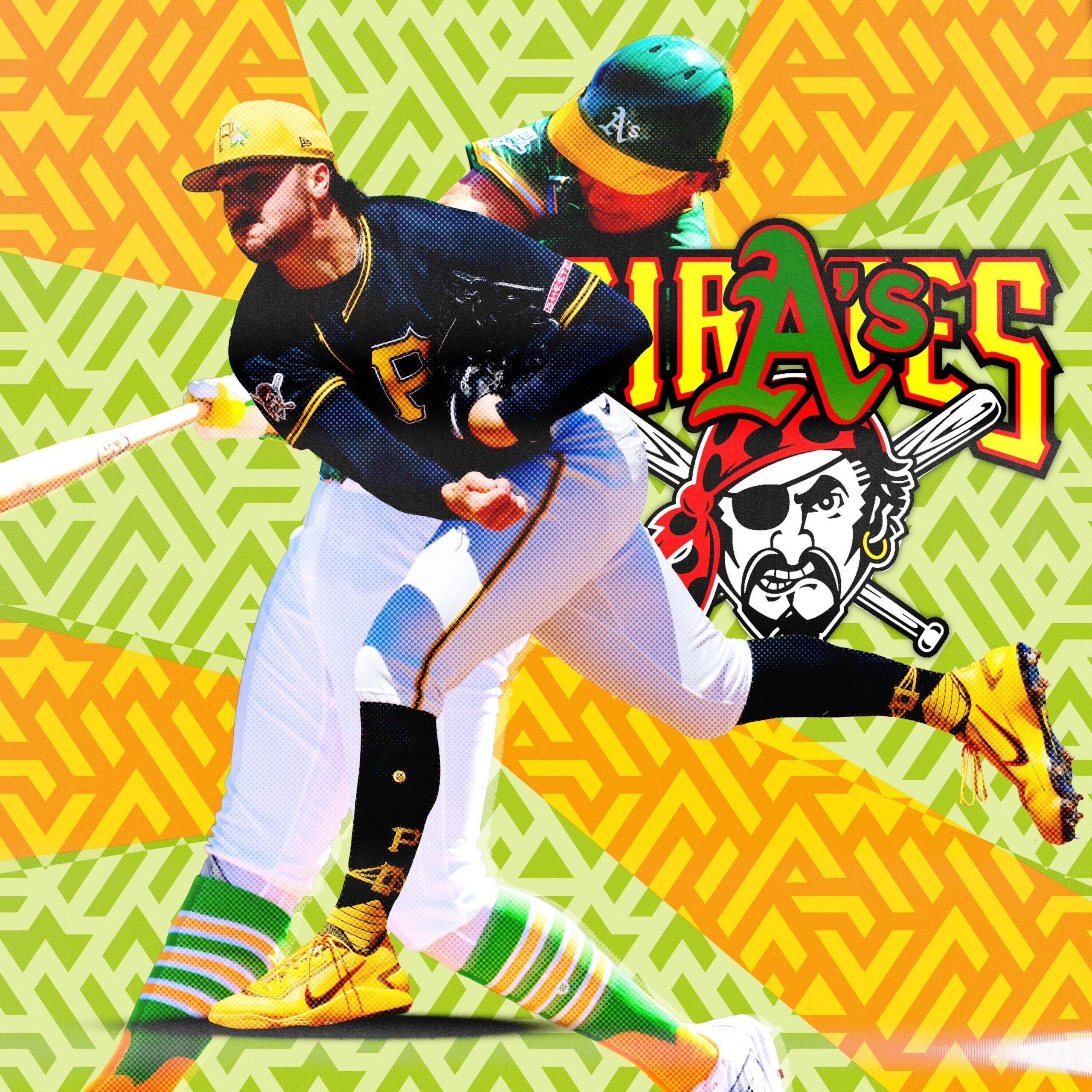
Only when we reach the last two tentacles of this octopus of perennial also-rans do I become the Kombucha Girl meme. Can I interest you in the Pittsburgh Pirates and the (unofficially Sacramento) Athletics? Here we have, if not two good teams, at least two halves of good teams: Pirates pitchers and A’s hitters. Independently, each team is an unfinished horse drawing. If we could combine them into the Piretics, we’d really be in business.
In 2018, I vivisected the then-terrible Orioles and Royals into the “Orioyals” and determined that even with their powers combined, they would be big losers. These Pirates and A’s lend themselves to the same exercise, with superior results. In early February, FanGraphs’ Dan Szymborski used his ZiPS projection system to (technical term) smoosh the two teams together and project how good the resulting roster would be. The hypothetical combined club averaged 89 wins and graded out as a contender in either the NL Central or the AL West. Pirates pitching plus A’s hitting equals two great tastes that taste great together.
The actual Pirates and A’s are far less likely to make real runs at a return to October after their respective 10- and five-year absences. But even though they’re saddled with two of the sport’s worst owners—and, relatedly, two of MLB’s eight lowest payrolls—they’re kind of compelling. If we want to find fresh blood for the playoff field, we’ll have to settle for stanning lopsided dark horses.
Excelling at one facet of the game and stinking it up in the other is nothing new for these two teams. Last year, A’s hitters ranked eighth in offensive runs above average and 13th in position-player WAR. Pirates hitters ranked 30th and 28th, respectively. Pirates pitchers ranked fourth in FanGraphs WAR, while A’s pitchers ranked 27th. In simpler terms, the A’s scored the 12th-most runs, and the Pirates scored the fewest; the Pirates allowed the fifth-fewest runs, while the A’s allowed the fourth most. All told, the two clubs finished a combined 30 games below .500. Yet A’s hitter WAR and Pirates pitcher WAR put together would have ranked 10th in the majors in combined production, just behind the Mariners and ahead of four playoff teams (the Tigers, Padres, Reds, and Guardians).
This year is shaping up to be a similar story. Individually, the Pirates and A’s rank 21st and 22nd in projected team WAR, just a tenth of a win apart. (The A’s are 14th in hitter WAR and 26th in pitcher WAR; the Pirates are 24th in hitter WAR and ninth in pitcher WAR.) But the Piretics, a product of each club’s good side, would be 11th, sandwiched between two division favorites, the Tigers and Cubs.
MLB rules forbid alliances like this—out of such unholy unions, baseball abominations like the 1899 Cleveland Spiders once threatened to arise—so the A’s and Pirates are each on their own. Might either team’s strength outweigh its weaknesses by a big enough margin for the well-rendered rump to propel the hastily sketched head to the postseason?



More in MLB
The good news for the A’s and Pirates is that roster well-roundedness is overrated. On the whole, it doesn’t seem to matter much whether a team is comparably capable at pitching and hitting or excels on one side of the ball at the expense of the other. As long as the total value is similar, balance is beside the point. In a 2006 study published in SABR’s Baseball Research Journal, Cyril Morong concluded:
Balance seems to matter very little. More balance, holding everything else constant, only slightly increases winning percentage. The most balanced teams don’t win more than the least balanced teams. The teams with the best and worst winning percentages are no more or less balanced than other teams. Even in specific cases where teams saw a big change in balance … winning percentage hardly changed. General managers should concentrate on improving teams in any way that they can and should not worry if their team is balanced or not.
Plenty of “balanced” teams have been bad: Last year’s Rockies, for instance, who are catching their second stray in this article, ranked dead last in both batting and pitching. Last year’s Brewers were balanced, too: They ranked sixth in each category and led the majors in regular-season wins. Many teams have qualified for the postseason with bigger mismatches between their leaguewide ranks in FanGraphs batting and pitching WAR than the A’s and Pirates project to have. The table below lists the most lopsided playoff teams in the wild-card era (1995 on), in terms of the difference between their hitting and pitching ranks. Perhaps it’s heartening that a Pirates team—the 2014 wild-card winner—tops them all, albeit for being much better at hitting than pitching. Those Pirates lost to the Giants, who were nearly as lopsided in the same direction and who went on to win the World Series.
The Most Lopsided Batting/Pitching Playoff Teams, Wild-Card Era
As Morong wrote, merely being unbalanced isn’t bad. But an unbalanced club with playoff aspirations had better be elite at either hitting or pitching. And as much offensive firepower as the A’s possess, they may not have enough pop to put their subpar pitching over the hump.
Of the five A’s hitters with the highest wRC+ figures last season (minimum of 100 plate appearances)—Nick Kurtz, Shea Langeliers, Tyler Soderstrom, Brent Rooker, and Jacob Wilson—only Rooker is projected to hit as well or better this year. Kurtz, who won the AL Rookie of the Year award over runner-up Wilson, had the third-highest wRC+ of any rookie in major league history (minimum of 400 plate appearances), after Shoeless Joe Jackson in 1911 and Aaron Judge in 2017. He also had the third-highest gap between wOBA and expected wOBA of any hitter with at least 200 PA, which sometimes indicates a coming regression, although the presence of four A’s in the top 10 on that leaderboard suggests that Sutter Health Park may have helped. (The team’s temporary home increased scoring more than any other park except Coors Field last season, although the A’s actually hit more homers on the road.)
Then again, the starting lineup’s holdovers beyond last year’s biggest boppers—Lawrence Butler, the other Max Muncy, and defensive standout Denzel Clarke—are all projected to be a bit better than they were, if not exactly good. And the team’s highest-profile pickup over the winter—second baseman Jeff McNeil, acquired from the remodeling Mets in December—shores up a keystone spot that was weaker last year than any other club’s except the Rockies’. (Third Rockies stray!)
What’s especially exciting is that much of the core of this A’s offense is committed to the team for the long term. Rooker, Wilson, Soderstrom, and Butler have all signed extensions through at least 2029, the year after the franchise’s prospective debut season in Las Vegas, and Kurtz and Langeliers have also been in contract talks with the team. The A’s had the third-youngest collection of batters last season, and there’s more youthful talent on the way: 19-year-old shortstop Leo De Vries, the centerpiece prospect of last summer’s Mason Miller trade, made it to Double-A last year, raked in this year’s spring training, and may be in Sacramento soon.
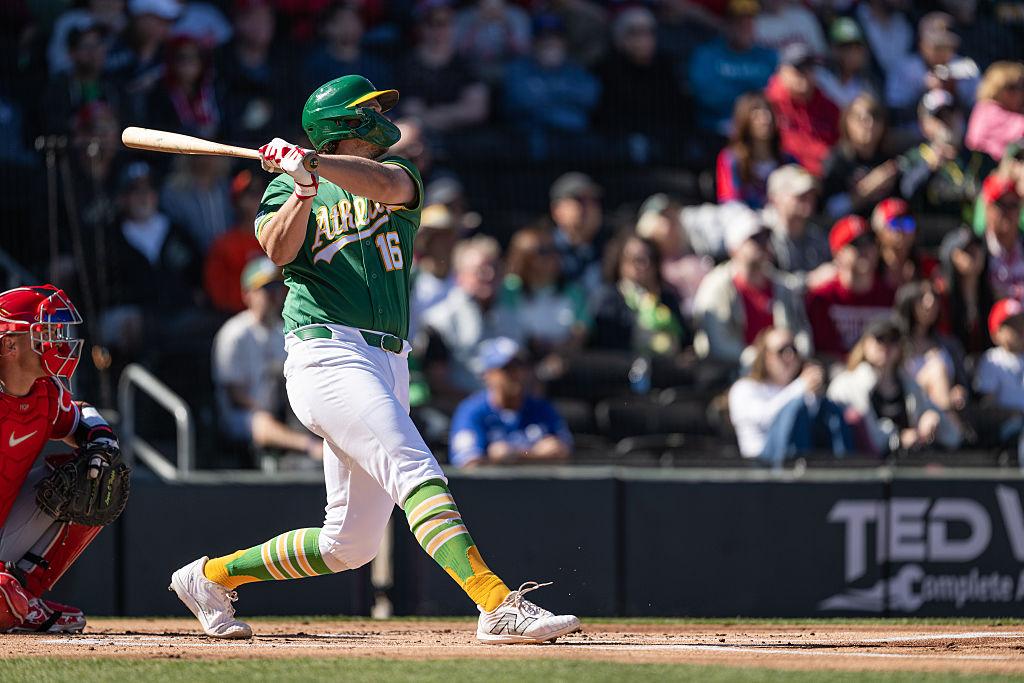
Nick Kurtz bats during a spring training game against the Los Angeles Angels
Unfortunately, the A’s also have to pitch. And the only offseason additions to last year’s lousy staff were relievers Mark Leiter Jr. and Scott Barlow and starter Aaron Civale, which explains why both the bullpen and the rotation are projected to again be among MLB’s worst. The team’s top pitching prospect, Gage Jump, could bolster the staff at some point this season, but it’s still going to get ugly. Only a few teams spent less on free agents this past winter than the A’s. It’s hard to know whether that’s more attributable to John Fisher’s penny-pinching or to the fallout from A’s “ace” Luis Severino’s complaints about the ballpark last summer—why not both?—but it’ll be a tall order for even this A’s offense to score more runs than this A’s staff allows. Hence the team’s modest playoff probability of roughly 21 percent.
The Pirates, however, have more than double those chances because their arms are even better than the A’s bats (and their bats are at least as good as the A’s arms, if not better). Paul Skenes didn’t make it out of the first inning on Opening Day, thanks to a workload limit and shoddy defense behind him, but the 23-year-old reigning Cy Young Award winner is the best pitcher in the National League. Skenes fronts a starting rotation composed entirely of young to youngish, homegrown Pirates, including Mitch Keller (the wizened veteran at 29), Bubba Chandler, Braxton Ashcraft, and Carmen Mlodzinski. Then there’s the additional homegrown depth, including Jared Jones, who’s recuperating from internal brace surgery and may be ready to return in late May; Hunter Barco; and Thomas Harrington. Even after trading Mike Burrows to Houston in the three-team swap that brought back Brandon Lowe, Jake Mangum, and Mason Montgomery, the Pirates seem to have a surplus of pitching and one of the best projected rotations in baseball.
In fact, if all goes well—and hey, when doesn’t all go well with young pitchers, right?—the Pirates could end up with one of the highest FanGraphs WAR totals in more than half a century by age-30-and-under starters who had never previously pitched for another MLB team.
Most FanGraphs WAR by 30-and-Under SP Who Had Never Previously Pitched for Another MLB Team, After 1973
So can the Pirates hit? Who knows. A November Jeff Passan report that the Pirates were “primed to spend” more than twice their previous free agent record (a meager $39 million for Francisco Liriano) on Josh Naylor before Naylor re-signed with Seattle raised expectations for a Pittsburgh splurge. The Pirates were said to have pursued or expressed interest in other high-profile free agents—Kyle Schwarber, Kazuma Okamoto, Eugenio Suárez—but the biggest bats they wound up signing were Ryan O’Hearn and Marcell Ozuna. Lowe, Mangum, O’Hearn, and Ozuna raise the offensive floor, but four kinda cromulent 30-somethings do not a playoff-caliber offense make. A fully healthy Spencer Horwitz would help. So would a bounce back by Bryan Reynolds, a belated breakout by Statcast legend Oneil Cruz, or Henry Davis not being baseball’s worst hitter.
Oh, and then there’s that other guy: Konnor Griffin, the best prospect in baseball. Griffin, a strapping 19-year-old shortstop, raked his way from A ball to Double-A last year and competed for a big league job this spring. Although he hit some tape-measure taters, he also batted .171 and on-based .261, with 13 strikeouts and two walks in 46 plate appearances. Given his youth and upper-level inexperience—he played only 21 games in Double-A late last year—he would have had to tear up the Grapefruit League (or possibly, yes, sign an extension) to break camp with the big club. But if he has a hot start in the minors, the Konnor cavalry could arrive soon. Griffin already projects to be the Pirates’ second-best position player, and he’s preternaturally talented enough to make that forecast seem conservative.
The A’s and Pirates will probably play postseason-caliber baseball for at least half of their frames this season. The top halves of A’s innings in Sacramento and the bottom halves of Bucs innings in Pittsburgh will be the true test of whether they’re ready to end their October exiles and add some intrigue to what otherwise might be a fairly familiar playoff field. Will they be able to pass as complete competitors, or will they look more like two partial teams in trench coats? Uncovering the answer to that mystery ranks high among the many reasons this season to watch big leaguers play ball.
Thanks to Michael Mountain for research assistance.