How Doomed Is the Price of Oil? An FAQ.
Gas prices are skyrocketing due to the conflict in Iran. How worried should we be? Let’s go deep on exploding plankton, market mood swings, and one of the strangest industries in the world.

One inescapable fact about the price of oil is that it’s both a vital issue affecting the daily lives of billions of people and a supremely crass thing to have to worry about. Ever since the U.S. and Israel attacked Iran on the grounds of “We just sort of felt like it” last month, plunging the Middle East into chaos and sending gas prices through the ceiling, I’ve kept seeing variants of the same dark joke—a joke about how, if we were in the midst of the actual apocalypse, if the sky filled with green fire and the dead walked the earth, the American media still wouldn’t shut up about pain at the pump.
And yes, God, of course, I get it. There’s something unutterably depraved about looking at the rubble of the girls’ school in Minab, or at the more than 800,000 people in Lebanon displaced in the first 10 days of Israeli bombardment, and going, “OK, but how does this so-called rain of death and misery impact a 46-year-old above-ground pool technician in Maple Heights, Ohio, who just bought a pre-owned Chevy Silverado?”
On the other hand, very unfortunately, the price of oil is also a significant factor in the lives of … well, most people on earth. This is true on the individual level, in that the cost of energy determines who can access everything that uses energy (transportation, heat, food, medicine). It’s also true on the collective level, in that shocks to the oil economy can destabilize everything the oil economy touches (politics, international relations, prices of most goods, jobs, interest rates).
As the Iran conflict lurches forward on its strategically indecipherable timetable (it’s a war, it isn’t a war, it’s a war again, we need help, we don’t need help, no one will help us, we’ve already won but we’re still fighting, we’ve destroyed the whole Iranian military but Iran is still blowing up ships), this might be a good time to look at the least morally compelling and most globally significant aspect of the U.S.-Israeli attacks. If you’re anything like me, you probably already have a vague sense of how the oil market functions. Words like “crude,” “barrel,” “OPEC,” “supply and demand,” and “strategic reserves” are rattling around in your head. But you might not have the clearest sense of how all the pieces fit together because many of the pieces are boring and complicated, and life’s too short to waste time thinking about upstream hedgers on futures contracts (at least it was, before you started reading this article).
So let’s ask. What’s happening to the price of oil? What are the forces behind it? How does the oil economy actually work? And how screwed are we if prices keep skyrocketing?
Answer: pretty screwed! But you knew that. Let's dive into this sea of dark sludge together.
1. What exactly … is oil?
It’s the remains of prehistoric plants and animals, transmuted over millions of years into a golden-black gloop. We all know the term “fossil fuel,” but honestly, we don’t talk enough about how truly, truly weird it is that the interlocking systems of modern civilization are powered by the liquefied remnants of beings that lived on earth millions of years before we got here. Once there was a majestic dinosaur that took a nap among some ferns. Now you are able to fly to Boise at 7 a.m. on a Delta codeshare operated by SkyWest. Sincerely: What?!?!?
It’s important to note, though, that most crude oil—“crude” is the name for the oil that comes out of the ground, before it’s processed and refined; “petroleum” is another word for it—doesn’t come from dinosaurs. Most of it comes from microscopic sea organisms like plankton. I swear the main purpose of plankton is to make every story about biology less fun. It’s always like, “Behold, the blue whale, the most titanic of all creatures!” “Does it do anything cool?” “It mostly just swims slowly while microscopic sea organisms drift into its mouth.” In fairness, this probably does seem cool if you’re a whale.




More From Brian Phillips
2. How does a liquefied slurry of very ancient plankton make my car go?
Basically by blowing up! The oil industry word for the plant and animal remains in petroleum (remember, that’s another term for crude oil) is “hydrocarbons.” Similar sorts of hydrocarbons also make up coal and natural gas, by the way, though coal is exclusively plant-based. Believe me, you did not want to die 200 million years ago. So many bizarre things could have happened to your corpse. Anyway, when the hydrocarbons in gasoline are sucked up into a car’s engine, they’re ignited with a spark (this is the function of a spark plug). This makes them sort of politely explode. The pressure from the explosion pushes down on a piston, which then rises again post-explosion, and the rising and falling of the pistons helps turn the wheels.
Here’s a video that explains the process through the power of children’s animation.
Before petroleum can do anything, though, it has to be processed at a refinery. This is because crude oil is made up of a bunch of different types of hydrocarbons all mixed together, some heavier, some lighter, and engines are designed to work with a particular molecular weight.
So when the soup of mostly sea algae and (let me have this) some T. rexes is taken out of the ground, it has to be sent to refineries, where it’s separated into sub-soups of different molecular weights that can be used for different applications. Gasoline is pretty light. Diesel and heating oil are medium-weight. Asphalt is heavy. And yes, asphalt is a petroleum product. You drive in a box powered by exploding plankton corpses to the playground, where you shoot some hoops on a hard surface of (hopefully) non-exploding plankton corpses. Life is nothing if not complex.
And yeah, I realize this is a simplified explanation of how all this works. I would love to hear a more detailed breakdown from any engineers or scientists who happen to be reading this. Please write at great length, and direct all correspondence to idontcare@autodelete.biz.
3. Why is the Middle East so unusually rich in this sludge made of extremely old dead things (the world’s most precious substance)?
Because of the specific way two continental plates crashed into each other 30 million years ago. The Middle East doesn’t have the most oil of any region on earth; what it has is a lot of high-grade oil that’s relatively easy to access. Hundreds of millions of years ago, the area that’s now famously full of deserts was covered by a large sea called the Neo-Tethys Ocean. The Neo-Tethys Ocean was shallow and featured extended periods of low oxygen, which meant that our old friends the marine microorganisms didn't decay very quickly when they died. Instead, they sank to the seabed, hung out in the fissures of the rock, and slowly turned into oil over a span of eons. Never give up on your dreams (assuming your dream is to slowly turn into oil).
Then, 30 million years ago, which is last Tuesday in geological terms, the Arabian tectonic plate collided with the Eurasian tectonic plate. This pushed up a bunch of mountains, the Zagros range, now in [checks notes] Iran, and also thrust huge quantities of the old Neo-Tethys oil closer to the surface, where it sits conveniently in underground domes called “anticlines.” A lot of this oil is of a particularly desirable type—light, sweet crude, “sweet” meaning it has low levels of sulfur—thanks to conditions in the Neo-Tethys. And it’s comparatively accessible thanks to the tectonic plates.
Venezuela has more oil than Saudi Arabia, but it’s mostly darker and heavier, and thus more expensive to refine. In other places, there’s lots of light, sweet crude, but it’s harder to get at, and thus more expensive to extract. In this one extremely specific way, the Middle East is in the literal sweet spot.
Incidentally, the collision of the Arabian plate and the Eurasian plate also created a narrow strip of water called the Strait of Hormuz, which we’re going to hear more about in a second.


4. So petroleum is extracted from the ground, then taken to refineries to be turned into gasoline and diesel. Who decides how much it costs?
I’m going to tell you, but oh my God, you are not going to believe how bonkers the explanation is. Basically, it’s a combination of supply and demand, betting, and … vibes.
Before we get into it, though, let’s take a brief mental health break. Please enjoy this beautiful video of Niagara Falls, one of our planet’s greatest thrill rides for freshwater plankton. Maybe hit play on this and leave it running while you read the next couple of paragraphs.
The first and most straightforward part of the oil price equation is supply and demand. The more people want oil, and the less oil is produced, the more the price rises. Demand for oil is generally fairly robust, insofar as the entire planet craves it at all times. Humanity burns through about 100 million barrels of oil every day. There are about 42 gallons in a barrel, meaning our daily consumption rate is about 4.2 billion gallons. How much is 4.2 billion gallons?
Let’s see if we can work out a way to visualize that amount. Look back at that video of Niagara Falls. About 40 million gallons of water flow over Niagara Falls every minute. Arithmetic tells us that 4.2 billion divided by 40 million is 105. Every day, the world uses an amount of oil equivalent to 105 minutes of water flowing over Niagara Falls. Watch the video for an hour and 45 minutes, and you'll have an idea of how much oil we use in a 24-hour period.
Supply is where things get interesting. Oil-producing countries—particularly the 14 member states in OPEC, the Organization of Petroleum Exporting Countries—try to influence the price of oil by releasing more or less of it into the market. OPEC nations account for about 40 percent of the world’s oil production, so they exert considerable, but not total, control over the global oil supply. When the price drops below the level OPEC wants, OPEC cuts back, and when the price rises too much, OPEC floods the market. Other oil-producing countries play the same game: The massive oil stockpile of the U.S. Strategic Petroleum Reserve, for instance, gives the U.S. a means of increasing oil supply and thus driving prices down. (Last week, the Department of Energy announced it was releasing 172 million barrels to combat rising fuel costs caused by the conflict in Iran.)
The actual price of oil, however, isn’t set by OPEC. It’s also not set by the United States, or by Russia, or by your local Shell station, or even by the Niagara Falls tourism board. It’s set by traders in the futures market. The futures market is where investors buy or sell commodities at an agreed-upon price on some agreed-upon date in the future. Say I have a space-crystal mine, and you have a starship fleet that runs on space crystals. You might be worried the price of crystals is going to shoot up in six months, so you agree to buy some of my crystals at current prices on a future date, to avoid getting burned by a potential price increase. Alternatively, you might not have a starship fleet at all (get a starship fleet, loser), but you agree to buy some of my crystals in six months in the hope of flipping them for a profit. The vast majority of futures trading is of the latter variety—in other words, people speculating on future prices but not intending to use the commodities they’re buying.
Is this a form of betting? Basically! Is this the exact system on which prediction markets like Kalshi and Polymarket are modeled? It sure is!
It also means that the price of oil is heavily influenced by feelings. By mood. The price of oil is an emotional price. If I feel like, hey, things look pretty stable, the market is humming along, everything’s normal, etc., I’m going to expect to get crude at a reasonable price. If I feel like, oh boy, things are looking bleak, there’s a lot of instability, and this guy at Caltech might invent cold fusion tomorrow, I’m going to expect to pay more. And once my feelings are priced into the market via one of several benchmark reference crudes, they influence the cost of everything that happens to the oil afterward, including the price you pay at the gas pump.
Unrest in the Middle East tends to cause oil prices to spike, partly for the obvious reason—unrest threatens supply—but also because unrest feels like it’s going to threaten supply. Oil prices often rise during periods of upheaval even if supply isn’t affected, simply because the mood gets dark. And when supply is affected, as is the case during the current Iran conflict (more on that in a second), prices rise faster, because not only is there less oil on the market, but the mood is even worse.
5. So what’s happening to prices during the current Iran war, or non-war, or excursion, whatever we’re supposed to call it today?
I made you a graphic. I’m pretty excited about this. This is a timeline of the average price of gas over the past year (ending March 16, when I remembered how to add text in Photoshop). I took the graph from this website and just added a couple of small notes to bring the timeline into focus. Feast your eyes on this.
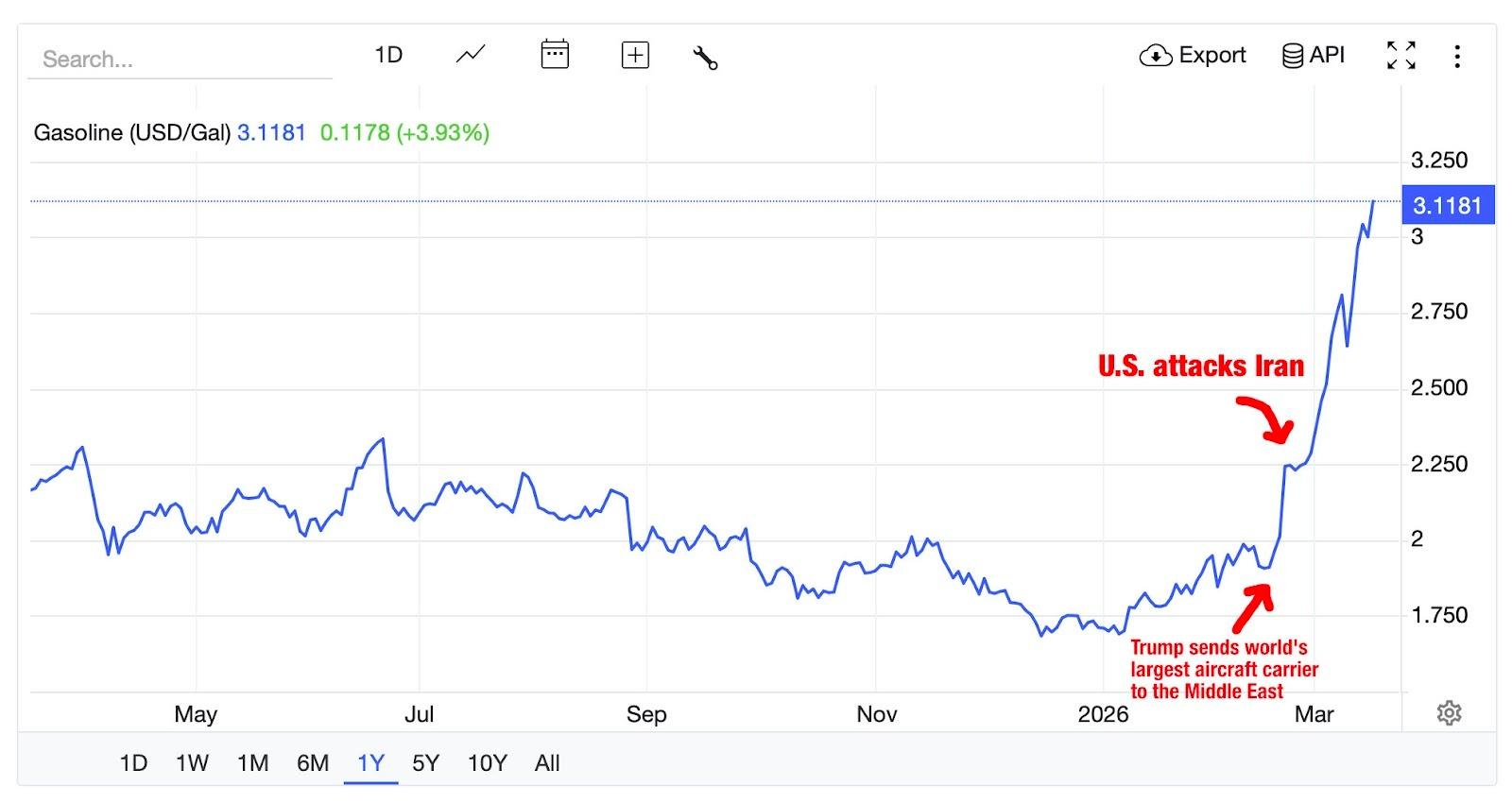
If you’ve followed the White House’s slopaganda videos, the Great Iran Something has seemed like a fun little adventure for the bros. But if you’ve stood at the gas pump in the past few weeks and gone, “What the fuck? This fucking sucks,” you’re not imagining things; prices have gone up and up.
6. What’s directly causing the price increases?
Some of it is the aforementioned investors’ feelings, but in the case of Iran, there’s also a direct supply issue. Remember the Strait of Hormuz, the narrow waterway that was created when two continental plates smashed into each other 30 million years ago? The Strait of Hormuz is only about 100 miles long, but it happens to be the only water route between the Persian Gulf and the Indian Ocean. A fifth of the world’s oil output travels through it en route from the Middle East to the rest of the world. Iran is on the strait’s north coast, which means Iran can attack ships passing through the strait. Which means Iran can shut down the strait—thus dramatically curtailing the flow of oil out of the Middle East—whenever it wants to.
And that’s what Iran is doing. After the U.S. and Israel launched their assault on February 28, Iran started attacking ships in the strait with drone boats and mines, trapping hundreds of ships in the Persian Gulf. Oil can’t get out; prices rise. Investors worry; prices rise more.
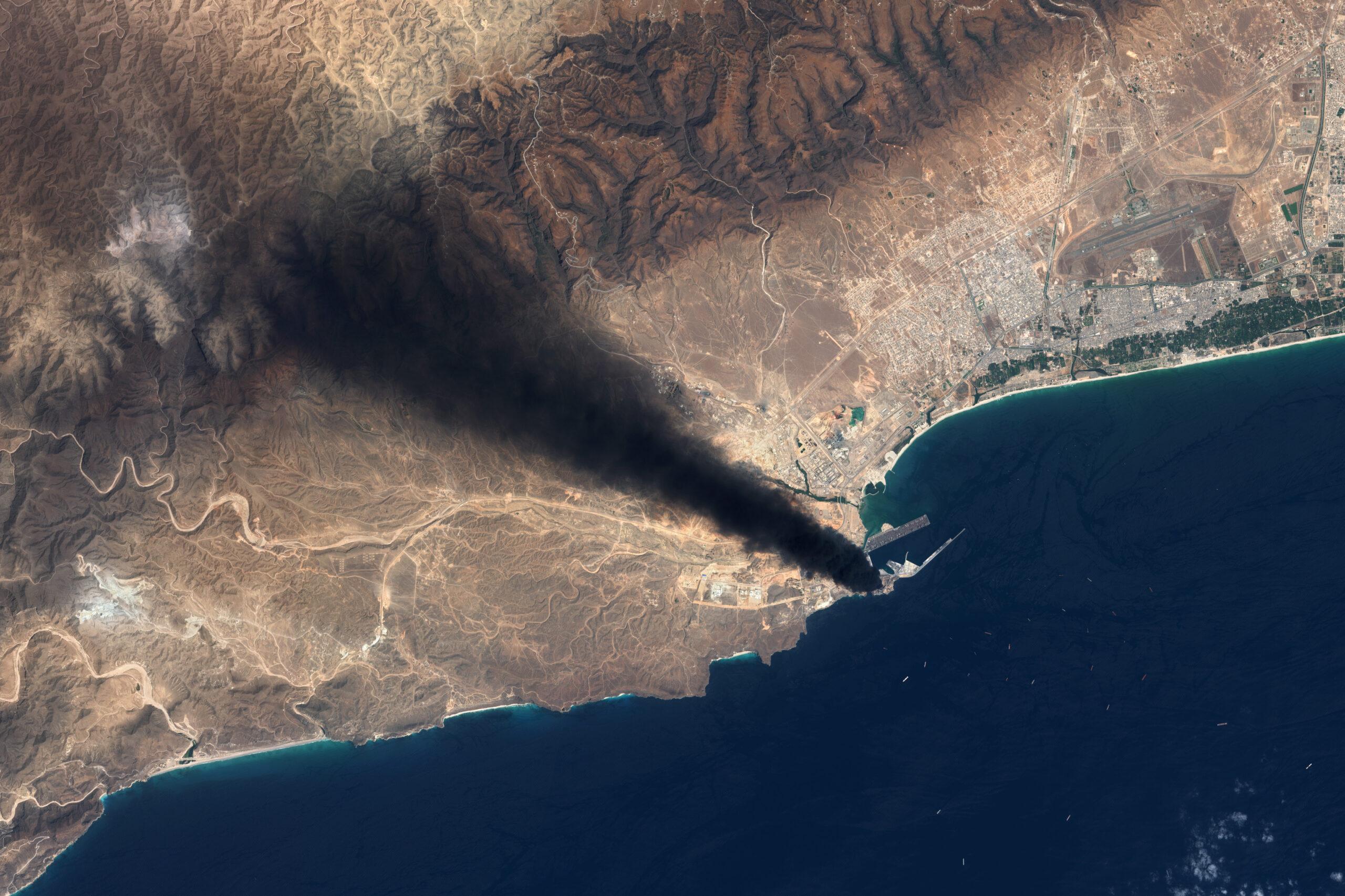
Satellite view of the Salalah oil storage fire in Oman. An Iranian drone strike on March 11 ignited the blaze, sending a plume over the Gulf of Oman’s strategic port.
7. How does Iran retain military control of one of the world’s most strategically significant waterways if the president of the United States says 100 percent of Iran’s military capability has been destroyed?
Wow, great question. It might be time to consider the possibility that the president of the United States is completely full of shit.
8. Do rising oil prices around the world even matter in the U.S.? Trump says the blocking of the Strait of Hormuz “doesn’t really affect” us since the U.S. produces more oil than we use.
Yeah, that’s another one for the “completely full of shit” column. The oil economy is global. Prices respond to the total supply, not to the local production numbers. Your gas is objectively more expensive than it was at the start of the conflict.
9. What happens to the world economy if oil prices continue to rise?
Everything gets more expensive. That’s obviously true of oil-related products—your heating bill will go up, your car will get costlier to drive—but it’s also true of anything that has to be transported, because most trucks and ships and cargo planes run on oil, and increased transportation prices will get passed on to consumers. Since almost every product has to travel somewhere before it’s sold, the cost of living in general will go up.
Inflation will likely rise. The global economy has been struggling with inflation ever since the pandemic, and particularly since Russia’s invasion of Ukraine in 2022 (which also spiked oil prices). Central banks raised interest rates to keep inflation under control and have only recently brought them down somewhat; if oil prices keep going up, they could raise them again. That will make borrowing more expensive, at a time when higher inflation means that incomes won’t stretch as far.
The Trump administration chose to attack Iran, for reasons it still hasn't totally bothered to explain, at a moment when many people already feel like they’re barely hanging on and when prices are already rising thanks to the effects of Trump’s mostly illegal tariffs. If oil prices keep going up, it will be harder for regular people to make ends meet, meaning a lot of pain even for those of us lucky enough not to live under bombardment. Not that it will matter to the White House; Trump will simply tell you you're wrong if your lived experience contradicts whatever he wants to be true.
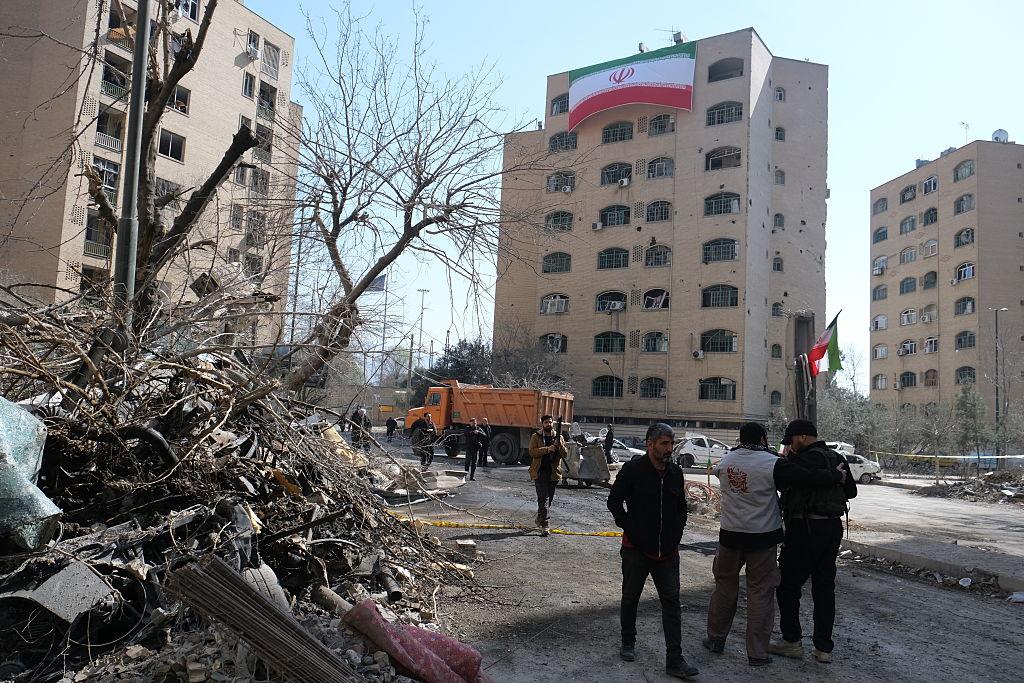
Basiji militia forces in southeast Tehran, which was heavily struck by Israel and U.S. during Operation Epic Fury
10. Shouldn’t the U.S. have had, like, some kind of plan to deal with this situation before it started firing missiles into Tehran?
Yes, that seems like something a competent governing body would have done. (You’d think even an AI clone might have thought of it.) But these guys … well, does anyone still think they’re competent? That's a great question, actually. I said at the start of this article that the price of oil was a crass thing to have to worry about during a humanitarian crisis; let’s check in with a MAGA voter at a gas pump.
Nothing this woman says is wrong, as far as I can tell. Sometimes the crassest analysis is the quickest path to the truth.