How College Basketball Crushed the Cinderella
The dramatic transformation of the NCAA landscape is widening the gap between the haves and the have-nots. What does that mean for March Madness—and your bracket?

Thursday and Friday of the NCAA tournament’s opening week are two of the most sacred days on the American sports calendar. For two afternoons every March, large swaths of the country agree that nothing is more important than the dozens of college basketball games being played in arenas across the country. Work productivity dips to near zero as college basketball fans stream games in the background and pretend to answer emails. In classrooms, hoops-loving teachers abandon lesson plans and tune the projector into the madness.
We love this tournament because single-elimination basketball is inherently captivating. But we cherish it for the new cast of characters introduced every March. More than anything, the magic of the tournament lies in one simple promise: that somewhere in the bracket lies a Cinderella in waiting. That some team and player will rise from obscurity to slay a powerhouse and claim their few days in the national spotlight.
Nobody knows where the Cinderella will come from—not even your colleague who became a college basketball analyst on Selection Sunday and claims to be certain—but that’s what makes it special. Many of the most memorable runs in men’s NCAA tournament history were made by underdog squads. In the past decade alone, we’ve seen 15-seed Oral Roberts ride Max Abmas to the Sweet 16, 16-seeds UMBC and Fairleigh Dickinson topple no. 1 seeds, and Saint Peter’s crash the Elite Eight as a 15-seed. In 2018, America fell in love with Sister Jean as Loyola Chicago marched to the Final Four as an 11-seed.
There’s no single formula for busting a bracket, but most Cinderellas share a few underlying themes. Many are mid-majors with a roster full of upperclassmen and a distinct personality; when VCU reached the Final Four in 2011, the Rams had the 15th-oldest roster and a havoc-wreaking style that rattled more talented teams. Many feature microwave scorers capable of erupting for 30 on the right night; when Oral Roberts upset Ohio State in 2021, Abmas and Kevin Obanor combined for 59 points. And many are composed of players who had spent years building chemistry while the sport’s biggest programs chased the highest-upside freshmen. When Butler made the national championship in 2010, it had the most returning roster continuity in the country.


College basketball’s parity era peaked coming out of the COVID-19 pandemic. In 2021, after a disrupted season full of opt-outs and COVID cancellations, there were four double-digit seeds (Syracuse, Oregon State, Oral Roberts, and UCLA) playing during the second weekend in the bubbled tournament in Indianapolis. In 2022, Saint Peter’s made the Elite Eight as a 15-seed after beating both Kentucky and Purdue.
By 2023, the NCAA transfer portal had become an unregulated black box and schools had learned how to leverage it to their benefit. That year delivered one of the strangest tournaments ever: 16-seed Fairleigh Dickinson beat Purdue as a 23.5-point underdog, 9-seed Florida Atlantic reached the Final Four, and mid-major powerhouse San Diego State played for the national title.
Miami head coach Jim Larrañaga, who built his roster through the transfer portal that year en route to the Final Four, described the new landscape of the sport in simple terms: “Right now, in this sport, anybody can beat anybody.”
But three years later, that sentence has never been less true.
The men’s NCAA tournament expanded to 64 teams in 1985, and last year was the first tournament in history in which all 16 top-four seeds advanced to the second round. And none came particularly close to losing; all 16 won by nine or more points. In the past two tournaments, only two teams seeded eighth or lower have advanced to even the Sweet 16—and both were high-major schools with pedigreed backgrounds in NC State and Arkansas.
This year, that trend is projected to go even further. For the first time, all 16 top-four seeds are favored by at least 10 points in the first round. On average, opening-round point spreads for Thursday and Friday games are larger than they’ve ever been, and the gap between the 5-seeds and the 12-seeds in KenPom’s adjusted efficiency margin is the largest on record, according to Basket Under Review writer Will Warren.
This is the strongest top 20 the men’s tournament has ever had. Michigan, Arizona, and Duke are breaking the ceiling of KenPom’s metrics; they represent three of just 13 teams that have posted a plus-35 or better adjusted efficiency margin since 1997. The other 10 all made the Final Four, and eight of the 13 have now come in the past three seasons.
At the bottom of the bracket, the aspiring Cinderellas haven’t been able to keep up. And this year, the gap will be exacerbated by the unusual number of regular-season conference champions who failed to secure an automatic bid by winning the conference tournament, meaning there are fewer tournament spots up for grabs across the board. The graph below shows the adjusted efficiency margin of no. 1 and no. 13 seeds over time, illustrating the growing divergence at the two ends of the tournament spectrum.
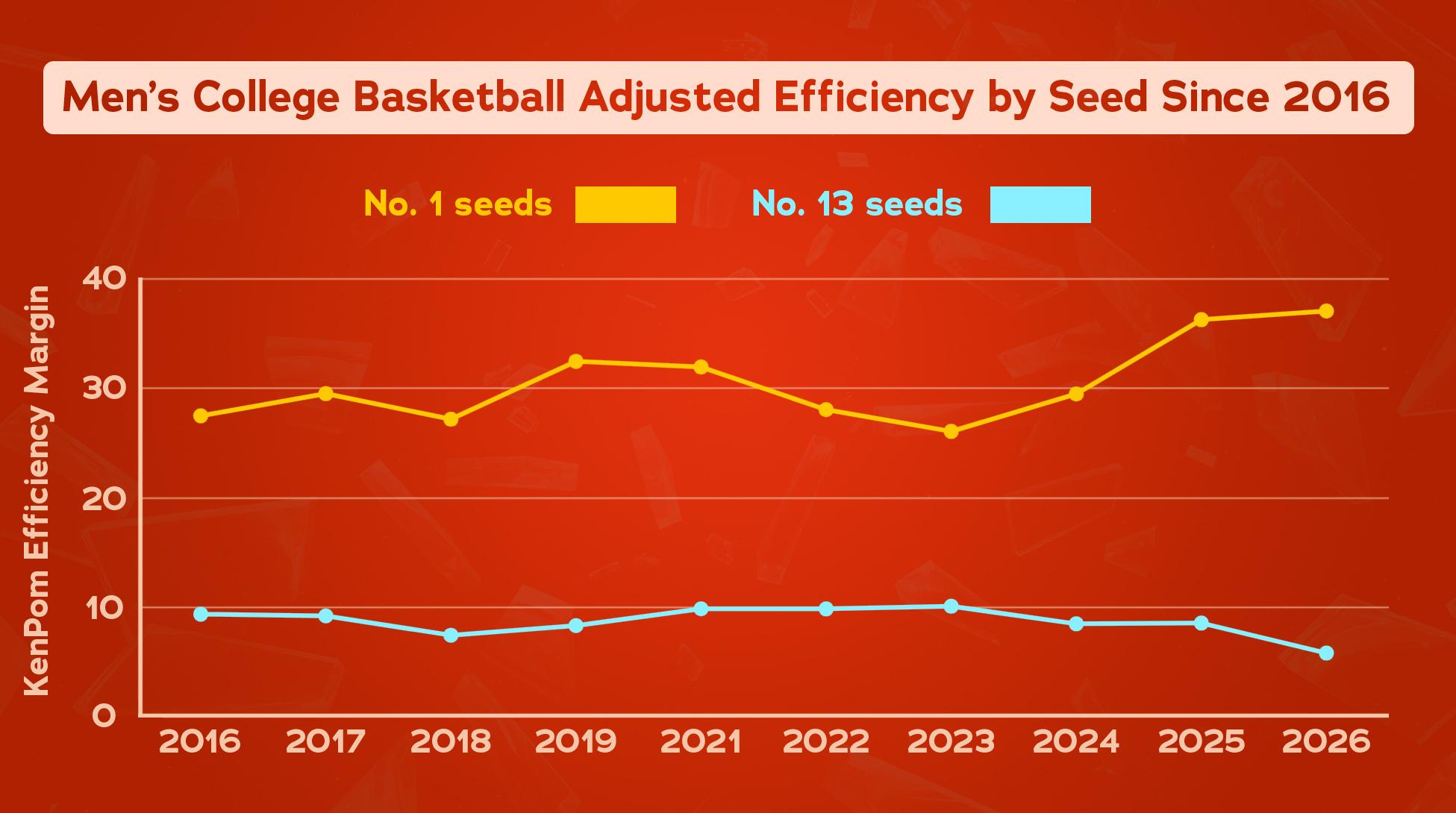
Instead of a rising tide lifting all boats, college basketball’s economy and tournament looks a lot more K-shaped. It’s a dangerous proclamation to make days before the tournament could render this hypothesis silly, but the data and recent changes to the very structure of college basketball suggest this is less of a two-year blip and more of a new normal. So what caused the death of the Cinderella? And is there any hope for a return to the previous normal?
The Cinderella didn’t disappear by accident. College basketball’s new economy quietly killed it.
The introduction of NIL deals and the subsequent transformation in the sport has widened the gap between the haves and the have-nots. And that disparity has deepened following a massive settlement last summer that gives schools the ability to directly pay players. While the average SEC school is spending $9.7 million on its basketball roster, the average mid-major is spending around $2.3 million. Jump down another level to low majors and the total falls below $1 million.
“The money has definitely caused there to be a large disparity between the big schools and the low-major leagues,” NBC broadcaster and unofficial Big East ambassador John Fanta tells me. “Those schools in the lower-major leagues are not playing the same game.”
Those smaller schools have also been hit hard by new transfer rules, which make it easier for players to jump from one program to another. The structure now resembles something closer to European soccer, with mid-majors increasingly functioning as feeder clubs for wealthier programs. But when Manchester United or Chelsea raids the English midtable, the selling club at least receives a transfer fee for its players. When Michigan poaches a star like Yaxel Lendeborg from UAB, the Blazers are left with nothing to show for their scouting and development, even as Lendeborg goes on to win Big Ten Player of the Year.
Last year, the three biggest stars of the men’s tournament were Alabama’s Mark Sears, Auburn’s Johni Broome, and Florida’s Walter Clayton Jr. All three were AP All-Americans, and all three had begun their careers at mid-major schools before transferring up and becoming superstars at the highest level of college basketball.
Ohio, Morehead State, and Iona once could have built entire teams around players like that. Now those programs are essentially serving as farm systems for the sport’s richest schools—an idea that many mid-major head coaches have embraced as a selling point in their pitch on the recruiting circuit.


But if every breakout star eventually gets poached, the chances of a true Cinderella contender ever staying together long enough to make a run shrink dramatically. Continuity used to be an advantage for smaller schools, but the script has flipped. Now, all the players to start four years in one program do so in the high major leagues.
“Someone told me I was one of five players to start four years at one school,” says UConn forward Alex Karaban. “That’s crazy. To be one of the rarity of what college basketball has turned into is special to me.”
The on-court evolution of college basketball has also squeezed many would-be Cinderellas out of the dance. Smaller programs used to be able to lean into the advantages and variance presented by the 3-point line. Math helped the minnows level the playing field against their shark opponents. Slow down the game, shoot tons of 3s, and win over the neutral crowd, and suddenly the talent gap doesn’t feel quite so large. Steph Curry’s Davidson team wasn’t a traditional Cinderella, but still is a prime example of a mid-major school using the 3-point line as the great equalizer after he hit 23 3s in four games during Davidson’s run to the Elite Eight in 2008.
In the ongoing battle over shot volume, schools with more resources have started building bigger teams that completely dominate on the glass. These juggernauts try to “upset-proof” themselves by generating more scoring opportunities than their opponents. It’s not a coincidence that the top four teams in this year’s tournament rank inside the top 30 in height. All of the elite teams have ways to win that aren’t entirely dependent on whether their perimeter jump shots will fall on any given night.
This stands in stark contrast to the evolution of college football, where the very top of the field has leveled off, producing more chaos in January. In basketball, the biggest schools are pulling the ladder up behind them, and leaving nothing behind for the mid-majors.


What does this mean for the NCAA tournament? A chalkier bracket would lead to more heavyweight clashes in the later rounds, which could generate its own kind of interest. But March Madness is known for more than just competitive games between the best teams. If Michigan, Arizona, and Duke run roughshod over the field on their way to the Final Four, will the tournament feel empty?
The slow build of an upset is a core part of the March Madness experience. You can feel the moment it starts to become possible: The underdog just drilled a 3 to take the lead with eight minutes left. The broadcast cuts to commercial. The iconic March Madness theme is playing, and for the first time all night, the favorite starts to panic. The euphoric feeling of hope (or maybe existential dread, if it’s your team that’s suddenly trailing) washes over you.
But now that the kind of teams that once became Cinderellas are just farm systems for the programs they used to shock, the clock seems to be striking midnight on Cinderella before she’s even arrived at the ball.