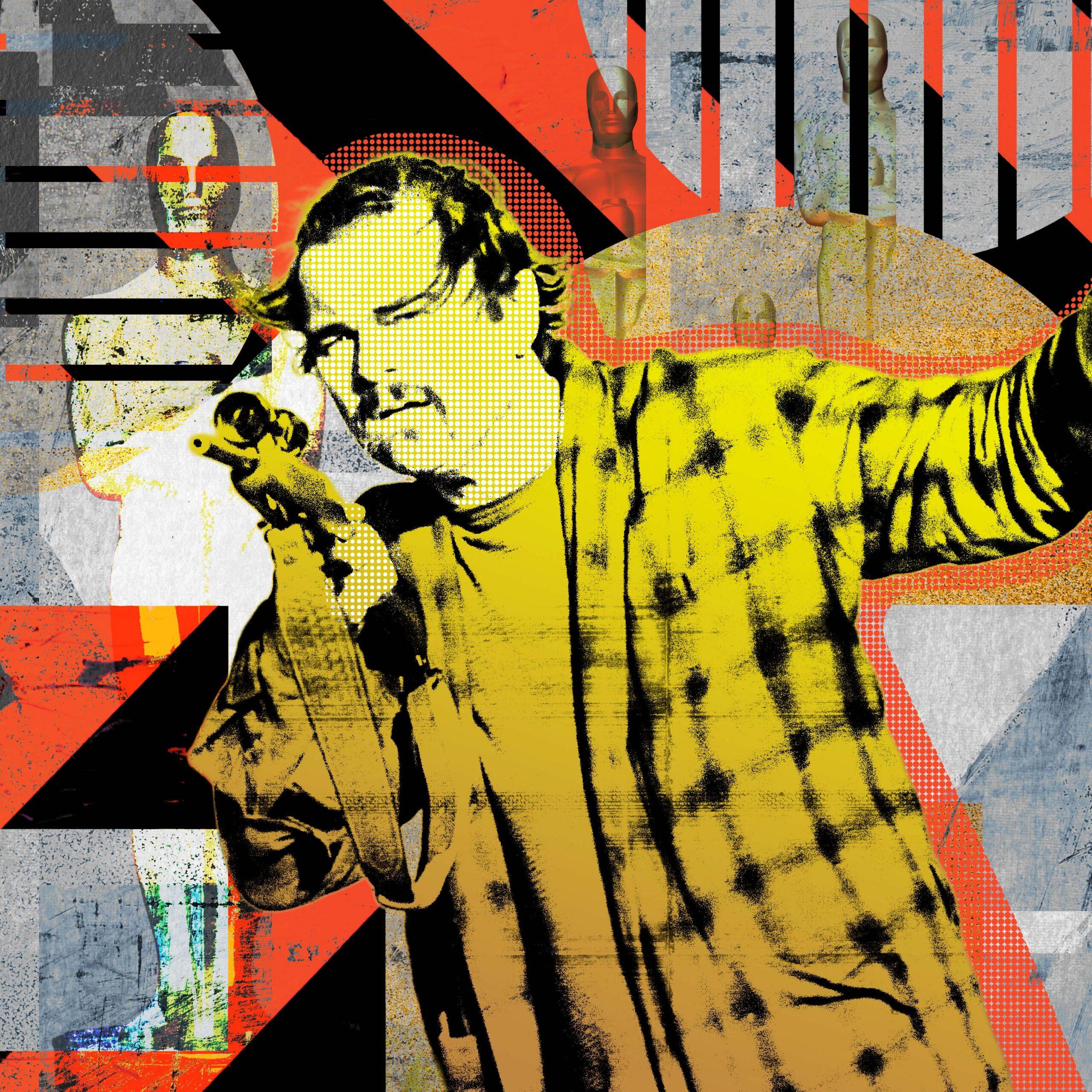

Bob Ferguson used to be somebody. “They used to call me Ghetto Pat, Rocket Man,” he pleads over the phone in hopes of tracking down his on-the-run daughter. “Only problem is, I fried my brain since then.” Leonardo DiCaprio delivers the appeal with genuine conviction and desperation, as if evoking the past might grant him some kind of legitimacy in a fucked-up present. He might as well be saying, “They used to call me Leonardo DiCaprio.”
One Battle After Another is the latest vehicle for the mode latter-day DiCaprio has settled into. The reluctant teen star with a baby-faced charm has given way to a middle-aged thespian of few words (and movies) who’s achieved legendary status but has never quite shed the reputation as an off-screen lothario that he developed during decades as a tabloid fixture. On-screen, this evolution manifests as a fascinating metatextual layer to perhaps the greatest run of performances of his career: 2019’s Once Upon a Time … in Hollywood, 2023’s Killers of the Flower Moon, and now, One Battle After Another. That he’s thus far come up empty at the Oscars in that span is criminal.
What DiCaprio has been doing in his films over the past seven years isn’t dissimilar to, say, what George Clooney accomplished in the deceptively deep Jay Kelly, or even what Tom Cruise aimed for with Top Gun: Maverick. These are guys whose off-screen personas are inextricable from the parts they play in movies. Instead of trying to run from that, they channel it into something thematically compelling: What does it mean to be a guy who used to be The Guy? Plus, reckoning with a movie star persona as the very concept dies out makes these roles feel especially urgent. The recent filmographies of DiCaprio and his ilk aren’t just the latest must-sees from our most reliable actors; they increasingly seem like the last of our dwindling opportunities to see this type of star command the screen.
But DiCaprio’s string of layered performances doesn’t simply bring him in line with his peers. For one thing, he’s just better than the others at this kind of performance. Even when the personal foibles of DiCaprio’s characters echo his real-world persona, it never feels like it’s winking or contrived. (I enjoyed Jay Kelly, but the joke about Clooney’s fictional movie star possibly running for office was the equivalent of Clooney staring straight into the camera.) DiCaprio is also never “playing himself.” Perhaps it helps that we don’t quite know who he is: Despite his off-screen notoriety, he has remained an enigma.



Make the Oscars Case
DiCaprio is an all-time excellent actor who does very little press (although he made an exception for the Kelce brothers … and The Ringer), was a playboy in the “Pussy Posse,” and attended Jeff Bezos’s incredibly gauche wedding, but also uses his few public appearances to make passionate pleas to protect the environment. There’s always been something slightly incongruous about his whole deal, which lends itself perfectly to these morally gray characters who are living in the past while also running from it. Maybe there’s a parasocial element to watching DiCaprio act because we can’t help but feel that these on-screen characters are our only conduit to who this guy might actually be. But it still takes tremendous skill to deploy a reputation that loaded in a way that’s captivating but not distractingly self-parodic.
Handing Leo an Oscar this year wouldn’t just be a Return of the King–esque reward for that three-picture run. One Battle After Another features DiCaprio’s best performance in that stretch and also presented the highest degree of difficulty.
Once Upon a Time’s Rick Dalton is maybe the funniest DiCaprio’s ever been (the dressing room scene will always be a staple of Leo highlight reels), but that role allowed him to lean on schtick when Brad Pitt took over for the big, emotional moments. Killers of the Flower Moon’s Ernest Burkhart required a delicate balance, as DiCaprio fleshed out a pathetic pawn who was both weaponized by a more nakedly evil force and also fully aware of what he was doing. But by design, Ernest was pretty vacant behind the eyes, and that depleted a lot of the suspense that made the source material of Martin Scorsese’s epic so unnervingly gripping. The adaptation’s change to the book’s point of view is one of the most frequently cited criticisms of the movie, and it ultimately dampens the performance the slightest bit.


But Bob Ferguson truly contains multitudes: He’s a good but flawed father who’s not really keen on improving but is forced to spring into the kind of action he hoped was long behind him when crisis comes knocking at his door. He chides a neo-leftist out of pure frustration, in a scene that could have easily strayed into hacky culture-war commentary in lesser hands. He believably (and endearingly!) musters up some Spanish (complete with whistle) when turning to community members for guidance. He’s also very, very funny—“We’re talking about freedom, baby” has been rattling around in my head for five months now.
This is a character who, within a roughly five-minute span, openly admits to driving drunk and asks pointed questions about his daughter’s friend’s pronouns, yet manages to keep you rooting for him. Bob is a harder character to explain than Ernest or Rick because he’s kind of, well, normal. And it’s hard for anyone to act normal, let alone a multimillionaire who’s been famous since he was 19! Bob has to guide you through the relentless propulsion of One Battle After Another while maintaining recognizably human emotions that keep the personal stakes in full view.
In the eyes of an Academy that’s very selective about who gets to own multiple Oscars, DiCaprio’s campaign does have a major knock against it: He’s already won once. And in a historically stacked Best Actor race, that’s relegated him to a distant third in the odds. He’s going against a living legend with nary an acting Oscar to his name (Ethan Hawke), as well as two young superstars (Timothée Chalamet and Michael B. Jordan) and a breakthrough international performer (Wagner Moura) who are seeking their first wins. Every single performer in this category has a genuine case for the statuette.
This actually might be a case where an actor is due for a makeup Oscar to make up for their first makeup Oscar.
But this is my plea to the Academy to set aside its anti-second-Oscar bias for a moment: Is there any actor around who’s more worthy of two trophies? DiCaprio was famously nominated for four Oscars before finally notching the win in 2016 for Alejandro Iñárritu’s The Revenant, long after he had established himself as a premier talent of his generation. To put it bluntly: No one thinks that The Revenant is DiCaprio’s best performance. Even at the time, The Revenant was praised but not effusively so, and it definitely had its detractors. DiCaprio does what the movie asks for—which is mostly “look cold and gnarled”—but, in hindsight, the win feels like a makeup Oscar for [The Wolf of Wall Street? The Aviator? Catch Me If You Can? Insert your pick here]. In the 10 intervening years, DiCaprio has turned in even more impressive work that’s surpassed many of the iconic roles from the first half of his career, let alone The Revenant. This actually might be a case where an actor is due for a makeup Oscar to make up for their first makeup Oscar.
Ideally, the politics regarding whose “turn” it is to win an Oscar wouldn’t affect the Academy’s decision. And if that were the case, then DiCaprio would still stand out in a crowded field. In One Battle, he summoned a performance that no one else could give, and—in conjunction with the film’s many accolades (including a likely Best Picture win)—his turn as Bob Ferguson seems destined to be remembered as one of the signature roles of an actor who already has plenty of them on his résumé. It’s not often that we get to see an actor who’s already reached the top continually find new peaks to summit. DiCaprio has done that—and in the process, repeatedly reminded us that he’s still Leo, with all that that entails.