
The film most responsible for reshaping the Oscars’ Best Picture race never even made the ballot. In 2008, The Dark Knight was a legitimate cultural phenomenon, a blockbuster that entertained the masses without coming at the expense of thought-provoking ideas and evocative performances. Even if you didn’t believe that The Dark Knight was one of the best movies of the year, few could object to something of its ilk earning industry recognition, following in the tradition of recent tentpoles like Titanic, Gladiator, and the Lord of the Rings trilogy. So when The Dark Knight was shut out of the Best Picture lineup at the 81st Academy Awards, prompting outrage, the Academy didn’t rest on its laurels.
After The Dark Knight’s omission, the Oscars went from nominating five movies for Best Picture to expanding the field to 10. (Since then, the Academy changed the rules so that anywhere from five to 10 films could be nominated before settling, again, on a fixed number of 10.) The hope was that, by allowing more nominees, other blockbusters that were well received by critics—and could attract more casual moviegoers to watch the ceremony—wouldn’t suffer a similar fate. Within the first year of the rule change, the gambit worked as the likes of Avatar and Inglourious Basterds made the cut; since the pandemic, the Oscars have been especially blockbuster friendly, opening the door to nominations for Top Gun: Maverick, Avatar: The Way of Water, Barbie, Wicked, and the Dune franchise. The other upside of the widening Best Picture lineup is that the Academy has become less mundanely middlebrow, finding room for more foreign-language films and even the Cronenbergian body horror of The Substance.
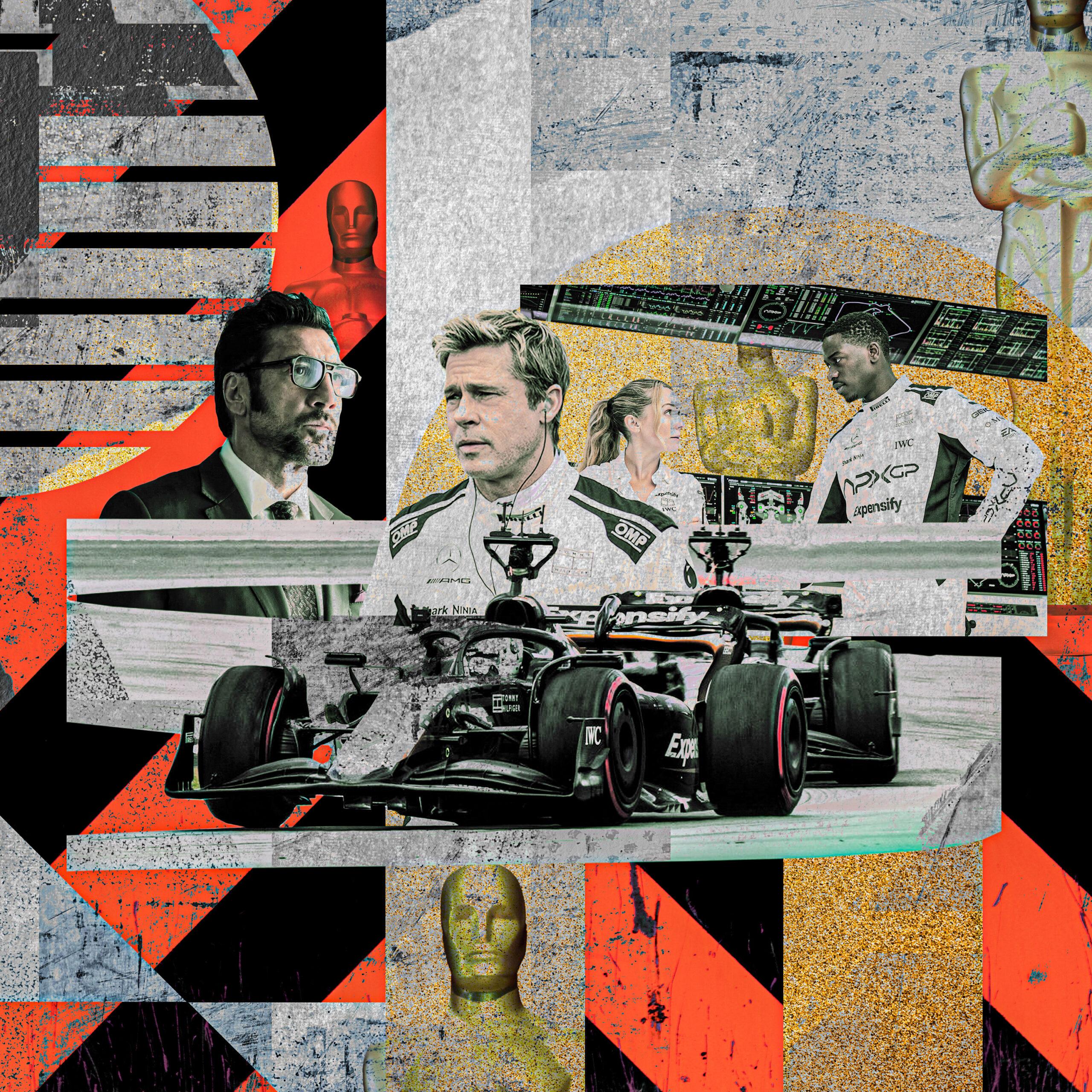
Given that context, it boggles the mind that one of the villains of awards season, pilloried as “one of the worst Best Picture nominees ever” and as something that “sets the bar low for the 2026 Oscars,” is the F1 movie. A crowd-pleasing Top Gun pastiche featuring the fastest cars on the planet—directed by none other than the guy who brought us Top Gun: Maverick—F1 is an odd choice to become an Oscars pariah. But because F1 was thought to have had an outside chance of scoring a Best Picture nomination, its inclusion has been interpreted as the reason that smaller, worthier films like Sorry, Baby and It Was Just an Accident missed out.
I can’t, in good conscience, say that F1 is a greater artistic achievement than Sorry, Baby. But pinning all the blame for its exclusion on F1 is like getting mad at the weather forecast for the damage left behind by a storm. (Also: Hamnet is right there, folks.) For one, all signs pointed to the blockbuster slot(s) being filled by Avatar: Fire and Ash and/or Wicked: For Good until they were received as lesser sequels. And while Sinners and One Battle After Another nominally fall under the blockbuster category, the awards season narratives surrounding both projects center on the brilliant visions of Ryan Coogler and Paul Thomas Anderson, respectively. These are auteur nominations, first and foremost.
What we’re left with, then, is F1. Filmed in collaboration with the Fédération Internationale de l'Automobile, the governing body of Formula One, the movie follows an aging driver (Brad Pitt) who’s enlisted by his old friend (Javier Bardem) to race for his struggling F1 team, APXGP, and mentor their gifted, temperamental prodigy (Damson Idris). On a script level, F1 is a Russian nesting doll of sports clichés: the veteran who’s getting one last shot in the big leagues; the hotshot rookie who doesn’t take advice from anyone; the sinister C-suite executive (Tobias Menzies) who wants to tear everything down; the boss (Kerry Condon) who insists she doesn’t mix work with pleasure until [gasp!] the love interest looks like Brad Pitt; the team defying the odds when it matters most. Pitt’s character arc mirrors Tom Cruise’s in Maverick so much that if these movies didn’t share the same director and writer, Apple’s film division might’ve had a lawsuit on its hands.

F1: From the Track to the Film
But you don’t watch something like The Raid or Crank for the plot; F1’s success hinges on what it can do on the racetrack, and that’s where the film shines. Developing specialized cameras to mount onto the cars, director Joseph Kosinski combines practical effects and state-of-the-art CGI wizardry to make the audience feel like they’re in the driver’s seat. (Pitt and Idris did get behind the wheel of F2 cars before being digitally inserted into the F1 races; you don’t notice any of the seams.) In an IMAX theater, the experience is all-consuming: a level of immersion that gives greater appreciation for the genuine life-or-death stakes intrinsic to the sport. Ideally, F1 would mimic the Memoria rollout, never becoming available to stream at home to ensure that the movie is seen the way it’s meant to be seen. And since Warner Bros. could soon be acquired by Paramount, shrinking the already thinning ranks of Hollywood studios willing to take swings in the vein of Sinners and One Battle After Another, a film like F1 is an adrenaline-pumping reminder that blockbusters are built for theaters, not living rooms.
Of course, it’s strange that F1 feels like a savior for the multiplex when it hails from Apple, which, as it happens, partnered with Warner Bros. on the movie’s global release. But while streamers encroaching on traditional studio territory should be met with some skepticism, Apple has thus far proved to be a reliable steward of blockbuster cinema—giving proper theatrical runs to nine-figure epics from Martin Scorsese and Ridley Scott and also, for some reason, to Argylle. These Apple Originals failed to light up the box office, but F1 defied the odds, becoming the highest-grossing movie of both the company and Pitt’s career. More eye-opening is F1 making more money than Superman and Fantastic Four: First Steps, two superhero tentpoles that were expected to dominate the summer. Box office receipts aren’t everything, but it’s easy to see why Academy voters might be drawn to an old-fashioned, star-driven tentpole that outpaced the superhero-industrial complex. As one anonymous member of the producers branch told Variety: “I fucking love that movie.”

Make the Oscars Case
To which I say: Amen, brother. You can certainly quibble with F1—that its script is hackneyed, that it spends too much time focused on the minutiae of tire management, and, most egregiously, that it doesn’t even try to conceal its purpose as a glitzy Formula One branding exercise. It’s hard to argue with that, but just as many people are willing to overlook that the Top Gun movies glorify America’s Navy as a global force for good against extremely vague foreign adversaries, I can accept F1 approaching the historically scandalous sport with rose-tinted glasses. Because whatever its flaws, F1 is Dad Cinema in its purest form: a meticulously crafted, no-nonsense spectacle that Hollywood doesn’t make nearly enough of anymore. Its Best Picture nomination is more than deserved.
Is that enough to deem F1 worthy of winning Best Picture? If the Academy really wanted to zig where everyone expects it to zag, there’s a compelling narrative in crowning the rare modern blockbuster that isn’t a sequel, reboot, or part of a sprawling cinematic universe. F1 is about legacy, aging stars refusing to fade into obscurity, and pushing machines to their limit—qualities that could endear the movie to old-school voters. Still, as a card-carrying member of the Dad Cinema brigade, I’ll concede that the prospect of F1 actually taking home Best Picture is about as likely as Brad Pitt passing Lewis Hamilton down the main straight at Silverstone.
Perhaps in an alternate timeline in which Academy membership requires mainlining Ken Burns documentaries and ritually watching every movie that airs on TNT, F1 would clean up. But even if F1 isn’t realistically going to challenge Sinners, One Battle After Another, or Marty Supreme, the film doesn’t deserve your Best Picture scorn. It’s the exact type of movie the Academy has sought to recognize since The Dark Knight’s shocking snub, and treating it as an interloper is a fundamental misunderstanding of why the field was expanded in the first place. Besides, like the drivers racing for APXGP, F1 is best appreciated as the perennial underdog of awards season: It’s not going to win, but simply making the Best Picture podium is reason enough to celebrate.