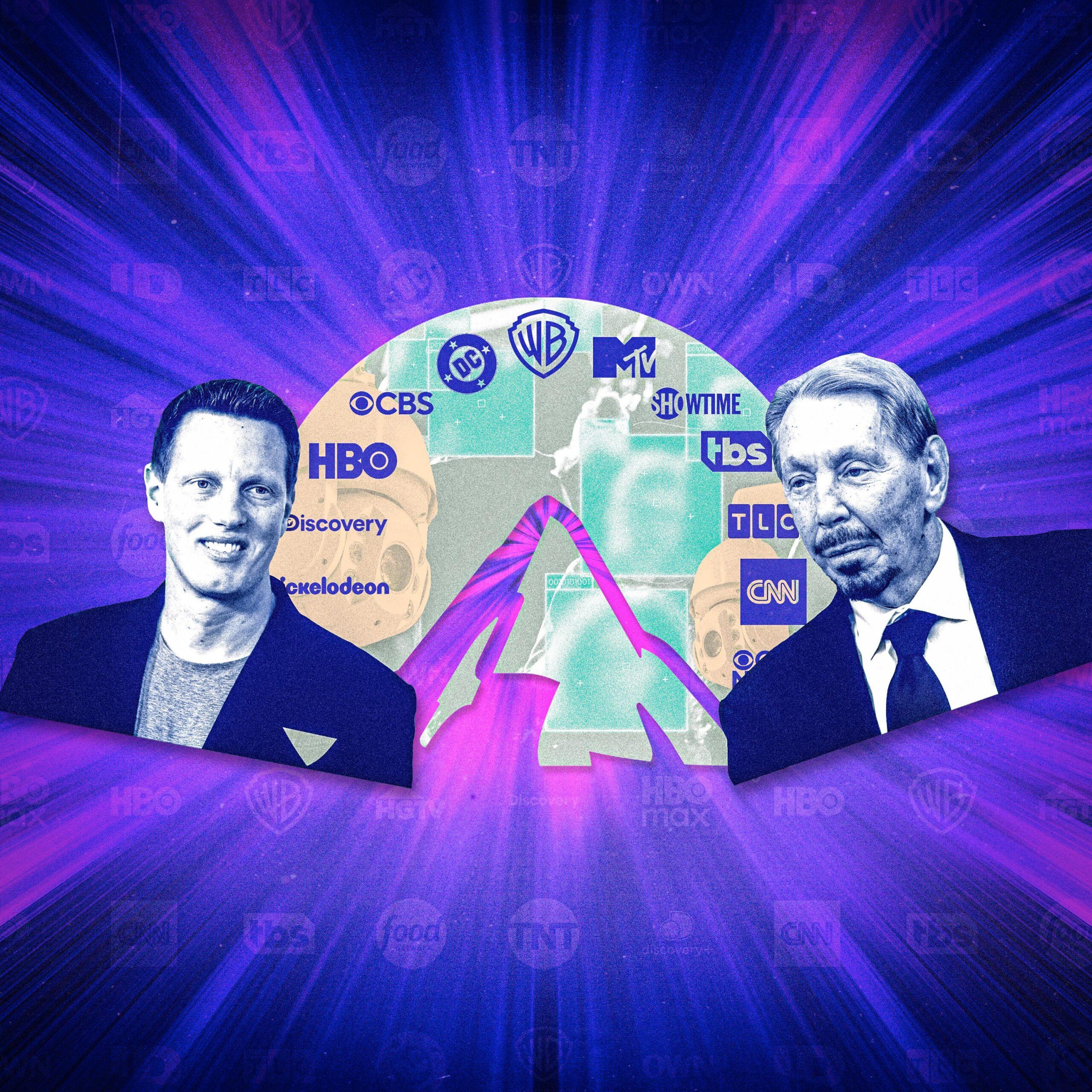

What are the Ellisons building? I wonder if even they know. Last week, the news broke that the superbillionaire family had beaten out Netflix—or sort of beaten out Netflix? after Netflix had initially won?? and then the Ellisons swooped in and reversed the outcome through a combination of no-holds-barred political maneuvering and saying the biggest number???—in the battle to acquire Warner Bros. Discovery and its sprawling stable of media assets. The proposed deal has attracted a lot of criticism, largely because it sucks. That’s a broad statement, so let me be more specific: It only sucks for every affected industry, the United States, and humanity as a whole. For the equally important parties on the other side of the deal—namely, Larry and David Ellison—it could turn out pretty great.
Most criticism of the deal so far has focused on its effect on the streaming, entertainment, and news industries. And understandably so: Larry, the world’s sixth-richest man and a key ally of the Trump administration, and his son, David, already control one massive media conglomerate, which they gained when Skydance, the company David founded in 2006, bought Paramount last year. If the $111 billion Paramount–Warner Bros. merger goes through, the Ellisons’ media empire will gain a second major movie studio; add CNN, HBO, and Comedy Central to its portfolio of TV channels, which already includes CBS; and take control of a massive trove of popular IP, including Looney Tunes, DC Comics, and Harry Potter. The merger will have a colossal impact on American culture; almost everyone who isn’t billionaire-pilled to a Cybertruck-loving degree agrees the impact will be negative. No wonder people are freaking out.
“Lawmakers on both sides of the political aisle,” Reuters reports, “have raised concerns that any deal to acquire Warner Bros. could result in fewer choices and higher prices for consumers.” Theater owners worry that a Paramount-Warner merger would mean fewer movies released in theaters. Entertainment industry insiders worry that it would mean fewer entertainment industry jobs. Media analysts, noting the Ellison family’s close ties to the Trump administration, worry that the merger would push America’s fragile news ecosystem further in the direction of right-wing propaganda. “This deal endangers our democracy by giving a family of pliant billionaires even more control of vast swaths of our news coverage, TV stations, and movie studios,” said Craig Aaron, the co-CEO of the watchdog group Free Press.
The more I’ve turned this deal over in my admittedly frazzled and paranoid mind, however, the more I’ve started to think that even the most critical assessments of this news have missed what makes it so alarming. The merger—which still has to win regulatory approval, a process that Warner Bros. CEO David Zaslav (who knows his way around a cursed business decision) says could take up to 18 months, though since the Trump White House is involved, it could also be done by, like, Thursday—would give the Ellisons control of a multifarious, multicorporate entity essentially unprecedented in U.S. history. I realize that calling it an “entity” makes it sound like a Mission: Impossible villain—Mission: Impossible being one of the franchises the Ellisons already control—but there’s not really a better word for “loosely connected empire of data mining, surveillance, news, and entertainment, divided among multiple companies but basically answerable to the whims of two guys and so huge that it could fundamentally alter the American information environment.” (At the very least, it will fundamentally alter the name of HBO Max, yet again.)
Maybe I’m overstating things—again: paranoid, frazzled—but here are five considerations that suggest we should be even more disturbed by the Ellison media takeover than we already are.



More From Brian Phillips
1. Larry Ellison controls one of the largest corporate surveillance operations on earth.
The Ellisons’ wealth, as you might know—but then again, maybe not; Larry has, until recently, been one of the more clandestine American billionaires—comes from Oracle Corporation, the tech giant Larry cofounded in 1977. Oracle is one of the 25 largest companies in the world by market capitalization; the senior Ellison was its CEO for 37 years, until 2014, and is still its chairman and chief technology officer. He owns around 40 percent of its stock. Which, sure, is not technically a controlling share, but for reference: Mark Zuckerberg owns about 13 percent of Meta. How much of Amazon do you think Jeff Bezos owns? About 9 percent.
Larry is, in other words, very much still the driving force behind Oracle, and Oracle, in addition to all the other stuff it does, runs one of the largest and most amoral tracking and data-harvesting programs in the world. Oracle software, which processes data that includes facial recognition images, license plates, DNA profiles, and logs of religious activity, helps power China’s surveillance state. In 2024, the company settled a lawsuit alleging it tracked internet users so aggressively without their consent that it had compiled dossiers on a majority of the world’s population. And unlike Palantir, which provides a similar suite of law-enforcement and data-analytics tools, Oracle has very much been in the business of selling your data to the highest bidder.
The lawsuit accused Oracle of building a “worldwide surveillance machine.” Some years before the lawsuit, however, at the 2016 Oracle OpenWorld conference, Larry had explained how he personally saw Oracle's consumer-tracking operations, and … yeah, he spent his keynote speech boasting about building a worldwide surveillance machine. Oracle Data Cloud, he said, had more data on internet users than Facebook, including “micro location information, what they’re searching on, what websites they’re going to, what product comparisons they’re doing.” He said that Oracle could combine that data with users’ “demographic data, their past purchase data, all of this other information we have about them.” There were 5 billion people in Oracle’s “identity graph,” Larry added. “How many people are on earth? Seven billion. Two billion to go.”
Oracle is a company that wants to know everything about you, has been sued for spying on you without your knowledge, and has previously been willing to use what it learns for its own purposes.
Unrelatedly, did you know that Hawaii is made up of eight major islands, and Larry Ellison essentially owns one of them? He moved there full time a few years ago but recently relocated to a 60,000-square-foot compound 20 minutes from Mar-a-Lago.


2. Larry Ellison thinks AI-powered surveillance is the key to the society of the future.
Ellison has publicly laid out a vision of the future in which AI-monitored cameras record everyone at all times and instantly report misbehavior. That may sound hard to believe, but I’m not exaggerating. “Citizens will be on their best behavior,” he told the audience at Oracle’s Financial Analyst Meeting in late 2024, “because we’re constantly recording and reporting everything that’s going on.”
This video is less than two minutes long; I recommend watching all of it for a glimpse of how blithely chilling a billionaire’s conception of a well-run society can be.
In Larry’s ideal future, there are cameras everywhere, and “it’s not people that are looking at those cameras. It’s AI that’s looking at the cameras.” When he imagines someone misbehaving, he grins and wags a finger in the air: “no, no, no.” Any action that’s deemed unacceptable will instantly set off the AI overseer’s alarm and be reported “to the appropriate person.” Police will also be watched by AI at all times, ensuring that they, too, never misbehave (which would totally work, because police cameras simply never turn off when it suits them). But human police officers will have less to do, as much of their work will be turned over to autonomous drones.
In this vision of the world—which Ellison clearly assumes people will find appealing, even utopian—individual autonomy, privacy, and freedom count for nothing, at least for the billions of regular people subject to this top-down control. (I doubt he expects the cameras to be recording and reporting on him 24/7.) Order, authority, and the repression of rule-breaking count for everything. “And it’s unimpeachable,” he said. “We’re going to have supervision.” It was not lost on observers that Larry seemed to be describing Big Brother from Orwell’s 1984. Only, unlike Orwell, Larry was into it.
Who will develop, deploy, and control this AI? That part is unclear, but it’s worth noting that Oracle is reportedly considering laying off as many as 30,000 of its 160,000 employees to help free up funds as it copes with the financial fallout of its aggressive investment in data centers.
3. David Ellison thinks data is the key to winning the media industry.
Meanwhile, David Ellison has spent his career in the entertainment industry arguing that media companies should operate more like tech companies, adopting a data-driven approach to a traditionally creative business. And, sure, most entertainment execs talk this way in 2026, but David is particularly extreme: “Technology will transform every single aspect of this company,” he’s said about Paramount. He talks a lot about embracing AI, suggesting a future in which the tech generates much of his company’s content; in meetings, according to Variety, “he alludes to having developed revolutionary ways to understand what consumers want by accessing vast troves of data.” (Where that data will come from, Variety notes, “remains a mystery.”) He also talks about using Oracle’s resources to transform Paramount’s streaming business.
It’s hard to say precisely what this means; unlike his dad, David tends to speak in platitudes when making public statements: many challenges, great opportunities, etc. But data-driven media companies often focus on personalization strategies to tailor content to individual viewers. So, for instance, the vast troves of mystery data could be used to build recommendation algorithms that take into account intimate details of a person’s life and identity. They could eventually be used to generate AI content based on a close reading of a viewer’s personality, tastes, and biases—which could mean either an action movie clip or a piece of propaganda laser-targeted at its audience’s biggest vulnerabilities. It could conceivably mean both at the same time.
Either way, David doesn’t seem terribly interested in blazing an independent path. His dad’s money supported the bid to buy Warner Bros., and his dad’s company is his model for building a media business—as well as a corporate ally whose know-how he intends to leverage to help him do it. It’s probably overstating the case to say that the behemoth created by merging Paramount and Warners would act as Oracle’s entertainment division. Given the close father-son relationship and the two men’s apparently identical political priorities—both support the Trump White House, and both are allies of Israeli Prime Minister Benjamin Netanyahu; Larry is a major private donor to Friends of the Israel Defense Forces—I’m not sure it’s overstating it by all that much.


4. The Ellisons have already shown a willingness to distort information in the media to achieve their aims.
David Ellison is the same guy, after all, who brought in Bari Weiss, an anti-woke conservative activist with no management experience above the Substack newsletter level, to run CBS News. Weiss was seen as a palatable choice for Trump, whose administration has consistently demanded concessions from merger-seeking media companies in need of regulatory approval: The ones that help Trump politically get their business deals approved; the ones that don’t, don’t. A contributing factor in Netflix’s decision to back out of the chase for Warner Bros. was likely Trump’s demand that the streaming giant kick Susan Rice, Barack Obama’s former national security adviser, off its board, which Trump said Netflix must do or “face the consequences.” (And, no, that is not how the federal regulatory process is supposed to work.)
Trump’s shakedowns haven’t been a problem for the Ellisons, however; they’ve been happy to comply. Their pursuit of Paramount last year connects to the cancellation of Trump critic Stephen Colbert’s top-rated late-night show, and their approach to their news divisions can be summed up in CBS anchor Tony Dokoupil’s fawning on-air appraisal of Trump’s “extraordinary” and “historic” State of the Union address last week. David has reportedly promised the White House that he’ll make sweeping changes at CNN if Trump lets the deal go ahead.
Trump has been complaining about CNN’s coverage of him for years—in the same way he complains about all coverage that’s within a catapult toss of accuracy—so these changes would presumably include widespread layoffs, new and more MAGA-friendly leadership, and a general shove in a rightward direction, possibly one coordinated with the new-look messaging at CBS. This is certainly what staffers at CNN expect, and in an environment where MAGA-allied billionaires already control our biggest social media platforms, our biggest news channels, and some of our most storied newspapers, the fall of another source of reasonably reliable information would be … well, look, I’m sorry to use hyperbolic language here, but it would not be great!
5. Add this all together, and you end up with … what, exactly?
I don’t mean to suggest that the Ellisons have some flawlessly detailed master plan to usher in a sci-fi dystopia by using Oracle’s data-mining operations to tailor Paramount-Warner’s propaganda and misinformation operations to support a repressive security state powered by Oracle’s surveillance and AI software. Whatever is happening is looser and more haphazard than that. David probably wants to use his dad’s tech company to make himself a real Hollywood mogul; Larry probably wants to use David’s media company to reinforce his preferred political messaging and curry favor with the White House. There will still be boundaries between the companies, and between divisions within the companies. The day after the merger goes through, if it goes through—Trump’s regulators presumably won’t be a problem, but California and other states might be—David’s focus will be on merging HBO Max and Paramount+ and on building an algorithm to rival Netflix’s, not on building AI thought-control tools.
Still, when you combine this specific set of powers with this specific set of priorities in this sort of informal family relationship, you end up with something that defies even the negative categories we’re used to slotting corporations into during Trump 2.0. The abstract concern hovering around the table when Larry and David sit down to dinner is more than just a state propaganda outlet, more than just a surveillance-friendly software company, more than just a right-wing misinformation machine. If the merger comes into being, it will mark a new evolutionary stage in the transformation of the American information ecosystem: a loosely affiliated set of operations capable of both spying on and manipulating the public to an unprecedented degree, in the interest of a tiny cohort of oligarchs and their political allies, with a reach rivaling that of the rest of the media combined. How vigorously those powers would be exercised remains to be seen, especially given the massive debt load the new company would be under, but no one buys a lever factory and declines to pull any levers.
We simply can’t know where this will go. Possibly the Ellisons themselves don’t even know, but at the very least, the deal points toward a world where it’s much harder to keep government and Big Tech from watching us, and much easier for government and Big Tech to keep us from watching them.