
In the First Age, the Elves of Valinor, in the Uttermost West, made several magic orbs. Whoever gazed into one of these crystals could see what was happening in other places and could communicate across great distances with other users of the orbs. Stronger users could read weaker users’ thoughts and control what weaker users saw. The name for one of these seeing stones was palantír, from the words in Quenya, an elvish language, meaning “those that watch from afar.”
In the Third Age, one of these palantíri found its way into the hands of the Dark Lord, Sauron, who used it, as J.R.R. Tolkien relates in The Lord of the Rings, to spy on, demoralize, seduce, and corrupt his enemies. The most significant of his victims was Saruman, the most powerful wizard of the White Council. Addressing Saruman through Saruman’s own palantír, the Dark Lord played on the wizard’s lust of power, convincing him to betray his allies and making him a pawn of the evil forces threatening Middle-earth.
In 2003, in Palo Alto, California, the investor Peter Thiel, who’d helped start PayPal and served as its CEO before its sale to eBay in 2002, cofounded a new company. This new venture, which was funded partly by the CIA's venture-capital fund, would focus on software for the intelligence community, capitalizing on the expansion of American surveillance infrastructure after the September 11 attacks. A Lord of the Rings fan, Thiel decided to name the new company after the far-seeing magic stones that Tolkien had treated as a parable for the dangers of surveillance technology.
In the years since its founding, Palantir Technologies has contracted with a host of government agencies and private corporations. It’s expanded into military tech and AI. It’s built software for ICE. It’s developed close ties to the Trump White House; Stephen Miller, Trump’s most influential adviser, owns more than $100,000 of Palantir stock. It’s been accused of abetting everything from the erosion of civil liberties to genocide. In Trump's second term, Palantir seems to pop up everywhere, but because of the secretive nature of much of its work, it’s also nowhere: Everyone has heard of it, but few people seem to know precisely what it is or what it does. In a cultural environment increasingly dominated by the convergence of authoritarian politics, aggressive militarism, surveillance technology, anti-wokeness, and AI, Palantir, which brings all these things together, has been the invisible elephant in the room.
Last week, Palantir signed a $1 billion agreement with the Department of Homeland Security, cementing the company's role as the information backbone of Trump's security state. At the same time, Palantir abruptly announced that it had moved its headquarters from Denver to Miami, marking its second major relocation since 2020. The company gave no reason for the move, though it's worth noting that Palantir had inspired multiple protests in Denver over its work with ICE and its support of Israel's war in Gaza. (It's also worth noting that Florida's tax and labor laws are extremely friendly to tech companies and rich people.)
The combination of Palantir's massive new deal with the DHS and its sudden relocation to a MAGA-friendly state makes this as good a moment as any to ask: What exactly is Palantir? Is it evil? Have its sinister qualities been exaggerated? Who runs it? And—especially given that Thiel, its chairman and cofounder, has been delivering secret lectures in San Francisco arguing that the antichrist may be in our midst—what do we know about its goals?
Place your hand upon the seeing stone, acolyte; let us search for the answers together.



More From Brian Phillips
Cool. So what is Palantir?
Palantir, at the simplest level, is a tech company that makes data integration and analytics software. Data integration means it can take information from different sources and pool it all together; think of an app that can show you your accounts at two different banks in one place. Data analytics means it can analyze that data—can identify trends and use them to make predictions, for instance. (And you'd better believe Palantir software can produce fancy-looking graphs.)

Say you’re a spy who urgently needs to find an enemy agent, a woman with a red umbrella. Say your spy agency keeps a helpful database of everyone who visits the umbrella store. Say a different spy agency within your government keeps an equally helpful database of people’s favorite colors. But—and here's the problem—the databases aren’t linked. If you want to make a list of all the women who've shopped at the umbrella store in the past six months and whose favorite color is red, you’ll have to painstakingly go through both databases looking for matching names.
This is where Palantir comes in. Palantir can sell you software that pulls together the data from both spy agencies under one platform. Now a simple search query will generate your list. But there's more. Building on tech originally intended to find fraud on PayPal, Palantir's AI software can analyze more complex behavioral patterns—travel records, social media posts, whatever it has access to—to identify likely red umbrella purchasers based on whatever factors it's been trained to consider.
That sounds like pretty basic software? Why should I care?
Well, hang on, because it's going to get less basic. But the entry-level reason to care is that over the past few years, Palantir has become one of the most controversial companies in America; its own employees have criticized and even left the company over its actions. There are several reasons for this, including (1) what its products can do, (2) who it’s willing to grant access to those products, and (3) what its leaders believe about the world. We’ll look at each of those as we go, but in the meantime, another reason to care about Palantir is because of its increasingly deep reach into the apparatus of American state power. (Also, in some cases, foreign power.) Palantir software is integrated with the Army, the Navy, the Air Force, the CIA, the NSA, the FBI, the Department of Homeland Security, the IRS, the CDC, the Department of Health and Human Services, and countless state and local law enforcement agencies. Its critics say it's facilitating the construction of a digital police state; if so, the scope of its involvement with the government should be alarming to all of us.
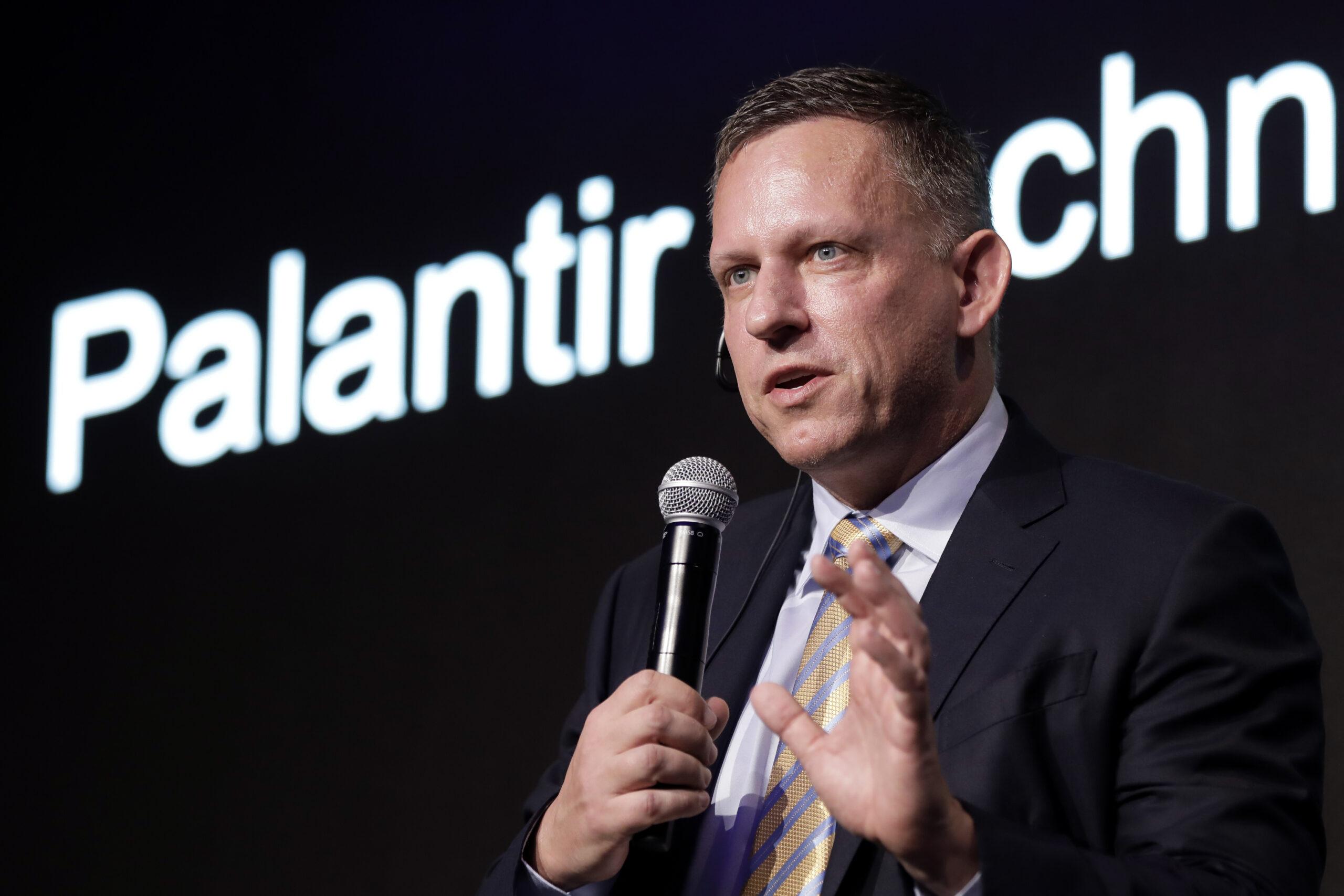
Peter Thiel speaks during a news conference in Tokyo
OK, but if I asked Peter Thiel about Palantir, there's no way he'd say, "We're building a digital police state." What does Palantir say Palantir does?
The Palantir website, while fancy, does not go out of its way to clarify the nature of Palantir's operation. It features lots of evocative video of, like, off-shore oil rigs and soldiers in camouflage tapping on tablets. Brightly colored dots, indicating Data, oscillate on screens, and a slogan reads, “AI-Powered Automation for Every Decision.” There’s a page about Palantir’s commitment to “upholding liberal democratic values”; there's a page about an AI-powered vehicle called TITAN that Palantir developed for the Army. (Palantir software, it says, will “produce and deliver decision-quality targeting information to warfighters and reduce Soldier workflow burdens and cognitive load,” which I guess means it tells the soldiers what to shoot. Also, sic.) There’s a whole section called “Palantir Explained," which includes entries like “Purpose-based Access Controls at Palantir” and “Privacy & Civil Liberties Engineering." This section tells you, in two separate articles, that Palantir Is Not a Data Company. It does not, however, explain Palantir.
If you poke a little deeper on the site, however, you start finding a lot of references to “the West." Western values. The Western tradition. Palantir’s Careers page, for instance, opens by declaring grandly that “a moment of reckoning has arrived,” before announcing that “we built Palantir to ensure the future of the West, not to tinker at the margins.” Palantir’s Meritocracy Fellowship invites young people to receive grounding "in the ideas that animate the West." Elsewhere there are references to “securing and defending the West” and to preventing America’s adversaries from obtaining technology “that can be used to undermine and assault the West.”
I haven't found a definition of "the West" on Palantir's site, but presumably it means, broadly, Europe and the United States, the former Cold War alliance now confronting Russian aggression and a rising China. I suspect the word is also intended to convey the idea that Palantir is the true heir of European intellectual history, the defender of marble busts and fluted columns, the guardian of Plato's Republic, which our woke universities have abandoned. (Both Thiel and Alex Karp, Palantir's CEO, who has smart-guy hair, have cultivated reputations as deep thinkers.)
Whatever its products do, then, Palantir is telling a dramatic story about itself: The West is under attack, the world is at a pivotal moment, and only Palantir's suite of AI and data-analytics solutions can preserve our way of life.
So Palantir is a company that integrates umbrella databases in order to defend the West? Respectfully: What?!
Well, sort of. Palantir is also a company that stocks nicotine pouches in its vending machines to help its employees work longer hours. But to understand both the scope of Palantir's work and the danger it represents, imagine vastly more complex and high-stakes versions of the umbrella scenario. You have a problem to solve and a messy bank of information to help you figure it out. You're a military commander; which house should you bomb to eliminate the terror suspect? (Palantir software is widely believed to have helped locate Osama bin Laden.) You're a police commander; where should you allocate your forces to prevent the most crime? Or—because Palantir also works with private companies, although more than half its revenue comes from government contracts—you're a logistics manager; how should you build your distribution network to reach customers in the most cost-effective way? In each case, Palantir’s software pulls in a bunch of data, analyzes it, and suggests action. Blow up that house. Send squad cars to that neighborhood. Ship these packages first. There's a chance the software could also, now or in the future, automate these decisions, which raises a whole slew of other concerns.
The data belongs to the clients; the platform for analyzing it is supplied by Palantir. Not everything Palantir does is connected to intelligence or the military—it’s made hundreds of millions building a controversial platform to connect data systems within the U.K.’s National Health Service—but Palantir's leadership seems to have an affinity for rough work: In a letter to shareholders, Karp once quoted the political scientist Samuel Huntington, who said that the rise of the West was made possible “by its superiority in applying organized violence.”
How big is Palantir, exactly?
Depends on how you look at the question. It's still a fairly small company by Big Tech standards, but "fairly small" by Big Tech standards is still immense: Palantir's current market capitalization is around $321 billion, which is less than a tenth of Apple's or Nvidia's, but slightly larger than Toyota's. And thanks to its Trump ties and the AI boom, it's growing fast. In the fourth quarter of 2025, it reported 70 percent revenue growth, and it's projecting an even larger bump in the first quarter of this year.
That said, Palantir's stock price, although down from its peak last year—it's lost about a third of its value in 2026, mostly because its valuation had shot up so high during Trump's first months in office—is still seen as inflated by many Wall Street insiders. Michael Burry, the famed investor featured in The Big Short, recently wrote a 10,000-word Substack post predicting that Palantir's stock will drop 70 percent. Burry's fund has wagered millions that Palantir's valuation will plummet. Karp has taken Burry's skepticism in his typical philosophical fashion, calling Burry "batshit crazy" and declaring, "I'm going to be dancing around" when he's proved wrong.
For now, at least, Thiel and Karp aren't hurting too much. According to Forbes, Thiel is worth around $28 billion, making him the 40th-richest man in America, and Karp is worth around $12.9 billion, good for 74th place.
So all this sensitive data Palantir is working with … where does it come from? Is Palantir spying on me?
No. Palantir isn’t a surveillance company. At least according to Palantir itself, Palantir’s platforms only allow organizations to “better manage the data that they already lawfully control.” Palantir doesn’t harvest your Social Security number, your license plate number, or your biometric data. It doesn’t see that data even if its clients already possess it. “We do not and cannot reuse or transfer our clients’ data for our own purposes,” Palantir says. It doesn’t sell your personal information or read your emails, unlike some tech companies I could name.
Oh, OK, so Palantir is actually fine? If it’s not doing anything sinister with my data, why’s it so controversial?
Because there are other ways to be sinister. You might, for instance, take $30 million from ICE to build a system designed to aggregate visa records, border-entry records, address records, and Facebook posts to identify deportation targets, then produce a map showing those targets' locations along with a dossier about them.
Or you might take millions from police departments to pull together massive amounts of information on American citizens, facilitating predictive-policing systems designed to identify likely criminals in advance—an idea so obviously rife with potential for human-rights abuse that it was already inspiring dystopian fiction 70 years ago. (Predictive policing doesn’t work and tends to reinforce racial bias in law enforcement.)
In other words, Palantir doesn’t have to spy on you to be sinister. It can be sinister by building tools to enable overwhelming state surveillance and violence, then selling those tools to people who are eager to use them.
What's Peter Thiel's deal, anyway? You mentioned something about the antichrist?
Peter Thiel is Palantir’s billionaire cofounder and chairman. He’s the guy who named it Palantir. Actually, let's take a second to talk about that, because Thiel's LotR fixation runs deep. Palantir’s offices around the country are named—this is the most embarrassing thing I've ever typed—after Middle-earth locations: Gondor, Rivendell, the Shire. The defense-tech company Anduril, named after Aragorn’s sword in the Tolkien novels, was cofounded by former Thiel employees with money from Thiel’s investment fund. Mithril, a venture-capital fund cofounded by Thiel in 2012, is named after the metal used to make armor in Middle-earth. There are more examples. You get the point.
Born in Germany and raised partly in South Africa, Thiel was one of Trump’s earliest boosters in Silicon Valley and has been one of Silicon Valley's biggest Republican donors. Politically, Thiel is often described as a libertarian, which is an interesting conclusion to draw about a guy whose work has consistently had the effect of enhancing state power and who once famously said, "I no longer believe freedom and democracy are compatible." There's a sort of übermensch libertarianism that you often encounter in narcissists who see themselves as Ayn Rand protagonists; full of elevated ideas about their own grand destinies, they believe they themselves should live in unconstrained freedom, but they don't really care if their housekeepers do. (Generally, they seem pretty happy with any hierarchy that places other people beneath them, which is not how libertarianism is supposed to work.) Maybe Thiel is that sort of libertarian? I wouldn't know.
Thiel has cultivated a reputation as the intellectual leader of Silicon Valley's recent rightward turn. He's been involved with any number of projects that at least suggest someone with an elevated sense of his own destiny. On the one hand, he's been ruthless about wielding his power and money to achieve his ends: He bankrolled Hulk Hogan's lawsuit against Gawker, thus opening the tech billionaires' assault on the media. On the other hand, he's also been at the forefront of some of the wackier visionary-oligarch trends of the last few years. Prepping for the end of the world by buying an estate in New Zealand? Yes. Searching for immortality? Yes. Seasteading? Yes. Appearing more than two thousand times in the Epstein files? Absolutely. And yes, giving lectures about the antichrist, though that's not so much a trend as something specific to Thiel himself.
I think there are people whose egos require them to believe they're living through moments of world-historic import. These people may be drawn to narratives about the cosmic war between good and evil, about impending apocalypse and the battle for the fate of the world—not because those narratives are real but because they provide a suitably grandiose setting for the lives these people wish to be living. Fine; it takes all kinds. Whether software overseen by those specific people should be allowed to permeate the security functions of a liberal democracy is, of course, a different question.

Alex Karp at the World Economic Forum
What about Alex Karp, the CEO?
He's an old friend of Thiel's from Stanford Law School, where they bonded over their love of political debate. Like Thiel, Karp presents himself not as a businessman but as a philosopher who happens to do business; he loves to name-drop Nietzsche, has a PhD from a German university, and cowrote a book, The Technological Republic, arguing that the human spirit needs a heroic dimension and that the way to provide it, somewhat counterintuitively, is for tech companies to contract with the Department of Defense. Karp talks a lot about how society has become decadent and must be renewed, which is a signal theme of fascism; Karp, however, identifies as a socialist who happens to also believe in militant nationalism, which is … a choice.
For all his intellectual pretensions, Karp's rhetoric turns with startling regularity to fantasies of violence and revenge. He's into swords. He recently told Andrew Ross Sorkin that "I love the idea of getting a drone and having light fentanyl-laced urine spraying on analysts that tried to screw us.” The fashion designer Diane von Furstenberg, a personal friend, says Karp sees himself as Batman, which checks out: Palantir's defense and police software is called Gotham, which is also the name of the company's New York office.
I really enjoy reading Karp's shareholder letters. They're written in a distinctive style, a sort of pastiche of mid-20th-century translations of 19th-century philosophical texts: "Our financial results, those crude and imperfect metrics by which a market filled with both excitement and fear attempts to assess the value of the companies it covets, have again exceeded even our most ambitious expectations." A lot of pontificating: "What is the common set of values and sentiments—that messy yet fertile amalgamation of interests, predilections, and commitments that constitutes an authentic community?" A lot of sentences that begin with "Indeed." I find the precocious-undergrad pretentiousness of all this sort of touching, at least until I get to the inevitable moment in the letter when Karp starts talking about applying "organized violence" and the "lethal advantage" he seeks over his enemies—or the West's; it's not always clear.
I guess my big question is … if Palantir is defending "the West,” and "the West" is the alliance of liberal democracies that won the Cold War, how is it even remotely consistent with Western values to build technology that's obviously ripe for authoritarian misuse? Isn't that literally what the Cold War was about? Doesn't it seem like a champion of Western values would take some lesson from 1984 other than "we should help create Big Brother"? I mean, if you actually care about freedom, wouldn't you be reluctant to introduce means by which the state could exert vastly greater power over all aspects of everyday life? Like, how does Palantir even begin to reconcile these contradictions?
These are great questions. Nothing I've read or seen suggests that Palantir is reconciling these contradictions at all. At the moment, however, it's not reconciling them all the way to the bank.