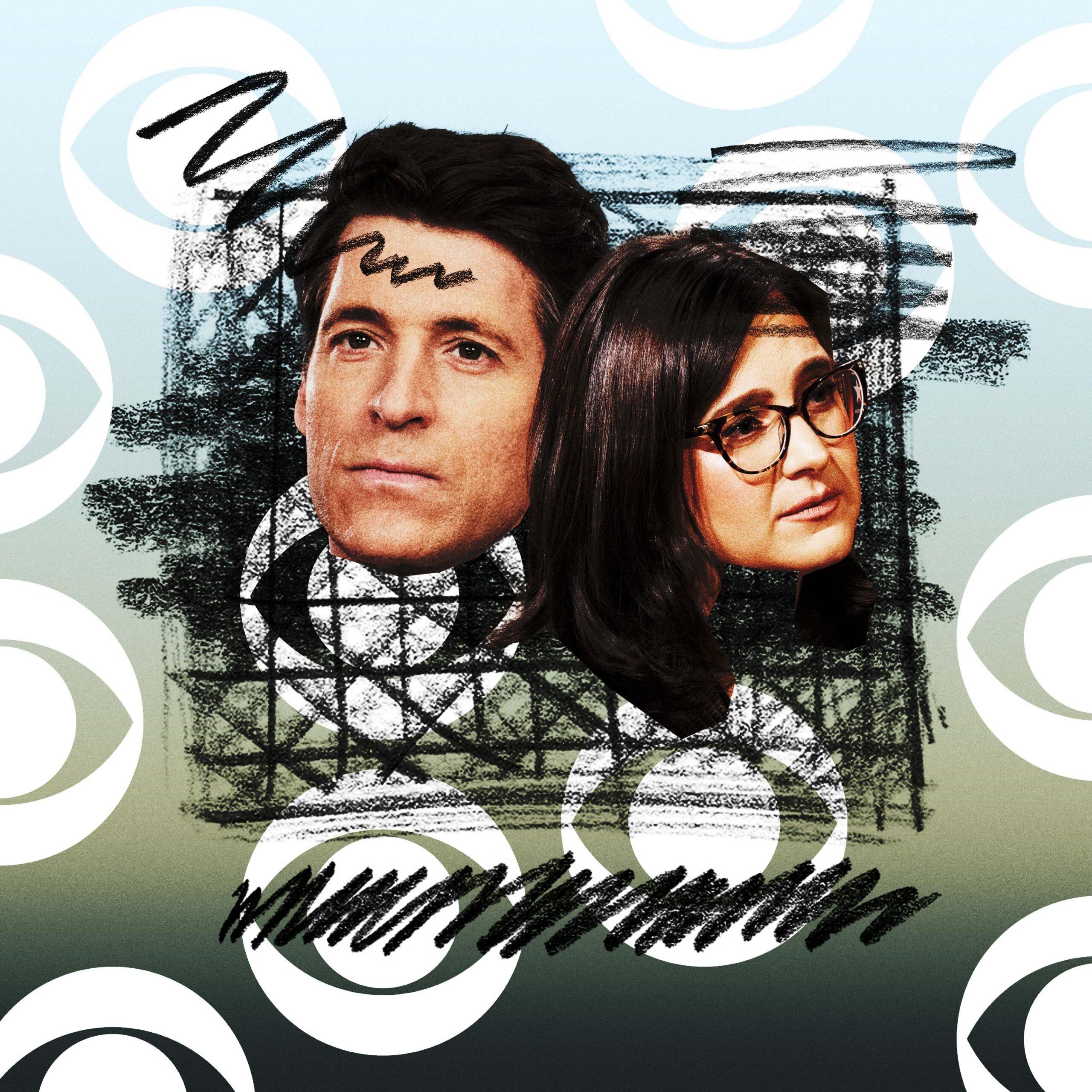

It's hard to blame Tony Dokoupil. If you have the ability to throw a football through a tire 70 yards away, you have to try to become a quarterback, and if your entire being screams "news anchor" to the extent that Dokoupil's does—the accentless news anchor baritone, the sturdy news anchor jawline, the impeccable glazed swoop of anchorly hair—you probably have to take your turn in Walter Cronkite's seat.
Dokoupil, as you probably know, is the new anchor of CBS Evening News. He was appointed in December by Bari Weiss, the editor-in-chief of the network's news division. Weiss was herself recently hired by CBS's new owner, David Ellison, the son of the MAGA-friendly billionaire Larry Ellison. If that seems like a lot of names to take in at once, all you have to remember is this: The scion of a superbillionaire family bought CBS in August, and he hired a conservative former New York Times opinion writer with no TV experience to remake the news division, and she gave Dokoupil, a cohost of CBS Mornings best known for accosting Ta-Nehisi Coates over Israel, the anchor's job. This is his third week in the role. Against all odds, it's going even worse than you'd expect.
It's going horrendously. I don't mean there have been a few minor speed bumps; I mean the bus is pancaked, Wile E. Coyote–style, against the side of the mountain. Ratings have nosedived. The broadcasts have been beset by basic technical errors. Dokoupil has been pilloried on both the left and the right, to the point that he seems to have broken several of his critics' brains in fascinating new ways: Megyn Kelly, whose brain wasn't exactly running smoothly to begin with, blamed Weiss's sexual orientation for convincing her to hire the "soft" Dokoupil. ("This is a lesbian's idea," she sneered, "of what women want.") A new exposé about the chaos inside CBS News seems to drop every day, stuffed with juicy quotes from staffers furious about Weiss's leadership. (They’re also stuffed with bizarre details: According to a scorched-earth New York Times piece last week, one of the lieutenants Weiss brought with her to CBS is Sascha Seinfeld, whose main qualification seems to be that she's Jerry Seinfeld's daughter.) At one point, Dokoupil cried on the air.
"Let's do the fucking news!" Weiss shouted at her staff during her first editorial meeting, on October 7. Well, here's some of the fucking news CBS has done on her watch, as reflected in the headlines it's inspired. "CBS Anchor Tony Dokoupil Is Stuck in an Endless Loop of Humiliation." "This Tony Dokoupil Thing Isn't Working." "It's Worse Than Even CBS Thought It Could Be." "Tony Dokoupil's 'Embarrassing' First Days at CBS Evening News Savaged by Staff." "'Blood in the Water': Bari Weiss's Chaotic First Three Months in Charge of CBS News." "The CBS Evening Debut of Tony Dokoupil Was Embarrassing in Ways I Didn't Know Possible."
And then—oh, friends, then there was Whiskey Fridays With Tony Dokoupil. Did you follow the Whiskey Fridays with Tony Dokoupil saga? Last week, as America melted down in 50 new ways, as Minneapolis resisted a brutal ICE occupation, as Donald Trump's Mar-a-Lago club hosted a party where dancers dressed as French aristocrats and wore dog masks to raise money for canines in law enforcement, images leaked of a new segment apparently being readied at CBS Evening News. Its name? You guessed it. Whiskey Fridays … with Tony Dokoupil.
Sorry, that's the wrong image. I apologize. First day, big problems here. Let's try that again:
What was Whiskey Fridays With Tony Dokoupil, we asked ourselves, back in those innocent days before the first Whiskey Friday rolled around? No one knew. We could draw certain inferences. It would involve whiskey. It would happen on Fridays. It would feature—you see where I'm heading with this—Tony Dokoupil. Beyond that, our horizon disappeared. Would Dokoupil read the news while slowly sipping corn liquor from a Mason jar, perhaps pausing to smack his lips and say, "That's the good stuff!" before reporting on the latest measles spikes? Would he get more charming and relaxed as the segment progressed? Would he cry more? Could Whiskey Friday possibly start on Tuesday, the way it does at my house?
Alas, even before Friday's broadcast aired, Whiskey Fridays proved to be a mere illusion. First Jack Daniel’s, perhaps responding to the large "Sponsored by Jack Daniel’s" sign CBS had placed on the Whiskey Fridays set, clarified that it was not in fact sponsoring Whiskey Fridays, and also had never heard of Whiskey Fridays. Then CBS announced that the set for Whiskey Fridays wasn't actually a set for Whiskey Fridays. It was "an experimental mockup." In sober truth, there was no Whiskey Fridays. CBS had simply been dreaming of an alternate universe, in much the same way that, in an earlier segment featuring Secretary of State Marco Rubio, Dokoupil had shown an AI-generated image of Rubio as the new shah of Iran.
For me, what emerged from the crucible of Whiskey Fridays is that Dokoupil's Evening News has managed to invert the very concept of the news. We turn to a news show for accurate information and to help us make sense of a confounding world. But on CBS, what's most confounding is the production of the news show itself.
Before Dokoupil's first night in the anchor's chair, CBS laid out "five simple principles"—pledges to the viewer that would shape this new version of the evening news. Let's consider them one by one, to help us make sense of the 105-degree fever now dampening the pillow of one of America's most storied media institutions. We can have whiskey afterward. I don't care what day it is.


Principle No. 1: "We Work for You."
Full text: "We work for you. That means you come first. Not our advertisers. Not politicians. Not corporate interests, including the corporate owners of CBS News."
How does it sound? Great. Noble. Important. Kinda punk rock!
How accurate is it? In the legal, financial, moral, and literal senses? Wildly inaccurate. Dokoupil has his job for one reason only, which is that Ellison, CBS's new owner—his media company, Skydance, acquired the network's parent company, Paramount, in August—wants to make his news division more friendly to the Trump administration. This is why he hired Weiss, a 41-year-old writer known for anti-woke, anti–cancel culture, and pro-Zionist views. Weiss wrote for the opinion pages of the Times from 2017 to 2020; her only prior managerial experience came from editing a popular Substack newsletter, The Free Press, which Ellison bought for $150 million when he brought her to CBS.
To be plain, then: Dokoupil works for Weiss, Weiss works for Ellison, and Ellison works for his family's business interests, which means seeking favor from the White House. To be plainer still: In the silent depths of interstellar space, there are clouds of ionized gas that are doing as much to "work for you" as any of these people.
The best way to understand Dokoupil's CBS Evening News is as an extension of Weiss's media persona, which has been built around a peculiar sort of performance. She brands herself as a heterodox thinker, a champion of free speech, even someone who leans to the left, and then adopts positions that flatter the reactionary oligarch class. She isn't a conservative! She just independently thinks her way to conservative conclusions over and over again. If you're a rich white man convinced that pronouns and trans athletes are the greatest threats facing America today, Weiss is there to assure you not just that you're right, but also that your bile is proof of your intellectual fearlessness.
The staging of this performance is neither particularly subtle nor particularly complex. Weiss will typically define "elites" exclusively as left-leaning academics and journalists, then depict the billionaires who feel aggrieved by those academics and journalists as the leaders of a bold grassroots rebellion against the tyranny of liberal groupthink. (Here she is, for instance, calling Peter Thiel, J.D. Vance's billionaire mentor and the chairman of the powerful surveillance technology company Palantir, the "vanguard" of an "antiestablishment counter-elite"; in this view, the establishment elite would be, like, a Middlebury professor.) Billionaires, not a flattery-averse demographic overall, love it when she writes lines like "He's beholden to no tribe but himself, no ideology but his own"—that's Weiss on Thiel again—and reward her by funding her projects and giving her jobs.
In hiring Weiss, Ellison surely understood that he was bringing in someone who would both serve his agenda and clothe her service in the language of moral heroism. The Ellisons are currently working to expand their media empire—they're among the controlling investors in the impending sale of TikTok—which exposes them to potential oversight from regulatory agencies. The acquisition of Paramount last year made it clear to them, if it wasn't already, that the Trump administration will gum up the business dealings of media companies that don't curry the president's favor: Approval for the long-delayed deal came through only after CBS paid Trump $16 million to settle a very sketchy lawsuit, then canceled the late-night show of Trump critic Stephen Colbert, who had called the payment a "big, fat bribe."
So the Ellisons want to please Trump. Weiss wants to please the Ellisons. Put all these pieces together, and you end up with Dokoupil, the public face of the enterprise, bellowing "Marco Rubio, we salute you!" live on national television. It's how you end up with Dokoupil's long infomercial of a talk with Defense Secretary Pete Hegseth. It's how you end up with his shit-eating chat with the president himself, who bragged that the anchor had Trump to thank for his new role: "If she got in"—meaning if Kamala Harris had been elected president—"you probably wouldn't have a job right now. … You wouldn't have this job, certainly, whatever the hell they're paying you." A normal news network might have cut that bit of the interview out; CBS couldn't, because Trump threatened to "sue your asses off" if they edited his interview, and through the 60 Minutes settlement, CBS had created a world in which it was normal to capitulate to White House pressure on free speech.
So no, none of this suggests that CBS Evening News works for us as opposed to "politicians" and the "corporate owners of CBS." The exception here is the many CBS staffers who are reportedly seething behind the scenes at what's happening in their building, and who have relentlessly leaked details to other media outlets revealing how corrupt and shambolic Weiss's operation has been. The staffer who told The Independent that the network was now "state TV"? They were working for you.


Principle No. 2: "We Report on the World as It Is."
Full text: "We report on the world as it is. We’ll be honest and direct with you. That means no weasel words or padded landings. We’ll tell you what we know, when we know it. We'll update our reporting when we uncover new facts. And we’ll admit when we get it wrong."
How does it sound? A little weird! This is literally just a description of how a news organization is supposed to work. Uniqlo doesn't have to put a giant placard in the window reading, "We will sell you socks." If it did, I'd feel suspicious.
How accurate is it? Not particularly! I don't mean Dokoupil lies on camera, or even distorts narratives Fox News–style. It's more that the tone of his reporting, which combines a professionally folksy everyman demeanor with low-calorie pseudo-gravitas, smooths away the sharp edges of events, favoring vibes of unity and healing over real understanding, particularly when the causes of a tragedy lie in right-wing ideology. Conservative media reacted to the killing of Renee Nicole Good by trying to convince you she had it coming; Dokoupil, by contrast, delivered a much-mocked soliloquy filled with high-toned rhetoric that, on close examination, didn't seem to mean much at all. "There is so much to say about the last 24 hours," he intoned, "but sometimes, what matters most is what is yet to be said at all, and what we all still need to hear."
The effect of this speech was to turn an event with very clear and specific political causes into a lukewarm bath of emotions. The real tragedy, Dokoupil seemed to say, isn't that ICE shot Good; the real tragedy is our national mood, and our national mood can be rescued by Dokoupil looking into the camera and taking it very, very seriously. All the words, in this case, were weasel words. None of them honestly, directly depicted "the world as it is"; instead, they softened the world into a gentle, sorrowful, vaguely mysterious blur. In this way, CBS seemed to acknowledge our feelings while suggesting that no one, least of all the people whose decisions led to Good's death, could possibly be held to account.
Principle No. 3: "We Respect You."
Full text: "We respect you. We believe that our fellow Americans are smart and discerning. It’s our job to present you with the fullest picture—and the strongest voices on all sides of an issue. We trust you to make up your own minds, and to make the decisions that are best for you, your families and your communities."
How does it sound? Like an influencer about to drop four minutes of anti-vax propaganda?
How accurate is it? Hmm. I can't say I felt hugely respected by CBS's decision to push the transparently ludicrous claim from anonymous Trump officials that the ICE officer who killed Good "suffered internal bleeding" during the incident. (A bruise, technically, is a form of internal bleeding.) Nor did I feel trusted to make up my own mind when Weiss yanked a 60 Minutes segment that might have made the administration look bad. If you think I'm so smart and discerning, don't you think I've noticed that this sort of deferential wise-centrist rhetoric—there are always two sides, and they must be presented with equal weight so that viewers can decide for themselves—is almost always a cover for incorporating right-wing misinformation into the news? Do you think presenting me with the fullest picture ought to mean acknowledging that?
Over the past couple of years, one of Weiss's side projects has been the founding of an anti-woke, notionally pro–free speech liberal arts university in Texas called the University of Austin. Funded largely by conservative billionaires and supported by a bevy of prominent right-leaning academics, the tiny school is currently melting down over an ideological litmus test one of its free-speech-loving donors wants to impose on faculty and staff. Last week, Politico published a story about the conflict, and this story included a detail that made my head spin: There is a marble bust of Weiss in the university library. I repeat: There is a marble bust of Weiss in the university library.
I'm sorry, but a 41-year-old journalist who commissions, or even permits, a marble bust of herself in public respects neither journalism nor her audience. Deference to billionaires is not a form of respect.


Principle No. 4: "We Love America."
Full text: "We love America. And we make no apologies for saying so. Our foundational values of liberty, equality and the rule of law make us the last best hope on Earth. We also believe in Franklin’s famous line about America as a republic—if we can keep it. We aim to do our part every night: One way to think about our show is as a daily conversation about exactly where we are as a country and where we are going."
How does it sound? Empty.
How accurate is it? You'll be surprised to learn that I don't think it's accurate at all, even to the extent that boilerplate jingoism can be accurate. Anyone who really believed that "our foundational values of liberty, equality and the rule of law" made us "the last best hope on Earth" would presumably want to defend those values. But CBS, under its new ownership, is engaged in a conscious project of enabling the forces working to subvert them. Anyone who believed, with Franklin, that we have a republic "if we can keep it" would presumably want to help us keep it. But CBS, under Weiss, is contributing to the larger right-wing project of undermining access to accurate information, thus making the republic more fragile by making the public easier for would-be authoritarians to manipulate.
Democracy depends on voters seeing the truth. Dokoupil, wittingly or not, is serving as the acceptable face of a collection of powerful people who want to make the truth harder to see. This is not a patriotic project in any way. The patriotic language here is a disguise, meant to keep you from noticing what's really happening.
Principle No. 5: "We Respect Tradition, but We Also Believe in the Future."
Full text: "We respect tradition, but we also believe in the future. We embrace the tools that allow us to reach you where you are. Some of you will watch this show on linear television. Others will increasingly watch it on social media. What we can guarantee is that the tools will continue to change—but some things never will. One of those things is honest journalism."
How does it sound? Pretty good, I guess. Like CBS has heard of phones!
How accurate is it? In the sense that it's saying "you can watch CBS News on your phone," I'd say it's stunningly accurate. You can watch CBS News on your phone! At last, CBS has found a way to report on the world as it is. The world contains phones, and those phones contain CBS News. This is honest journalism of a sort that even the legendary Cronkite, who anchored CBS News from 1962 to 1981, could never have practiced, largely because he retired more than two decades before the smartphone was invented. Responding to a viewer comment earlier this month, Dokoupil said, “I can promise you that we’ll be more accountable and more transparent than Cronkite." Mission accomplished, I guess!