
Hope springs eternal as the first spring training updates roll out across Florida and Arizona. The players give interviews saying they’ve never felt better; optimism floods the training complexes—hitters who have managed to unlock something, pitchers throwing harder than ever, managers insisting that the vibes are at an all-time high.
But this year, beneath the traditional optimism, there are even more stakes riding on the opening days of spring training. A tiny wrist bone has sidelined several superstars and given rise to explainer articles. A 19-year-old is steadily becoming considered one of the best prospects of the 21st century. A World Series contender publicly challenged its franchise icon and unceremoniously cut an enigmatic veteran. A potential bounce-back powerhouse is already running short on pitching. The players’ union is navigating leadership turmoil months before a looming labor fight. And the World Baseball Classic is about to place the sport onto a global stage again.
Despite all this news, it’s hard to not wonder if 29 teams are just playing for the right to challenge the Dodgers (and probably lose) in the postseason yet again. With spring training now underway and games beginning across Florida and Arizona this weekend, it’s time to break down the biggest spring training story lines.
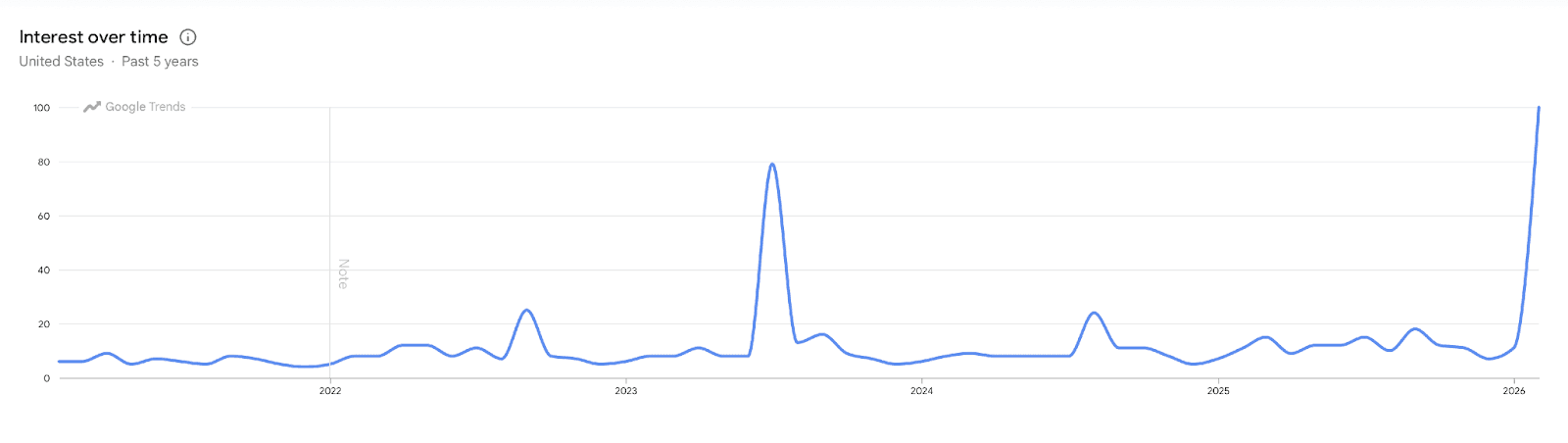
This is the year of the hamate.
There are always a handful of injuries that get reported as MLB players arrive at spring training, but it’s rare that one unusual, obscure bone in the wrist becomes the subject of an entire week of discourse.
For those who are unfamiliar, it’s time to introduce the hamate.
Francisco Lindor, Jackson Holliday, and Corbin Carroll have all suffered broken hamate bones and have undergone surgery before Opening Day. The Orioles already announced that Holliday will begin the season on the injured list, while Lindor and Carroll are attempting accelerated recoveries to be ready by late March.
A hamate fracture is not exclusive to baseball—Bryson DeChambeau had surgery for the same injury in 2022—but it’s uniquely common in the sport because of the repetitive violence of swinging a bat.
The injury typically occurs when the knob of the bat jams into the heel of the bottom hand, often on a foul ball or a high-torque swing that applies pressure through contact. Over time, that repeated stress breaks the “hook” of the hamate, a small bone on the pinky side of the wrist.
Within baseball circles, there’s long been a conventional wisdom that even after hitters return from hamate surgery, their power doesn’t come back right away. A 2020 American Journal study examined the outcomes from the hamate surgery and found that there was a decline in hitting efficiency upon return.
Instead of repairing the fractured hook, doctors remove it entirely. The surgical recovery timeline is relatively straightforward. The aforementioned study said the median return time was 48 days. Even if the Orioles can weather the loss of one of their promising young hitters, the Mets and Diamondbacks need immediate production from their respective franchise cornerstones. The Mets are already breaking in newcomers at first, second, and third base in their 2026 lineup. If Lindor isn’t available by Opening Day, they could move Bo Bichette to shortstop temporarily, or rely on Ronny Mauricio to plug the gap. Neither would be ideal. Bichette was the league’s worst shortstop defensively by outs above average in 2025, while Mauricio has not yet proven himself to be an MLB caliber hitter.
In Arizona, Carroll has had injury scares in the past, mostly involving his shoulder. But he’s only missed 30 total games over the last three seasons, and the Diamondbacks have scored the second-most total runs in baseball across that stretch. He’s the perfect encapsulation of the Diamondbacks’ ability to make contact and use their speed to wreak havoc on opponents. Without him, Arizona’s attempt to return to the playoffs after near misses in the last two seasons is considerably weakened.
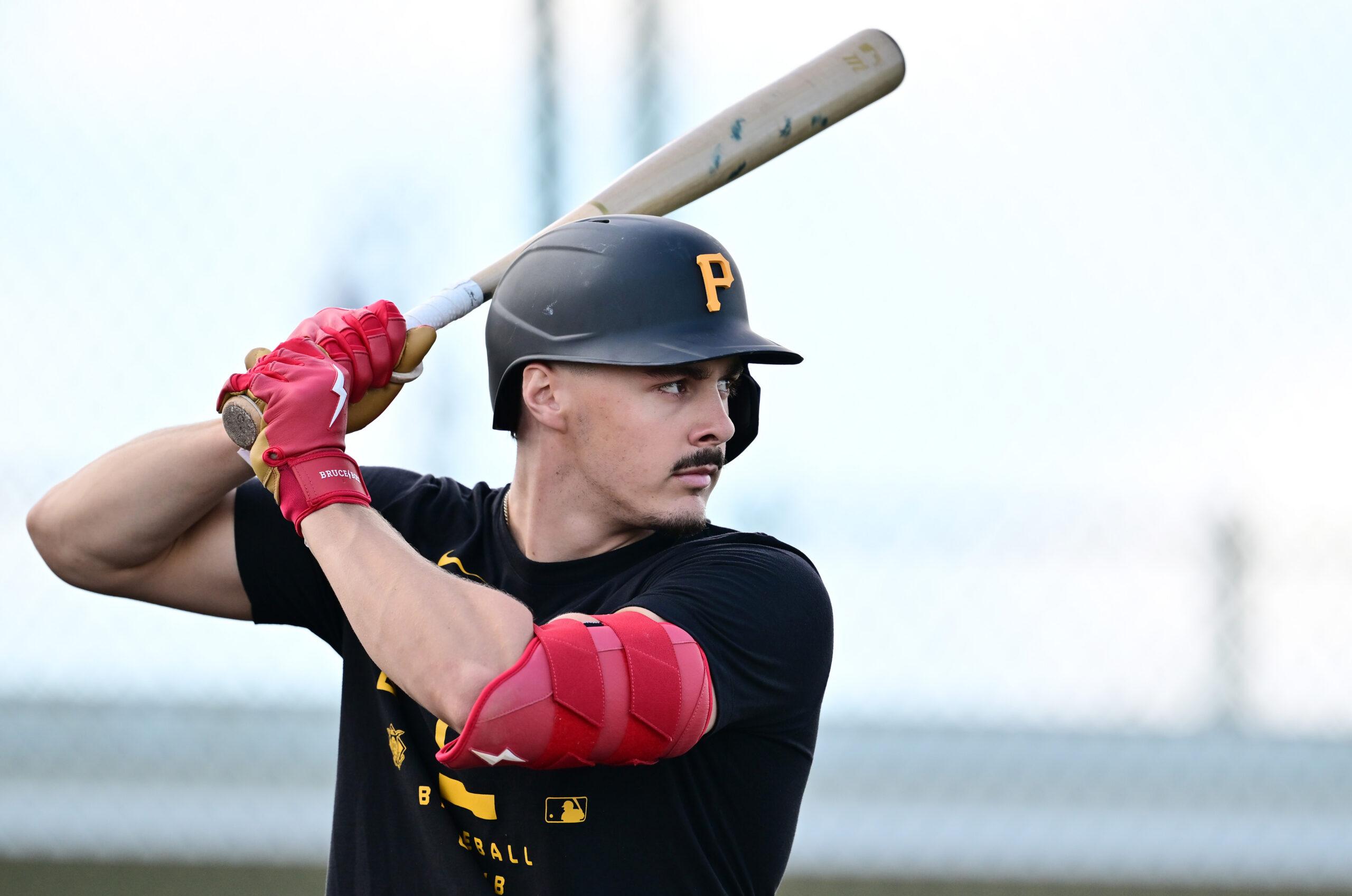
Konnor Griffin at bat during a spring training workout at Pirate City
Could Konnor Griffin actually make Pittsburgh’s Opening Day roster?
FanGraphs released its updated top-100 prospects list with write-ups on Monday, and the language used to describe SS/CF Konnor Griffin stopped me dead in my tracks:
Griffin is a freaky five-tool superstar with big power and enough contact ability to weaponize it. He’s also incredibly fast and has quickly developed into a plus shortstop. He’s about to be one of the best young players in the game.
Griffin is not only clearly the best prospect in baseball, but also one of the top handful of prospects ever evaluated during the current era of FanGraphs scouting, which goes back a little over 10 years. He’s a potentially franchise-altering entity whose talent rivals that of Bobby Witt Jr., a young, level-headed Hanley Ramirez, or a faster Carlos Correa. The rate at which Griffin has become this good is astonishing.
Griffin, the ninth pick in the 2024 draft, is one of 16 hitters ever to get a 70-grade future value rating from MLB Pipeline, which is only given when all five tools—contact, power, speed, glove, arm—are 60 grade or better on the traditional 20-to-80 scouting scale.
There’s no denying Griffin’s elite upside and MLB-ready swing—but would Pittsburgh actually fast-track him to the majors at 19 years old in time for Opening Day? Pirates manager Derek Shelton did not rule out the possibility. Griffin has not yet played above Double-A, but he absolutely crushed it there last year, posting a .961 OPS (albeit in less than 100 plate appearances.)
The fact that Griffin is essentially the co-favorite at FanDuel to win National League Rookie of the Year, despite no guarantee that he’ll even play for the Pirates to begin the season, is a reflection of his immense potential. If you pair him with the star power of ace Paul Skenes, the Pirates now feature two of the most exciting 23-and-under players in baseball and could well finish above .500 for the first time since 2018.
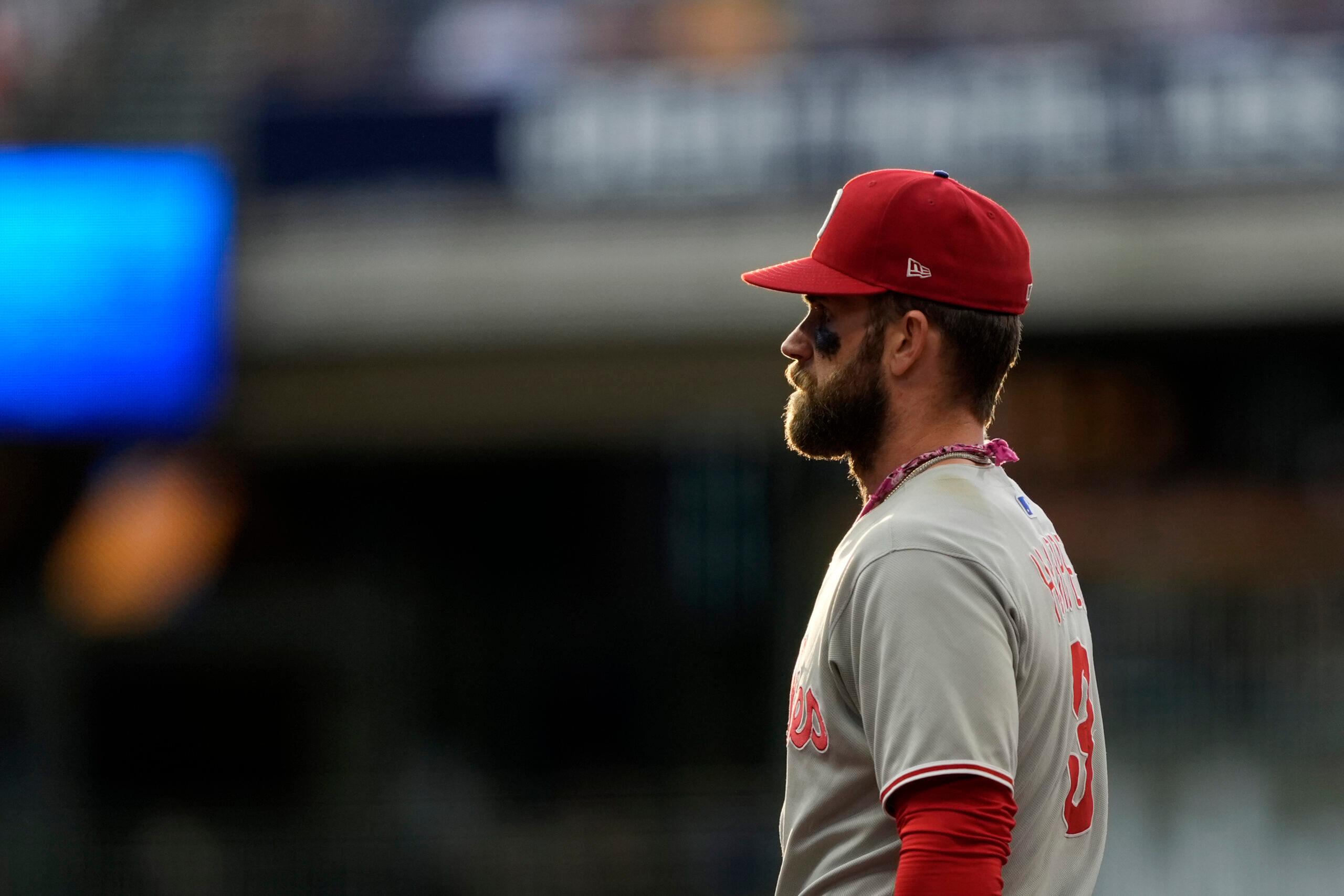
Bryce Harper during a game between the Phillies and the Brewers
The Phillies’ offseason soap opera spills into spring.
The Phillies have one of the most veteran, uninterrupted cores in baseball. Bryce Harper. Kyle Schwarber. Zack Wheeler. Aaron Nola. J.T. Realmuto. Alec Bohm. Bryson Stott. Trea Turner.
Since 2022, the organization has chosen stability over reinvention, most recently achieving consecutive 90-win seasons and back-to-back NL East titles. They’ve trusted continuity and their experience with a belief that the contours of October would eventually bend in their favor.
Two straight NLDS exits have left the Phillies in an uncomfortable tier of baseball purgatory. They were good enough to win 90 games without that much strain, but ultimately unable to execute across a handful of tense playoff games.
On paper, 2026 should feel like a smooth continuation of a successful run. The Phillies extended Schwarber for five years at $150 million. They retained Realmuto. Two of the organization’s most hyped prospects—center fielder Justin Crawford and RHP Andrew Painter—are expected to be everyday contributors. The window is still open.
Still, this spring for the Phillies has felt more like an overly dramatic soap opera rather than a recommitment to winning.
The expected yet controversial release of Nick Castellanos, after failed trade attempts, marked the end of a strange four-year tenure. Castellanos produced just 0.7 fWAR across four seasons after signing a five-year, $100 million deal before the 2022 season. The value never matched the contract, but there were moments that endeared him to a segment of the fan base.
He hit four home runs in two days against Atlanta in the 2023 NLDS. He made a sliding catch to preserve Game 1 of the 2022 World Series. He walked off the Mets in the 2024 NLDS. Castellanos had a flair for the dramatic, but he also failed to provide consistent value on the field for the Phillies.
Last Thursday, following news of his release, Castellanos posted a handwritten letter on Instagram offering his gratitude to the organization, as well as an explanation—and apology—for an incident that occurred between him and manager Rob Thomson last season. After Thomson pulled him for defense late in a game against Miami in June, a frustrated Castellanos brought a beer into the dugout in protest. Field microphones picked up shouting from the Phillies dugout during the broadcast, which can be inferred to be Castellanos. Recent reporting from The Athletic suggests that he wasn’t viewed as a bad teammate, but he wasn’t exactly seen as a team player, either.
The Phillies told him to not report to spring training. They waited until camp was underway to formalize the release. What could have been procedural instead became theatrical.
Once you add in president of baseball ops Dave Dombrowski’s public challenge of Bryce Harper last year, and Harper’s repeated comments about it, the Phillies are entering 2026 in a strange position.
After the postseason loss to the Dodgers, Dombrowski said Harper “didn’t have an elite season like he has had in the past.” He went further: “Can he rise to the next level again? I don’t really know that answer.”
Harper posted a photo in December wearing a shirt that read “not elite,” despite Dombrowski a month earlier saying he and the two-time MVP had cleared the air. Then, when asked about the same comments in camp earlier this week, Harper doubled down.
“For Dave to say that,” he said, “it’s kinda wild.”
There’s a plausible reading of the situation in which Dombrowski understood exactly what he was doing. Harper’s 2025 was solid. It was definitely not elite. Dombrowski’s comments were not inaccurate, but the decision to make them publicly raises flags. Harper did look emotionally disengaged throughout parts of 2025. If Dombrowski believed his franchise cornerstone needed provocation, then maybe this was calculated. Harper’s probably not going to be the peak player we’ve seen in the past, but Dombrowski has now fired shots at the Phillies’ longest-tenured position player and heartbeat of the franchise.
The Phillies are still talented enough to win the division and even the World Series. But they have now officially entered the most fragile stage of contention, when the clock is ticking much closer to midnight than a new dawn.
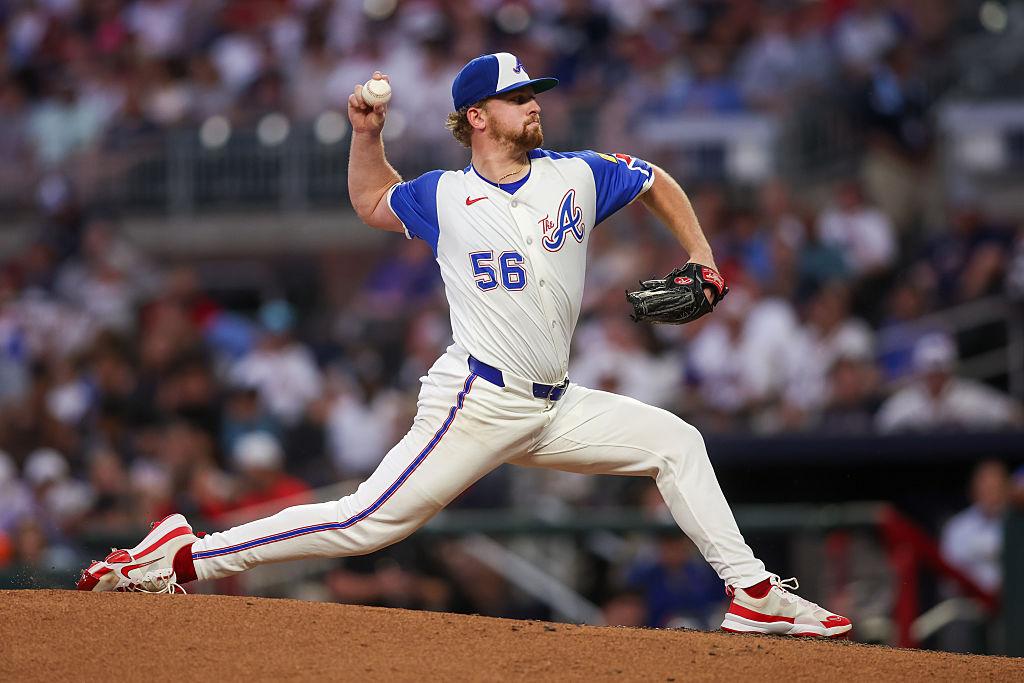
Spencer Schwellenbach pitches against the Phillies
Atlanta’s pitching injuries threaten its bounce-back narrative.
The Braves are your favorite baseball pundit’s favorite bounce-back team of 2026.
It makes sense on paper. Atlanta entered 2025 as the betting favorite in the NL East yet somehow finished fourth at 76–86, one of the most jarring underperformances in the league. The bullpen hemorrhaged late leads, the rotation unraveled due to injuries, and the lineup that once felt inevitable suddenly looked mortal. Longtime manager Brian Snitker has since stepped down and transitioned into a senior advisory role.
It’s easy to make the case that the Braves simply had bad injury luck and a down season, and that there are brighter days ahead. But it’s not quite that simple.
Chris Sale is still the rotation’s anchor, but that sentence would have felt dystopian in 2023. Behind him, every spot feels precarious. Up-and-comer Spencer Schwellenbach was placed on the 60-day IL with right elbow inflammation after posting a 3.23 ERA across his first 38 career starts. Hurston Waldrep flashed great stuff last year with a 2.88 ERA breakout season across nine starts, but the presence of loose bodies in his elbow could cost him a minimum of three months now that he needs surgery.
Spencer Strider is technically the no. 2, but his fastball didn’t have the same life last year and his strikeout rate dipped to near league average. Reynaldo López, coming off a season-ending shoulder injury, is penciled in behind him. That leaves Bryce Elder once again tasked with meaningful innings. Since his surprise All-Star appearance in 2023, he owns a 5.59 ERA across the last two seasons. Grant Holmes projects to round out the opening rotation, but he’s more of a swingman than a reliable starter.
And Atlanta’s lineup isn’t immune from the dropoff, either.
Matt Olson’s power dipped from its 2023 peaks. Ozzie Albies hasn’t put together a fully healthy, peak-caliber season since 2023. Over the past few seasons, Atlanta’s front office bet aggressively on long-term extensions and internal continuity. The core is locked in, but the organizational depth is thinner and now the margins are getting squeezed by the recent success of the Phillies and Mets.
The Braves are talented enough that they might go on and win 95 games and remind everyone what they can be. But with every new pitching injury and lineup setback, their aura is dwindling.
The World Baseball Classic is about to have another moment.
The 2023 World Baseball Classic took advantage of a slow period in the sports calendar—the sweet spot after football, before March Madness, and in the midst of the NBA regular-season doldrums—with a wonderful celebration of the international growth of baseball.
Three years ago, Team USA lost in the final to Japan in a thrilling classic, but now the Americans return with Tarik Skubal and Paul Skenes at the top of their pitching staff. The Dominican Republic failed to get out of the group stage after losing to Venezuela and Puerto Rico; they now return with a starting lineup featuring seven 2025 All-Stars. Puerto Rico won’t have Francisco Lindor due to injury and Carlos Correa due to insurance issues (despite the best efforts of Bad Bunny), but they remain a serious threat.
The U.S. will face off against Mexico in Houston on March 9, three years after Randy Arozarena and Mexico beat the U.S. in group play in Phoenix. Team USA is currently the betting favorite to win the whole thing with their pitching upgrades, but they’re also on a potential collision course with Japan in the semifinal.
International competitions like the Olympics, World Cup, and World Baseball Classic can bring out the national pride and sense of community that we love about sports. And in 2026, we get to enjoy all three as global sports fans.
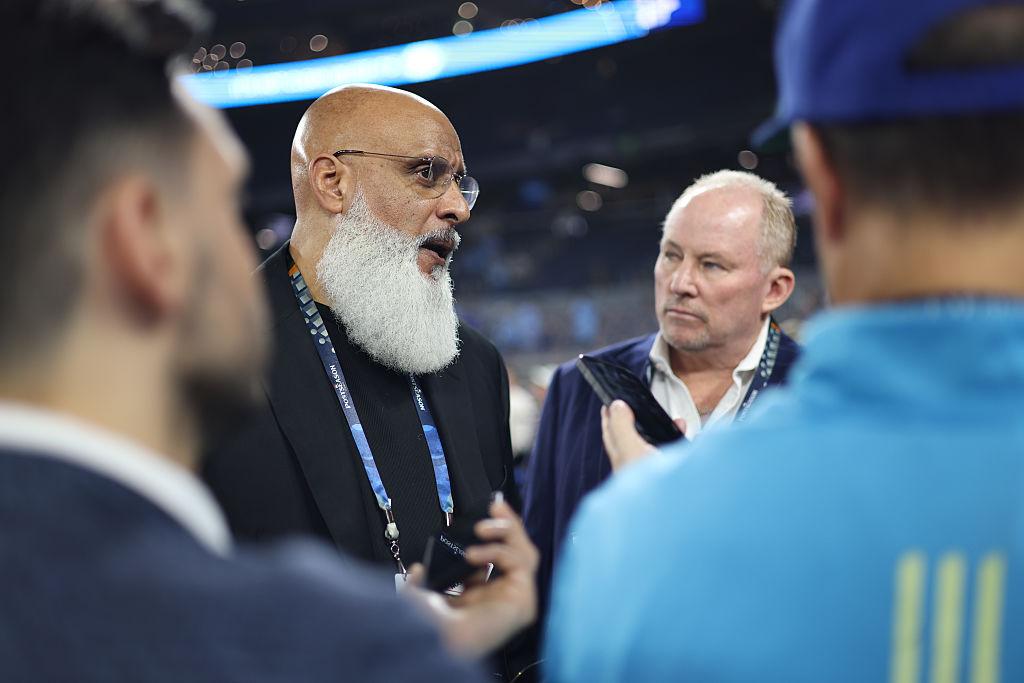
Former executive director of the Major League Baseball Players Association Tony Clark talks with media at the 2025 World Series
An MLBPA leader unexpectedly steps down ahead of a pivotal negotiation year.
On Tuesday night, the MLB Players Association announced the abrupt resignation of executive director Tony Clark following reports of an “inappropriate” relationship with his sister-in-law, who also worked for the union. Clark’s exit could have a serious domino effect: MLBPA just lost its executive director months before what is expected to be one of the most combative collective bargaining negotiations in recent memory.
MLB owners have signaled a desire to revisit revenue structures, competitive balance mechanisms, and potentially the luxury tax system. The union was already preparing for a fight. Now it’s doing so amid leadership turmoil. The battle lines are still being drawn ahead of the upcoming negotiations, with questions looming over a potential salary cap and floor and both sides poised to dig in ahead of a potential lockout in 2027.
At the exact moment the players need steady hands to manage a tumultuous period, they have increasing uncertainty about who’s leading their unified front.