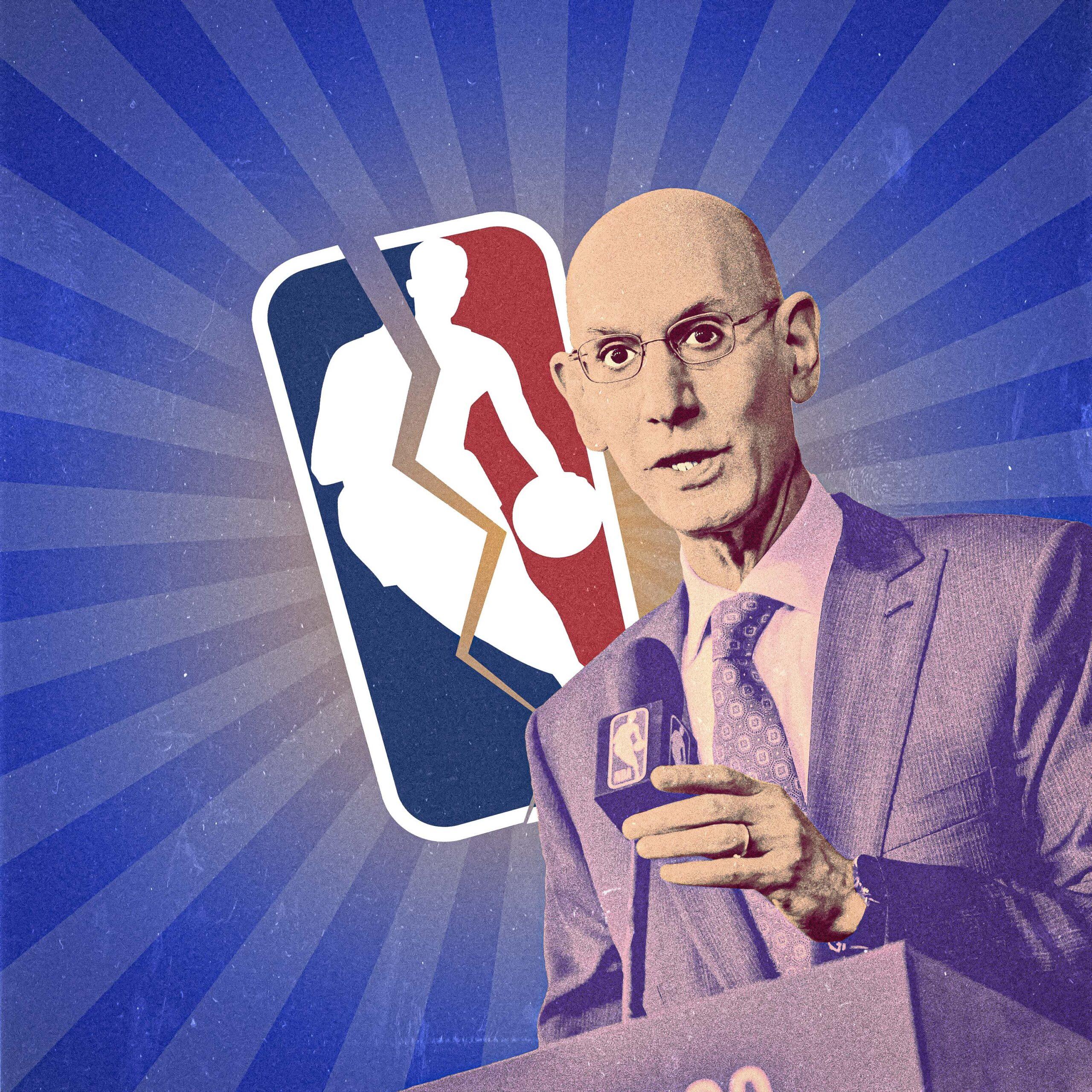

Adam Silver tipped off the latest All-Star Weekend, as he does every All-Star Weekend, with a little techno-wizardry at the NBA’s tech summit, an invite-only gathering of league execs, agents, sponsors, movers, shakers, and varied VIPs. With the assistance of (naturally) an influencer named Jesser, the commissioner rolled out “POV Mode”—an AI-powered feature that would allow fans to view games, in real time, through the point of view of any player on the court.
For a few dazzling moments, everyone in the YouTube Theater auditorium became Dallas rookie Cooper Flagg as he flicked a midrange jumper over Charlotte’s Moussa Diabaté. The massive digital screen showed Flagg’s arms and hands in front of us, as if they were our own. Neat.
Except all the “players” on the screen looked like robots, with gray, faceless orbs for heads, and the arena background was dark, devoid of fans. It looked more like a 20th-century video game than a 21st-century NBA game. But POV Mode was, well … sorta cool? I guess?
Silver seemed to think so. Or at least he did a commendable job of reciting his lines and putting on a gee-whiz smile as he watched his pal Jesser explain it all.
“So this is all what we’re gonna be able to do in real time,” Silver said, feigning childlike wonder as the cartoon robots with real-world player names ambled around a virtual Mavericks home court.
It wasn’t clear when, how, or even if this slick new feature would be available in our living rooms. But then, Silver’s annual tech summit presentations are generally more dreamy than practical.
Last year, it was robots rebounding for Steph Curry. The year before that, it was a face-swap gizmo that put Ahmad Rashad’s head on Victor Wembanyama’s body. The year before that, Rashad was magically transported into a Lakers-Jazz game, where he promptly posterized Damian Jones. Back in 2019, Silver showed off a “smart jersey” that would give fans the power, via an app, to change the name and number on an NBA jersey (presumably so they wouldn’t have to buy a new one every time their favorite player got traded).
Over the past decade, the NBA has loudly touted the metaverse, crypto, NFTs, virtual reality, augmented reality, and just about every other kind of reality. The gizmos and gimmicks rarely make it to the real world, but, well, it’s the aspiration that counts. Yet it always leaves us wondering: Is any of this actually useful? Would it improve the game? The league? Our collective experience? Our enjoyment?

More on the NBA’s Troubles
Alas, if only the tech bros could make an app to solve the NBA’s tanking problem. Or player tampering. Or salary cap circumvention. Or soft-tissue injuries that sideline stars for weeks. Or load management. Or the slam dunk contest. Or League Pass glitches. Or the fractured broadcast landscape. (“Hey Siri, what freaking channel is the game on tonight?”) Or the WNBA’s labor standoff. Or, uh, how to prevent NBA players and coaches from getting entangled in the gambling industry.
Because the fact is, the league has never faced a more daunting array of challenges, scandals, and scattered land mines than it does today. And Silver, a veteran of countless crises in his 12 years as commissioner—from Donald Sterling’s racism to the COVID shutdown—is facing more pressure and scrutiny than ever.
All-Star Weekend is supposed to be a celebration, but Silver's annual press conference on Saturday in Los Angeles practically became an interrogation. The first question was about tanking, a problem Silver conceded is worse than ever, despite various attempts to curb it. Then came a question about the WNBA’s labor woes, which could threaten the 2026 season and destroy all the momentum of the last few years. There was a question about Giannis Antetokounmpo investing in a “prediction market” outfit that, among other things, lets consumers … bet on where Giannis Antetokounmpo will play next. And, of course, there was a question about the Los Angeles Clippers, who played host to the All-Star Game, even as an army of lawyers continues to investigate the club for what, if true, might be the most brazen and egregious cap-circumvention case in NBA history.
There were also the usual questions about expansion (still under consideration) and a planned European league (still in progress), along with a perfunctory question about Phoenix hosting next year’s All-Star Game. But the underlying tenor of the session was: Hey, Adam, how do you plan to fix all of these problems plaguing your league?
Yes, the NBA has endured gambling scandals before (see Donaghy, Tim) and cap scandals before (see Smith, Joe) and labor problems before (see NBA lockouts in 1998 and 2011) and tanking and tampering concerns across the decades. The NBA has seen worse and survived worse. If David Stern were alive today, he’d chuckle condescendingly and remind us once more that in the 1970s and '80s, the league was considered "too Black," recreational drug use was ubiquitous, and the Finals were broadcast on tape delay.
So yes, the league has always had its challenges. But never has an NBA commissioner been faced with so many crises, on so many fronts, all at once. Nor so many that cut to the core of the league’s credibility.
The Clippers’ case may sound trivial—what pro sports team doesn’t try to skirt the rules?—but what they’re accused of, secretly funneling tens of millions of dollars to a player and his family members, would thoroughly undermine the salary cap structure and destroy any sense of trust or competitive fairness among the 30 franchises.
The gambling case brought by the federal government last fall needs little elaboration. An active NBA head coach (Chauncey Billups), an active NBA player (Terry Rozier), and a former player and assistant coach (Damon Jones) were arrested following yearslong federal investigations into illegal gambling. According to the indictments, Rozier and Jones allegedly provided insider information to professional gamblers, while Jones and Billups allegedly helped organize rigged poker games, which, while unrelated to the NBA, further compromises their standings.
And then there’s tanking, a scourge the NBA has repeatedly tried (and generally failed) to extinguish over the past four decades. Just last week, Silver hit the Utah Jazz with a $500,000 fine for benching healthy starters in a winnable game and fined the Indiana Pacers $100,000 for holding healthy players out of the lineup. Both teams are heading to the draft lottery and have every incentive to lose games the rest of the way.
That the Jazz engaged in such brazen tanking tactics before the NBA had even reached the All-Star break had to be especially galling to Silver, who just seven years ago touted new lottery reform measures that he hoped would discourage (if not eliminate) such blatant manipulation of the system.
“Overt behavior like this that prioritizes draft position over winning undermines the foundation of NBA competition, and we will respond accordingly to any further actions that compromise the integrity of our games,” Silver said in his statement last week. At his press conference, Silver declared the league would consider “every possible remedy … to stop this behavior.”
As ESPN’s Bobby Marks noted (accurately) in a recent social media post, billionaire owners are hardly moved by fines, even fines in the hundreds of thousands of dollars. So when Silver says he’s considering everything, that could mean more extreme punishments, such as stripping draft picks from offending teams, or more extreme solutions, such as a thorough overhaul of the draft and lottery. The league can’t afford to do nothing, and league sources insist they are committed to making substantive changes in the coming months.
In his press conference, Silver vowed he would “take a fresh look” at the issue—a phrase he’s invoked often and a defining feature of his leadership. Under Silver’s watch, the NBA has reformed the lottery, added a play-in round to the postseason, launched the NBA Cup, streamlined the schedule, expanded instant replay, and experimented frequently. He’s tweaked the All-Star Game itself multiple times and, based on the rousing praise we heard for Sunday’s new format, might have finally revived it.
At the most basic commercial level, the NBA is undeniably thriving. League revenue could exceed an eye-popping $14 billion this season, just four years after first crossing the $10 billion threshold. The league is a global juggernaut and has the security of a $76 billion media rights deal that runs through 2035-36. But all that wealth can’t insulate the league from scandal, or the slow erosion of its credibility in the public eye.
Silver distinguished himself early in his tenure by decisively banning Sterling after tapes surfaced of the then–Clippers owner making racist remarks. He forged a true partnership with the players association, in contrast to the adversarial relationship that defined the Stern era. He earned praise for his steady stewardship during the 2020 pandemic. Within two years, he could be marking the NBA’s official expansion into Europe, and its first domestic expansion in two decades.
But Silver’s legacy, like that of any sports commissioner, might ultimately be defined by the crises thrust upon him. The league has to solve tanking once and for all. It needs better safeguards to insulate itself from criminal gambling interests. It badly needs new standard-bearers to take the torch from LeBron James and Stephen Curry when they soon retire. And perhaps more than anything else, it needs to figure out how to keep players healthy and on the court, to justify the skyrocketing ticket prices and lavish media rights deals.
It’s a weighty list, to be sure. But hey, we just saw a legitimately competitive and entertaining All-Star Game for the first time in forever, with its highest viewership in 15 years. If the league can solve that debacle, maybe there’s hope for everything else.