The Evidence of Our Eyes and Ears Is Under Attack
Extensive video footage is prevailing in debunking false accounts of Alex Pretti’s killing in Minneapolis. Next time, it may not be enough.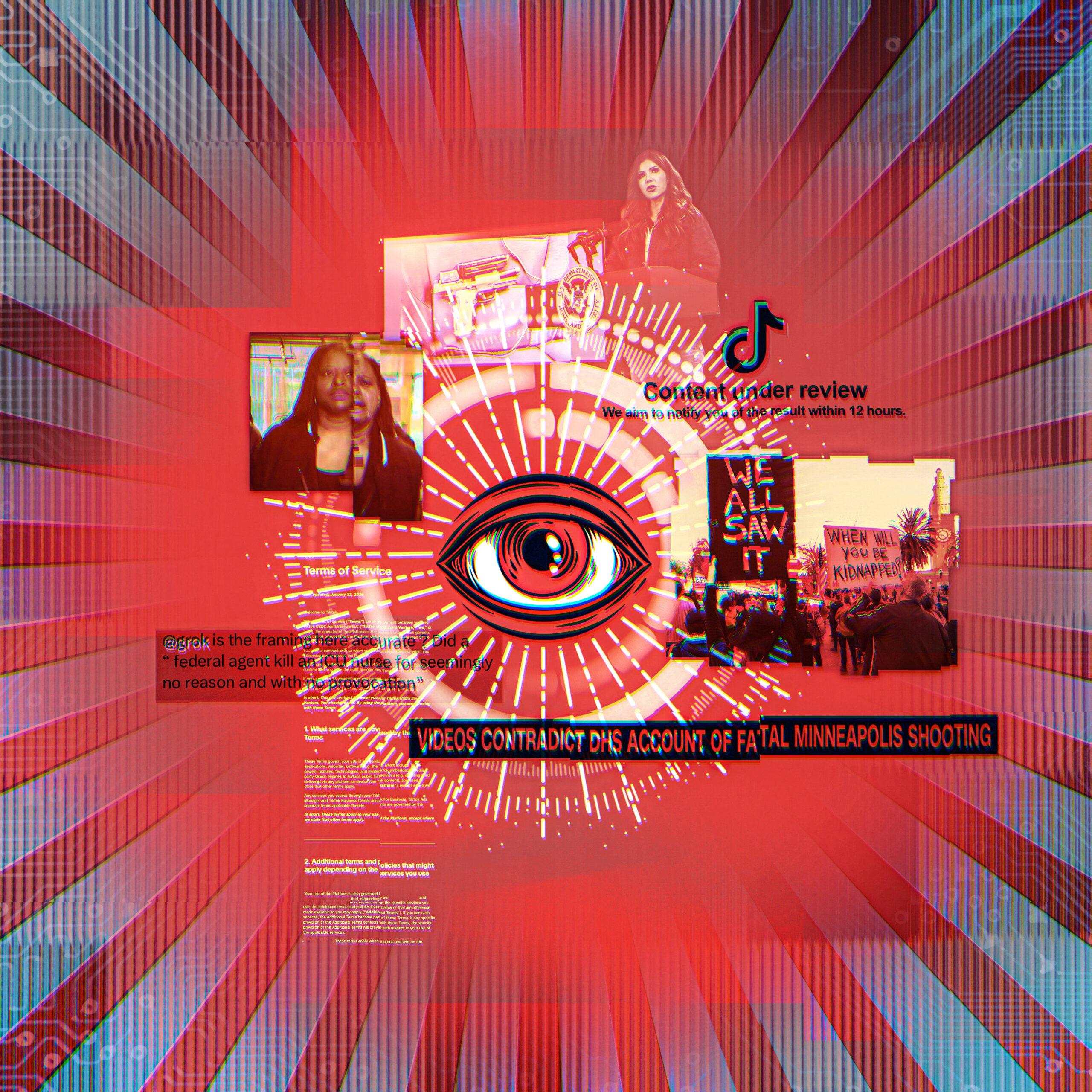

On January 26, two days after masked Border Patrol agents shot Alex Pretti to death in Minneapolis, the city’s largest newspaper, The Minnesota Star Tribune, published a citizen’s guide to riot-control gas. The piece, which was written by Kim Hyatt and Louis Krauss, looked at the range of chemical agents deployed by federal immigration forces during the Trump administration’s sprawling, chaotic, and deadly surge in Minnesota. It explained to everyday readers, nontrivial numbers of whom have been indiscriminately gassed by federal operatives, how to identify different chemicals by the empty canisters left on the ground and what the consequences of inhaling each formula might be. National media has covered the invasion of Minnesota from a big-picture perspective, but the Star Tribune’s reporting was practical, specific, and local. Hexachloroethane comes in a gray container and is highly corrosive and carcinogenic. An “intense orange-colored, metallic fire” emitting from a burning canister probably means tear gas. Most chemicals won’t be toxic if encountered outside, but in an enclosed space, such as the SUV in which a family in north Minneapolis was gassed (after tear gas canisters were thrown beneath the car) on January 14, they can quickly grow dangerous; the family’s 6-month-old baby, the Star Tribune notes, arrived at the hospital unconscious and foaming at the mouth.
The story of the Trump administration’s assault on Minnesota has been, in part, a story about information. For once, it’s a story in which accurate knowledge is prevailing over propaganda and lies. This is true at the ground level: Minnesotans have been able to resist ICE and Border Patrol so effectively because they’ve found ways to share concrete information about the armed, masked gangs tearing up their neighborhoods; have relentlessly filmed federal agents’ brutality; and have built up a store of functional intelligence like that contained in the Star Tribune article. It’s also true at the national level: The nationwide outrage over the killings of Renee Nicole Good, on January 7, and Pretti, on January 24, was fueled by videos of the shootings that clearly refuted the White House’s account of events.
The White House told Americans to reject the evidence of their eyes and ears; Americans refused to comply.
“The Party told you to reject the evidence of your eyes and ears,” ran the quote from Orwell's 1984 that spread across social media after Pretti’s killing. “It was their final, most essential command.” President Trump described Good as a “professional agitator” who “behaved horribly” and “ran over” the ICE agent who shot her. Vice President JD Vance and Homeland Security Secretary Kristi Noem insisted that she had engaged in "terrorism," and Deputy Chief of Staff Stephen Miller (and Noem once again) said the same of Pretti. Miller went as far as to call Pretti an “assassin,” while Border Patrol commander Gregory Bovino said Pretti had set out to “massacre law enforcement.” The videos showed nothing of the kind. They showed Good as a mom who was driving with her partner and her dog after dropping her kid off at school; they showed Pretti, a nurse who worked with veterans, as a legal observer whose most aggressive act was to try to help a woman Border Patrol agents were attacking. (According to bystanders, his last words were “Are you OK?”) The White House told Americans to reject the evidence of their eyes and ears; Americans refused to comply. The result: Bovino, who’d led the administration’s traveling circus of punishment through Los Angeles and Chicago before coming to Minneapolis, was put out to pasture, and the administration began backing down, at least to an extent, in Minnesota. Noem’s job is reportedly under threat; Noem is complaining privately that Miller was the architect of the disinformation campaign and insisting she was only following orders from the White House. The truth, supported by extensive video evidence, is winning.

And that’s what worries me. The administration’s defeat in Minnesota is a perfect illustration of the importance of accurate information to a democracy. It’s also a perfect illustration of the lengths to which this White House will go to deceive Americans. (Often successfully: On Tuesday night, Democratic Minnesota Representative Ilhan Omar, a frequent target of the president's lies, was attacked at a town hall on immigration in Minneapolis by a man who sprayed her with “a strong-smelling liquid” before he was tackled by security.) And as ICE continues to ramp up aggressive surges in other states—Maine is currently in the crosshairs—there are signs that a new wave of misinformation is coming for the United States. The next killing may be accompanied not by unambiguous video evidence but by multiple videos that show wildly different versions of events.
The administration’s defeat in Minnesota is a perfect illustration of the importance of accurate information to a democracy. It’s also a perfect illustration of the lengths to which this White House will go to deceive Americans.
Consider:
- On January 22, two days before Border Patrol agents killed Pretti, the Trump-backed sale of TikTok’s U.S. arm to a new ownership group was finally completed. The consortium is led by longtime Trump ally Larry Ellison, the world’s sixth-richest man. Reports began to appear that the app was throttling political speech and censoring content critical of ICE. (TikTok blamed it on technical issues.) The app also changed its terms of service in the wake of the deal to allow it to track its users more closely, including details such as their immigration status and precise location.
- On the same day, the official White House X account posted a digitally altered photo of a woman arrested at an anti-ICE protest in St. Paul. The woman, Nekima Levy Armstrong, wore a calm expression in the real photo; in the altered image, she’s weeping and visibly in fear. (Armstrong, who is Black, also has noticeably darker skin in the altered photo.) Experts said the photo was probably altered by AI. The Trump administration has posted many AI-generated images and videos over the past year, but most have been cartoonish or otherwise clearly artificial. This was a case of the federal government doctoring the photographic record to deceive Americans about a news event. When asked by The Guardian whether the photo had been digitally altered, the White House ignored the question but forwarded a tweet from Deputy Communications Director Kaelan Dorr reading, in part, “Enforcement of the law will continue. The memes will continue.”
- Also on January 22, Wired reported on the likelihood that advances in AI could soon lead to the rise of “disinformation swarms,” huge clusters of social media accounts controlled by AI agents capable of delivering “society-wide shifts in viewpoint” by saturating the information environment with coordinated lies. The report was based on a paper recently published in Science and authored by 22 experts “drawn from fields including computer science, artificial intelligence, and cybersecurity, as well as psychology, computational social science, journalism, and government policy.” The TL;DR conclusion: The more powerful AI becomes, the greater the likelihood it will be used to profoundly destabilize democracy by blocking our access to, and warping our idea of, the truth.
- Of the major social media platforms in the United States, X and TikTok are now controlled by Trump allies; Facebook and Instagram are controlled by a MAGA-curious Roman Empire fetishist who doesn’t care whether his platforms are used as a breeding ground for misinformation.
- Of the major news networks in the United States, Fox and CBS are now controlled by right-wing interests. (CBS was acquired last year by David Ellison, the son of the billionaire whose group just bought TikTok.) Of the major newspapers, The Washington Post and the Los Angeles Times are controlled by MAGA-friendly oligarchs. Local TV news is largely controlled by two right-wing corporations, Sinclair and Nexstar. Local newspapers continue to be gutted. Even The Minnesota Star Tribune, which published the riot-gas story, is owned by a Republican billionaire—Glen Taylor, the former owner of the Minnesota Timberwolves—who, when he bought the paper in 2014, declared his intention to make its coverage more friendly to the right.
In simpler terms, three things appear to be true at the same time:
- The Trump administration is growing more brazen in the ways it deceives the public, including by digitally doctoring imagery from the news.
- The technology available for altering photos and videos is growing more powerful, and, in the AI era, the ability to spread such altered photos and videos may soon grow exponentially more powerful.
- The major conduits by which information reaches the American public—social media, television, and newspapers/websites—are increasingly controlled by antidemocratic and pro-Trump interests.
See why I’m nervous? In a way, it may sound like I’m not saying anything new. We've been living in the age of misinformation for a decade now, and the fear of artificial videos indistinguishable from the real thing has existed since the first deepfake blinked its eyes. And it’s not news to anyone, including most of Trump’s supporters, that the Trump administration is lavishly staffed with liars. But there’s a distinct point at which the water becomes too hot for the frog to survive, and that point happens well after the frog thinks the heat is old news. I don’t think we’re at that point. I do think we’re closer than we’ve ever been.
The reason that authoritarians like Trump, Miller, and Noem love misinformation is not really that they expect you to believe it. It’s that they want to fill you with doubt.
Voters in a democratic society have to make choices about the direction of the country, and those choices require an accurate picture of the world. Let’s take a silly example. Imagine that Hawaii was hit by a freak blizzard and was buried under snow and ice. (This is easy for me to imagine, as it is an accurate description of my house at this moment.) Seeing pictures of the aftermath, we’d know exactly how to help, right? Send snow plows, road salt, and puffy jackets. Now imagine that a billionaire had a vendetta against Hawaii—he once fell over during a hula competition, due to his non-aerodynamic hips—and bombarded the 100 million users of his social network with AI-generated videos “proving” that Hawaii was actually in the grip of a heat wave and that Hawaii residents were lying about the storm for nefarious reasons of their own. Suddenly, a third of the country is made up of Hawaii snow truthers who want to arrest the governor for declaring a state of emergency. Tucker Carlson alleges that Hawaiian demons attacked him in his sleep; a lot of yelling ensues on the internet, and the end result is that the Department of Health and Human Services links pineapples to autism, and a lot of cold people go without coats.
The reason that authoritarians like Trump, Miller, and Noem love misinformation is not really that they expect you to believe it. It’s that they want to fill you with doubt. This is why it’s not a tactical problem for Trump that he constantly contradicts himself: The aim is to make you feel as though nothing is true, or everything is equally true, or the truth is constantly changing. (We had always been at war with Eastasia.) If you feel that way, you lack the confidence necessary for democratic decision-making; you either turn to authority for clarity or you turn away from politics in cynical disgust. By manipulating the narrative, authority can manipulate your emotions, keeping you in a permanent state of anger in response to whatever emergency it says is threatening you at the moment: It’s MS-13! No, wait, it’s Greenland! It’s Antifa! No, it’s the Somalis! And when you’re in a state of sustained emotional arousal with a weakened sense of reality, you are exceedingly easy to control. Some people like being in this state, because it frees them of responsibility, or because the constant parade of faraway crises makes for good TV. It’s not a condition that’s compatible with democratic citizenship.
Considering who currently controls the flow of information in America—who tunes the algorithms, sets the terms of the conversation, decides what airs on TV—I’m afraid a lot of people will end up thinking they’re trusting their eyes when they’re really being fooled.
Good’s and Pretti’s deaths galvanized much of the country because the videos were relatively unambiguous. We could see that Good did nothing to merit a violent response. We could see that Pretti never drew the (legal, licensed) handgun he was carrying and that he’d been disarmed before the agents shot him. We could trust the evidence of our eyes.
But what happens the next time federal agents kill someone? What happens the time after that? Would you put it past this administration to drop an AI-generated gun in the hand of a victim, release the video to every news platform, and then claim the real video is the fake one? Or to change a victim’s words—“I’m not mad at you,” say—to something more incriminating, then use the doctored audio as justification for their murder? And considering who currently controls the flow of information in America—who tunes the algorithms, sets the terms of the conversation, decides what airs on TV—I’m afraid a lot of people will end up thinking they’re trusting their eyes when they’re really being fooled. I’m afraid some of the people who see both videos will decide there’s no way to tell which one is real, throw up their hands, and go with whatever version of events better suits their feelings.
I don’t want to be a pessimist. I want us to be prepared. The courage and intelligence of regular people in Minnesota over the past few weeks have given me more hope for this country than I’ve felt in a long time. But when we post that Orwell quote to our feeds, we need to think about its implications if the current arc of misinformation continues on its present course. We need to think about the ways it can be subverted. Otherwise, when I look at the future, I don’t see a boot stamping on a human face forever. The memes will continue, after all. I see all of us who want to save American democracy smiling for the camera, flashing two big thumbs up, in a pinned post at the top of the profile page of the official White House X account.