

In the past few years, the word that has come up more and more to describe the Kansas City Chiefs has been inevitable. Kansas City has played in the past three Super Bowls and the past seven AFC championship games, and it’s made the past 10 playoffs, a run that covers the entire duration of the Patrick Mahomes–Andy Reid era. Inevitable, such that any perceived fragility––a bad record or a misleading one, a roster weakness or a star’s bad season––began to underscore the Chiefs’ ultimate strength: They were never out even when they were down. An 11-6 regular season in 2023 gave way to a Super Bowl win; poor underlying metrics in last year’s 15-2 season didn’t prove costly until the Chiefs were already AFC champions. Inevitable, so that even early struggles this season seemed incidental, like a test to see who might dare predict the sun to rise in the west the next day.
That cloak of inevitability came off on Sunday, as the first major chapter of Mahomes’s career in Kansas City and the best run in franchise history ended in a 16-13 loss to the Chargers that, because of wins by Buffalo, Houston, and Jacksonville, eliminated the Chiefs from playoff contention 11 days before Christmas. There was no Mahomes magic that could save them. The two-time MVP tore his ACL on a fourth-quarter scramble, the first season-ending injury of his career. So, for the first time in a decade, the Chiefs will close out the regular season thinking not about a potential playoff run, but about rehab and recovery, reps for younger players, and possible retirement for older ones as they head into an offseason that will be an inflection point in this franchise’s arc.
If there is good news for Kansas City here, it is that this lost season may serve as a needed wake-up call about the state of the roster. Outside of retooling the offensive line—highlighted by the selection of left tackle Josh Simmons in the first round of the draft—Reid and general manager Brett Veach did not make many significant changes last offseason and instead relied on continuity. That could be a reasonable reaction to three consecutive Super Bowl trips, but perhaps they were overlooking the number of lucky bounces it took to get the Chiefs there. Kansas City’s 11 wins in one-score games last year were the most in a season in NFL history, but that luck regressed in serious fashion this year. The Chiefs’ record in one-score games is currently 1-7, worst in the NFL, despite the fact that their plus-60-point differential is actually better than last year’s team’s.
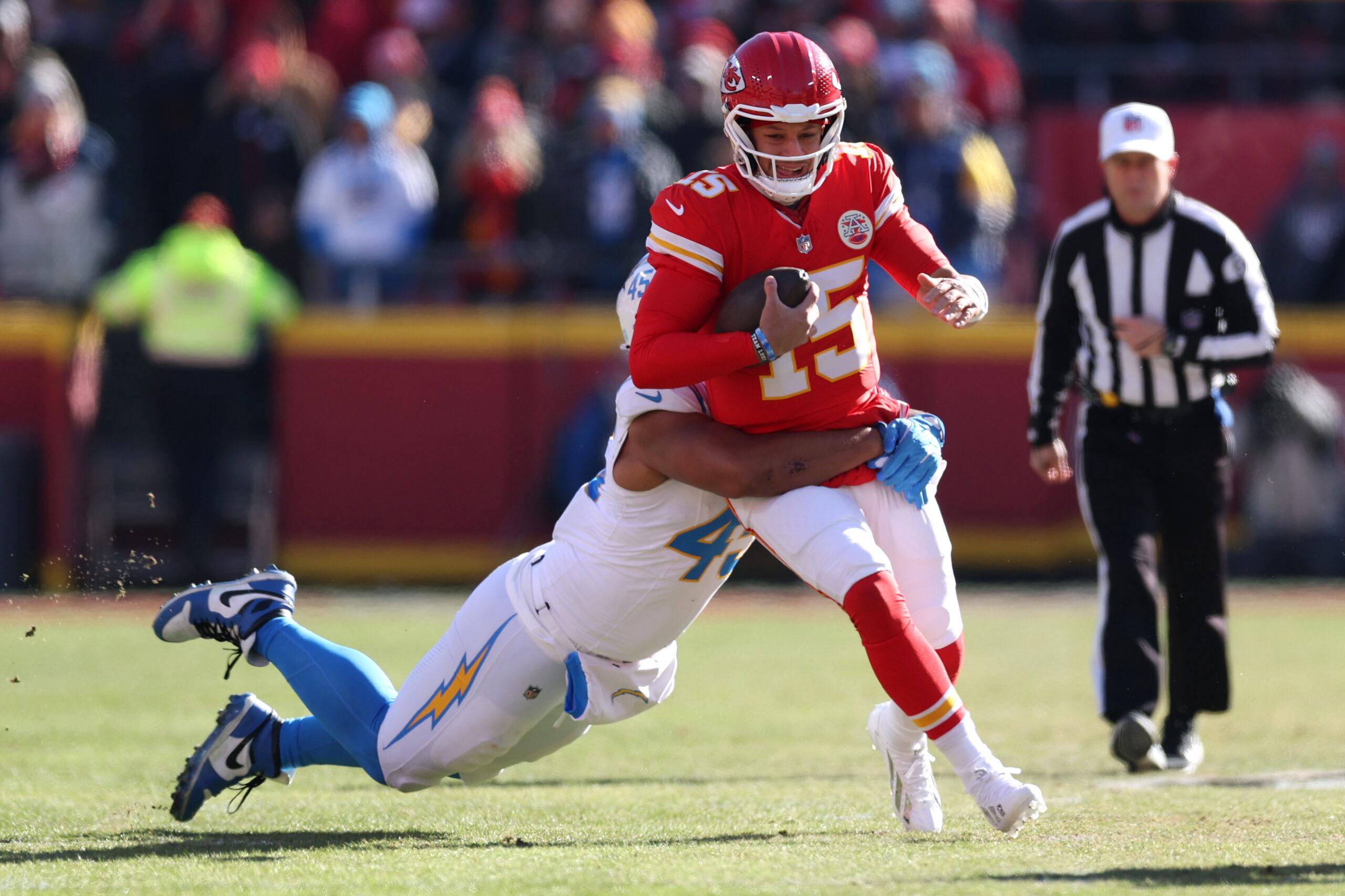
Patrick Mahomes is sacked by Tuli Tuipulotu of the Chargers on December 14
There should be some comfort in that, but this is still a roster with clear holes. Over the course of the past couple of seasons, the Chiefs have transformed from a team that wins with explosive offense to one that’s reliant on defense and efficiency. The lack of speed and playmaking has become a clear weakness that’s been exploited by opponents. It’s darkly fitting that Mahomes’s season ended with a scramble as he desperately tried to create something out of nothing on a play in which he lacked good options downfield. This season, Mahomes has had career lows in completion percentage and completion percentage when pressured and a career high in rushing yards.
The Chargers’ defensive game plan succeeded on Sunday, and they won in the same way opponents like the Bills have beaten the Chiefs this year—they were able to get pressure on Mahomes without blitzing and covered Kansas City’s receivers one-on-one. Veach can’t let this roster go into next season without a better solution than this year’s plan, which was mainly to have Mahomes throw a lot of short, quick passes. According to Next Gen Stats and ESPN, Mahomes attempted 244 passes in less than 2.5 seconds this season, the most in the NFL. That could mean once again prioritizing better protection for Mahomes so that he is forced into fewer quick throws and scrambles, or finally adding receivers who are better at getting separation.
The bad news for Veach is that the Chiefs are currently near the bottom of the league in salary cap space, although they could clear at least $60 million in room by restructuring Mahomes’s contract and releasing penalty-prone right tackle Jawaan Taylor, who has a nearly $20 million non-guaranteed 2026 salary. The team should also have some answers for its receiver issues that are already on the roster. A true top boundary pass catcher would probably have to come via a trade, but because of injuries and Rashee Rice’s suspension to start the year, Mahomes rarely had a full complement of active pass catchers this season..
Worthy’s usage and production (40 receptions, 491 yards, one touchdown) have been underwhelming given that the team hoped the speedy receiver would help make the team more explosive in his second season. Although Pro Football Focus’s charting has deemed him responsible for only one drop this season (in the game against Indianapolis, although he also dropped a deep pass in a high-profile moment against Dallas), he’s become a poster child for the ways this receiving corps has let Mahomes down. Per PFF, the Chiefs have 23 total drops so far this season, tied for the seventh most in the league. But it’s worth giving the 22-year-old receiver some time to develop and hoping that Reid and offensive coordinator Matt Nagy will take a closer look at how they’re using him. Worthy was often tasked with running complex routes over the middle, a big ask for his experience level and slight physical build. He’s also not been entirely healthy since suffering a dislocated shoulder from a collision with Kelce in Week 1. Still, it’s clear that Worthy is not on a WR1 trajectory and doesn’t have the size or consistency to be that kind of player. But the Chiefs can probably find better ways to maximize his skill set in the future.
Getting more explosive also has to mean fixing the run game. According to ESPN, the Chiefs entered Sunday’s game against the Chargers with the lowest explosive run rate, meaning plays of 20 yards or more, on running back carries in all seasons since 2000. This stems from Reid and Nagy’s reliance on shotgun runs and RPOs as the bread and butter of this part of their run scheme, something that’s drawn a lot of criticism from analysts this season. In terms of personnel, Kansas City may be due for a much-needed running back overhaul; Isiah Pacheco, Kareem Hunt, and Elijah Mitchell are all set to hit free agency.



More on the Chiefs
As much as this can be true of a team quarterbacked by Mahomes, defense has been the Chiefs’ focus for the past few years and, accordingly, is the part of the roster that’s in better shape. Still, Kansas City could use a defensive lineman other than 31-year-old Chris Jones who can be a reliable down-to-down playmaker. The Chiefs have just 18.5 sacks by defensive linemen this season, a sign that they’ve had to rely on exotic blitz packages to create any pressure.
None of those are easy fixes. But they’re the types of roster questions that teams, even good ones, deal with every year––dollars and cents and targets and pressures.
Then there are the roster questions that have a bit more complexity to them. Mahomes and Kelce are the two most visible Chiefs players, and it’s unclear how or whether either of them will enter the 2026 season. Kelce, who turned 36 in October, seems likely to retire, a decision he’s said he would share before the start of free agency in March. Mahomes is obviously not going anywhere in the long term, but he will miss at least the offseason while he recovers from ACL surgery, which was performed on Monday night. This is the most significant injury of his career, and even if he has a smooth and speedy recovery, he could miss regular-season games next year. In the coming months, the Chiefs will have to decide how much they want to invest in a backup quarterback from a pool of pending free agents that includes players like Marcus Mariota and Joe Flacco. Cash is tight and good backups don’t come cheap, but Mahomes is currently the only passer on Kansas City’s roster who’s under contract for next season. The Chiefs have to figure that a backup will be leading the team through significant chunks of the offseason—and potentially beyond.
Even in the longer term, Kansas City’s leadership will have to evolve, a strange reality for a team whose strategy has prioritized continuity. Jones will be 32 at the start of next season. Kicker Harrison Butker, who has been with the Chiefs since 2017, has missed eight kicks so far this season (four field goals and four extra points), and his mistakes have been a major contributor to Kansas City’s poor record in close games.
The Chiefs have had a decent draft record under Veach, and they need to find the team’s next generation of stars and develop them around Mahomes if they want to resume their dynasty. The best historical comparison for this is the Patriots in the late 2000s—just like Tom Brady, Mahomes tore his ACL during his ninth season, with three Super Bowl rings to his name. That precedent should be somewhat encouraging for the Chiefs. But from 2010 to 2012, the Patriots drafted Rob Gronkowski, Devin McCourty, Nate Solder, Marcus Cannon, Chandler Jones, and Dont’a Hightower, retooling the roster for the next set of championship runs a few years later. The Chiefs have to prove that they can get that part right, too.
It seems likely that Veach will be in Kansas City for a long time. It’s less clear whether Reid will be, though. He is 67, and for the first time in a while, there have been meaningful questions about his decision-making throughout the season. Besides the schematic gripes about the overreliance on RPOs and working out of the shotgun, Reid (and Nagy, who have a hybrid play calling arrangement in which Nagy relays calls to Mahomes but Reid ultimately chooses them) has had a few high-profile situational blunders.
In a loss to Dallas on Thanksgiving, Reid chose to punt on a fourth-and-4 from the opposing 44-yard line in the third quarter, after which the Cowboys used the following possession to extend their lead. And earlier this month, a shocking call in the fourth quarter against the Texans cost the Chiefs the game. With the score tied, Reid elected to go for it on fourth-and-1 from Kansas City’s own 31-yard line. That alone was risky, but the play call—a pass from the shotgun, instead of a run—was indefensible, and Reid admitted after the game that it was a mistake. Reid is likely in no danger of being fired, and I’m pretty sure that most Chiefs fans wouldn’t wish for a coaching change. But it’s fair to say that the coach who has been the heart and soul of Kansas City’s organization has seemed a little off his game this year.
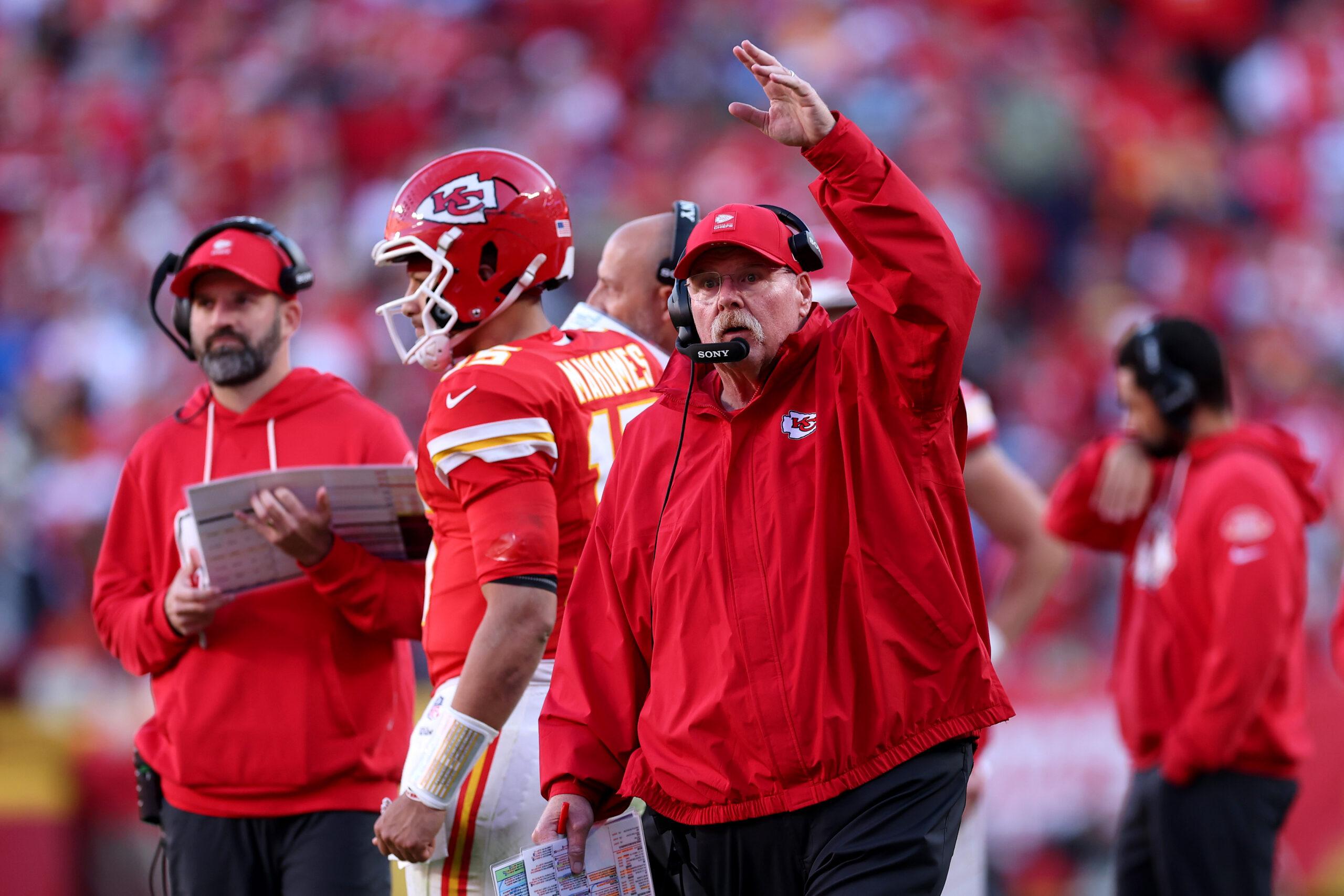
Andy Reid in the fourth quarter of the game against the Indianapolis Colts on November 23
It’s worth noting that these are, mostly, NFL-style Champagne problems. There is major change coming—and that is necessary—but this team is still very similar to last year’s. That’s true in ways both good and bad, but that 2024 team that got to the Super Bowl was very lucky, just like this team was very unlucky—and those bounces should even out in the future. It’s reasonable to have faith that Mahomes will cut down on the red zone turnovers, for example, without the Chiefs having to do much to make it happen. The Chiefs’ kicker, Butker or otherwise, probably won’t miss so many pivotal kicks again anytime soon. Kansas City probably won’t lose a game again because its best defender couldn’t tackle Trevor Lawrence—on a play in which he had already fallen on his rear. It will also, for the first time, have an offseason that’s not abridged by multiple weeks of playoff games and preparation.
But this is a moment of major change for the Chiefs. It seems likely that we’ll look back on 2025 as the closing of Mahomes’s first chapter, and this offseason will do a lot to shape how the next one begins. If Kelce retires, there’ll be a lot of tangible production that needs to be replaced, a tricky quarterback health situation to manage, and a growing leadership vacuum to fill.
And there’s also the question of what it means for the Chiefs and their opponents if they no longer seem inevitable. Their own results aside, this season has revealed new challengers around the league, like the Patriots with Drake Maye, the Broncos, and the Packers, the next generation of contenders—who don’t, or don’t yet, have the baggage of being also-rans (like Buffalo or Baltimore) in an era with a single most dominant team.
Yet another piece of uncharted territory for the Chiefs is learning how to win once you know you can lose—when you’re not inevitable. In the ESPN docuseries The Kingdom, about the 2024 Chiefs, there’s sideline footage of Jones speaking to defensive end George Karlaftis during the Super Bowl loss to the Eagles. “We’ve been so spoiled over the last three years. All we know is winning,” Jones said. “These are valuable lessons. When you lose, you learn. You learn a lot.”
The Chiefs’ next chapter will be about how much they learned.