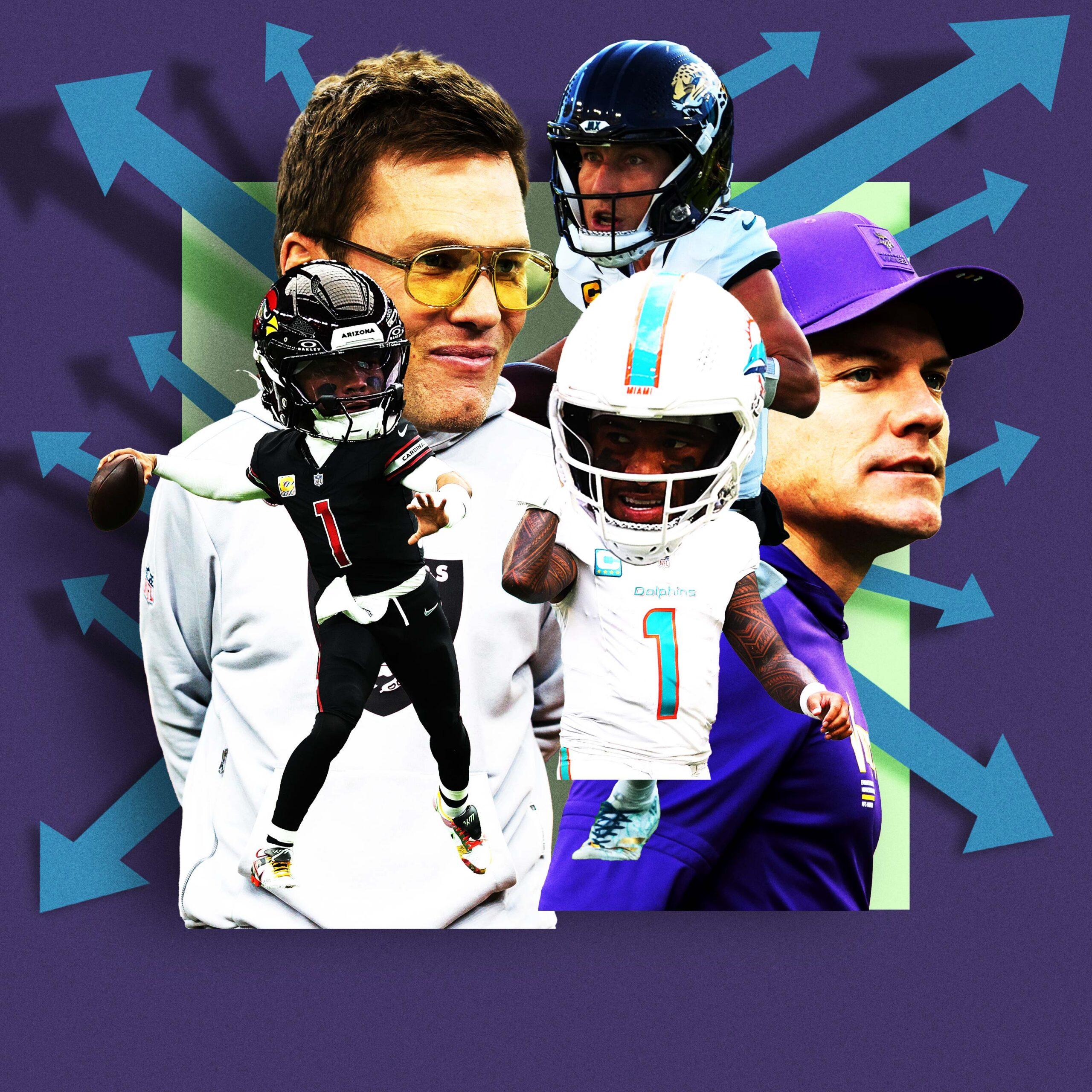

As we move into December and approach the last full month of the NFL regular season, we have a chance to look ahead and set the stage for what’s to come in the offseason.
Welcome to The Ringer’s 2026 Quarterback Carousel Primer, where we’re predicting which passers could be traded, signed, or replaced before the start of next season and looking at the teams that could be active in the quarterback market next offseason (and beyond). And we’ll cover the must-know prospects for the teams that are trying to find their next franchise quarterback in the draft.
Teams With a Need at Quarterback
In the NFL, losing isn’t just about the week-to-week results; it can be a perpetual mentality. And many teams’ flawed roster-building strategies, particularly at quarterback, beget more losing. It’s no surprise that we often see the same teams in the quarterback market year after year. Some of the teams in this section will enter the 2026 offseason in full rebuild mode, while others are expected to merely pivot or make a succession plan.
(Projected chances at a top 10 pick come from The Athletic’s simulator as of December 3, and salary cap data is from Over the Cap.)
Minnesota Vikings
Current starter: J.J. McCarthy
Projected chance of a top 10 pick: 78 percent
Projected 2026 cap space: Nearly $36 million over
Most Likely QB Plan: Trade for an Inexpensive Bridge Quarterback
Minnesota didn’t just whiff this season by choosing quarterback J.J. McCarthy over Sam Darnold or Daniel Jones (who were both on the Vikings’ roster last year, left in free agency in March, and are a combined 17-7 with their new teams this season). The Vikings may have buried their chances at contending over the next few seasons as well. McCarthy, who missed his entire rookie season with a knee injury, isn’t just having a bad season for a first-time starter; he’s having one of the worst statistical performances we’ve ever seen at the position, drawing comparisons to all-time busts like JaMarcus Russell, Zach Wilson, and Josh Rosen. And after suffering an ankle injury early in the season and concussion symptoms more recently, he’s appeared in just six of Minnesota’s 29 games since he was drafted.
Typically, a team with playoff hopes and a potential bust at quarterback would just bring in a proven veteran, but the Vikings have no way of affording one. Minnesota is projected to be $35 million over the cap next offseason because of how much the team has spent in free agency in recent years. The Vikings had to be big spenders to add high-impact players after years of mistakes in the draft. If they wanted to trade for (and then pay) a starting-caliber veteran quarterback, here’s a list of current players who would likely need to be cut, be traded, or take a significant pay cut: tackle Brian O’Neill, edge rusher Jonathan Greenard, tight end T.J. Hockenson, running back Aaron Jones, defensive tackle Jonathan Allen, and center Ryan Kelly. In one offseason, a roster that currently has quality depth on both sides of the ball would likely become one of the league’s worst, and the Vikings might still be too cash-strapped to afford a high-end starter. That means Tanner McKee, Mac Jones, or Spencer Rattler might be the most realistic options to compete with McCarthy in 2026.


A Deep Dive Into QB Performances: The QB Notebook
New York Jets
Current starter: Tyrod Taylor (replaced Justin Fields)
Projected chance of a top 10 pick: 96 percent (the Jets also own the Colts’ first-rounder, which will likely go later in the first round)
Projected 2026 cap space: $100 million
Most Likely QB Plan: Draft a Quarterback and Sign a Veteran Backup
The Jets are easily the team that’s best equipped for a multiyear rebuild; they have enough draft assets and cap space to address their need at quarterback in either of the next two offseasons.
My advice for New York: Take your time with this process. The Jets have more than $100 million in projected cap space this offseason, and it would be wise to use that money to rebuild their offensive infrastructure and focus on adding quality pass catchers and linemen.
As far as the quarterback plan, so much hinges on how involved team owner Woody Johnson and his family want to be in the process. We heard his terse and cutting evaluation of Justin Fields this year, so we can’t rule out the possibility that Johnson’s frustrations will push him to have an outsize influence on what’s next for this franchise. And given what we know about how he and his family determine player quality, we could be in for a hilarious and disastrous roster pivot for the Jets.
If making a big splash is what matters most for the Jets, they could trade several early-round draft picks for a player like Trevor Lawrence. He has all the physical tools a franchise quarterback needs, has the name recognition necessary to draw eyeballs and ticket sales to New York, and could be a good fit in New York’s offense, assuming that coordinator Tanner Engstrand wants to replicate the success he helped cultivate in Detroit with Ben Johnson. If we’re being realistic, though, trading for Tanner McKee would be the smartest choice here by a country mile. McKee’s play style resembles that of Lions quarterback Jared Goff, he’d be an inexpensive addition to the team, and it wouldn’t hurt the Jets if it became clear that he’d be better off as a backup. By acquiring a player like McKee, New York could still go out and draft a young quarterback who fits in the Goff mold and potentially give him time to learn the offense before taking over as a full-time starter.
New Orleans Saints
Current starter: Tyler Shough
Projected chance of a top 10 pick: 99 percent
Projected 2026 cap space: $9.6 million over
Most Likely QB Plan: Sign a Veteran as a Contingency Plan
I could lay out the statistical case for New Orleans to get back in the market for a quarterback this offseason. Rookie Tyler Shough has the sixth-lowest EPA per dropback and the ninth-lowest passer rating in the NFL this season. I could make an analytical draft-based case, given that second-round quarterbacks (like Shough was) turn into franchise cornerstones at a substantially lower rate than first-rounders, and it’s rarely a bad idea to draft a quarterback if your top pick is high enough.
But this can be solved with a much simpler question: When you watch Shough, do your eyes tell you that he’s a multiyear starter or that he even has the potential to become an above-average player? I certainly don’t see that kind of promise, and I wouldn’t be willing to wager on an outlier case for a 26-year-old rookie. Since Shough hasn’t flashed any game-changing potential this year and Spencer Rattler isn’t of any interest to head coach Kellen Moore, New Orleans should focus its energy on its draft position to get its hands on a real franchise-changing talent; it will also need to prioritize getting its cap situation in order.
Las Vegas Raiders
Current starter: Geno Smith
Projected chance of a top 10 pick: 99 percent
Projected 2026 cap space: $108 million
Most Likely QB Plan: Draft a Quarterback and Sign a Veteran Backup
Raiders minority owner Tom Brady played a major part in three of the franchise’s most important decisions of the past year: hiring head coach Pete Carroll, hiring offensive coordinator Chip Kelly, and acquiring quarterback Geno Smith in a trade with Seattle instead of pursuing Sam Darnold in free agency. Las Vegas went 0-3 on those moves. Carroll’s in the midst of his worst season in 14 years as a head coach, Kelly has already been fired, and Smith has been one of the league’s worst starters.
Because of how poorly this season’s gone, there’s no good reason for the Raiders to retain Smith—at least not to be the starting quarterback, without any competition for the role. If the Raiders secure a top-three pick in the draft, they’ll need to come away with one of the top QB prospects. It’s feasible that the Raiders will give Smith one last chance to start and then supplant him with a rookie if and when his play starts to cost them games again.
The Raiders also have more than $100 million in projected cap space this coming offseason, and this roster has been so bad that it's hard to come up with a way to spend that won’t help. If the Raiders don’t go the draft route for a quarterback, a veteran like Kyler Murray could be brought in as a one-year bridge, giving the team some level of competent play while it addresses its other issues. And if Brady’s influence over quarterback decisions continues, we can take his compliments about Murray a season ago as a potential signal that he could try to bring him to Las Vegas.
The Raiders have been perpetual losers for so long that almost any quarterback wearing silver and black will earn all my pessimism. But with the right sequence of moves that hands this franchise off to a talented young player, Vegas can at least graduate from being one of the league's least serious organizations to becoming a more respectable cellar dweller.
Cleveland Browns
Current starter(s): Shedeur Sanders and Dillon Gabriel
Projected chance of a top 10 pick: 94 percent
Projected 2026 cap space: $7.9 million over the cap
Most Likely QB Plan: Draft a Quarterback and Sign a Veteran Backup
The discourse about quarterback Shedeur Sanders has been loud since the draft, but we’ve yet to see anything suggesting that he or fellow rookie Dillon Gabriel will be a long-term answer for the Browns. Cleveland has two first-round picks in the 2026 draft, which should be plenty of capital to land a potential franchise quarterback.
Cleveland is currently projected to be over the cap in 2026 as it navigates its way out of Deshaun Watson’s nightmare deal. We’ll likely see the team shed salaries and move on from veterans like offensive linemen Joel Bitonio and Wyatt Teller and tight end David Njoku. This roster is undergoing a full-blown reshaping, and I think that a high-ceiling prospect (and we’ll talk about them soon) would be ideal for the team and fan base, which need reason to hope for a better tomorrow.
Los Angeles Rams
Current starter: Matthew Stafford
Projected chance of a top 10 pick: 68 percent (since L.A. owns Atlanta’s 2026 first-rounder)
Projected 2026 cap space: $80 million
Most Likely QB Plan: Trade for a Capable Starter (if Stafford Retires)
Los Angeles owns two first-round picks in the 2026 draft—and could be in immediate need of a quarterback if Matthew Stafford retires. Even if he decides that he wants to play in 2026 at age 38, the Rams could be at the point where they have to consider their long-term succession plan. Based on GM Les Snead’s history of trading and the team’s surplus of draft picks, we should expect the Rams to be active. He went from 2017 to 2023 without a first-round pick, the result of the team’s “eff them picks” era, and former Rams quarterback Jared Goff is the only first-round quarterback he’s ever drafted. And head coach Sean McVay has never used a high pick on a quarterback since he arrived in 2017.
Los Angeles’s roster is built to make deep playoff runs right now, which takes several unproven quarterback options off the table. I’d also imagine that the Rams want to avoid being on the quarterback carousel again in a couple of years, so finding a quarterback already on a long-term contract would be a major plus. So if the Rams need to replace Stafford right away, the best option might be Trevor Lawrence, a highly talented player who’s under contract for several years—and who wouldn’t put any weighty contract guarantees on their books. After a trade, Lawrence’s contract would basically be a series of roster bonuses that pay him less than $50 million per season through 2028, a big discount for a starting quarterback of his age with high potential.
It bears repeating that any trade for Lawrence has such severe ramifications for Jacksonville that it’s probably not worth it for the Jags to deal, but if there’s one quarterback trade to melt our collective brains, this would be it.
Pittsburgh Steelers
Current starter: Aaron Rodgers
Projected chance of a top 10 pick: 2 percent
Projected 2026 cap space: $38.8 million
Most Likely QB Plan: Sign and Draft Uninspiring Passers (per Usual)
Pittsburgh desperately needs a new long-term option at quarterback, but we have no reason to trust that this franchise knows how to get one (or develop one, for that matter). Pittsburgh hasn’t had a season in which its passing offense has performed above the 50th percentile in EPA or success rate since 2018.
The Steelers are woefully behind the curve in play-action usage, generating explosive plays, and scheming players open. And as long as head coach Mike Tomlin is running the show, I don’t expect anything to change. His philosophy is so deeply rooted in avoiding risks and turning games into a war of attrition that I’m not sure I’d even want a young passer to play for him. Even if the Steelers were bad enough to get in range to draft a talented prospect, being in Pittsburgh seems like a surefire way for a rookie to never reach his full potential.
If I had to guess, I’d imagine that Pittsburgh will do the most predictable thing possible. That means signing a guy like Tyrod Taylor to be the starter, then trading for a quarterback like Anthony Richardson as a half-hearted attempt to bring in a player with a high ceiling. Those two would trade off weeks of being mediocre, and the Steelers defense would force an ungodly number of turnovers and drag this team to 7-10 while fans in Acrisure Stadium wave their towels in disgust.
Atlanta Falcons
Current starter(s): Michael Penix Jr. (injured reserve) and Kirk Cousins
Projected chance of a top 10 pick: Zero (their 2026 first-rounder belongs to the Los Angeles Rams)
Projected 2026 cap space: $2.2 million
Most Likely QB Plan: Trade for an Inexpensive Young Quarterback
The biggest problem for a franchise that repeatedly makes poor decisions at quarterback? It’s in a cycle of always looking for the next one. Atlanta thought that it had all its bases covered before the 2024 season, double-dipping at quarterback by drafting Michael Penix Jr. and signing Kirk Cousins to a four-year, $180 million deal. Instead, the Falcons’ first-round pick just had major knee surgery for the third time since 2018, and he has started in only 12 of Atlanta’s 29 games since he arrived. And Cousins is now a 37-year-old backup who hasn’t looked the same since tearing his Achilles in 2023.
Atlanta’s working with only about $2.2 million in projected cap space right now, but it could carve out extra space by trading or cutting Cousins and other veterans, like receiver Darnell Mooney or safety Jessie Bates III. If the Falcons free up some of that money in order to add a QB to serve as insurance during Penix’s rehab—and maybe push him after it—it might be best for them to grab a player like Spencer Rattler, Tanner McKee, or Mac Jones.
Current NFL Quarterbacks to Watch
The veteran quarterback trade market has been busy throughout this quarter century, dating back to 2001, when Trent Green was dealt from the Rams to the Chiefs. Just about every offseason has seen a starter get moved, and I don’t expect anything different in 2025, given some of the disastrous QB play we’ve seen around the league.
We’ve also seen players’ and franchises’ trajectories altered by recent free agency signings. Quarterback Sam Darnold has remade his career and changed both Minnesota’s and Seattle’s fortunes in the past two years. Tom Brady cemented himself as the GOAT in Tampa Bay, and his successor Baker Mayfield—who was viewed as an underwhelming free agent signing back in 2023—has kept that franchise atop its division. But free agent misses can tank a team. Remember Nick Foles’s disastrous tenure in Jacksonville? Or, more recently, the Jets’ decision to give Justin Fields a two-year deal in March (only for him to be benched before Thanksgiving) or Pittsburgh’s string of free agent misses: Fields, Russell Wilson, and now Aaron Rodgers?
So which quarterbacks could be on the move in 2026—either on the trade market or in free agency? These are the names to watch.
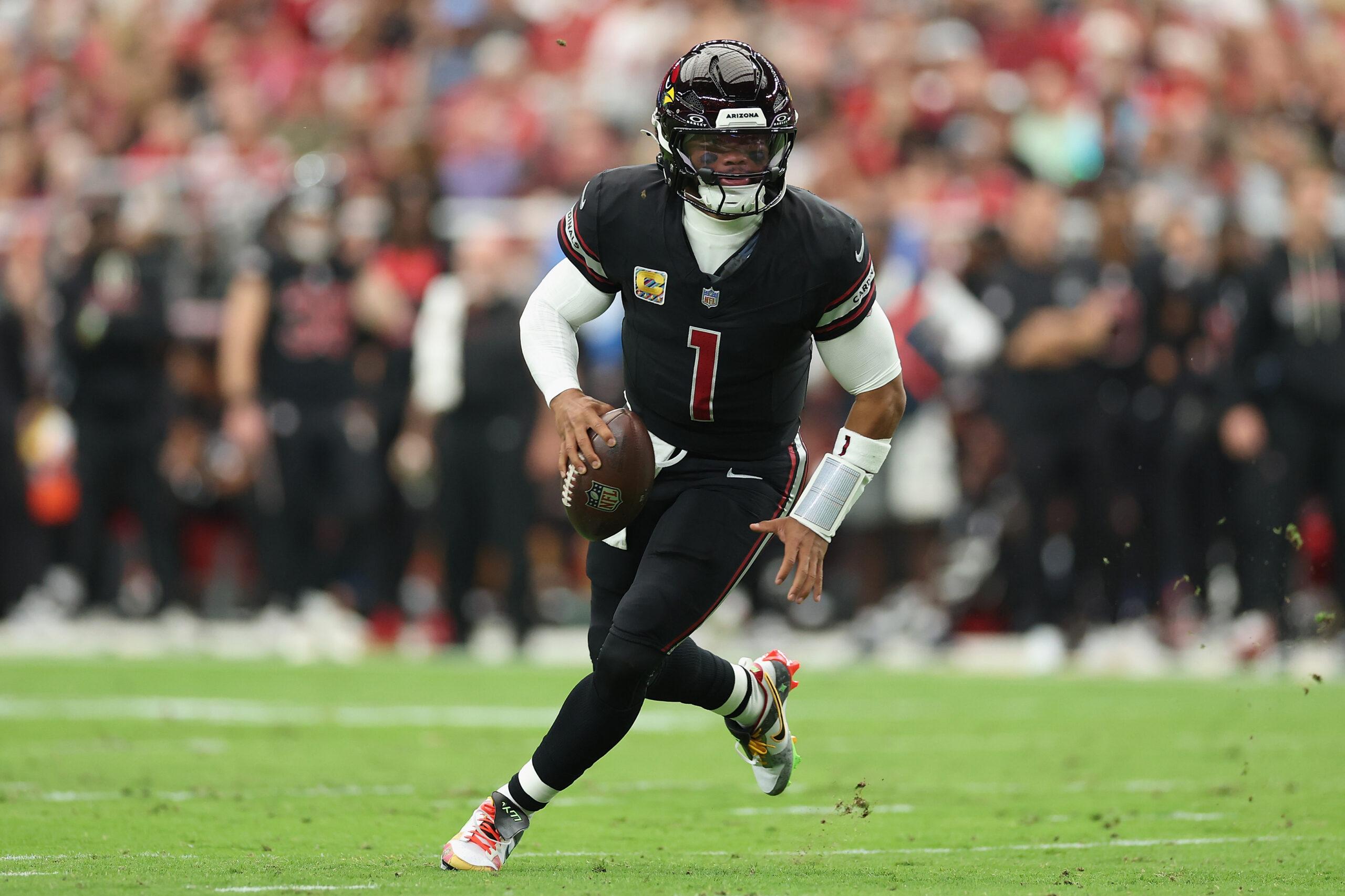
Kyler Murray
Age: 28
Contract status: Signed through 2028, $46.1 million per year
Potential trade compensation: One first-round pick
When healthy, Kyler Murray has rare mobility and raw arm talent. But in spite of his obvious physical gifts, he’s never been able to sustain a high level of play over a full season. He has also suffered a couple of unfortunate injuries since signing his big contract extension in 2022. It seems like it is time for both the Cardinals and Murray to make a clean break, and Adam Schefter of ESPN reported last month that there will be some urgency to get a trade done early in the offseason, as Murray has $19.5 million in guarantees to collect if he stays on the roster through early March.
A Murray trade should be fairly straightforward because the guaranteed money in his current deal runs out after the 2026 season. Arizona would incur only about $18 million in dead cap charges after trading him away, a relatively small number for a quarterback playing on his big-money extension. After his current foot sprain heals, Murray will be a desirable quarterback to trade for—at least in theory.
Finding the right landing spot for Murray will be tricky, though. Having him as your starter is a commitment to a play style that best suits him, and that means primarily running the offense from the shotgun. From 2019 (when Murray was drafted) through the end of the 2024 season, the Cardinals averaged more than six under-center dropbacks per game only once. His athletic ability creates real value in the running game, as the Cardinals have averaged almost 5 yards per designed run out of the shotgun since he came into the league. But running him more often means subjecting him to hits, a worrisome proposition for a quarterback approaching 30, especially one of his size.
When you combine all these factors—the need to move Murray quickly, his injury history, and his underwhelming career up to this point—he’s exactly the kind of quarterback who gets moved at a discount. Don’t be surprised if we hear that Arizona grants Murray and his agent a chance to find a trade suitor this offseason, just so it can expedite the process of moving on from him.
Still, if I were GM Monti Ossenfort, I’d hold firm on the asking price of a first-round pick or an equivalent value in multiple day-two picks. If the resurgence of quarterbacks like Baker Mayfield, Sam Darnold, and Daniel Jones has taught us anything, it’s that QBs we dismiss in one setting can still take major leaps elsewhere, and Murray has a higher athletic baseline than all three of them. There won’t be enough good quarterbacks available in the draft for teams to dismiss a high asking price from Arizona, either, and if several college prospects decide to wait until 2027, Murray would instantly be an attractive option for QB-needy teams. And because a deal for Murray wouldn’t be cost prohibitive for either side, rebuilding and fringe playoff teams alike could make a bid.
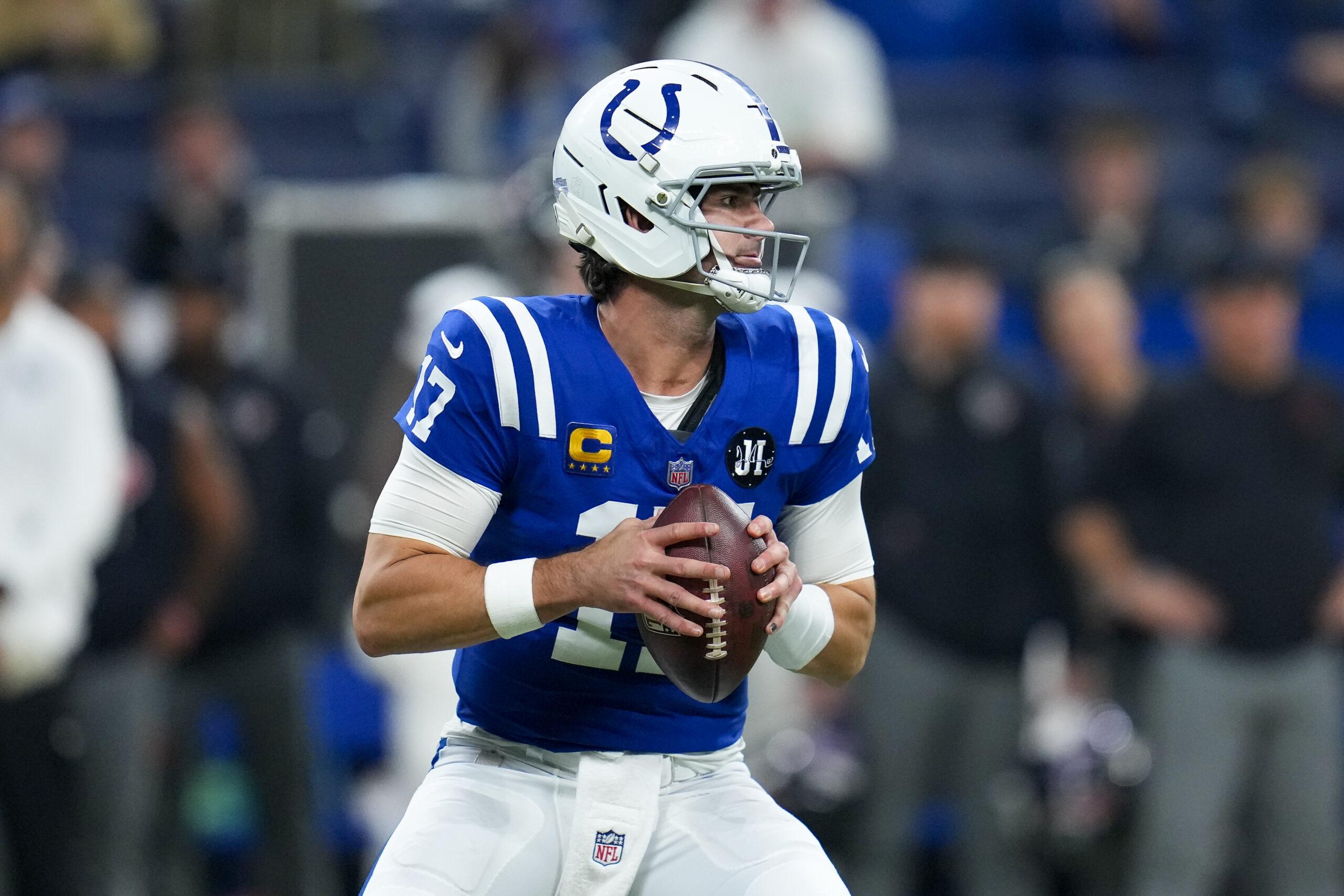
Daniel Jones
Age: 28
Contract status: Unrestricted free agent in 2026
Jones hasn’t signed an extension with the Colts yet, but Indianapolis seems ready to commit to him for the next few years. That’s what the franchise seemed to tell us last month when it traded away a pair of first-round picks to acquire cornerback Sauce Gardner. With the Colts on track to make their first playoff appearance since 2020, Jones has plenty of leverage. So he likely isn’t going anywhere, even if negotiations carry over into March. The Colts are going to pay him, and I’d guess it’ll end up at a three-year deal with an average annual salary of at least $35 million.
This is the most effective and consistent Jones has been in his entire career; he’s had a higher passer rating, passing yards, and touchdowns through 13 weeks than in any year during his time with the Giants. Last summer, it seemed like a questionable move to pick Jones over Anthony Richardson, but Jones has proved the Colts right. He hasn’t transformed into an entirely new player, but he knows his skill set and he’s better prepared for what defenses are throwing at him. He currently has a 99.9 passer rating when he’s pressured, and his previous high was 83.8 in 2022. When Baker Mayfield and Sam Darnold elevated into more reliable starters once they landed with new teams (with better coaching), they both experienced similar leaps in efficiency when pressured.
There’s still risk involved in signing Jones to a long-term deal, though. A major factor in his resurgence was his good health, and he looked fresh for the first few months of this season in a way we hadn’t seen since 2022. But Jones’s play has dropped off a bit in the past few weeks, and we can correlate some of that with the recent reports that he has been playing through a fractured fibula suffered sometime in late November.
If he’s banged up going into the playoffs, the Colts probably won’t be able to compete against the best in the AFC. But there’s nothing left for them to do but hope that he can gut through his current injury and deliver some postseason wins.
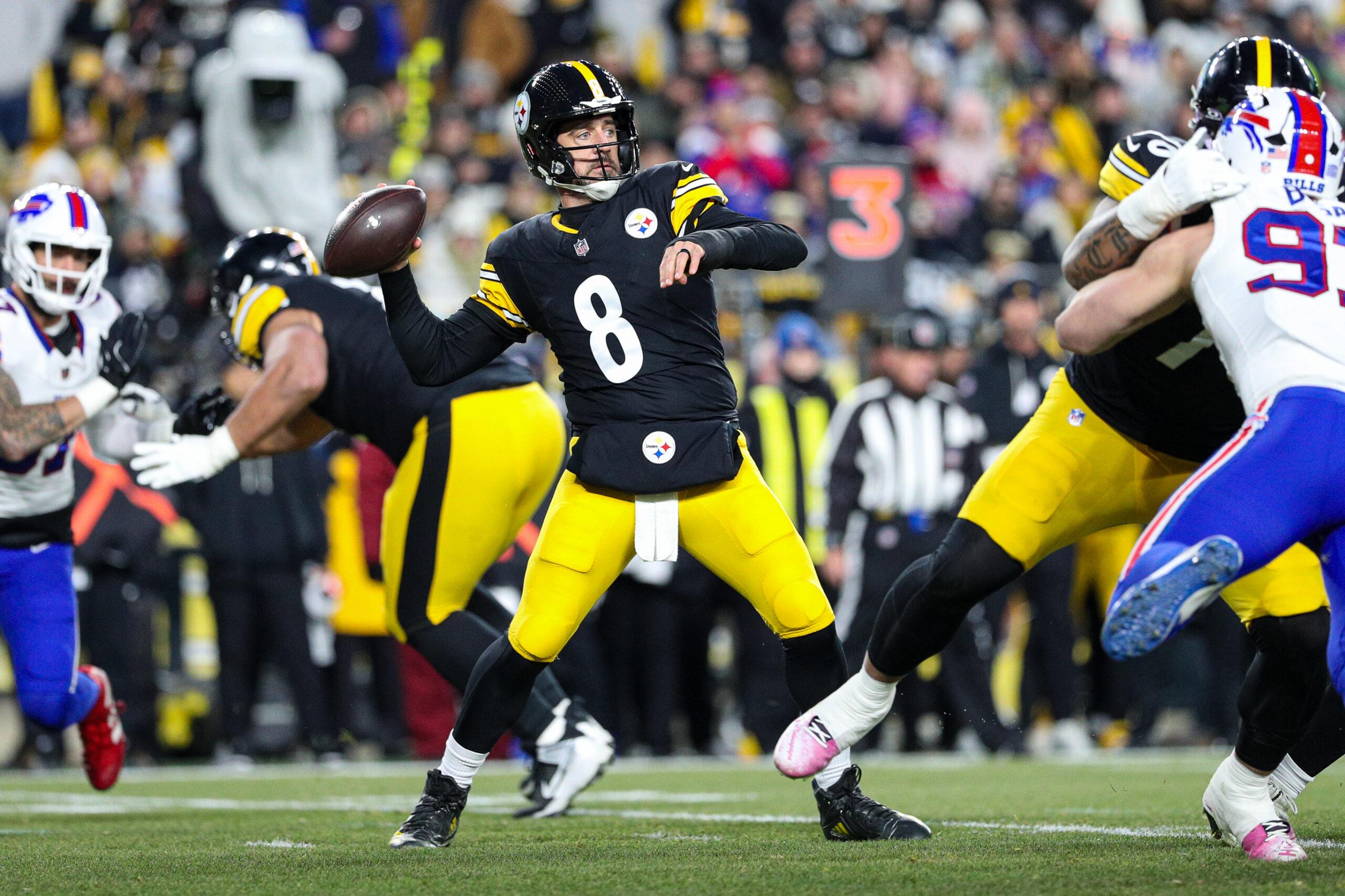
Aaron Rodgers
Age: 42
Contract status: Unrestricted free agent in 2026
Nobody needs to do this again in 2026. Rodgers has spent the past three years of his career either injured or playing on teams with no real pathway to Super Bowl contention, and he’s said that he plans to hang it up after this season.
The four-time MVP is currently the all-time leader in passer rating and is in the top five in passing yards and touchdowns, and that’s easily enough to cement him as a first-ballot Hall of Famer. He has little to gain and less to prove by playing in 2026, and none of the most quarterback-desperate teams could offer him a good enough situation in 2026 to make another season worth it.
The reality is that Rodgers, who turned 42 this week, isn’t a good quarterback any longer—and that should be expected after two decades of playing in the league. He can’t evade pressure, his risk aversion is as high as ever, and it’s difficult (and maybe impossible) to build a system around him. He had an excellent career, but the only thing left for him to do after 2025 is sign his retirement papers as a Packer and await his gold jacket.
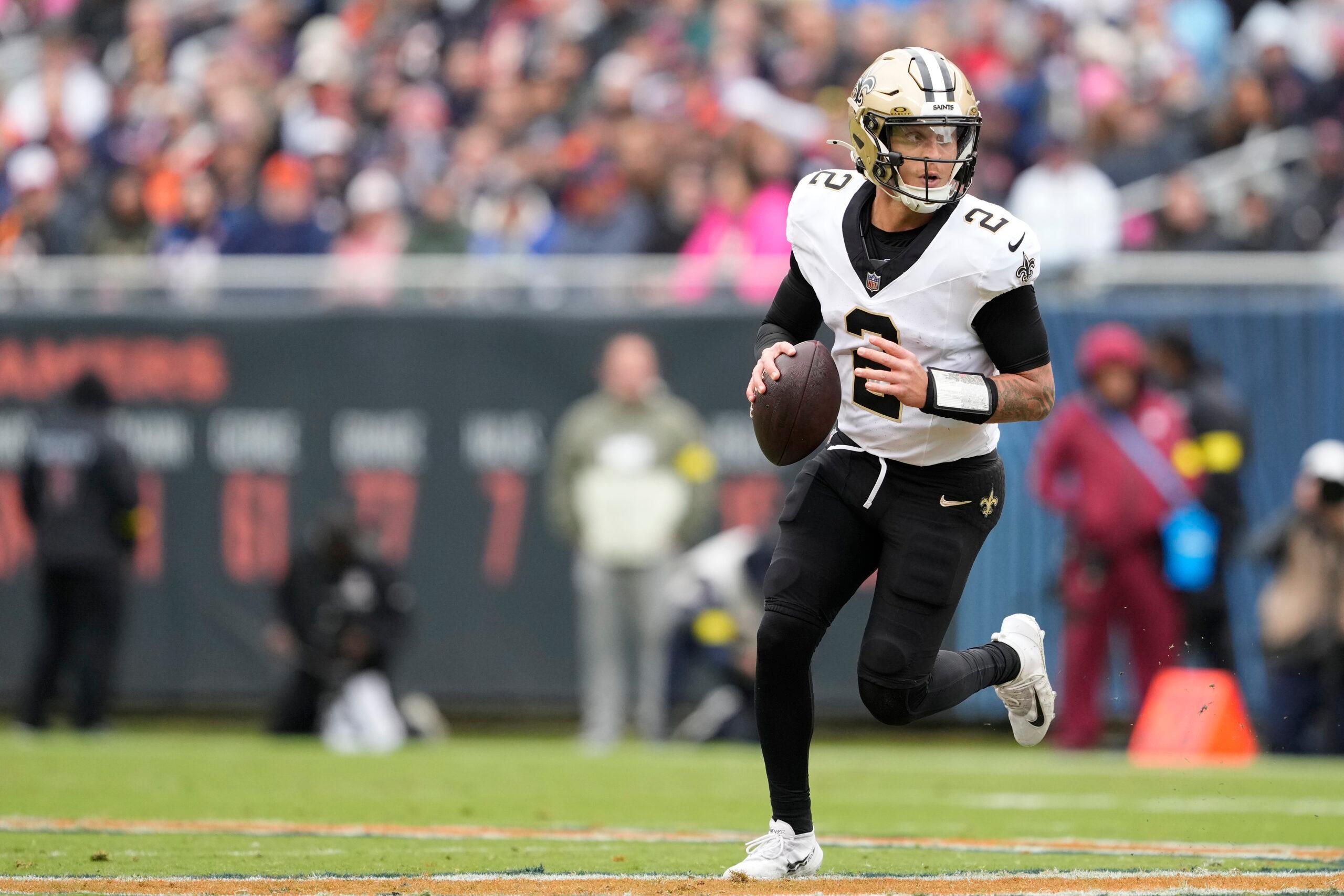
Spencer Rattler
Age: 25
Contract status: Signed through 2027, $1.2 million per year
Potential trade compensation: Fourth- or fifth-round pick
Saints backup Spencer Rattler’s situation is a tough one to sort out. I see him as a quarterback with enough talent to start—not just as a bridge quarterback but as a potential multiyear option. Before the Saints benched him in favor of rookie Tyler Shough this season, he was getting the ball out quickly, was taking fewer sacks than in 2024, and, for the most part, didn’t have much of a turnover problem. He was doing well for a late-round pick playing behind a porous offensive line, and I thought New Orleans should've given him more time as a starter.
There’s a new coaching staff in New Orleans, though. Head coach Kellen Moore wasn’t there when Rattler was drafted. Shough needed to play to justify the team’s decision to use a second-round pick on him. And if the Saints have no plan to open the quarterback competition again in 2026, then Rattler will provide much more value to this team as a trade asset than as a backup. He came into the league as a fifth-round pick, and I think that’s about where his trade value is now. But due to his arm talent and improvement as a decision-maker, I think he could be a hidden gem in the quarterback carousel.
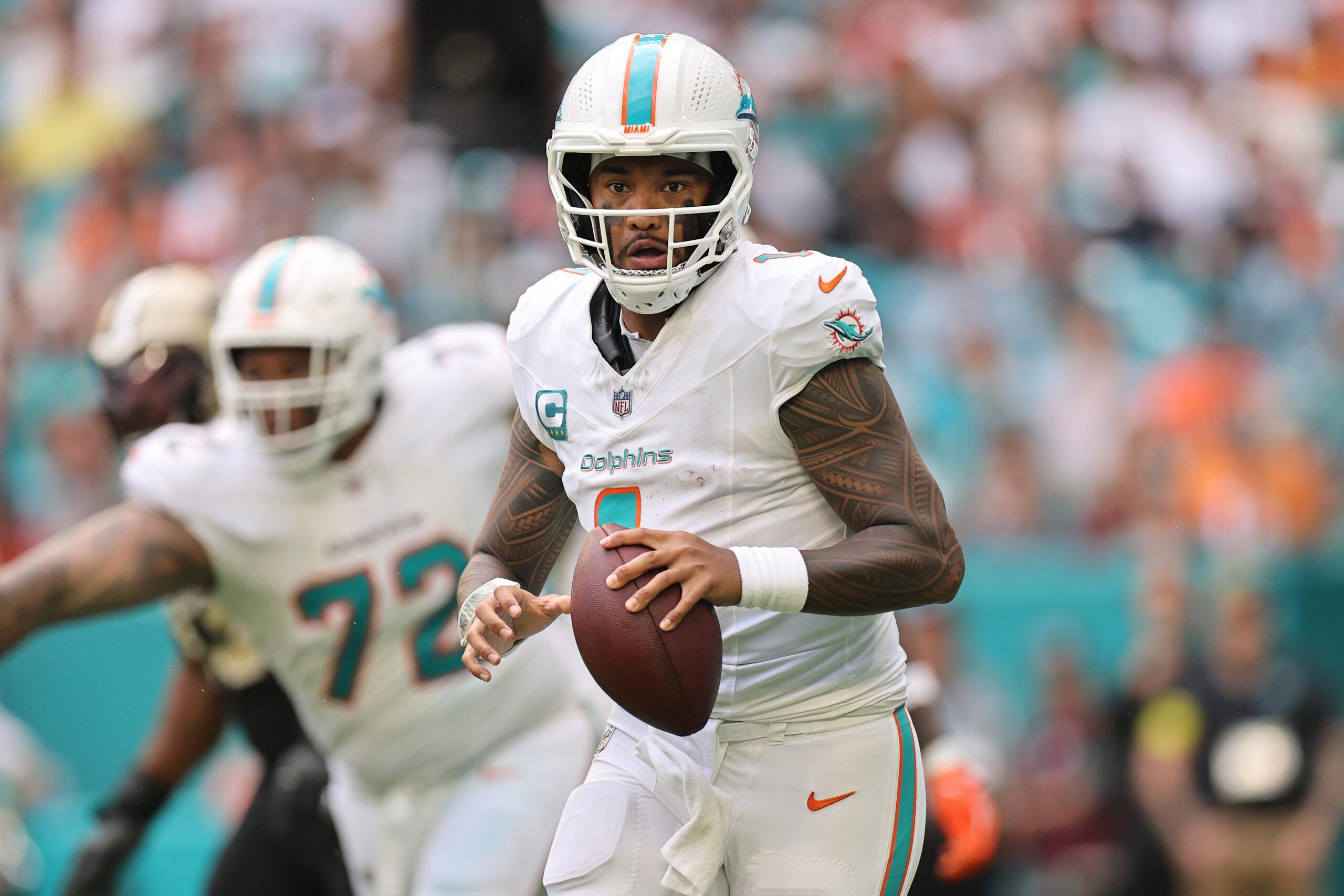
Tua Tagovailoa
Age: 27
Contract status: Signed through 2028, $53.1 million per year
Potential trade compensation: Conditional second- or third-rounder
The Dolphins are between a rock and a hard place with quarterback Tua Tagovailoa’s current contract. We’re only in the first season of the new money on his $221 million extension, so cutting him outright won’t even be feasible until the 2027 offseason. The only real way for Miami to move on from him this spring would be to trade him—and take on the massive financial loss that would come with it. And trading Tua might be tricky given his concerning history of concussions.
This franchise is in flux for the foreseeable future. Head coach Mike McDaniel is on the hot seat, former GM Chris Grier was canned around the midseason point, and aging star receiver Tyreek Hill suffered a significant, potentially career-threatening knee injury. Miami also has one of the league’s worst defenses and a thorny cap situation to navigate in the offseason thanks to Hill’s, Tagovailoa’s, and receiver Jaylen Waddle’s bloated contracts. Because Miami hasn’t won lately, it's been out of the public's consciousness—but fans know that the Dolphins are a galaxy away from their playoff form in 2023, and Tagovailoa’s not a good enough quarterback to drag the franchise out of this hole. In his 34 games against teams that finished with a winning record, he’s just 11-23, with a passer rating of just 86.9.
Unless a team like Las Vegas or Arizona wants to take a big swing on a trade for Tagovailoa in the hopes that he’ll have a resurgent season, Miami’s most likely path will be drafting a quarterback and letting him sit behind Tagovailoa in 2026. If Tagovailoa is healthy and the team is decent next season, it would be much easier to move on from him in the 2027 offseason. If the Dolphins are bad under Tagovailoa next year, Miami could usher him out the door—like New York did with Daniel Jones—and hand off the reins to the franchise’s next young quarterback.
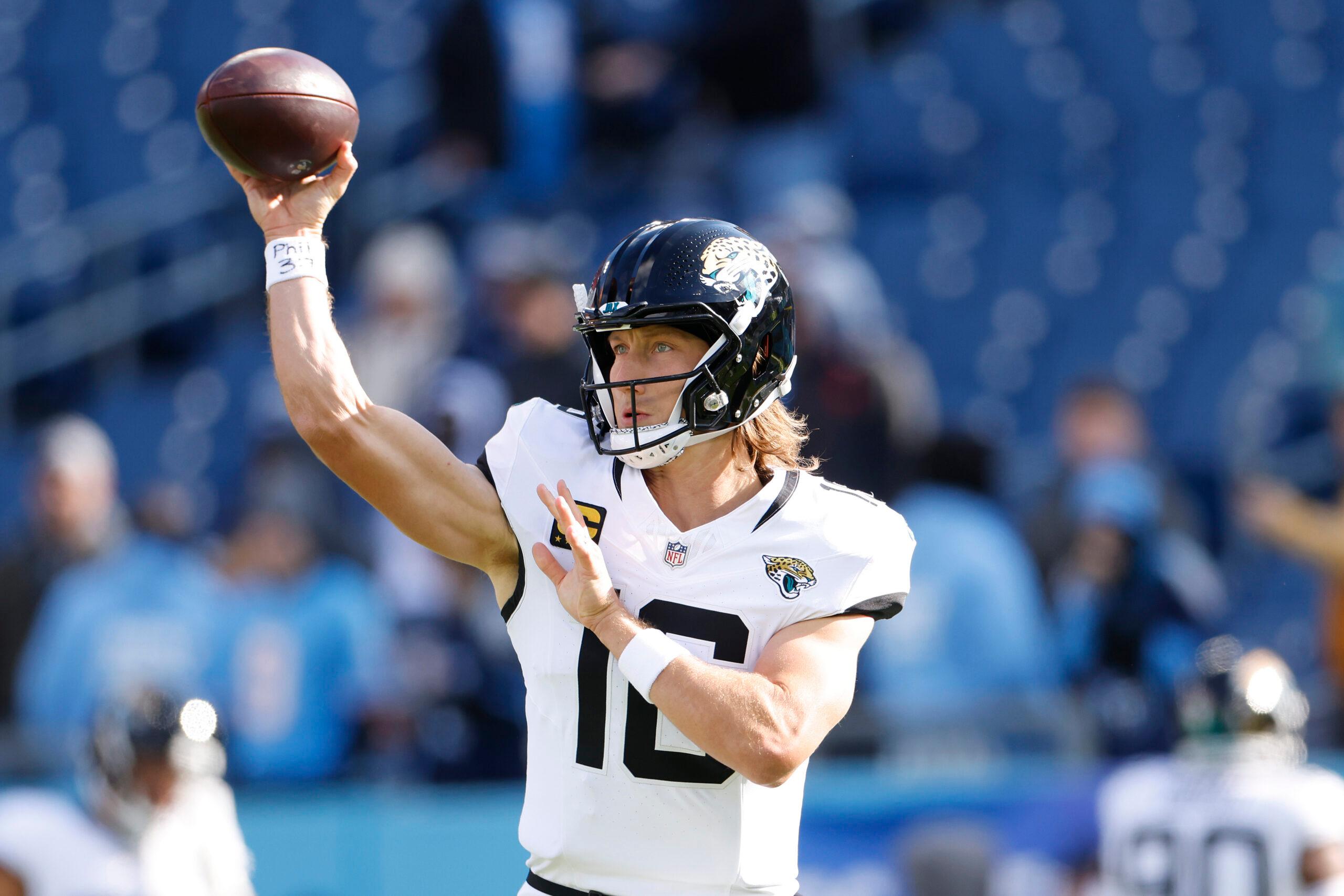
Trevor Lawrence
Age: 26
Contract status: Signed through 2030, $55 million per year
Potential trade compensation: Two first-round picks
Trevor Lawrence would be hard to move—he’s approaching what should be the prime years of his career just as the new money on the contract extension he signed in 2024 is kicking in. But if the Jags underperform down the stretch, he falls apart, or the new regime decides that it’d like to get its own guy … he could be an intriguing trade candidate. Dealing Lawrence between the end of the 2025 season and June 1, 2026, would cost Jacksonville more than $75 million in cap charges for the 2026 season alone and more than $130 million in accumulated cap charges through 2028. Because there’s effectively no escape from incurring these massive financial penalties, dealing him for anything less than premium value should be a nonstarter for the Jaguars because they already have more than $40 million in dead money on the books next year and would have significant cap penalties until 2028. And this is significant: Lawrence also has a full no-trade clause, which means that he’d have to be an active participant in facilitating any deal.
A couple of conditions would likely have to be in place for Jaguars GM James Gladstone to consider making this move. First, he’d need to see Lawrence’s deal as a mistake made by his predecessor, Trent Baalke, one that’s keeping Gladstone from building the roster in the way he sees fit. Second, at least two first-round picks would have to be on the table, and the full trade package would need to be similar to what Seattle received in the Russell Wilson trade nearly four years ago, if not better. The restrictions on dealing Lawrence would box Jacksonville out of free agency entirely and force the franchise into a multiyear rebuild through the draft alone—which is difficult enough after the team traded away its 2026 first-rounder last April to move up and select Travis Hunter. And given the inconsistencies and injury issues we’ve seen in Lawrence’s career, only a team with a major surplus in draft capital and a roster in win-now mode would even think about engaging in that kind of negotiation.
There will be quarterback-desperate teams, though, so don’t rule anything out. And if you set Lawrence’s less than impressive statistics to the side (60 percent completion rate, 79.4 passer rating) and just evaluate his play in 2025, you can squint and still see the outline of a winning player. There have been improvements in his decision-making, how he’s managed the pocket, and how quickly he identifies what defenses are trying to do to him. Lawrence still has some concerning shortcomings in his accuracy and reaction to pressure, and I think that might be true of his game for the rest of his career. But he’s mostly been unlucky on his worst days this season. His arm talent still flashes in a big way, and now that he’s shaken off his past injuries, his mobility is back to what we saw in his first few years. If he’s playing in a system built on play-action passes and early-down runs, Lawrence can deliver wins and trips to the playoffs—especially if he’s surrounded with high-end talent, the kind that’s been missing from his supporting casts in Jacksonville.
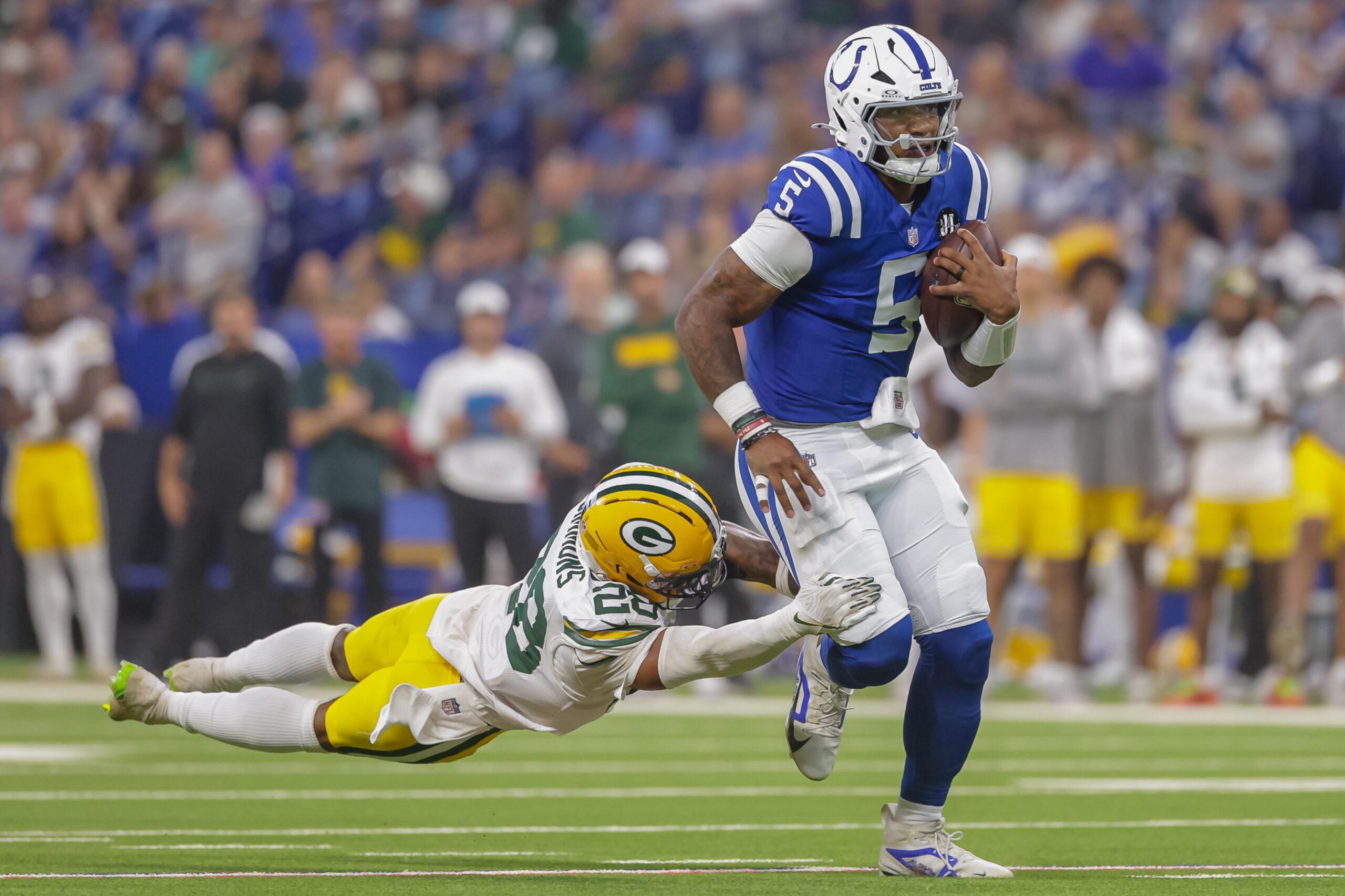
Anthony Richardson
Age: 23
Contract status: Signed through 2026, $8.4 million per year
Potential trade compensation: Fourth- or fifth-round pick
After a rocky start to his career, Richardson was passed on the depth chart by current starter Daniel Jones, and the Colts instantly catapulted into championship contention. They cashed in on this unexpected leap by trading away a few first-round picks for cornerback Sauce Gardner, a signal that the franchise is happy to commit to Jones for the next few years. It's in Richardson’s best interest to find a new landing spot—while the team would be smart to pick up extra draft picks.
Richardson is currently on the injured reserve (while recovering from a broken orbital bone) and won’t be a great fit in every offense, but he could be a good buy-low option for a team taking a one-year flier on an athletic, if raw, passer. The Colts might be able to get something similar to what the 49ers did when they traded Trey Lance to Dallas for a fourth-round pick.
Richardson still has potential; he’s got the physical tools and raw arm talent to become one of the league’s most interesting long-term development projects. Reputation matters, though, and what many will remember about Richardson’s Colts tenure is his terrible throws—and the time he checked out of a game because he was fatigued. If you remove where he was drafted (fifth in 2023) from consideration, he’s just another quarterback without enough reps to fairly evaluate him. That may scare several teams away.
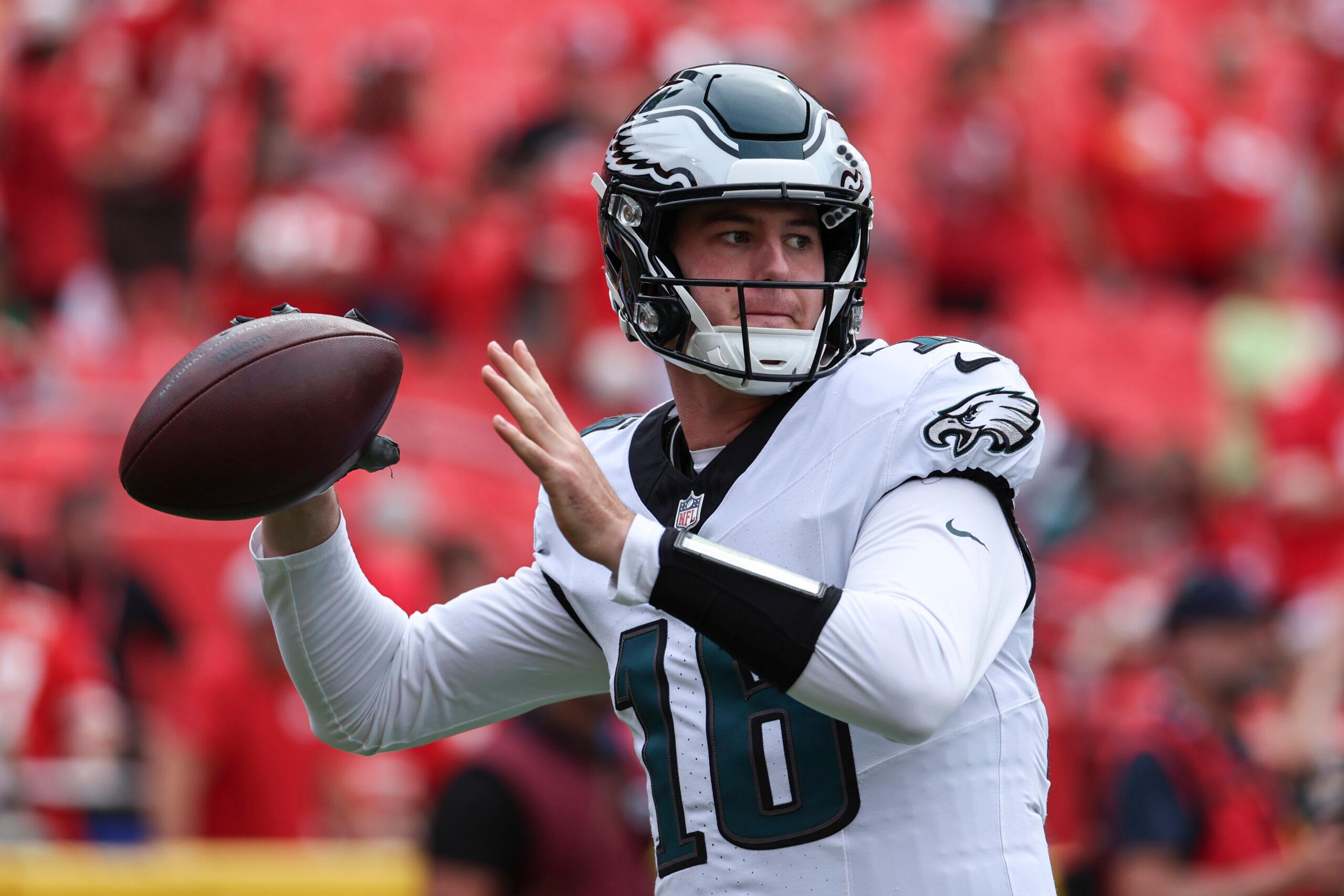
Tanner McKee
Age: 25
Contract status: Signed through 2026, $1 million per year
Potential trade compensation: Fourth- or fifth-round pick
McKee is well respected by his team and has played well when he’s seen the field in the preseason or on spot duty, but he’s stuck in an odd position in Philadelphia. The potential he’s flashed has been in such small doses that it’s difficult to gauge his real trade value. And he’s too important to the Eagles as a quality backup to be shopped around at a discount.
It will be fascinating to see how Philadelphia decides to manage its quarterback room after this season. McKee’s deal expires after 2026, and if the Eagles don’t intend to re-sign him, they would be wise to try to deal him this offseason. But because the time is running out on his deal, other teams probably won’t be as interested in him if he’s going at a high asking price. The worst outcome for Philadelphia would be to let him play out the remainder of this contract and reach free agency in 2027.
McKee doesn’t have any rare physical tools, but at 6-foot-6, he has a prototypical frame and an efficient play style that fits into any offensive scheme. He’ll go through his progressions exactly as prescribed and make his throws within that structure, but don’t expect him to create any offense with his legs or escape from danger if he’s under pressure. He’s a C-plus player across the board, and in the right system, he could lead an above-average offense.
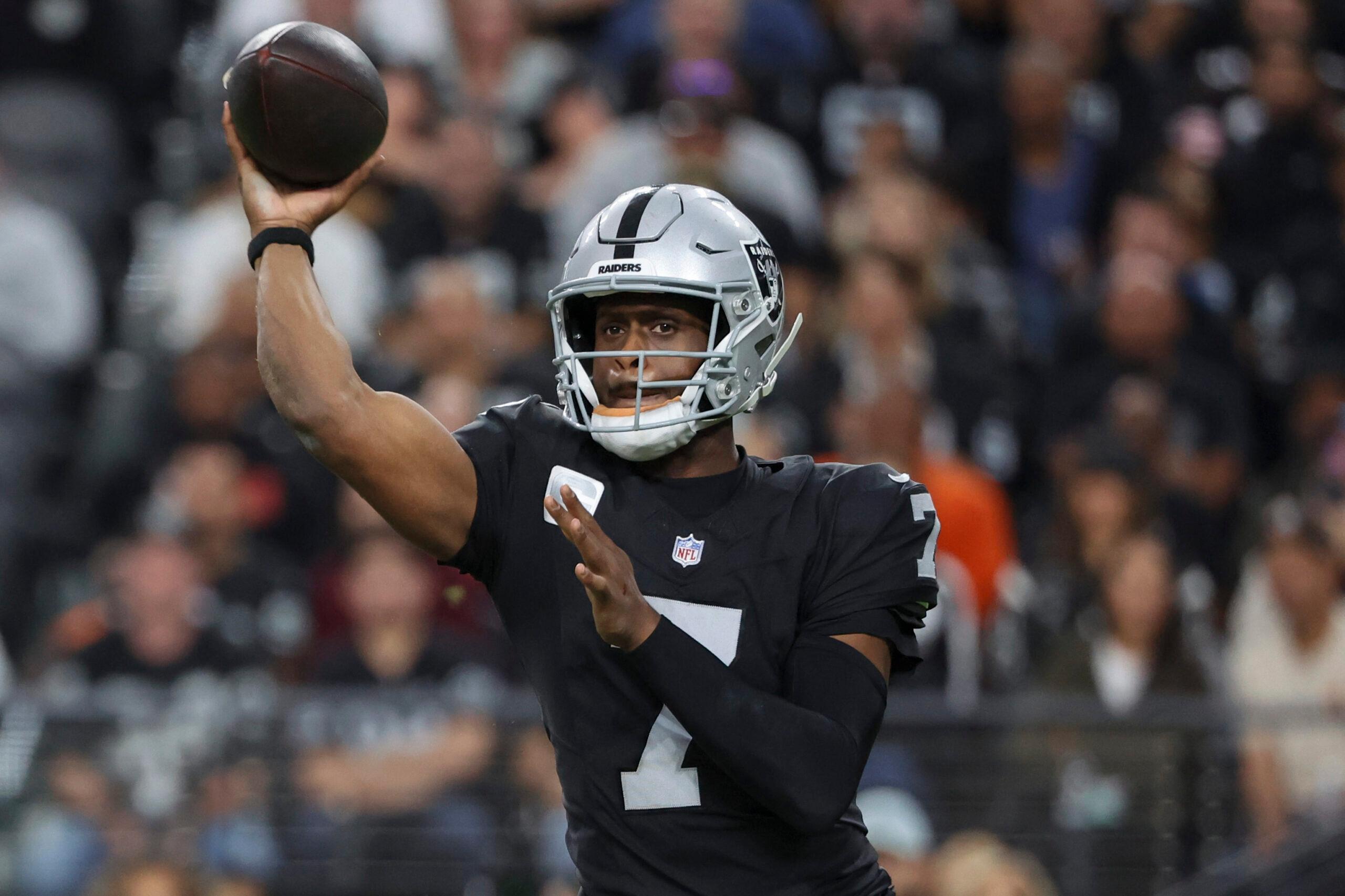
Geno Smith
Age: 35
Contract status: Signed through 2027, $37.5 million per year
Potential trade compensation: Fourth- or fifth-round pick
No matter what happens the rest of this season, Raiders quarterback Geno Smith will be seen as nothing more than a bridge quarterback for the rest of his career. Since 2024, no quarterback has been sacked or intercepted more than Smith, and now that he’s 35 years old, it’s fair to assume that his best throws are behind him.
Teams desperately looking for a Band-Aid in 2026 could offer the Raiders a couple of day-three picks to get a deal done—especially if Las Vegas already has its sights set on Smith’s replacement. He still has just enough arm talent to squeeze out some wins on a playoff-quality offense, but to work around his cold streaks, the team adding him needs to be equipped with the type of offensive personnel and scheme that Las Vegas does not have.
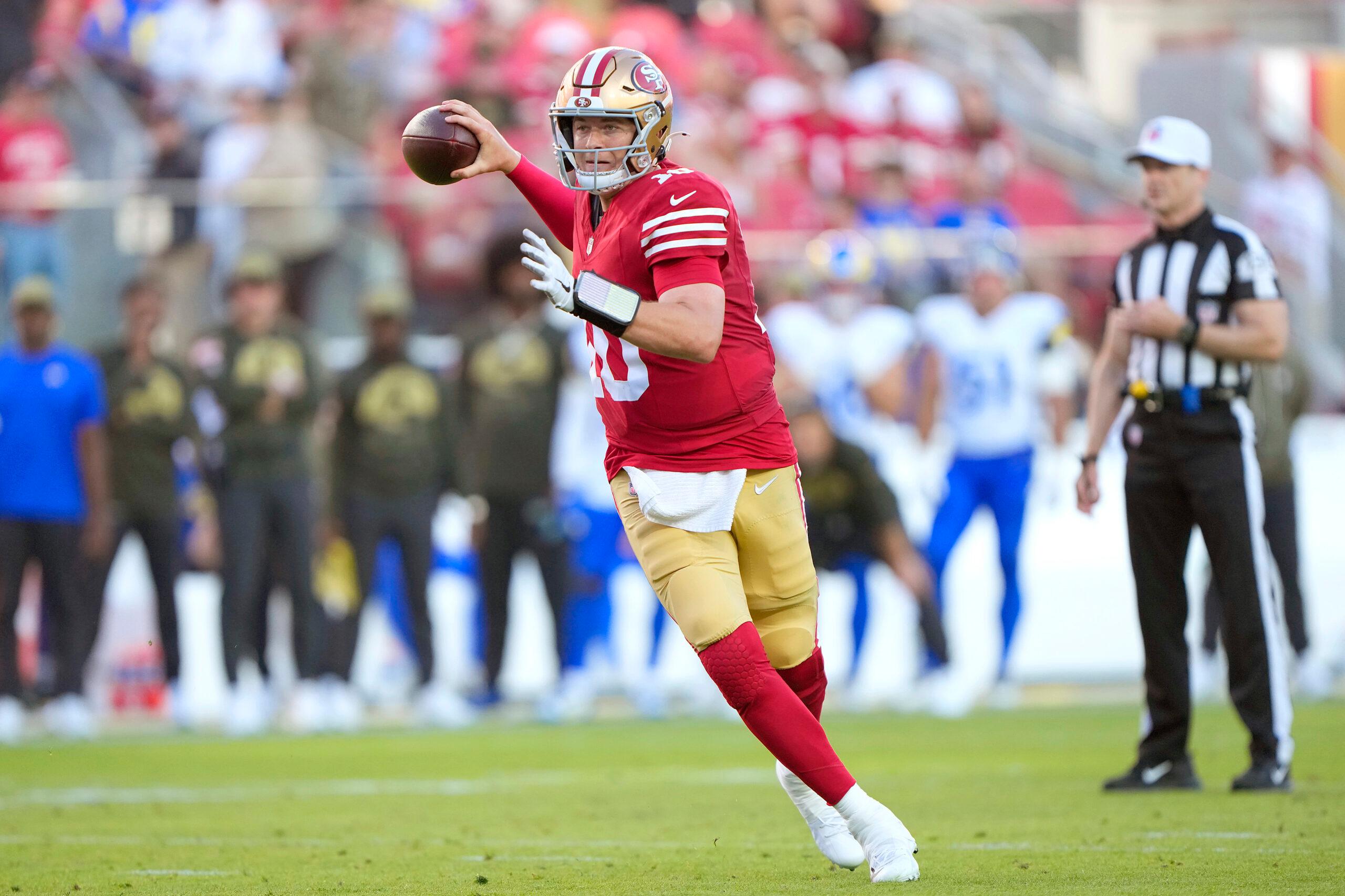
Mac Jones
Age: 27
Contract status: Signed through 2026, $4.2 million per year
Potential trade compensation: Fourth- or fifth-round pick
Maybe 49ers head coach Kyle Shanahan was right all along. Backup Mac Jones was one of the two prospects Shanahan was reportedly interested in during the 2021 draft, and he put up career-best efficiency in his nine games of action with San Francisco in relief for Brock Purdy this season. He’s been a perfect fit in this style of offense, getting the ball out of his hands quickly and playing within structure. He won games without some of San Francisco’s best playmakers and showed surprising poise in close games that he didn’t always demonstrate during his time in New England.
Jones should draw some trade interest this offseason, and if he gets enough, it could drive up his trade compensation (as well as increase the value of his next contract). Now that Jones has proved that he can thrive in a Shanahan system, I expect that the 49ers will receive calls from several members of his extended coaching tree.
The most important question is whether the 49ers would even be interested in dealing Jones. Unless they receive a wild offer for Jones, it might make more sense for them to keep him as Purdy’s backup in 2026 and let him hit free agency in 2027, when he might be able to cash in on the open market. Purdy’s a smaller quarterback who has previously sustained a torn elbow ligament and shoulder injuries and is still dealing with turf toe suffered earlier this season. Jones isn’t just playing at a discount right now; he’s become an invaluable way to protect the 49ers from spiraling if Purdy’s ever banged up. I’m interested in seeing whether Jones insists on pursuing a starting job elsewhere ASAP because that might be the only way he can push out of San Francisco and into a spot where he can compete.
Dishonorable Mentions
Marcus Mariota, Joe Flacco, Russell Wilson, Tyrod Taylor, Carson Wentz
All of these QBs started multiple games this season and are set to become free agents in 2026. They are all at least 32 years old (and Flacco is almost 41!). While both Flacco and Wilson were Week 1 starters this season, none of these QBs seem like they’ll land a starting job next season. I would expect each of these guys to be a backup for a quarterback on their rookie deals next year, present on rosters only as mentors and contingency plans.
Unless a talented quarterback has fallen significantly short of expectations, we can’t expect to see starting-caliber players hit the open market anymore. If teams want to make a quick pivot at this position, it most likely needs to come via trade or an early draft pick.
Quarterbacks to Watch in the 2026 Draft
For the teams that would prefer to try to find their next starting quarterback in the draft, there should be at least a handful of passers worthy of a first-round pick. In the NIL era, there’s no telling which guys will ultimately decide to stay in school, transfer to a different school, or declare for the draft—at least not before conference championship weekend and the playoff field is set. Until that clarity arrives, here’s the “who’s who” of this quarterback class.
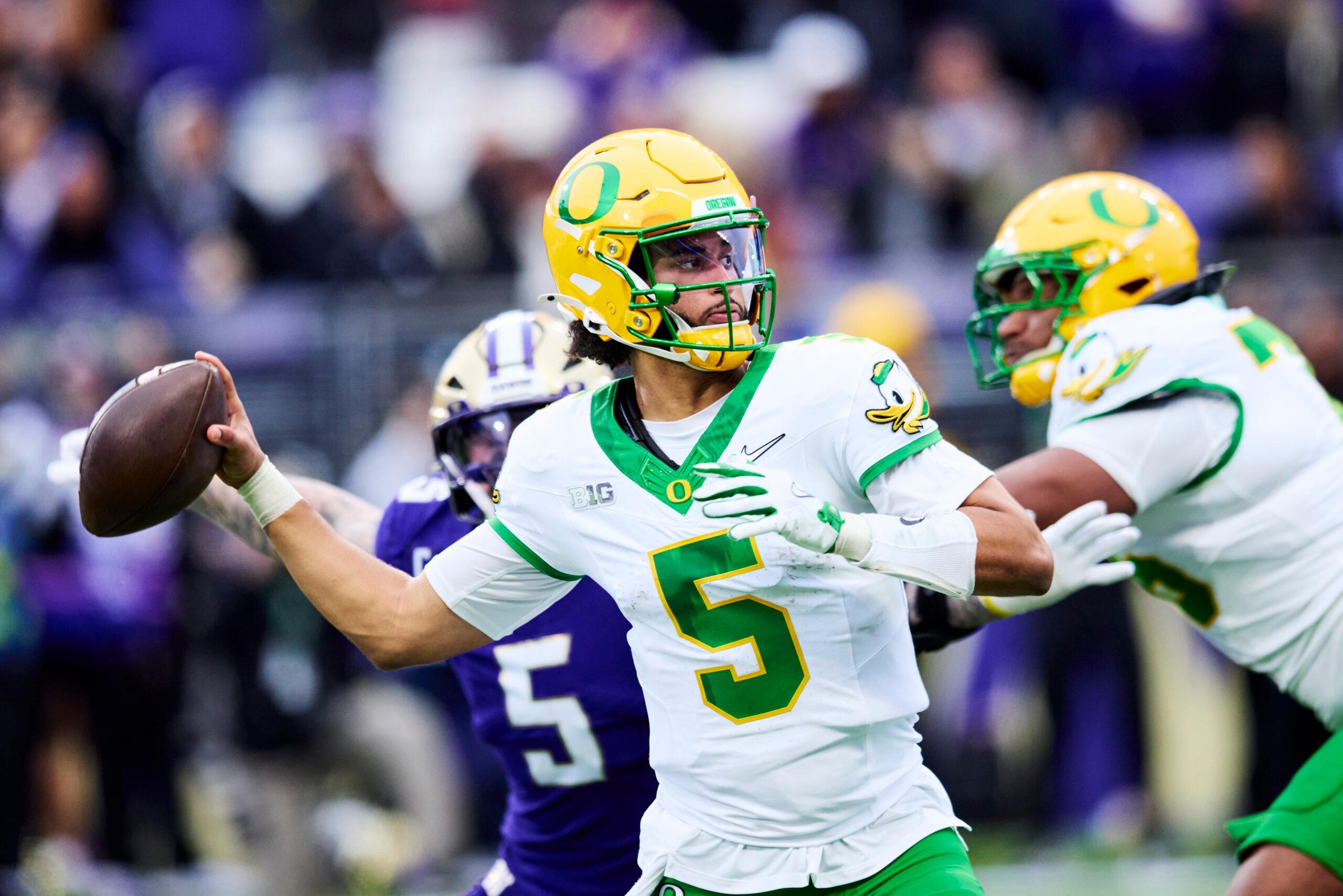
Dante Moore, Oregon
Moore is my favorite passer in college football, and would be my choice for top quarterback in the 2026 draft should he leave school. The Oregon (by way of UCLA) prospect reminds me of a young Dak Prescott. Moore checks all the physical boxes at 6-3, 206 pounds. He has the quickness to escape rushers and make plays out of structure, and the raw arm talent and accuracy to play from the pocket. Oregon has used him in the running game at times, too, and while he doesn’t have the same top-end speed as Lamar Jackson, he has just enough to put stress on defenses.
Moore is just 20 years old, so it probably makes more sense for him to stay in college an extra year. He’s a much more polished prospect than was Anthony Richardson, the last super-young quarterback to be selected near the top of the draft, but Moore still needs to work on his response to pressure and speed up his processing, because both have caused him problems this season.
Moore played his best football in November, and Oregon is on pace to make the College Football Playoff because of it. A deep postseason run would help Moore’s stock rise.
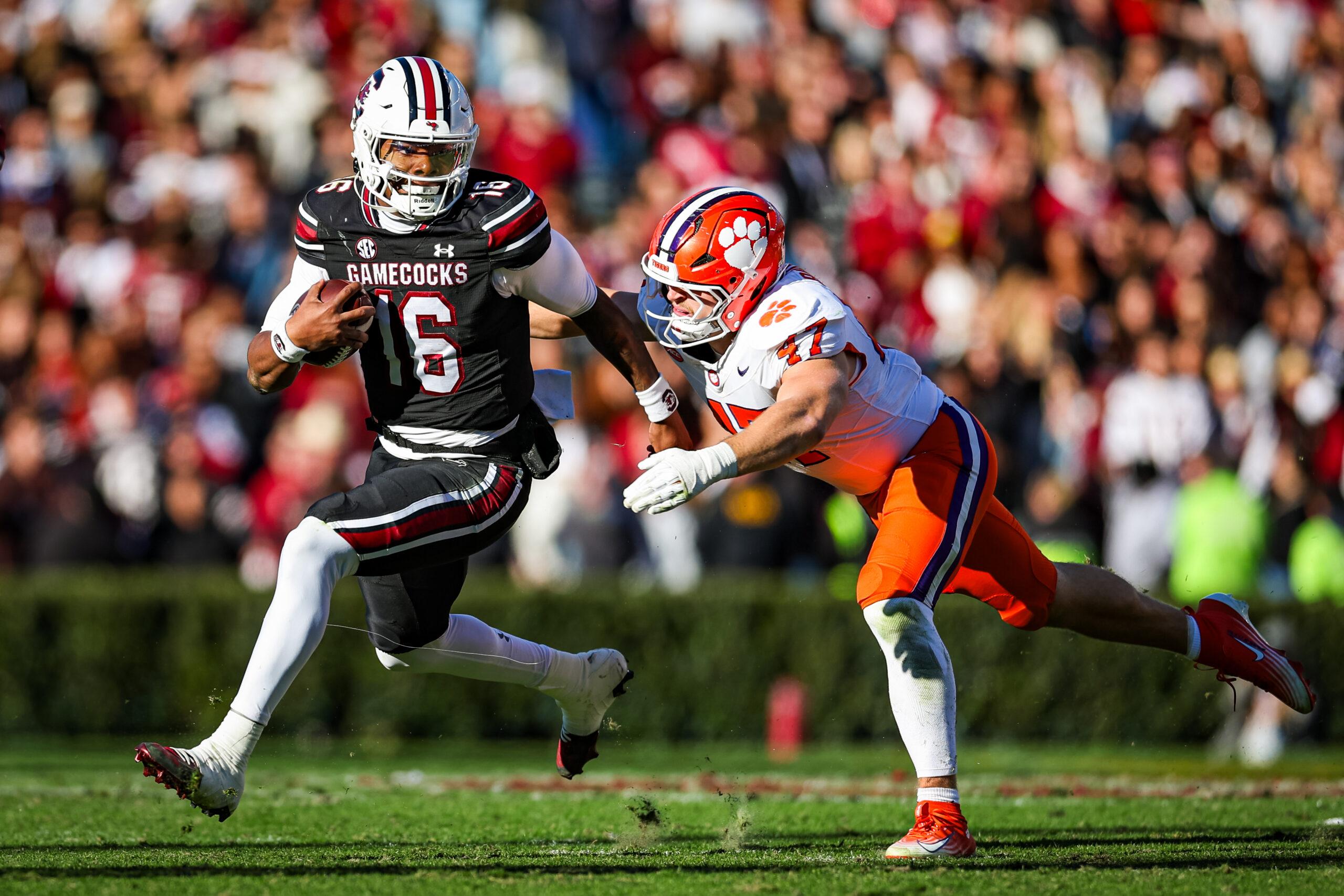
LaNorris Sellers, South Carolina
The evaluations of Sellers are all over the place.
My NFL comp for Sellers is Jalen Hurts. Sellers has more natural arm talent than Hurts, who was a second-round pick in 2020, but their play styles line up—in ways both good and bad. Sellers is a more consistently accurate passer when throwing outside the numbers than he is to the middle of the field, and he’s not afraid to take chances deep downfield even if his receivers are covered. As a downhill runner, he can build up enough speed to be a real asset in the run game, but we don’t always see that athleticism translate in how he responds to pressure.
Because he’s strong enough to escape the grip of pass rushers and a talented enough passer to drive the ball deep downfield, Sellers tends to hold the ball in the pocket. This can be a major positive at times, because quarterbacks who hold the ball longer allow deep downfield passes to develop—but sometimes it means that he’ll allow the pocket to close in on him, or he’ll miss easy throws because he’s stuck on his first look in the progression.
If Sellers declares for the draft, his NFL coaching situation will matter more for him than it would for any of the other potential first-round passers. The need to insulate an offense from Sellers’s inconsistencies means that he’ll need to play in an RPO-heavy, shotgun-based offense until he’s a bit more polished at working through his progressions. If you believe that’s possible (and I do), then Sellers can certainly grow into a multi-year Pro Bowl–level starter even with some inconsistencies—like Hurts.
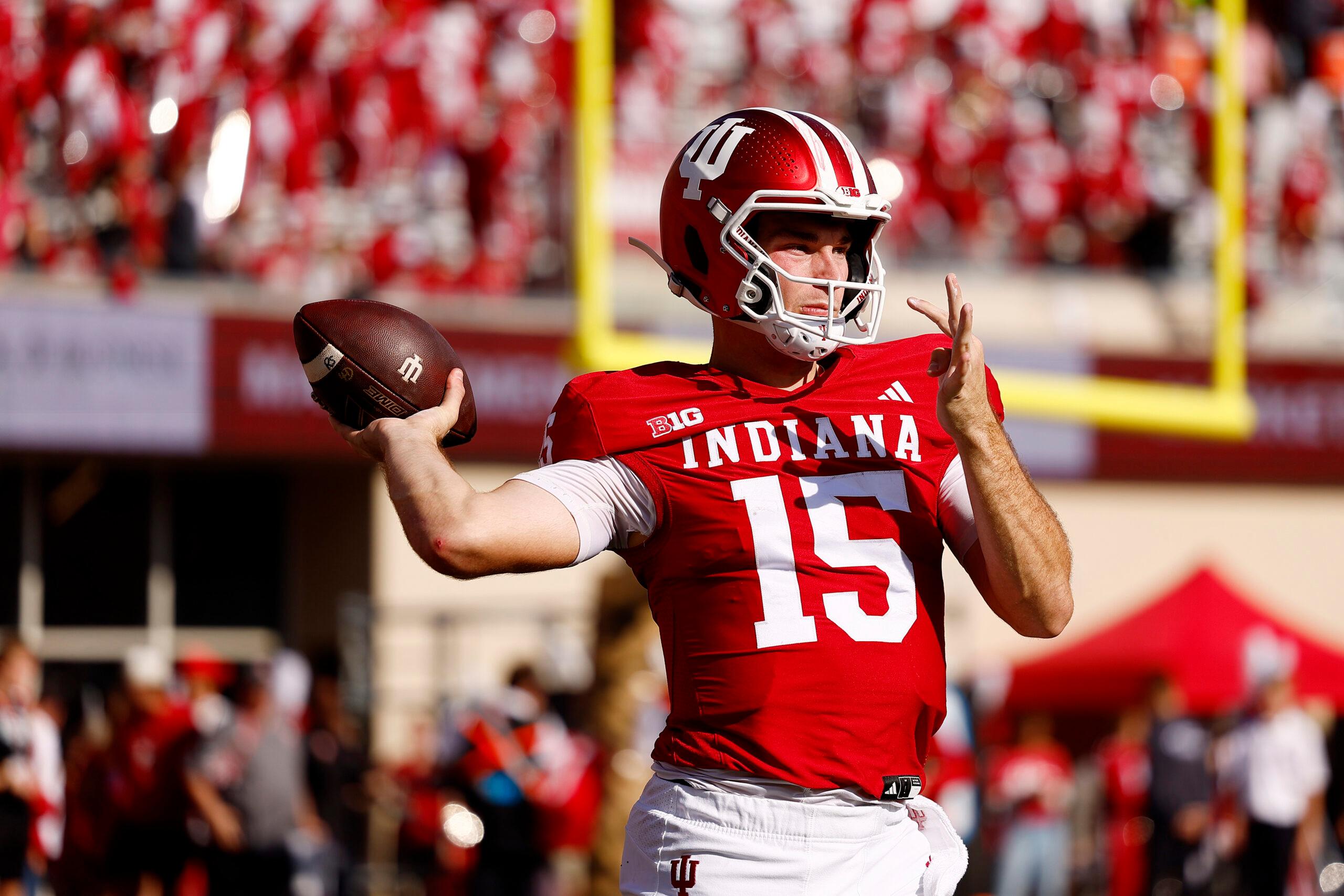
Fernando Mendoza, Indiana
If a team is looking for more of a prototypical pocket passer, Mendoza is the pick. His stock rose in 2024 in his final year at Cal before transferring to Indiana, but the year he’s spent with the Hoosiers has showcased him as an accurate, high-IQ passer with the correct answers for what defenses throw at him.
His 2025 tape shows him throwing into tight windows against zone coverage, throwing receivers open against man coverage, and anticipating blitzes and punishing defenses with his arm when pressure comes. Mendoza reminds me a lot of another former Cal Bear—Detroit Lions quarterback Jared Goff, down to the way he runs. If Mendoza is playing in a well-designed scheme when he gets to the NFL, I wouldn’t be surprised if he’s able to put up big passing numbers.
If there’s something to criticize on Mendoza’s film, it's his lack of creativity out of structure. Mendoza might be able to get out of the pocket on designed bootlegs, but don’t expect him to evade free rushers or take off for explosive gains very often. Combine that with an adequate but unimpressive arm, and Mendoza is the right quarterback in just about any offense, but far short of a transformative one.
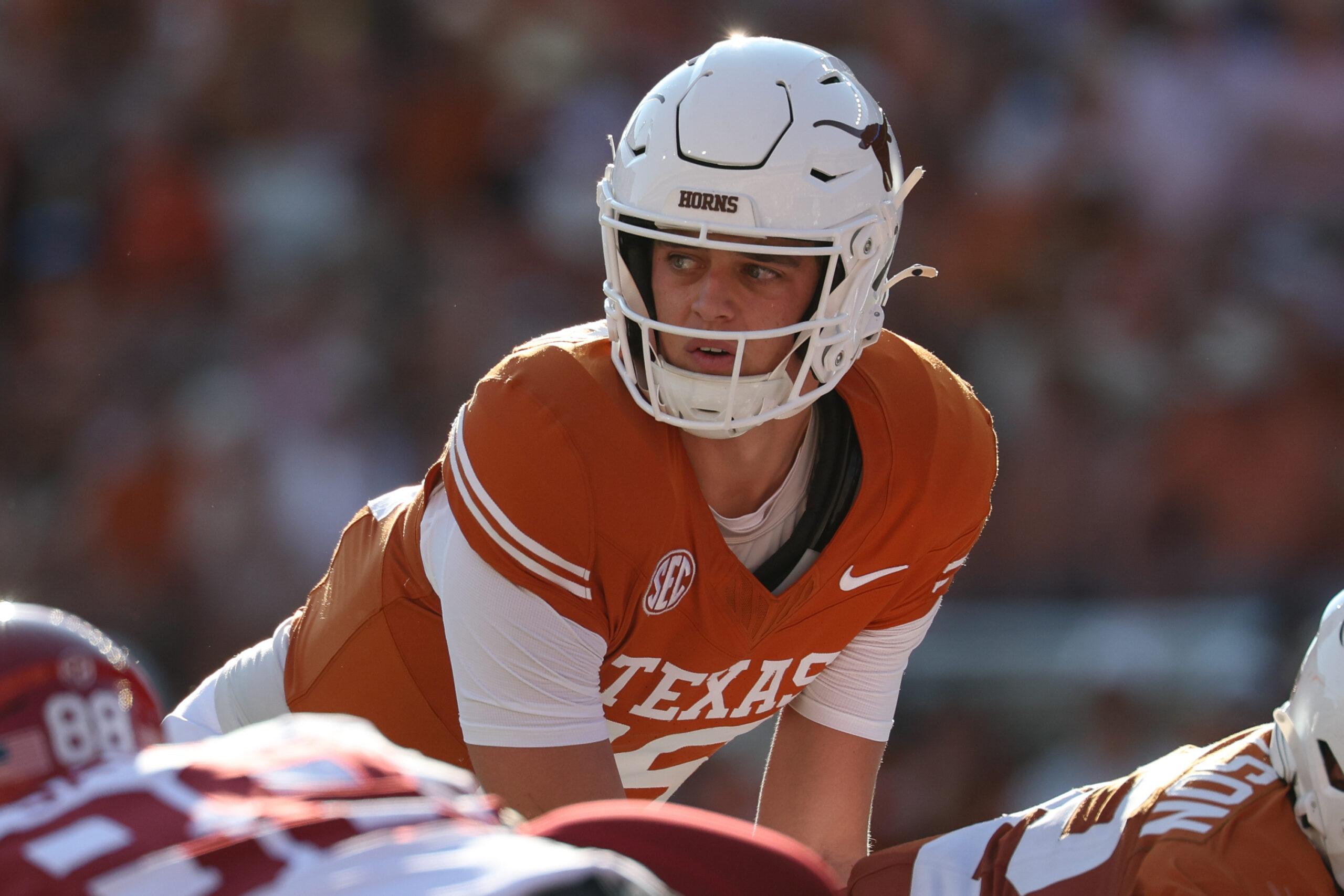
Arch Manning, Texas
Archie Manning, the patriarch of the famed quarterback family, said earlier this year that we should expect Arch to remain at Texas next year, so any tanking team’s March for Arch campaign can probably wait until 2027. And for at least the first half of this season, it looked like Manning would need several years in college to make good on all the hype we’ve heard since he was in high school.
He looked rough against an elite Ohio State defense, scuffled through the rest of Texas’s non-conference schedule, and didn’t fully adjust to the speed of SEC football until his three-touchdown game against Mississippi State. His stock has climbed steadily since that game and peaked with back-to-back wins over Arkansas and Texas A&M, as he finally flashed the combination of arm talent and athleticism that made him the most coveted high school recruit of the past half decade.
He’s still nowhere close to a finished product, and I’d have him ranked behind Moore, Sellers, and Mendoza if the draft were happening tomorrow, but his star potential is clearly there. He could stand to bulk up a little more and refine his passing mechanics to help his hot-and-cold accuracy, but I think we’ve seen just enough to consider him a legitimate pro prospect in this year’s draft or the next.
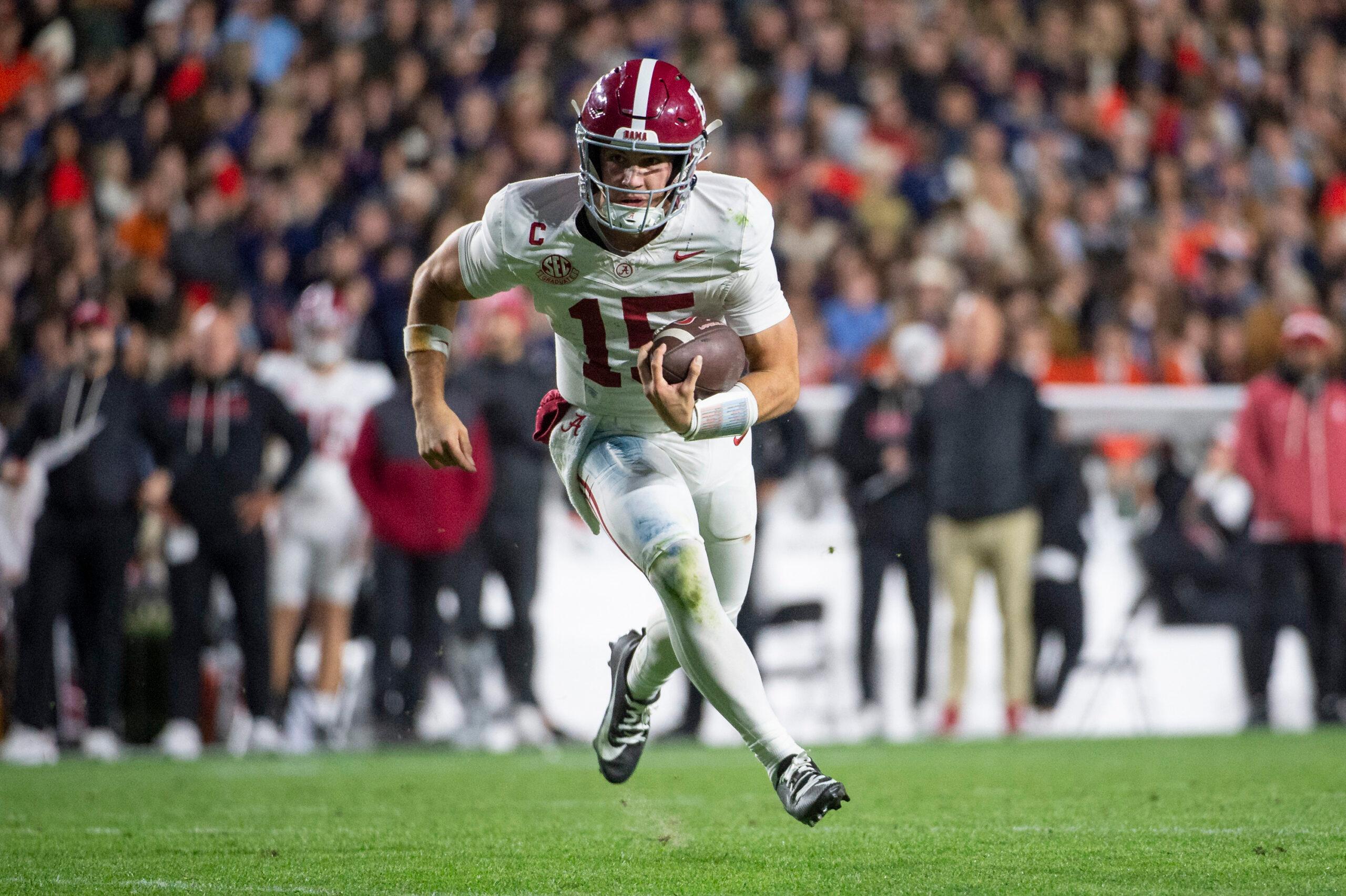
Ty Simpson, Alabama
The college football world seems to have warmed to Simpson in 2025 because of Alabama’s current success, but it’s easy to imagine LSU’s Garrett Nussmeier, Miami’s Carson Beck, or Clemson’s Cade Klubnik getting more buzz at this point in the predraft process under different circumstances—not because they’re better, but because their teams weren’t as good this year. Simpson has spent four years in the same offensive system at Alabama, but didn’t become the starter until this season. He knows how to get through a progression and how protection schemes work, so you don’t see him totally break down when the unexpected happens. He’s not a special athlete, but he’s a functional one, with enough mobility to be successful outside the pocket on bootlegs or other designed rollouts.
Consistent accuracy still escapes him, though, and that’s something we should expect to hear about in the pre-draft process. Simpson doesn’t have the arm strength to drive deeper throws, and he tends to sail the ball out of the reach of his receiver when he tries to push the ball downfield. His slim frame (listed at 6-2, 208 pounds) will raise questions about whether he can escape muddy pockets or rip away from sacks, and Simpson will have to answer for why we haven’t seen him string together enough seasons of dominant play to make him the clear top option in the draft.