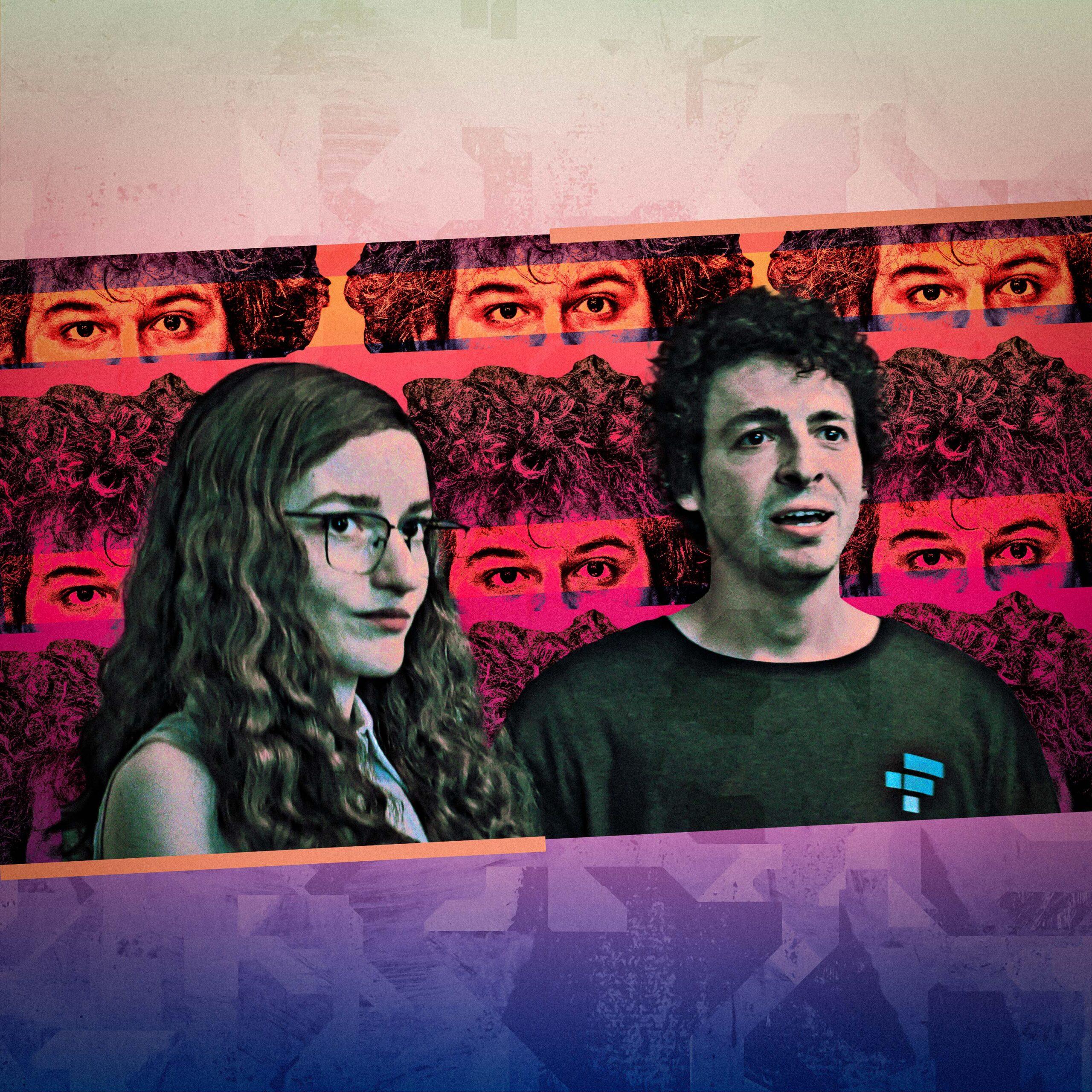

For a nice little while there, Sam Bankman-Fried excelled at spinning “doing good” into gold. In April of 2022, the eccentric MIT grad and founder of the cryptocurrency exchange FTX appeared on The 80,000 Hours Podcast and chatted at length about his approach to life and work, which for him were basically one and the same. “If your goal is to have impact on the world, and in particular, if your goal is to maximize the amount of impact that you have on the world,” Bankman-Fried explained, “that has pretty strong implications for what you end up doing.”
Bankman-Fried was, at the time, outwardly doing quite well. Earlier that year, FTX had raised a new funding round at a valuation of $32 billion. Larry David had agreed to headline the company’s big Super Bowl ad. The FTX brand graced an NBA arena in Miami and the uniforms of umpires in MLB ballparks nationwide. And Alameda Research, the trading firm Bankman-Fried had launched in 2017, was humming along. Operating in a somewhat lawless Wild West industry that’s lousy with scammers and shadowy figures, Bankman-Fried positioned himself as someone different—and better. He testified on Capitol Hill about the importance of regulating crypto; he launched ambitious philanthropic endeavors; he spoke of the way selflessness could go hand in hand with success.
“If you really are trying to maximize your impact,” he posited on the podcast, “then at what point do you start hitting decreasing marginal returns? Well, in terms of doing good, there’s no such thing. More good is more good. It’s not like you did some good, so good doesn’t matter anymore. That means that you should be pretty aggressive with what you’re doing and really trying to hit home runs rather than just have some impact.” The way Bankman-Fried saw it, the more money he could make, the more he could generously bestow on the world.
It would soon turn out, however, that this whiz kid’s limitless approach to making all that money involved taking money with total abandon and without, like, permission. Only eight months after that podcast appearance, Bankman-Fried was arrested near FTX headquarters in the Bahamas and extradited to the United States on charges of fraud, conspiracy, and money laundering. Less than a year after that, in November 2023, he was found guilty of illegally appropriating some $8 billion in FTX customer money, a crime for which he was ultimately sentenced to 25 years in federal prison.
Now, three years later, the 34-year-old Bankman-Fried is back on the airwaves, even as he serves his time behind bars. That’s because two new productions about his life and crimes are hitting streaming this November.
Amazon’s The Boy Who Stole Billions? (question mark theirs!) and Netflix’s The Altruists have plenty in common. Both cover the near-decade-long rise—and fall—of Bankman-Fried. Both jet-set around the planet, following SBF from the U.S. to Hong Kong to the infamous penthouse suite in the Bahamas where, eventually, the jig was up. Both engage with the backstories of Bankman-Fried’s workplace associates—some of whom were old childhood pals and one of whom, Caroline Ellison, was Bankman-Fried’s right-hand woman, intellectual sparring partner, and clandestine on-again, off-again boo. And both seek to make sense of the FTX saga by digging into the company’s deep roots in the modern philosophical movement known as effective altruism.
But the two projects are also markedly different in their approach. The Boy Who Stole Billions?, which drops on November 30, is a relatively straightforward three-part documentary from filmmaker Nanette Burstein that brims with archival footage, jailhouse interviews with the man himself, and let-us-down-easy disclaimers like “After several requests, Caroline Ellison declined to be interviewed.” Meanwhile, The Altruists is a scripted, eight-episode dramedy that premiered late last week and is—well, maybe I should let the creative professionals who made it try to explain for themselves? (Question mark mine.)
“Succession meets Step Brothers,” declares Anthony Boyle, the actor who plays Bankman-Fried in The Altruists, when I ask him over Zoom how he’d describe the tone of his new Netflix show. “Gen Z’s Bonnie and Clyde,” he adds—as his costar Julia Garner, sitting beside him, spins to face Boyle and interrupts: “Step Brothers? With Will Ferrell?!”
“Some days it did feel like we were doing Step Brothers!” Boyle insists. “Step Brothers on steroids!” Garner, who plays Ellison, can only shake her head and laugh. “I do love Step Brothers,” she says. “But if I were to compare [The Altruists] to, like, one project that has a similar quirkiness to it? Very different movie, but I would describe it like … Punch-Drunk Love, a little bit. Like, a very quirky love story.”
I’ll say. In The Altruists, Sam and Caroline the characters flirt over boxes of cereal in the office pantry, fight over games of speed chess, and deliver lines like: “Going all in every time is the mathematically optimal strategy” and “I’ve always found non-monogamy to be the mathematically optimal sexual system.” They feed off each other’s best ideas and worst instincts; they doctor spreadsheets and nurse resentments. Created by The Imitation Game’s Graham Moore and broadly based on the New York magazine reporting of Jen Wieczner and Kevin T. Dugan, The Altruists is less of a blow-by-blow biopic and more of a nerd-love rom-dram. Much like the financial scandal it covers, The Altruists is lively, often entertaining, and messy as hell. If I hadn’t already known that it was made by Moore, I would have assumed I was watching a Ryan Murphy joint on FX.
Inside the SBF Trial
Garner, who gamely dons a frizzy wig, glasses, and false teeth for the role, tells me she had precious little footage of the real Ellison to work with and mined the limited clips she saw for everything they were worth. “I could tell from [one] interview when she was not afraid and when she got scared answering certain questions just from where her eye placement is,” Garner says. “When people feel ashamed about things, they don’t want people to look at their eyes, because the eyes never lie.”
Boyle had the opposite problem. “That man loved an interview,” he says of Bankman-Fried. “There’s books written about him. … They’re all conflicting reports, so you’re like, OK, which one do I trust?” He leaned on Michael Lewis’s Going Infinite and hours of audio and fixated on details like Bankman-Fried’s perpetually bouncing leg (“this constant sort of motion in him, the sort of internal metronome”). He also did some fieldwork, popping into Forbidden Planet and other Magic: The Gathering haunts to “pretend to sort of have those mannerisms and the same voice that Sam had” and also study some of the regulars. “As an actor, you’re like a magpie,” he explains. “You’re just picking little things up.”
Other cast members seem to be having fun, too: I got a kick out of Alex Lawther’s saucy portrayal of former Alameda Research co-CEO (and Soak My Deck skipper) Sam Trabucco and appreciated Karan Soni’s nervous Nellie performance of SBF’s old pal Nishad Singh. But viewers who are familiar enough with Bankman-Fried’s story to appreciate these characters may find themselves rolling their eyes or furrowing their brows at other, more wayward depictions. (I definitely do not remember FTX engineer Gary Wang having the vibe of a ’90s movie stoner, but you know what, I’ll allow it.)
On social media, former FTX COO Constance Wang bristled at the trailer for the show, writing: “FTX’s collapse ruined so many people’s lives, including ours, and Netflix decided to make it a love story.” And as Slate’s Nitish Pahwa points out in his review of the show, The Altruists curiously portrays Caroline as a “sexed-up, aggressive femme fatale pushing Bankman-Fried into escalating criminality.” Conversely, it “coddles [SBF] to an almost astonishing degree.” He comes across as a bit of a malleable simp—just a boy who’s guilty of listening too closely to his girl.
In reality, though, Bankman-Fried had mostly himself to blame for his failings. In theory, anyway. Over the course of Bankman-Fried’s October 2023 trial, it became clear that the FTX founder has some rather idiosyncratic views re: the salience of concepts like blame. Asked on the witness stand about those missing billions, he told the jury that “for better or for worse,” he “wasn’t particularly interested in trying to dole out blame for it; that wasn’t my priority.” And during Ellison’s time under oath, she testified that Bankman-Fried’s guiding ethos was to do “whatever would maximize utility” and “create the greatest good for the greatest number of people or beings.” Which led to this exchange:
Prosecutor Danielle Sassoon: What did he say about how lying or stealing fit into that?
Ellison: He said he didn’t think rules like don’t lie or don’t steal fit into that framework.
We get a number of glimpses into Bankman-Fried’s framework during the course of The Boy Who Stole Billions? Watching this documentary right on the heels of The Altruists felt a lot like when I went home after a screening of the Elizabeth Holmes/Theranos film You Can See Everything and immediately fired up The Inventor, Alex Gibney’s more traditional documentary on Holmes. In both cases, the very different on-screen projects combine for a compelling pairing: One vibrates with creative license, the other serves as a vital corrective, and both offer different facets of the truth.
In The Boy Who Stole Billions?, Burstein conducts a number of jailhouse Zoom interviews with Bankman-Fried. They begin during the interregnum between when he was convicted in November 2023 and sentenced in March 2024, and in them the erstwhile boy wonder amiably recalls his childhood (introverted), describes his emotions (anhedonic), and pins his downfall on a single tweet from bitter crypto rival Changpeng Zhao (“if CZ hadn’t tweeted, then there would not have been a run on the bank, there wouldn’t have been a bankruptcy, and I wouldn’t be in prison”).
But when it comes to owning up to what he did—treating FTX customer funds like a piggy bank to be raided for various speculative personal investments, turning old friends into felons, and deceiving employees and investors and users—Bankman-Fried is less forthcoming. “Explain to me how it’s OK for Alameda to borrow money from FTX customer accounts,” Burstein asks gently in the third and final installment of her series. “Well,” Bankman-Fried says, suddenly a little haughty on his hot seat, “it’s kind of actually how a lot of banks operate.” (FTX, to be clear, was expressly and intentionally not a bank; it was an offshore crypto exchange whose own terms of service promised customers that none of their assets were “the property of, or shall or may be loaned to, FTX Trading.”)
At another point in The Boy Who Stole Billions?, Burstein asks former FTX executive (and current federal inmate) Ryan Salame to diagnose Bankman-Fried’s issues:
Burstein: Do you think one of his problems is that he thinks he’s the smartest guy in the room?
Salame: I think one of his problems is that he is often the smartest guy in the room. It’s not irrational. I mean, if you’re right 99 times, you probably think you’re gonna be right the hundredth time.
Burstein: You think he actually saw himself as stealing the money?
Salame: I could tell you for almost a fact that Sam does not actually think he did anything wrong. It’s just once you think you’re smart enough to save the world, you’re more of a problem than a solution, I think.
In November 2023, on the heels of Bankman-Fried’s conviction on two counts of wire fraud and five counts of conspiracy, Merrick Garland, then attorney general, issued a statement in support of the verdict. The case, he said, “should send a clear message to anyone who tries to hide their crimes behind a shiny new thing they claim no one else is smart enough to understand.” He was referring here to the cryptic world of crypto. But after watching both The Altruists and The Boy Who Stole Billions?, I’ve found myself thinking about how Garland’s words can apply to more than just the technology: They also speak to the shiny new(ish) philosophy that underpinned and motivated so much of what Bankman-Fried and Ellison did.
“What, in the current society, can an individual do to make the world a better place?” pondered Bankman-Fried, then 20 years old, in 2012 on Measuring Shadows, a sparsely updated personal Blogspot where he mused about (a) San Francisco Giants pitcher Tim Lincecum’s velocity stats and (b) the utilitarian tenets of effective altruism. “Note that many people decide to donate a little bit of money to a bunch of charities,” he continued. “This, to put it bluntly, is stupid.”
It’s easy to see why Bankman-Fried would find EA appealing; it’s basically where sabermetrics and saving the world collide, where squishy sentimentality gets run off the road (and/or the basketball court) by cold, hard, unassailable math. Why spend money attending some local art museum gala when that same price of admission could buy beaucoup bed nets to protect kids from malaria? Why accept some low-paying job at a well-meaning nonprofit when you could make 10 times or 20 times or, hell, probably even 100 times the salary in some mercenary, lucrative finance gig—and then use all those bucks to maximize your philanthropic impact?
It’s also easy to see how this manner of thinking can be extrapolated to rationalize just about any decision and/or outcome. Indeed, for Bankman-Fried, these entry-level quantitative thought experiments eventually made way for even bigger, vaguer, more existential ones. (It was ever thus.) At SBF’s criminal trial, Ellison recalled from the witness stand that her ex “would be happy to flip a coin [even] if it came up tails and the world was destroyed—as long as, if it came up heads, the world would be, like, more than twice as good.” (Ellison, who spent 14 months in the slammer for her participation in Bankman-Fried’s fraud, got a job at an EA shop called Manifund upon her release.)
It’s auspicious timing that both the Netflix and Amazon series are being released in the same month—and in the case of the former, on the same day!—that one of the biggest stories in the global financial markets is happening: the splashy IPO of the artificial intelligence frontier lab Anthropic, which made its debut on the Nasdaq exchange last Thursday in a deal valuing the 5-year-old company at a cool $1.5 trillion.
Founded by a contingent of former OpenAI researchers with deep ties to effective altruism, Anthropic launched in 2021 as “an AI safety and research company” concerned with “thinking about societal impacts.” (This was back in the happy days when worries about things like “rogue swarms of agents” and “human extinction” were considered rather niche, sci-fi concerns.) The company grabbed Bankman-Fried’s attention almost immediately—a detail highlighted, with gleefully clunky foreshadowing, in both The Altruists and The Boy Who Stole Billions? in much the same way that the movie Oppenheimer relished in mentioning that “junior senator from Massachusetts, young guy, trying to make a name for himself” that turned out to be, gasp, John F. Kennedy.
In April 2022, Bankman-Fried led Anthropic’s Series B round, putting $500 million into the startup. On the surface, the funds were on the up-and-up, originating from Alameda Research. But under the hood, it was one more investment fueled via Bankman-Fried’s illicit use of FTX customer assets. Over time, this Anthropic investment would become a source of both pain and pride for SBF.
During Bankman-Fried’s trial, U.S. District Judge Lewis Kaplan ruled that the defense team could not tell the jury about how much Anthropic’s valuation had already climbed since Bankman-Fried’s big investment. “This is like saying that if I break into the Federal Reserve Bank, make off with a million bucks, spend it all on Powerball tickets, and happen to win, it was OK,” Kaplan said. But by 2024, SBF’s Anthropic stake had been sold off by the bankruptcy estate for $1.34 billion, money that went toward repaying defrauded FTX users. Opportunistic buyers of the stake included a fund linked to Abu Dhabi’s Mubadala as well as Bankman-Fried’s old “earn to give” stomping grounds, Jane Street Capital.
If all that had never happened? In that case, and I hope you’re sitting down: Bankman-Fried’s early shares would have been worth, oh, a mere $37 billion when Anthropic went public last week. And it feels likely—from the original reporting behind The Altruists, from the ancient blog posts, from the TV hits and bonkers conversations that are included in The Boy Who Stole Billions?—that Bankman-Fried interprets that hypothetical 11-figure woulda-coulda-shoulda as confirmation that he’s been ethically pursuing the best possible outcome all along.
“So,” Bankman-Fried once ventured in 2022 on that 80,000 Hours Podcast appearance, “I think there are really compelling reasons to think that the ‘optimal strategy’ to follow is one that probably fails—but if it doesn’t fail, it’s great.” (80,000 Hours is, by the by, an influential EA organization that Bankman-Fried once considered worthy of his donations.) “But as a community, what that would imply is this weird thing where you almost celebrate cases where someone completely craps out—where things end up nowhere close to what they could have been—because that’s what the majority of well-played strategies should end with.”
It’s darkly funny to read that podcast transcript years later and see embarrassed disclaimers like “This podcast highlighted Sam Bankman-Fried as a positive example of someone ambitiously pursuing a high-impact career; to say the least, we no longer endorse that” appended throughout. Bankman-Fried, on the other hand, doesn’t seem particularly moved to apologize or backpedal, even from prison.
Asked by Burstein near the end of The Boy Who Stole Billions? whether he thinks he made any mistakes, Bankman-Fried does come up with an answer. “Um, not fighting harder against bankruptcy,” he says. “In general, I think my fuckups have tended to be in the direction of basically being too cowardly.” The smartest guy in the room can’t possibly have done anything wrong—not when all his calculations add up to him being right.