The Biggest Lie in the Jensen Huang Story
America’s AI leaders have been saying that China poses an existential threat. America’s leading chip company has been helping China stay in the AI race. What’s actually going on here?The Biggest Lie in the Jensen Huang Story
America’s AI leaders have been saying that China poses an existential threat. America’s leading chip company has been helping China stay in the AI race. What’s actually going on here?
What was the Jensen Huang story really about? What did we learn from it? For the first few days after Huang’s ouster as CEO of Nvidia, I think many people saw it as a funny story about sex. More recently, people have been treating it as a serious story about national security. A powerful, aging executive, one of the planet’s thirstiest leather-jacket enthusiasts, gets so horny that he jeopardizes the future of his multitrillion-dollar corporation by sleeping with a Chinese spy—that’s the sex story. The national-security story is hiding in the details: The AI industry’s most important chip manufacturer, which is led by a man who’s sleeping with a Chinese spy, exploits a regulatory loophole to grant Chinese AI companies access to huge quantities of its chips, despite the fact that the U.S. government officially prohibits the sale of cutting-edge AI technology to China.
Those are the two narratives I’ve seen everywhere over the past couple of weeks. The more I look at this story, though, the more I think there’s a third narrative that’s even more important. It’s a story about how the AI industry rigs economic narratives for its own benefit. It’s also a story that reveals one of the core arguments driving the American AI boom—the argument that the AI race with China requires American frontier labs to press ahead with rapid development, despite the risks—to be a wild exaggeration, if not an outright lie.
In other words, it’s a story that deserves to be front and center in the discussion of Huang’s downfall. The story is straightforward and easy to understand, but because it comes wrapped in a lot of boring-seeming details about export controls and Singaporean revenue share, I think most people are missing it. Let’s break it down into simple terms—but first, let’s run through a couple of quick refreshers about what we know so far in the Huang story.
- Refresher no. 1: Last month, The New York Times reported that Jensen Huang, the CEO and cofounder of the American chipmaker Nvidia, had been in a (cough) unusually close relationship with Alice Huang, a Chinese executive at the Singaporean tech company Megaspeed who was also suspected of being a Chinese intelligence agent. Jensen Huang initially denied the affair, but after Nvidia launched an investigation, another affair surfaced—this one with an Nvidia employee who reported to Huang—and Huang resigned from the company, presumably with the encouragement of Nvidia’s board of directors, on November 12. A campaign to bring him back to Nvidia has been in full swing since, and has included Elon Musk, Donald Trump, and Huang himself. But the Nvidia board says no thanks. Nvidia’s stock has been in a semi-controlled freefall since the news broke, wiping out $2 trillion in value and leading to fears of a broader AI market collapse. The company reported strong returns in its quarterly earnings call Tuesday, but the stock hasn’t rallied much.
- Refresher no. 2: The furor over Huang’s downfall at Nvidia led to a wave of fresh scrutiny over Nvidia’s relationship with China. The U.S. bans American companies from selling their most advanced AI chips to its geopolitical rival; it turns out Nvidia was circumventing the ban by selling chips to Singaporean and Malaysian firms that either smuggled the chips into China or put them in data centers that Chinese companies could rent via the cloud. “Jensen Huang built the backdoor route that keeps Beijing in the AI race,” as the Wall Street Journal succinctly put it. The U.S. government knew about the subterfuge, but both Trump and commerce secretary Howard Lutnick shielded Nvidia from investigation. Unrelatedly, both Trump and Lutnick have financial ties to Nvidia. Alice Huang’s firm, Megaspeed, was one of the companies that acted as a middleman-slash-decoy to allow Nvidia to access the Chinese market.
For me, one of the most surprising discoveries to emerge from the Huang affair is just how central Nvidia’s chips are to worldwide AI development. I probably should have known this already—I spend so much time following the AI industry that I often long to be swallowed by a whale—but I hadn’t really grasped the scale of it. Nvidia essentially has no competitors. Frontier AI development, almost without exception, runs on Nvidia chips. This includes Chinese models—you know, the ones that supposedly pose an existential risk to U.S. national security. “There’s never been a Chinese AI model trained on Chinese chips," Ben Buchanan, who served as the White House’s AI advisor during the Biden administration, recently said on Derek Thompson’s Plain English podcast. “The frontier Chinese AI models, which are still themselves eight to 10 months behind the American frontier, are all trained on smuggled chips, remotely accessed chips, chips that Trump has allowed to be sold to China.”


There have been Chinese companies that claimed to train models on domestic chips, and Chinese companies that have reportedly trained models on domestic chips in their early stages. But for the advanced stuff? The models that pose a competitive threat to Anthropic and OpenAI? Those are all trained on Nvidia. Chinese chipmakers have tried to close the gap, but the American company still has massive advantages in supply-chain management, engineering, manufacturing, and the architecture of its CUDA operating core.
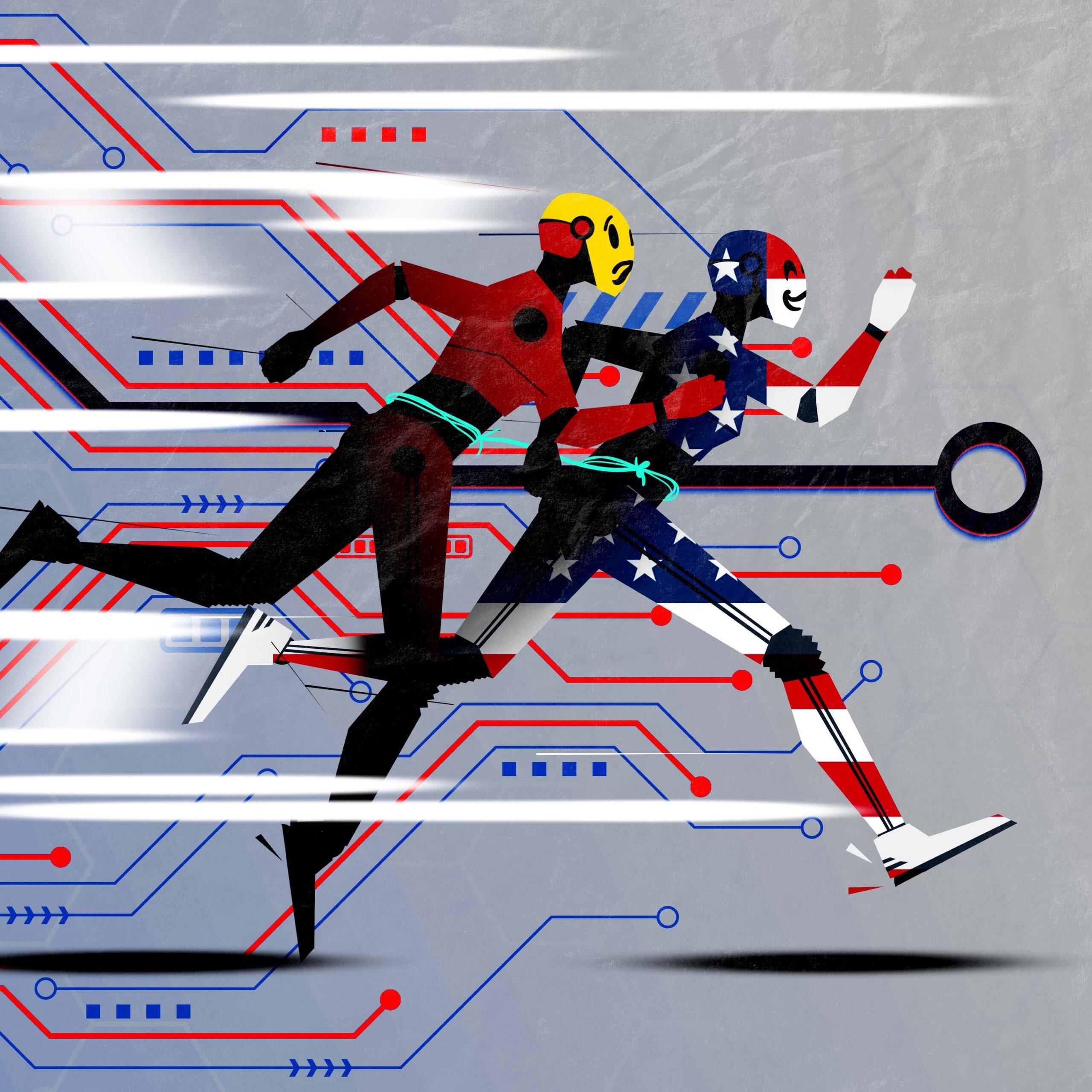
OK, wait, I thought as I took this in. But aren’t we locked in a life-and-death battle with China for AI supremacy? Isn’t the winner of this battle supposedly the nation that will control the future of humanity? And we’re really just … looking the other way while an American company makes a fortune by providing China with the chips it needs to stay in the race?
The more I thought about this, the more I bounced back and forth between two reactions. On the one hand, the national-security conversation around AI has always seemed to me to be fundamentally unserious. “We can’t allow our opponents to develop technology they could use to seize control of our military systems and lock us out, therefore we must develop our own technology that could seize control of our military systems and lock us out” is a farcical strategic position. The danger of AI threatens humanity as a whole rather than one particular country, and I think we’d be better off talking about it in those terms.
On the other hand, WHAT IN THE ULTRASONIC FUCK ARE WE DOING??? It’s hard to say how much of Nvidia’s revenue comes from its legally shady China deals, partly because Nvidia changed its accounting to hide its Singapore revenue last year, but it’s definitely a lot. (Nvidia’s revenues from Singapore were topping $100 billion at the time it made the accounting switch.) If AI is as important as the Trump administration and the AI industry says it is, this is a tactical self-own that should resonate through space and time until the fall of biological life on earth.
I mean, if U.S. military contractors had been caught selling enriched uranium to Soviet-controlled weapons labs at the height of the Cold War with the full knowledge of the president and the secretary of defense, it would have caused a scandal so seismic you’d have studied it in school. If the Tune Squad had taken a $30 billion payout to let the Monstars have Michael Jordan, Space Jam would have ended with Bugs Bunny in jail.
Of course, it’s possible that the people pushing the AI-race narrative are being dishonest about some or all of their most extreme claims. Maybe AI isn’t as important as they say it is. Maybe the technology is more similar to cars or electricity—something that could change our daily lives without putting the entire world in danger. Maybe China—try to imagine it!—isn’t interested in putting all of humanity at risk, a group that would include all Chinese citizens as well as their leaders. Maybe none of this is really worth worrying about.
But if that’s true, then why are most of the major players in American AI so keen to make us worry about it? Who’s benefitting from the idea that we’re facing an existential wipeout if Chinese frontier models reach the vague and moving finish line before Claude gets there?
It’s also possible that the AI-race narrative is accurate, and this is simply a case of some oligarchs colluding with a corrupt presidential administration to duck the guardrails meant to keep us safe. Maybe we are facing an existential wipeout, and Huang, Lutnick, and Trump simply don’t give a shit as long as they get paid. But if that’s true, then why aren’t the other players in the AI industry doing more to sound the alarm about Nvidia’s most powerful chips falling into the wrong hands?
For many years now, as you’ve probably noticed, people within the AI industry have talked a lot about the likelihood that their products will kill everyone on earth. Among the many things that make the AI industry unique, this is the most striking. Most companies try to downplay the damage their products might cause. You don’t see tobacco CEOs telling rooms full of investors “our scientists, if left unchecked, will find ways to turn your lungs to black ash by 2029.” You don’t see the lead researcher for the Lego corporation tweeting that, unless he’s stopped, every bare foot on the planet will be in unbearable agony within the next 18 months. Many AI researchers and executives, however, talk exactly like this.
I’ve found one of the most consistently reassuring things about this nightmare rhetoric to be how closely it tracks the self-interest of the people spreading it. Jensen Huang, who wanted to sell chips to as many people and companies as possible, said in September there was a “zero percent chance” that AI would usher in the apocalypse by 2030. Executives at Anthropic and OpenAI, which want to restrict competition and give themselves total control over frontier development, are more likely to say unchecked AI will have devastating consequences. (And only they, of course, can be trusted to wield the technology for the benefit of humanity.) Almost every higher-up in the industry has studied the data, thought about it objectively, and arrived at the exact conclusion that benefits them the most. And this makes the whole doomsday narrative seem suspect; nothing this richly lacquered in self-serving bullshit can be trusted, I tell myself, albeit with less and less confidence after every new report of a rogue agent.
The race with China is a case in point. Over the past few months, Anthropic’s Dario Amodei, OpenAI’s Sam Altman, and the Waffen SS’s Elon Musk have all called for AI development to be slowed down or paused while the labs find ways to mitigate the risk to humanity. But development hasn’t slowed down or paused; if anything, it’s accelerated at a pace its creators say they aren’t prepared for. Why? Because of China. “There is no day after tomorrow if China wins at this,” U.S. Treasury Secretary Scott Bessent said in September amid rising calls for an AI slowdown. “If they were to pull away from us on AI, then nothing else would matter.”
“If we didn’t have the adversaries we have,” Palantir CEO Alex Karp said around the same time, “I would be very in favour of pausing this technology completely, but we do. You can’t pause it because it’s a structural advantage.”
“There is a SICK conspiracy going on against AI and Data Centers,” Donald Trump posted on Truth Social that same month, “and the only one that is happy about it is China. WHOEVER WINS AI, WINS!”
Even Amodei, the most high-profile proponent of an AI pause, said that the rate of Chinese progress would make a slowdown challenging. The Chinese threat is so serious, and the stakes are so high, that the AI oligarchs simply have no choice but to push ahead with development as fast as possible. They hate to do it—truly!—but they have to keep building more data centers, and watching their agents wreak havoc, and extending their competitive dominance, for the good of us all. They have to win, thereby massively increasing the risk of humanity’s annihilation, because losing would massively increase the risk of humanity’s annihilation.
Are they getting very, very rich in the process? Yes, and they know it’s unfortunate. But it’s merely a byproduct of their heroic commitment to the general good. Anthropic loves humanity enough to push through its grave reservations and go ahead with its $1.4 trillion IPO.
AI development can’t be paused because of the race with China, then. Which is odd, because the race with China is only happening because of the bottomless supply of chips Nvidia has been passing through the backdoor to China. The Chinese AI boom has been powered by an American company with the support, or at least the awareness, of the U.S. government. Had Nvidia cut off the supply of chips to Megaspeed and its ilk, there wouldn’t be a race in the first place, because the chip deficit would have taken China years to overcome. We could have paused AI development at any time. Instead, we’ve hurtled recklessly forward, while the bogeyman of China has functioned as an all-purpose master key to allow everyone in the American AI industry to grow as fast as possible—Nvidia by selling to Chinese companies through sketchy (albeit hot) intermediaries, the frontier labs by reluctantly giving in to the necessity of outcompeting the companies Nvidia is making competitive in the first place.
Huang’s downfall, then, shows the extent to which the whole story of the AI race with China has been stage-managed by the American AI industry. Whether deliberately or by accident, Nvidia and the big frontier labs have jointly exploited a narrative about the Chinese threat that’s pumped up their stock prices and validated their most aggressive behavior. The global economic consequences of this exploitation—measured in everything from data center construction to interest rates to your retirement account—run to the trillions of dollars.
There are two possibilities here: Either the China threat is real, and the leaders of Nvidia (and their cronies in the Trump administration) have been willing to flirt with mass extinction in order to get richer; or the China threat is exaggerated, and the rest of the AI industry has been relentlessly lying to us to justify a breakneck pace of development that circumstances don’t actually dictate. Door no. 2 seems more likely, given what we’ve learned from the Huang story. Either way, though, when you put all the reports from the past few weeks together, what’s clear is that both sides have found a way to manipulate the situation to their own advantage, even if their interests, on paper, should be fundamentally opposed.
Nvidia wants to sell to China. The frontier labs want to beat Chinese competition. The Singaporean backdoor gave them both a way to win. The only losers are the rest of us.