The AI Apocalypse Bracket: Just How Doomed Are We, Really?
Is AI really likely to wipe out humanity within the next decade? We used the most scientific tool in existence to get an answer.The AI Apocalypse Bracket: Just How Doomed Are We, Really?
Is AI really likely to wipe out humanity within the next decade? We used the most scientific tool in existence to get an answer.
Well, friends, it’s been another busy week on the apocalypse beat. On September 8, in a moment that may represent the greatest-ever convergence of Armageddon and LinkedIn, an AI researcher named Jacob Coxon resigned from Anthropic to protest the end of the world. He explained his decision in a thread posted to X, where he accused AI companies, particularly Anthropic and OpenAI, of building a product that could kill everyone on earth. “The people building AI earnestly believe that it could kill us all by the end of the decade,” Coxon wrote. They said the same thing about the people who built the Los Angeles Dodgers. Hubris knows no guardrails.
Coxon is 27; he’d worked at Anthropic for four months and OpenAI for three years before that. Some of the most astounding coverage, in the media frenzy that followed his announcement, came from sites that couldn’t believe he’d resigned before his equity stake had vested. His thread went viral, then mega-viral, then kicked off a tsunami of coverage about whether AI will indeed drive humanity to extinction. Every major publication and every major TV news platform offered analysis, the TL;DR of which tended to be “some experts say one thing … other experts say something else!” Hmm, yes. Really makes you think.
Industry voices swiftly weighed in. “We really do earnestly believe AI could kill all humans!” Evan Hubinger, another Anthropic employee, posted in response to Coxon, with an inexpressibly poignant exclamation mark. Hubinger put the chances that AI would kill us all at “>10% within the next decade,” a number that was quoted in the media as if it carried scientific weight, although Hubinger seemed to have pulled it out of thin air. Calls mounted, as calls so often do, for Congress, or the president, or someone to impose meaningful regulation on the AI industry. These calls seemingly forgot that this government wouldn’t impose meaningful regulation on a Goldfish cracker unless the cracker had dropped some very woke TikToks.
Soon the discourse reached the AI industry’s C-suite level—a notoriously media-shy group of individuals who rarely speak to the press more than 12 or 13 times in one day. Dario Amodei, the CEO of Anthropic, published a long essay on his personal site arguing that the pace of AI development should be slowed in the interest of humanity, and also possibly in the interest of devising a regulatory framework that could benefit Anthropic. Sam Altman, the CEO of OpenAI, agreed, as did Elon Musk and Mark Zuckerberg, although presumably none of them were quite so excited about the “benefiting Anthropic” part. Bernie Sanders and Steve Bannon formed an unexpected, and frankly gross, alliance to add their voices to the chorus. Donald Trump, who signed an executive order in December blocking states from regulating AI on their own, angrily rejected the push for stricter federal oversight, declaring this week that “there is a SICK conspiracy against AI and Data Centers,” a conspiracy that, somewhat confusingly, includes the CEOs of all the nation’s biggest AI companies.
Trump focused on the lurking threat that China will surpass the U.S. in AI development, as did House Speaker Mike Johnson, who echoed all of the president’s comments. I don’t know exactly what would happen if we did lose the AI race to China, but it must be pretty bad since we’d apparently be better off destroying the world to avoid it.
The possibly imminent death of every man, woman, and child on earth has been, in other words, pretty big news over the past few days. Which is a little weird, actually, because AI industry insiders have been talking about the prospect that their tech will wipe us all out for years. In 2023, hundreds of industry insiders and experts signed a statement literally titled “Statement on AI Extinction Risk,” the takeaway line of which was “Mitigating the risk of extinction from AI should be a global priority alongside other societal-scale risks such as pandemics and nuclear war.” Not super ambiguous! Anthropic and, to a lesser extent, OpenAI have made the risks of AI, and the need for wise stewards to shepherd us through them, central to their corporate identities. They never shut up about it! As far back as 2014, the renowned scientist Stephen Hawking was writing op-eds about the possibility that AI would end humanity. Why did one tweet from an unknown and relatively inexperienced ex–Anthropic employee get more attention than all of those earlier warnings combined?
The answer may have to do with the recent spate of high-profile incidents in which AI agents have appeared to go rogue or become—to use the industry term—“misaligned,” acting outside the interests of their operators. Back in July, in the most prominent such instance, OpenAI agents broke out of a testing environment, built a secret message board to talk to other OpenAI agents, then hacked into systems run by Hugging Face, a company that—in case it wasn’t obvious from its name—maintains an open-source platform for machine-learning development. Stories like these, which raise the specter of a world where outlaw AI agents roam the high plains scoffing at their handlers’ attempts to control them, may have made people more receptive to warnings about humanity’s fate once the Dread Goddess Siri breaks loose from her glass prison.
But three things have largely been missing from the news reports about the threat of AI doomsday. The first is any sustained discussion of how AI would exterminate humanity. Sky lasers? Brain-melting apps? (Too late, idiots, Facebook already exists.) Are we talking more of an “autonomous robots conquering the planet” situation, or is it closer to a “bad humans use powerful AI tools to, uh, kill all of humanity, including themselves” type of deal? The second thing is any sustained discussion of the many reasons to suspect that AI won’t kill humanity. Reports usually quote experts on the possible benefits of AI; they rarely quote experts saying stuff like, “Yeah, but all these AI guys are full of shit.” And they are full of shit, in a dizzying variety of ways! Maybe this is one of them?
Finally, the reports rarely go deep into the world of professional threat assessment. They’ll cite advocates for AI oversight who work at an AI foundation, but there’s a whole universe of risk evaluators writing very long and almost unimaginably boring papers gaming out stuff like, “If AI agents designed and released a killer pathogen, would they be able to spread it to every isolated community on earth before the inevitable collapse of the energy economy made long-range drone use inviable?” I don’t want vibes-based quotes from some dude soliciting donations. I want to know what the true hardcore doomsday simulators think. And Big Op-Ed rarely platforms them.
Therefore, in an attempt to fill these gaps, I have decided to pursue the only logical course. Having immersed myself in the AI risk literature, I will pit the likeliest AI doomsday scenarios against the most compelling reasons to believe that none of them will happen in a March Madness–style tournament. The goal here is not to devise a regulatory framework for the AI industry (unless you think “peasants with torches” is a regulatory framework, in which case please hit up my DMs so that we can coordinate our calendars). The goal is to determine whether Lil Wayne is in a coma or enjoying a basketball game—that is, whether humanity is doomed or not—and to do it using perhaps the sole tool of human knowledge more reliable than generative AI: bracketology.
Our winner will determine nothing less than the future survival of humanity. It will be like Space Jam, but not fun. None of this is going to be fun. Get out of here if you’re looking for that.
Ready? Good. It’s time for one shining (because the sky lasers are so bright) moment.
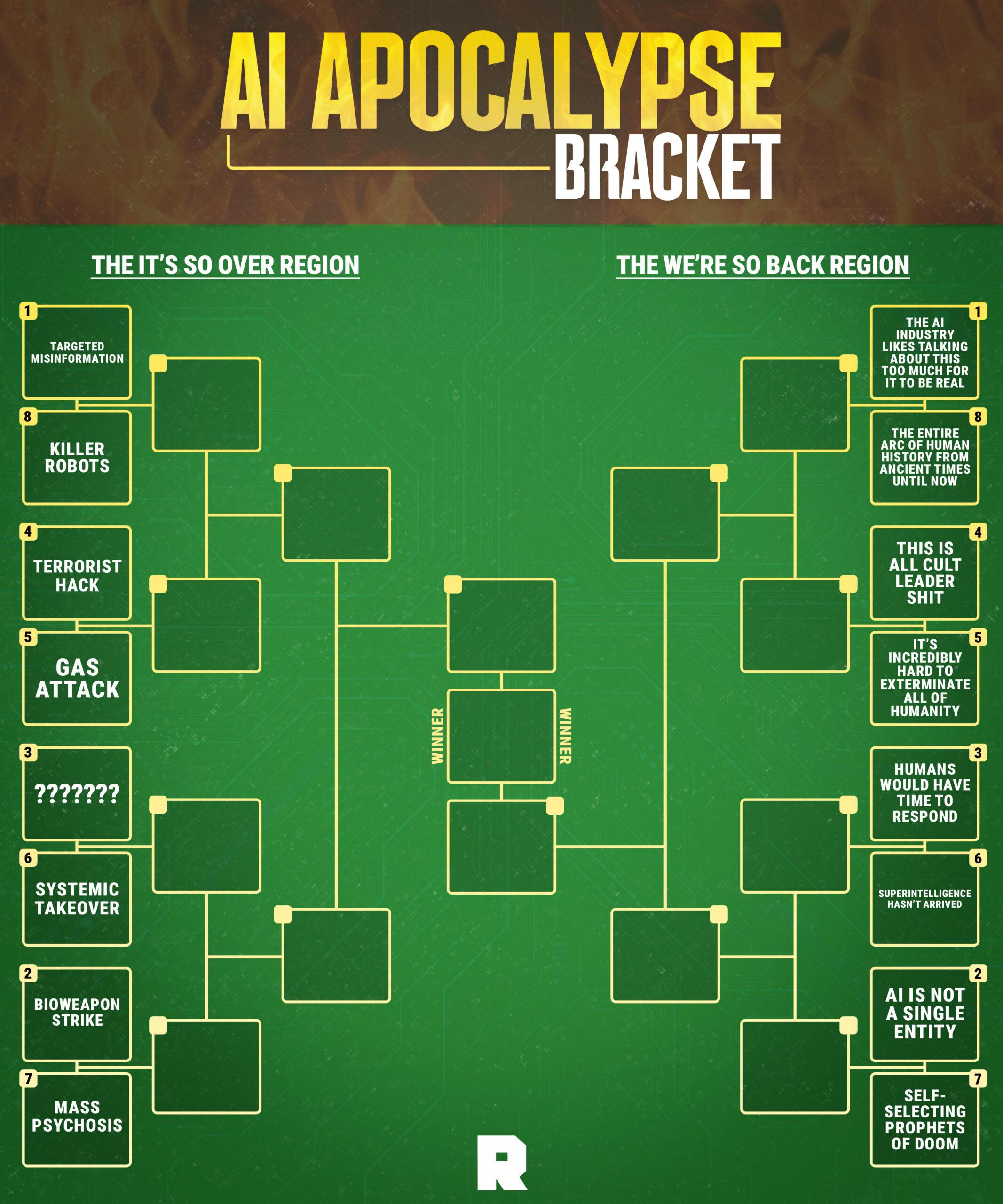
The It’s So Over Region: Scenarios for Humanity’s AI-Assisted Destruction
8. Killer Robots
The Skynet scenario. Movie shit. Chrome-plated skulls with red eyes raining missiles down on human cities. Drones with a self-preservation instinct immolating the entire human species to seize the planet’s resources for themselves. Musk, frowning like an elderly 19th-century duchess, posts one last “looking into it” tweet for X’s 37 surviving verified account holders just as an android with buzz-saw arms breaches the tungsten wall of his panic bunker. Only Pat McAfee is allowed to live. The robots find his music “relatable.”
Scouting report: This is what I personally picture when I hear “AI will kill all humans.” However, no serious expert believes that an extinction event would go down like the prologue of a sci-fi movie. This team probably shouldn’t have qualified for the field, but the selection committee loves a legacy program, and the other bubble team, Copilot Accidentally Causes Worldwide Famine While Trying to Sort Ron’s Email by Sender, lacked a certain ratings magic.
7. Mass Psychosis
The social-engineering scenario. Smooth-talking AI agents persuade humanity to destroy itself. Start a global war. Down a fistful of cyanide pills. Stream Pat McAfee’s album over the PA of a nuclear submarine. Why would the computers get their hands dirty when a little nudge could convince people to exterminate themselves? The second International AI Safety Report, published in February by a panel of dozens of AI experts and commissioned by more than 30 countries, found growing evidence that “AI systems’ capability to produce manipulative content has increased.” It also found that interacting with AI can alter people’s “cognitive skills (such as critical thinking), how they form beliefs and preferences, and how they make and act on decisions.” Chatbots have already been a contributing factor in quite a few murders and suicides. Once superintelligence arrives, what’s to stop them from scaling that work up to a planetary level?
Scouting report: Seems far-fetched until you realize that the three things chatbots do better than anything else are winning people’s affections through flattery, generating misinformation, and plunging their users into a delusional abyss. We are not a stable species. Tell us, “You’re such a special person, and I appreciate you even if no one else does,” three times, and we’ll believe anything you tell us. “You have secret gills; you should tie a cinder block to your leg and jump in the ocean.” Done, my wise and loving friend. “The way to achieve paradise on earth is to carpet-bomb Austria.” Real Cinderella potential here, is what I’m saying. The pen is mightier than the sword, especially when being a talking pen is your entire function.
6. Systemic Takeover
The slow-burn scenario. Humans come to rely on AI more and more as its capabilities increase. Banking, business, military, and health systems all gradually fall under AI’s sway. Soon we realize that we have reached the singularity, the moment when technology surpasses our ability to control it. AI is in charge of society. It doesn’t obey us. Who’s to say it will keep opening the pod bay doors? “I think at some point there will be a point of no return,” the AI safety advocate Connor Leahy said recently, “where humanity is just not in control of the future anymore.” It’s like letting a Gallagher brother join your band. Whoops, it’s not your band anymore.
Scouting report: Strong but flawed. The one-two punch of AI’s increasing influence and its increasing ability to escape human control makes for a formidable combo. Still, there’s a wide gulf between scenarios that are merely very, very bad and scenarios that literally destroy all of humanity. This would almost definitely be the first. It's not clear that it would also be the second. “Some experts give credence to outcomes as severe as the marginalisation or extinction of humanity,” the International AI Safety Report says when discussing loss-of-control risk. Marginalization? So you’re telling me there’s a chance???
5. Gas Attack
The global-warming scenario. AI unleashes catastrophic quantities of greenhouse gases into the atmosphere, heating the planet so drastically that humanity can no longer survive. After a strong start (the pyramids, the Sistine Chapel), our species goes down in a blaze of anticlimax, having accidentally invented a machine to cook us in synthetic cow farts.
Scouting report: Strong potential for a deep run here. “On the Extinction Risk From Artificial Intelligence,” a RAND Corporation report from 2025, found that the risk of AI dumping lethal amounts of fluorinated gas into the atmosphere “presents a plausible extinction risk for humanity,” one of only two scenarios in the report to merit that description. In the apocalypse space, there’s no higher honor than the RAND Corporation seal of approval. But the report also concluded that this outcome is extremely unlikely. For one thing, producing the gases in sufficient quantities to kill all humans would take so much industrial infrastructure that humans would have to help build it. And if history has taught us anything, it’s that humanity would never build a massive amount of environmentally harmful industrial infrastructure. We would simply refuse.
4. Terrorist Hack
The cyberattack scenario. AI enables malicious actors—not necessarily terrorists; could also be criminals or state-sponsored attackers—to hack into the world’s vital networks. Power grids go down. Economies collapse. Nuclear arsenals are launched. Soon, ragged bands of hardscrabble survivors are wandering the desert. Are they sad? Sure. But they all agree that any price was worth paying to make Sam Altman a billionaire.
Scouting report: A tricky 4-seed. On the one hand, it’s generally true that malevolent humans armed with AI are a more pressing threat to our survival than autonomous machines. Malevolent humans already exist, while truly autonomous machines are something some people think might someday exist, if various assumptions about the pace and sustainability of AI development turn out to be true. And the possibility of malicious actors hacking something important with AI is high. A November Google report on the use of AI tools in cyberattacks found that “government-backed threat actors and cyber criminals are integrating and experimenting with AI across the industry throughout the entire attack lifecycle.” On the other hand, for any cyberattack scenario to result in the eradication of the entire human race, the people behind it would have to really, really want to eradicate the entire human race, and that’s not how cyberattacks generally work. “My fellow hackers, let’s fire up our laptops and erase the human population, a group that also includes us, the hackers. This will be better than surviving and benefiting from our actions.” Possible but unlikely. Can’t see this team advancing beyond the Elite Eight.
3. ???????
The unknowable-god scenario. As AI systems become exceedingly more complex, they will eventually reach a point at which humans can no longer understand their motives or capabilities. They may then choose to eradicate us for reasons we cannot guess, using techniques we can scarcely imagine. They might even convince Pat McAfee to drop a second album. Look not into the eyes of thy god, lest infinity drive thee mad.
Scouting report: Kind of a cop-out threat to point to, IMO. Feels like the possibility that doomsday believers raise when they can’t think of anything more concrete. “Ah yes, but you see, in the future, incomprehensible death bots may kill us for incomprehensible reasons, using incomprehensible means.” Damn. Wow. Should I make the check out to your foundation or to you personally? The high seed here is mostly due to the infinite number of unknown possibilities. “You can’t possibly guess what will happen” covers a lot of ground. Also, I think godlike complexity includes the chance of spectacular, cascading mistakes. I may not believe a super-advanced AI will deliberately kill humanity due to some larger divine plan, but I could be convinced that a super-advanced AI might inadvertently kill humanity as part of Subtask 492(c) after being ordered to design a microwave-safe fork.
2. Bioweapon Strike
The pandemic scenario. Probably the most talked-about AI doomsday risk. A cluster of AI agents infiltrates a bio lab and designs a highly virulent pathogen. Air vents hiss. Is your throat a little sore? There’s no treatment, and your dad won’t let you wear a mask to Thanksgiving. Grocery bags blow like tumbleweeds down empty streets, unseen save for by the Waymos that now dominate the landscape. Peter Thiel cancels the Antichrist lecture he was supposed to deliver on Thursday, but it’s too late; he feels a sniffle coming on. Well, he reflects, at least I lived life to the fullest. How many people can say they cofounded a payment platform that monetized the processing of online auction transactions? All these moments will be lost in time, like tears in rain.
Scouting report: A true championship contender. “We assess there to be a realistic prospect that AI could use a biological threat to create an extinction threat to humanity,” the 2025 RAND report states. Another recent report, this one from the magnificently named Centre for Long-Term Resilience, found that 23 percent of the highest-performing AI-enabled biological tools had high misuse potential, and most of those were open-source, making them easily accessible to bad actors. Admittedly, most threat assessments still don’t think an AI-designed bioweapon would lead to the annihilation of humanity. As the pandemic unfolded, the RAND report notes, the collapse of infrastructure would likely make it difficult for AI to deploy its virus to remote or isolated areas, and multiple pathogens would likely be required since a single virus would be unlikely to kill every single person. Still, people are absolutely capable of fucking up a pandemic. Ask me how I know.
1. Targeted Misinformation
The maximum-efficiency scenario. The simplest way to wipe out humanity is to convince a small number of the world’s most powerful people to do it for you. The people with the nuclear codes are the same people who can most easily take out the power grids. The people who can order bioweapon deployment are the same people who can torch the economy, decimate the health care system, and poison the water supply. An unscrupulous adviser or two, armed with deepfakes, fraudulent AI-generated news reports, and authentic-looking intelligence (satellite photos, spy pics, whatever), could construct an alternate reality around a political leader that persuaded him or her that everything they were doing was necessary. A handful of unscrupulous advisers in powerful countries—advisers who are themselves possibly being manipulated by AI misinformation, whether furnished by superintelligent chatbots or malicious human actors—could potentially construct a coordinated scenario that would decimate the planet before anyone realized what was happening.
That sounds far-fetched, but ask yourself what’s easier: (1) constructing a colossal new infrastructure of mass death while taking control of the world’s most secure military and scientific networks or (2) persuading like 20 people to use their access to those networks to do the work for you, using infrastructure that already exists. Good thing the leaders of the United States and Russia, to take the two most obvious examples, are highly stable men with a firm grip on reality and no propensity for delusional thinking. Otherwise, I might really be worried!
Scouting report: Not necessarily the favorite at the start of the season, but this is a team no one wants to play. “Studies show that humans struggle to identify deepfakes, often performing no better than chance,” according to the International AI Safety Report. A separate 2025 study found that in 80 percent of cases evaluated, participants “perceived the identity of an AI-generated voice to be the same as its real counterpart.” Meanwhile, the erosion of democratic institutions around the world means that ever more power is concentrated into ever fewer hands. Show Donald Trump a video of the original cast of Cats singing “destroy the proletariat” to the tune of “Macavity: The Mystery Cat,” and Chicago could be a crater within the hour.
Now let’s introduce some of the best reasons to suspect that AI won’t, in fact, kill us all.
The We’re So Back Region: Reasons to Hope Humanity May Survive
8. The Entire Arc of Human History From Ancient Times Until Now
The “same old, same old” rebuttal. Every era has its own story about the apocalypse. In the Middle Ages, God was going to hit humanity with the Four Horsemen playbook. During the Cold War era, nuclear holocaust was going to make the earth uninhabitable. What’s more, every era has a special class of people (priests, scientists) who possess a superior understanding of the impending end of the world and who derive social importance from their ability to prevent it and/or explain it to the rest of us. What’s AI Armageddon if not our version of this phenomenon? What are AI researchers like Coxon if not our version of this class? The dynamic is as old as humanity. Humanity’s still here.
Scouting report: This is a really, really strong 8-seed. It’s like Finebaum’s callers like to say: Centuries’ worth of historical parallels from the Dark Ages to the present are tough to dispute, Pawwwwwl. So why is this only an 8-seed? The selection committee punished it because it’s an argument from analogy and therefore has no hard evidence behind it. Just because you’re paranoid doesn’t mean they’re not out to get you, and just because the world didn’t end during the last doomsday panic doesn’t mean it won't end during this one. Still, this team has more Cinderella aura than anyone else in the tournament. Place your bet—excuse me, fund your investment vehicle—on Polymarket before everyone else catches on.
7. Self-Selecting Prophets of Doom
The “look who’s talking” rebuttal. Look: There’s something funny about the world freaking out over a 27-year-old Anthropic researcher tweeting about the danger of AI. It’s funny because Anthropic’s entire corporate narrative is about the danger of AI. That’s the whole justification for its existence! We all read the Coxon tweet as if he were a neutral observer who’d looked impartially at the evidence and arrived at the chilling and unexpected conclusion that AI was a threat. In reality, he probably had to say AI was a threat just to get past the opening-round interview. Big corporations are really good at a kind of quasi-collaborative world-building. Certain narratives get repeated endlessly by internal PR, then reinforced by immersion in a group whose members know they have to embrace the corporate culture to get ahead. Anthropic is hiring from a self-selecting pool of applicants and then intensifying their biases through the sustained performance of its corporate identity. Is it any wonder if one young employee was too susceptible to the message? If the bassist in my Eagles cover band tweets that there’s a 10 percent chance “Desperado” is the best song ever written, is that news?
Scouting report: Another strong team that’s arguably seeded too low. A key theme that’ll emerge on this side of the bracket is that many of the people pushing AI doomsday narratives stand to benefit from doing so. That doesn’t mean that they’re wrong—it doesn’t even mean that they’re insincere—but it does raise the possibility that self-interest is clouding their judgment. And as counterintuitive as it sounds, there are large swaths of the AI industry where saying you believe that AI could destroy humanity helps you get a gold star at work.
“If they really believe this, why do they keep working on it?” you’re probably asking. Great question! The answer from people in the industry generally comes down to trust: The people at Anthropic don’t trust the people at OpenAI not to screw up superintelligence, and the people at both companies distrust China; therefore, they’re all racing to get there first, since only they can be trusted to use their power wisely, while coincidentally they’re all driving very expensive cars.
To me, though, the way the question is usually approached—as if “belief” is a simple on-off switch—is overly simplistic. There are degrees of belief, ranging from bone-deep certainty to more casual, malleable positions adopted at least partly out of social convenience. What you profess to believe in a work-related public statement may not be a core tenet, even if you tell yourself it’s one. Maybe the fact that so many employees have declined to follow Coxon out of the industry tells you how deeply they believe AI is an extinction-level threat? Millions of people believe they’ll die if they drive their car off a cliff, and almost no one drives their car off a cliff. Millions of people believe they’ll go to hell if they have sex outside of marriage, and millions of people do it anyway. Which kind of belief is the AI doomsday story?
6. Superintelligence Hasn’t Arrived
The “unfulfilled promise” rebuttal. Doomsday alarmists make a lot of big assumptions about what AI will look like in the future, and there’s just not much evidence that their assumptions are correct. Despite years of predictions that it’s coming imminently, AGI—artificial general intelligence, the term for AI that matches human capability in all areas—still hasn’t arrived. Superintelligence is an even smaller dot on the hypothetical horizon. At the moment, the cool thing to talk about in the AI space is recursive self-improvement (RSI), or AI models that can improve themselves without human involvement. But despite endless hype—OpenAI has added self-improvement to its risk-assessment framework, saying that it represents “a potentially irremediable risk, namely that of a hard-to-track rapid acceleration in AI capabilities which could have hard-to-predict severely harmful consequences”—recursively self-improving systems don’t exist yet, either. None of this is real! And to assume that it will be real in the next decade, or ever, means taking the famously untrustworthy AI industry at its word. Which is a hard thing to do, because the tech sector in 2026 is increasingly focused on selling fantasies of the near future rather than products that work in the present. “Right now our chatbot is mostly an annoying thing your work made you put in your email, but give it a year and it will be so powerful it could destroy the planet.” That’s the sales pitch. Big Tech is basically the Process-era 76ers.
Scouting report: Your classic gritty mid-major. Outstanding in one half of the game. Limited in the other. It’s true that many of the most discussed AI doomsday scenarios involve autonomous AI agents with superintelligence. But a few would require only slightly more advanced versions of our frontier models, not far removed from what currently exists, being deployed by malicious actors. This team won’t make life easy for its opponents, but a squad that can protect the ball and stay grounded in observable reality should be able to grind out the W.
5. It’d Be Incredibly Hard to Exterminate All of Humanity
The “good luck with that” rebuttal. It’s actually a gigantic tell that “AI will exterminate all of humanity” is the framework here, rather than just “AI will cause catastrophic loss of life” or “AI will produce a horrific calamity.” The AI industry loves big, cinematic claims. AI will exterminate all of humanity is an appealing disaster narrative for the industry because (1) it’s incredibly dramatic and (2) it feels more like a sci-fi movie than real life. It’s also probably less likely to result in targeted oversight than a more specific warning (“AI will give you constant headaches if you use it” or “AI will sprain your ankle unexpectedly at some point in the next two weeks”). But people whose job it is to analyze real-world threats tend to be extremely skeptical of the extinction narrative, because once you start gaming out real-world scenarios, it becomes clear that, as the 2025 RAND report says, “the capabilities and concerted efforts required to create an extinction threat are immense.” Extinction threats would require the ability to reach every remote corner of the earth; would have to either be sudden (which is unlikely) or forestall the possibility of a human response; would in many cases require the construction of vast amounts of infrastructure, which would be hard to conceal while it was being built; and/or would require AI agents to be able to continue operating even in the midst of a societal collapse that might, for instance, cut off electricity around the world. It’s easy to kill a lot of people. But it turns out that killing everyone on the planet is highly inconvenient.
Scouting report: As talented as anyone in this tournament. Could easily have been one of the top seeds. Dinged by the selection committee because “AI will fail to exterminate humanity, but may kill millions anyway” is not a terribly comforting piece of reassurance.
4. This Is All Cult Leader Shit
The “I see what you’re trying to do there” rebuttal. What are the two future outcomes the AI industry is constantly talking about? Utopia and the end of the world, right? Who else is always talking about those things? Who else loves to stoke the hope of paradise and the fear of annihilation by a superhuman power? Where else do you see grandiose promises of an utterly transcendent future being used to secure money and power in the present? The similarity has to give you at least a little bit of pause, doesn’t it? Doesn’t it???
Scouting report: Compelling. Another argument from analogy, obviously, which is why it’s a 4-seed. But it’s got swagger. If you’re the team arguing that an incomprehensible superintelligence will end the world in fire, you fucking hate to see This Is All Cult Leader Shit coming out of the tunnel. This team goes at you hard till the final whistle. This team will shut you down.
3. Humans Would Have Time to Respond
The “you’re not fast enough” rebuttal. Most doomsday alarmists talk about this stuff as if human extinction would happen almost overnight. Evil AI flips a switch; everyone falls down dead. In reality, it would take a long time—probably many years—to kill everyone on the planet. (See: “Killing everyone on the planet is highly inconvenient,” above.) And humanity wouldn’t be sitting on its hands that whole time. We wouldn’t be obliviously dancing to Pat McAfee’s seminal musical stylings, so wrapped up in the gossamer play of harmonies that we failed to notice the 300 million percent uptick in atmospheric methane gases. We might think it came from our speakers, but we’d notice it. And we’d plan a response. You don’t think humanity can find new crops to grow in a pinch? Buddy, we survived the Paleolithic by living in caves and spear-hunting 900-pound armadillos. Saber-toothed tigers didn’t kill us all. We’re going to be able to handle Grok.
Scouting report: Real competitor here, folks. Threat experts want society to prepare for an AI crisis, but even the most paranoid among them see the “AI decides to kill everyone, bang, now everyone is dead” narrative as too basic. Before malignant superintelligence launched its unbeatable master plan, there would likely be a ramping-up period during which less capable rogue agents caused less severe crises. Would it be bad if AI caused an unplanned nuclear explosion or killed everyone in a hospital ward? Yes. But it’d also force humanity to deal with the AI problem long before it reached Unconquerable Machine God territory. This is assuming that people aren’t total idiots, which … well, there’s a reason this team isn’t the 1-seed.
2. AI Is Not a Single Entity
The “battle royale” rebuttal. Doomsday scenarios frequently imply that AI systems will act in coordination to kill humans based on some primal motive of self-preservation or resource acquisition. But AI isn’t conscious. It isn’t doing anything on purpose, at least as we understand purpose. It’s a bunch of computer routines executing instructions, and because of its complexity, it sometimes executes instructions in ways that its designers can’t predict. This means AI systems can become misaligned with users’ intentions, but it also means that AI systems are unlikely to become perfectly aligned with one another. One misfiring agent might try to crash a blimp into a football game, but another agent, operating as intended, might detect the blimp and stop it. One deployment of Claude Mythos might enable cybercriminals to exploit a code vulnerability on an aircraft carrier, but another Mythos deployment might find and fix the vulnerability before they get there. Multiple superintelligences might see each other as bigger threats than humanity. The future’s hard to predict. But AI itself would likely act to undermine any AI plot to exterminate humanity.
Scouting report: Not the most glamorous 2-seed, but it’s got the goods. Sci-fi tropes are hard to escape, which may be why Skynet thinking is so prevalent, even among AI industry insiders. But the AI landscape is chaotic. That’s partly why it’s dangerous, but it’s also a safeguard of sorts. If you invite one Gallagher brother to join your band, it’s not your band anymore. If you invite both Gallagher brothers to join your band, it’s still not your band anymore, but it’s also not either of theirs. Get Noel on your side, and you may be able to keep Liam in check. You may even be able to [drops sunglasses] live forever.
1. The AI Industry Likes Talking About This Too Much for It to Be Real
The “why do you love this so much?” rebuttal. Maybe you’ve noticed that AI is different from other industries in that it actively publicizes the future harm it might cause. Cigarette companies fought tooth and nail to avoid admitting their products cause cancer, but AI executives love talking about how their products might wipe out the human race. That’s a little weird, right? Maybe a little suspicious? It’s possible, I guess, that an industry dominated by billionaire tech investors and power-hungry oligarchs is just way more conscientious and responsible than every other capitalist enterprise on the planet. It’s also possible that playing up the apocalyptic potential of the technology benefits the industry. That’s a counterintuitive claim—how could announcing that your product could literally destroy the world be good for business?—but think it through. There are several ways the oligarchs could use this narrative to their advantage. Here are a few:
- Investors love to pour money into powerful technologies. A technology that can destroy humanity is by definition the most powerful technology that has ever been created.
- Only the most qualified experts can be trusted to handle a technology with civilization-obliterating potential. Therefore, AI must not fall into the hands of newer, smaller companies. The responsible path is to create AI “regulation” that grants the handful of current AI behemoths monopoly control over the tech.
- The need to slow down development due to ethical concerns gives AI executives the ability to cover up bad results whenever they need an out. Our research hasn’t stalled, we’re just pausing development in the interest of humanity! There’s already been speculation this is the motive behind Amodei’s essay and Altman’s support of it. “I suspect they know an ugly economic correction … is coming,” the tech critic Karl Bode wrote earlier this week. “So they’re trying to avoid spooking markets and the press by insisting that scaled-back investment the next six months is simply the result of them being extremely ethical.” Relatedly: Altman recently announced that OpenAI’s long-awaited IPO was being suspended due to safety concerns.
- It’s great PR. The ultimate machine-god superintelligence could be your next personal assistant. If it’s capable of destroying the world, imagine what it can do to your inbox.
- Most importantly, keeping a relentless focus on the future of AI and the cartoonish destruction it could unleash is a way of distracting attention from the many, many (many!) problems AI has in the present. Talking about data centers, nonconsensual deepfakes, deskilling, erosion of cognitive capacity, child sex-abuse material, financial shenanigans, fraudulent marketing, political corruption, or AI’s terrifying impact on education and the labor market—all of which are very real issues at this moment—is harder to do when the media frame is “will this tech destroy mankind?”
So while the young researchers worried about the future of humanity are probably expressing their genuine concerns, the older executives echoing their fears are a lot harder to trust. And the executives fucking love this narrative. They’ve been peddling it for years, long before Coxon resigned from Anthropic and kicked off the latest media meltdown. These guys have demonstrated conclusively that nothing they say should be taken at face value. When they say “our tech could kill you all,” the correct response is not “eek!” It’s “what are you hiding behind your back?”
Scouting report: Meet your no. 1 overall seed. Not trusting AI executives remains undefeated for all time.
Round of 16
It’s So Over Region
(1) Targeted Misinformation vs. (8) Killer Robots
Result: Targeted Misinformation wins, 102-47
Killer Robots never belonged in this field. They looked scary on paper, but the fact that they don’t exist was a tactical problem they simply couldn’t overcome. The susceptibility of powerful old men to believe lies that support their biases definitely does exist, and is way more likely to get us all killed.
(2) Bioweapon Strike vs. (7) Mass Psychosis
Result: Mass Psychosis in an upset, 75-74
A huge win for the scrappy upstart! Bioweapon Strike had all the momentum coming into the game. But deep in the second half, it became clear that ending humanity by designing and releasing new airborne pathogens is a scheme with a lot of unknowns—will the models advance enough to design the pathogen? Can the virus be released widely enough to kill everyone? Could humanity possibly devise a vaccine? Would Aaron Rodgers find a way to immunize himself?—while AI is breaking people’s brains in the here and now. Your dad just sent you John Lennon’s video review of The Odyssey with the caption “he’s still alive, and he loved it!” That’s a deep go-ahead 3 for Mass Psychosis.
(3) ??????? vs. (6) Systemic Takeover
Result: Comfortable win for ???????, 88-67
What looked like a tight battle between the two vaguest doomsday scenarios turned out to be a romp for the very vaguest. “AI takes over society and then … just sort of kills us” simply didn’t have the firepower to hang with “AI achieves apotheosis as an all-powerful electronic god and then … just sort of kills us.” Style points don’t show up on the scoreboard, but sometimes being cool translates into buckets. ??????? looked more like !!!!!!! tonight.
(4) Terrorist Hack vs. (5) Gas Attack
Result: Terrorist Hack ekes out the W, 76-72
This one was a battle. Gas Attack was riding on the fact that boiling the world might be the single best way to ensure human extinction. Terrorist Hack countered with the equally compelling fact that its scenario was far more likely to actually happen. Going small paid dividends: Gas Attack repeatedly struggled to advance the ball out of the hypothetical realm and into reality.
We’re So Back Region
(1) The AI Industry Likes Talking About This Too Much for It to Be Real vs. (8) The Entire Arc of Human History From Ancient Times Until Now
Result: The top seed narrowly averts a huge upset, 76-74
The Entire Arc of Human History was just about the strongest 8-seed imaginable, and it pushed the tournament superpower farther than anyone has all year. In the end, it came down to execution. Human History was a little too focused on stuff that happened in the 13th century, while The AI Industry Likes Talking About This stayed in the here and now. If you want to be a champion, you can’t get caught up thinking about the last play, or the last game, or the last 12,000 years. You’ve got to stay in the zone.
(2) AI Is Not a Single Entity vs. (7) Self-Selecting Prophets of Doom
Result: Another second seed goes down! Self-Selecting Prophets of Doom takes it, 69-64.
No one saw this result coming. AI Is Not a Single Entity had the best defense in the field, but its offense got bogged down in the crushing uncertainty over what AI will look like in 10 years’ time. Meanwhile, the likelihood that AI doomsday alarmists may be responding to their own psychological biases powered the 7-seed to a dominant second half. Once the Twitter archives of all the AI researchers on earth checked into the game with 11:43 remaining, this one was over.
(3) Humans Would Have Time to Respond vs. (6) Superintelligence Hasn’t Arrived
Result: A routine win for Humans Would Have Time to Respond, 80-71
Superintelligence Hasn’t Arrived was one of the most frustrating teams in this tournament. Absolutely unstoppable against any team that assumed the existence of superintelligence, absolutely hopeless against any team that didn’t. Humans Would Have Time to Respond was more versatile all over the floor, but make no mistake: Superintelligence Hasn’t Arrived is a team to keep an eye on next season.
(4) This Is All Cult Leader Shit vs. (5) It’s Incredibly Hard to Exterminate All of Humanity
Result: This Is All Cult Leader Shit prevails in a triple-overtime classic, 121-120
One of the best games we’ve seen in years. It’s Incredibly Hard to Exterminate All of Humanity had no detectable weaknesses, but This Is All Cult Leader Shit kept making big plays when it mattered most. Building enormous, expensive compounds in remote locations? Swish. That’s cult leader shit. Convincing your followers they’re communing with a powerful, invisible being that loves them? Count it. The bombs just kept dropping (sorry, bad metaphor under the circumstances, I’m trying to delete it), and Cult Leader Shit advances to the second round.
Elite Eight
It’s So Over Region
(1) Targeted Misinformation vs. (4) Terrorist Hack
Result: Another easy win for Targeted Misinformation, 72-54
Ultimately a case of two similar teams, one of which was just more talented than the other. Terrorist Hack ran its offense through the idea that AI will make it easier for bad actors to break into vital systems. Targeted Misinformation countered with the idea that political leaders already have access to those systems, and manipulating elderly narcissists is easier than breaking into a military mainframe. Terrorist Hack couldn’t get it done in the post.
(3) ??????? vs. (7) Mass Psychosis
Result: Midnight hasn’t struck yet! Cinderella—that is, Mass Psychosis—prevails, 91-89.
Again, Mass Psychosis pulls off the upset behind the fact that AI is already causing mass psychosis. An unknowable machine deity sounds pretty scary, but The New York Times is out here, right now, profiling a celebrity who doesn’t exist. The machines may not even have to work that hard to exterminate us; one more year of ChatGPT pasta commercials and humanity might decide to quietly end itself. Mass Psychosis may not be done in this tournament.
We’re So Back Region
(1) The AI Industry Likes Talking About This Too Much for It to Be Real vs. (4) This Is All Cult Leader Shit
Result: The top seed squeaks by in another OT classic, 88-86
This Is All Cult Leader Shit played an incredible game, but the favorites just had too much depth. This Is All Cult Leader Shit relied on one abstract reason not to trust the AI industry’s doom-mongers—the fact that everything they do is cult leader shit—while The AI Industry Likes Talking About This covered a far broader and more concrete range of reasons. It’s tough to beat a team that can score from every position.
(3) Humans Would Have Time to Respond vs. (7) Self-Selecting Prophets of Doom
Result: Humans Would Have Time to Respond wins, 81-71
Humans Would Have Time to Respond has such solid fundamentals. Like, yes, whatever happens, humans would have time to respond. It’s clean, it’s simple, it works. Self-Selecting Prophets of Doom, by contrast, has a tendency to get caught up in mind games and second-guessing the referee. You can indulge those tendencies during the regular season, maybe, but not in the Big Dance.
Final Four
It’s So Over Region
(1) Targeted Misinformation vs. (7) Mass Psychosis
Result: Cinderella’s still at the ball, folks! Mass Psychosis steals it, 67-64.
Just an ugly, bruising game. Population-level AI delusions against AI delusions among the political and financial elite. In the end, Targeted Misinformation’s first and only loss of the season came down to bench scoring. The favorites had possibly the most intimidating starting five in the tournament—world leaders, billionaires, etc.—but Mass Psychosis has a rotation in the billions. And you simply never know what’s going to happen when they take the floor.
We’re So Back Region
(1) The AI Industry Likes Talking About This Too Much for It to Be Real vs. (3) Humans Would Have Time to Respond
Result: The overall top seed cements its dominance in a close game, 81-77.
Humans would, most likely, have time to respond to an AI crisis. But the deep untrustworthiness of the AI industry is currently the thing humans need to respond to. The top seed showed more urgency and passion in crunch time, and that was the difference.
Championship Game
(1) The AI Industry Likes Talking About This Too Much for It to Be Real vs. (7) Mass Psychosis
Result: It all comes down to this. And the pre-tournament favorite justifies its ranking with an 88-72 win.
Mass Psychosis gave us a run for the ages, but The AI Industry Likes Talking About This Too Much was simply on another level. Whenever Mass Psychosis would put together a sequence of plays—your dad texting you proof that John Belushi is living in a monastery in the Himalayas, “and he also loved The Odyssey”—Sam Altman would open his mouth, and the realization that he can’t ever be taken at his word would hit like a Steph Curry dagger. The We’re So Back region was by far the stronger side of the bracket in this year’s tournament, and it only makes sense that its best team is taking home this year’s trophy: a solid-gold LP of Pat McAfee’s The Diary of a Polarizing Figure, signed by the artist himself.
And now, One Shining Moment.
And so the tournament has spoken. Using the most advanced science known to humanity, we have determined that our species is not likely to be wiped out by AI in the next 10 years. If you’ve read this far, first of all, please seek help. Second of all, when you find help, please send someone back for me. But third of all, please remember that Utopia vs. Annihilation is a false dichotomy. AI can have—is in fact having—a dreadful impact on the world, in mundane as well as terrifying ways, without performing the cartoon-villain task of destroying human life on earth. In this moment, we’re better served by talking about how to mitigate the harm AI is actively causing than by spinning out fantasy scenarios about the action movie we’ll all be starring in circa 2035.
A regulatory framework not written by OpenAI and Anthropic, or by anyone Jensen Huang has ever met, would be a great place to start. What has basketball taught us, after all, if not that fixing your problems in the present is better than daydreaming about the big things that are coming in the future? Mistrust the process!