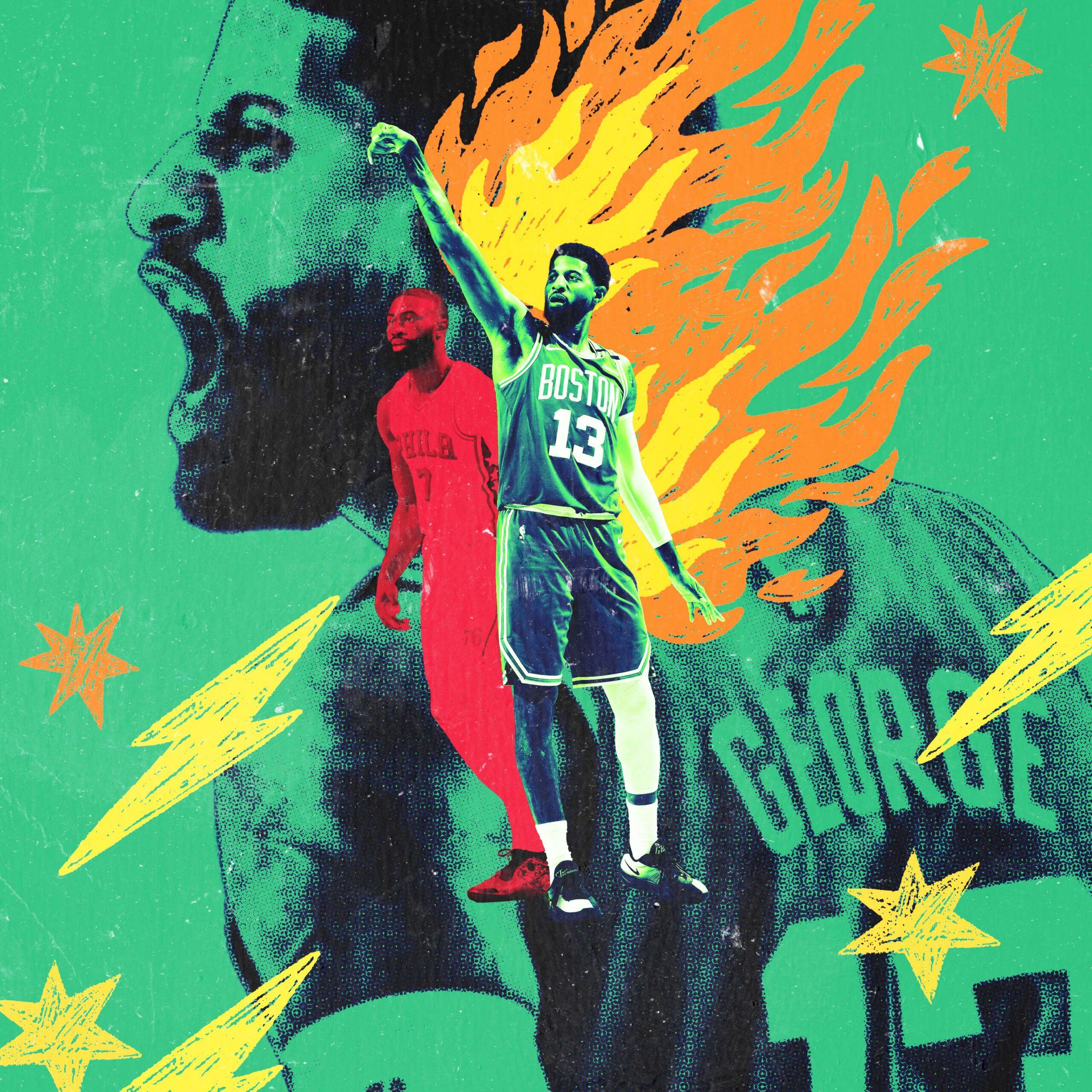

What is time, really? Just six months ago, Paul George, Tyrese Maxey, and Joel Embiid combined for 77 points at TD Garden in the Sixers’ stunning Game 7 win over the Celtics in the first round, catalyzing the end of one of the most enduring partnerships of this generation. Fast-forward half a year, to the 8:45 mark in the third quarter of Tuesday night’s Celtics-Sixers clash—the first since that Game 7. A back screen from Hugo González dislodged Jaylen Brown from his assignment on George, creating a mismatch on the block for PG with Maxey on his hip. Embiid stepped over to help on George’s turnaround fallaway, pulling into focus the three architects of the Celtics’ 2025-26 demise. It was an outrageous shot, the ball flung from behind George’s head, released past the apex of a two-footed jump that had to navigate space more laterally than vertically. It went in. Hoop, harm, and a spontaneous act of ’Toine-liness.
In a narrative-laden bout framed around the negative space between Jayson Tatum and Jaylen Brown, it was George who found serenity in the Celtics’ decisive 123-101 win over the Sixers. It figures that he would. Like the trade that brought George to Boston itself, eventually drama bows to logic. The introduction of George at first felt like a step back from a player like Brown, who was so comfortable with dominating usage in a way that increasingly felt less complementary to Tatum and more like territorial overlay. George may not have Brown’s fail-safe endurance and availability, but within the context of the team that Celtics president Brad Stevens has constructed, the 17-year vet fills gaps and reaffirms the team’s identity in a way that hasn’t really happened for the Celtics since Jrue Holiday’s first season in Boston. It’s become abundantly clear just a few games in that George is the ultimate reflection of the Celtics ethic. At the heart of it, the team functions more effectively when it highlights stars who actually prefer being the proverbial star in his role. Of course, that doesn’t mean sacrificing opportunities.
“I’m a little bit better with more usage—that’s no knock to my opportunities here with Philly,” George, who scored a game-high 36 points on an outrageous 77.3 effective field goal percentage, told NBC after the game. “Quite frankly, I wasn’t healthy to take on the workload I feel I’m at my best at. Here in Boston, they gave me an opportunity to be myself.”


George is right. After two seasons in Philly, where his usage dipped to levels he hadn’t seen since he was 22, he’s ramped right back up to a rate comparable to his five-year stint with the Clippers. Finally back in the right shape and frame of mind, George is having the most efficient start to a season in his career, ebbing and flowing his output to match the needs of the team on any given night. He’s communicating and rotating cleanly as an off-ball defender flanked by savvy ball hawks—this could be the first elite defense that George has played on since the turn of the decade.
The Celtics currently stand at the top of the Eastern standings, just a half-game ahead of George’s former team, with the league’s best net rating. George’s seamless transition into the role of supporting star has worked miracles for a team that could have struggled to get used to the feeling of a phantom limb left by the departure of a player who’d helped define the Celtics’ past decade. It was a grisly ordeal trading Brown away, but perhaps a necessary one. You could even say that George has been the light at the end of a colonoscopy.

It’s hard to argue with how well he’s fit in. For years, Boston’s game has been about bludgeoning teams with math. The sheer quantity of 3-point attempts from players up and down the rotation often forced defenses to stretch past their breaking point. It didn’t matter that the highest-usage Celtics were decent shooters at best; the math would math out as long as they kept taking them. Over the past five seasons, the team has never dropped below a 3-point attempt rate of 46 percent. Since the start of the Joe Mazzulla era in 2022-23, the Celtics have played 77 games in which the team hit at least 20 3-pointers, which leads the league by a considerable margin: that’s 10 more games than the Bucks and Cavaliers (the teams with the third- and fourth-most games, respectively) combined. Boston is now 72-5 in such games; only the Thunder (22-1) have a better win percentage leaguewide over the past five seasons when hitting that many 3s.
The best shooters on the Celtics were beneficiaries of the vortex that Tatum and Brown created—players like Holiday, Payton Pritchard, Malcolm Brogdon, and Sam Hauser over the years. George’s arrival posits, What if Boston’s best shooter didn’t have to emerge from the fringes?
The Celtics terrorized the Sixers on Tuesday by running their defenders through a litany of screening actions involving their best marksmen, creating a recurring pick-your-poison scenario that often led to open 3s after an extra pass was made. George is attempting more than 14 3-point attempts per 100 possessions in his first 10 games as a Celtic, easily a career high, and is drilling 44 percent of them. Among players averaging at least five catch-and-shoot 3-point attempts per game, only the timeless Steph Curry is hitting them at a higher percentage. The spacing has been immaculate for Boston, and it could result in the best shooting team that Boston has had since its championship season in 2023-24. There is a symbiosis created within the Celtics ecosystem: Tatum’s driving gravity creates soft spots in the defense for Boston’s myriad shooters to slide into, while the numerous threats from the perimeter (this season, chiefly George) have given Tatum all the space to find easier scoring opportunities in the lane.
In short, George’s arrival simplifies the hierarchy by bringing in a star capable of subsisting on a completely different shot diet. Brown and Tatum’s differences weren’t really about the size of their slice of the pie, it was about having to share said pie with each other. These days, there’s more space for everyone; everything makes that tiny bit more sense. That’s always been the promise of the back half of George’s career: What you sacrifice in availability, you gain in a sort of systemic undergirding. He can be anything you need him to be, within reason. In a game full of marquee stars still feeling their way around their new roles and responsibilities, it’s awfully poetic that George stole the show by simply being himself.
The Celtics are reaping the immediate benefits of George’s malleability, but the rough patches will come—missed games or cold streaks are also part of the experience. How the Celtics rise to that challenge may depend on whether Tatum ever regains his shooting touch. There will be nights when having a headstrong driver like Brown will be sorely missed, when no one else seems to have it. But that’s a problem for another day.
Tuesday night was a welcome reintroduction to George as a current star rather than a faded one. He is one of the most well-rounded basketball players of his generation, if not ever, equally adept at playing on or off the ball in both phases of the game. His two-way impact is a master class in scalability, his patterns of movement are almost frictionless. It can be hard to remember a time when he wasn’t so smooth, but he was at one point a raw athlete out of Fresno State who built up a confident handle and effortless stroke over time in one of the most stunning development arcs ever. He’s seen it all, and he’d be the first to tell you all the hats he’s worn in his long career. He’s been in both Tatum and Brown’s position before. He’s been the secondary star who briefly supplanted the more beloved franchise icon. He’s been in the dueling swingmen dynamic on the Clippers with Kawhi Leonard. The role he’s in now isn’t dissimilar to the role he played in Oklahoma City, where he was acquired to cushion the blow of Kevin Durant’s departure the year after he fell out with Russell Westbrook. Boston didn’t just trade for Brown’s replacement, it brought in a fount of accumulated knowledge who understands all too well the complicated dynamics of ego and the entitlement that comes with stardom.
He wasn’t who Celtics fans wanted initially, but, again, drama bows to logic, eventually. George understands the tension; he also understands how important a release valve can be.