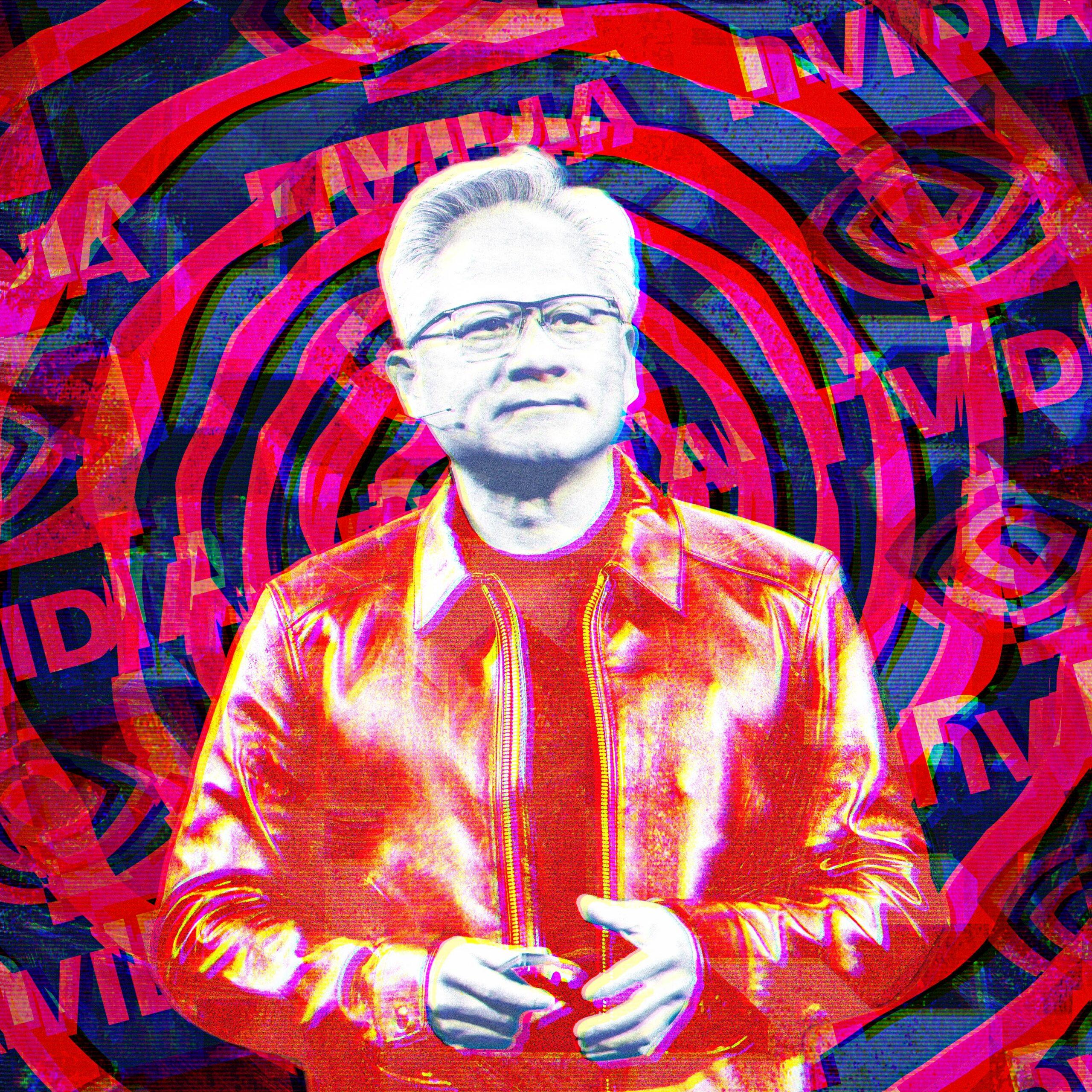

Look, no one wants to get an email from their boss over the weekend with the subject line: “A message to our company.” Even still, I’ll give Jensen Huang, the 63-year-old founder and CEO of multi-trillion-dollar chipmaker Nvidia, a tiny bit of credit for one thing: He sure made his off-hours corporate correspondence interesting.
“I owe my family and all of you an apology,” Huang began in his note to Nvidia’s tens of thousands of employees on Sunday. “I was unfaithful to my wife. My actions hurt her and our children. There is no excuse for what I did. I am deeply sorry.” As if that weren’t already enough of a bombshell, five paragraphs later, Huang continued: “Regarding the national security concerns raised in news reports, NVIDIA’s Board of Directors has initiated an independent investigation.”
Excuse me—the national what now? Not even two months ago, Huang was President Trump’s literal right-hand man at a White House summit about artificial intelligence, and throughout the fall the Nvidia leader made the rounds at conferences, offering up his often contrarian opinions on the state and trajectory of AI. His company was booming: one recent New Yorker piece on the history of computer chips noted that last year, Nvidia’s “stock single-handedly accounted for about 15 cents of every dollar returned by the S&P 500.” But after Sunday’s email admission—and all the whispers and machinations that led up to it—a harsh spotlight has been cast onto Huang and the universe around him.
According to a New York Times article this past Sunday, Huang admitted to his board of directors that the affair he’d had was with a woman suspected to be a Chinese spy. Whoopsie-daisy! The details of what exactly happened are still unwinding, and the ultimate ramifications are still to come. But this story already involves shell companies, surveillance, whiskey shots, and a secret memo from the Secretary of State. And what happens next could potentially upend the already tumultuous (and increasingly treacherous) AI industry—and maybe even jostle the global power balance.
As with all matters involving the intersection of artificial intelligence and human fallibility, there’s a lot going on here. Below, we’ll try to figure out what’s up—and why now.
So, what did Jensen Huang do this time?
Huang, who founded Nvidia in 1993, was already one of the tech world’s most recognizable and present figures. (“He’s like Taylor Swift, but for tech,” wrote Mark Zuckerberg on Instagram in 2024.) This man has the Nvidia logo tatted on his arm; he’s unafraid to autograph cleavage. (Talk about Jensanity, baby!) He has long been extremely vocal in his opinions, a core one of which is that cutting China off from the supply of advanced American chips would cause problems domestically. “It makes no sense to forfeit, to concede a large market, if you want to win globally,” Huang said in a February interview on CNBC. At a state dinner in September, Huang and his wife Lori dined at a table with President Trump and China’s president, Xi Jinping. That’s some seat of power!

But these recent admissions and allegations—that he had a relationship with a woman who was definitely a major customer of Nvidia and potentially a foreign spy—have now launched Huang into a higher echelon of notoriety, and placed him at the center of so many questions: What secrets were spilled? Was his outspoken support of free(r) trade with China a result or cause of his associations with this maybe-shady lady? Will he keep his job at the company he created in his image?
Nvidia’s board of directors said in a statement Sunday that they have “no reason to believe that either national security or Nvidia secrets were compromised” by Huang’s actions, though the board also promised to launch an official inquiry to make sure. Members of Congress, meanwhile, are also circling the story. Regardless of whatever additional information comes out from here, Huang’s motives and arguments for selling chips to China will carry an implied asterisk for quite some time.
And who is this gal?!
Alice Huang (no relation), who is also known as Huang Le, was a director at a company called Megaspeed International—a Singapore-based cloud computing and data center services company that has bought more than $4.8 billion worth of Nvidia chips in the past two years—in 2023, and a “leader” at the company in years since, according to The Wall Street Journal. Beyond that, her background is murky: one CNBC reporter based in China said on Monday morning’s Squawk Box show that while Alice supposedly used to work as an on-air broadcaster, according to a résumé on a Chinese website, there are curiously no clips of her work to be found.
The two Huangs began appearing in public together in 2024. Alice Huang pops up in an October 2025 New York Times article about whether Megaspeed was dodging U.S. export controls by helping funnel Nvidia chips into China. (“A Mystery C.E.O. and Billions in Sales: Is China Buying Banned Nvidia Chips?” read the headline.) The article places Alice at a bar in Taipei in June 2024, telling a group of tech executives, “I bet you guys I can get Jensen here”—and then notes that she was right. The Nvidia head did indeed materialize that night to take a whiskey shot.
Apparently, the U.S. intelligence community has suspected for some time now that Alice had a side hustle beyond Megaspeed: working in cahoots with China’s Ministry of State Security, or MSS. According to a classified memo reported on by The New York Times, China’s spy agency allegedly recruited her to gather intelligence on Jensen Huang—and to nudge Nvidia to lobby for China to get its most advanced chips. (Whether she targeted Jensen from the start or was recruited only after she grew close with the Nvidia founder remains an open question.) A Chinese foreign ministry spokesman, unsurprisingly, called the spying allegations “nothing more than slander and smearing.”
Are there any photos of Alice and Jensen together?
Are there ever! This is basically the AI equivalent of asking whether there are any photos of Mike Vrabel and Dianna Russini hanging out.
What is Megaspeed International’s deal?
Based in Singapore, Megaspeed was spun out of a Chinese gaming enterprise in 2023—shortly after the United States “kneecapped” Chinese labs by restricting exports of America’s most advanced chips. And Megaspeed was raising eyebrows well before this latest news. That’s because it seemed very specifically positioned to help circumvent the export restrictions prohibiting the sale of Nvidia products to China. According to a CNBC interview on Monday with Stephen Witt, the author of 2025 Nvidia history The Thinking Machine: Jensen Huang, Nvidia, and the World’s Most Coveted Microchip, Alice Huang’s company “was creating, what is functionally—if you believe U.S. intelligence—a smuggling operation” of advanced computer chips to America’s biggest tech boogeyman/rival.
Nvidia was restricted from straight up selling its top chips to China. But it could peddle them—$4.8 billion of them!—to Megaspeed in Singapore via various middlemen, and Megaspeed could then install the tech in data centers in places like Malaysia and Indonesia and rent out that computing power to, well, whomever, wherever. Such as, according to the Times, Alibaba … one of China’s most powerful tech companies.


Did any of this raise red flags before now?
It definitely did. And a little shoe-leather investigating over the past couple of years made it clear that not everything with Megaspeed was on the up and up. In September 2024, an official from the Commerce Department visited one of Megaspeed’s data centers in Malaysia, only to find that a good deal of the Nvidia hardware was still in boxes—a hint that it was destined to be shipped off elsewhere. A year later, in October 2025, The New York Times wrote of a similar finding: when its reporters traveled to Kuala Lumpur to visit Megaspeed’s offices, they were met with a crumbling storefront and an admin who answered “It’s not clear” when asked what the company does.
As if all that didn’t evoke Season 4 of Industry enough, this past May, a spirited short-seller called Culper Research published a 40-page report betting against Nvidia, claiming that the company’s “China problem” was more severe than it let on. The Culper report alleged that Alibaba, through a web of shell subsidiaries, appeared to be quietly bankrolling Megaspeed’s chip purchases. It called Jensen’s relationship with Alice “uncomfortably close” and ran a sub-section about the CEO headlined: “Is He An Idiot, or Is He In On It?” According to the Times, the U.S. intelligence community had already had their eye on Alice for more than a year.
Throughout all of these inquiries, Jensen Huang and Nvidia had repeatedly insisted there was nothing untoward to see here. (As recently as two weeks ago, Jensen was still calling his interactions with Alice “completely normal and not unusual,” and an Nvidia spokesman was in full denial mode.) President Trump, a man who’s particularly sensitive to any actions that threaten his cherished bull market, seemed to buy into that mindset: When Huang was conspicuously left off a list of executives joining the president’s trip to Beijing back in May, Trump personally invited him anyway, scooping him up onto Air Force One during a stopover in Alaska.
It sounds like a lot of this stuff had been floating around both the intelligence and the investment communities for some time. So why is it being revealed publicly now?
There are a number of theories about why the little birdies behind this spate of recent stories have chosen now to chirp. Maybe this was all just the culmination of more than a year of dogged investigation by top journos. Maybe the lopsided midterm election shook loose some inhibitions and got people yapping. Maybe that crisis PR firm that Huang hired last year advised Huang to just apologize, to seize the narrative. (Or a narrative, anyway.)
The explanation that makes the most sense to me involves the so-called “China hawks”—the contingent of power brokers in and around AI and/or Washington, D.C., who, and I’m exaggerating only a little bit here, equate selling state-of-the-art chips to China with selling nukes to our nation’s haters. Perhaps, sensing their moment post-election, they took the opportunity to further undermine any argument for relaxing export controls on China by calling into question Huang’s allegiances. One representative hawk? Secretary of State Marco Rubio, who’s been so harsh on Beijing over the years that China sanctioned him in 2020—and who oversaw a classified memo this past spring warning senior administration officials of Alice Huang’s links to China’s MSS.
Is there any chance Nvidia’s board of directors would oust Huang over this? Who would be his successor if it did?
Lots of companies, especially hotshot tech ones, become synonymous with their founders over time. But Huang’s grip on Nvidia is particularly strong, and the company is definitely a league leader in “key man risk”—a measurement of how inextricably a business is tied to one top person, for better and often for worse. Under Nvidia’s corporate structure, something like 60 top employees report directly to Huang. And his geopolitical connections within the U.S. and abroad can’t easily be replicated.
But unlike some of his peers in tech, Huang is also remarkably vulnerable to a corporate reshuffle. Whereas someone like Mark Zuckerberg at Meta holds special supervoting Class B shares worth 10 votes apiece, giving him roughly 60 percent of his company’s voting power, Huang owns about 4 percent of his company’s shares (and voting rights), making him quite susceptible to being ousted. On the other hand, Nvidia’s board of directors—which includes a VC who’s been there since 1993; a former Taco Bell International president; and the NFL’s former chief marketing officer among its ranks—may not be immediately inclined to make a drastic change, in large part because it’s not really clear who could step up in Huang’s place.
Huang’s son, daughter, and son-in-law all work for Nvidia. Spencer Huang is a director of product management in robotics; Madison Huang is a senior director of product marketing; and Madison’s husband, Nico Caprez, is a VP who handles Nvidia’s “neocloud” customers. (Yes, that’s the category Megaspeed falls into.) But the Huangfam are not necessarily serious people, so to speak. Their past experience includes running a cocktail bar in Taipei (Spencer), attending Le Cordon Bleu and working for the luxury brand LVMH (Madison) and alpine ski racing (Nico—who, to be fair, also worked at a Zurich asset management firm).
And even among the loyal non-nepo folks at the company, there are no obvious or well-groomed successors on Huang’s level. As far as anyone can tell, Nvidia’s succession plan is for Huang to lead forever.
So he’s just gonna wriggle his way out of this one?
Not so fast. Even if the Nvidia board isn’t keen on booting Huang, he’ll have another authority to deal with: the federal government. Representative Michael McCaul of Texas referred to the whole affair as “a classic move from the CCP’s playbook” and called for an immediate pause on advanced chip shipments to China. The Republican leaders of three House committees have asked Huang to sit for a closed-door briefing on November 18, the day after Nvidia’s next earnings report, to explain himself (and his interactions with Alice). The FBI may come knocking at some point, according to remarks by Trump on Monday. (The president added that Huang assured him he had no idea that Alice may have been a spy.) And with the incoming Democratic-led House and Senate eager to flaunt their mettle in Washington and tackle big questions swirling around AI, Huang will likely be considered a particularly splashy witness for quite some time.
Has our guy Bill Ackman weighed in on all of this?
I mean, does that man ever not weigh in? “I am hoping for a simple affair,” the outspoken financier opined on social media, “not a risk to our national security.” Great, now I’m wondering if Alice Huang incorporated “May I meet you?” into her spycraft.
What are some of the Nvidia-adjacent wild cards to keep an eye on going forward?
In no particular order:
Huawei: Huang has always been frank about the risks of icing China out from the top chip tech in the market. His argument? That blocking Nvidia products from China doesn’t stop the nation from building and innovating—it merely drives the U.S.’s geopolitical rivals to work with hardware from Chinese tech giant Huawei instead. “We went from 95 percent market share to 0 percent,” Huang complained at a Citadel Securities event in 2025 about the restrictions in China, “and so I can’t imagine any policymaker thinking that that’s a good idea.”
For many AI accelerationists, “But we can’t lose to China!” is a familiar response to any safetyist assertion that U.S. frontier labs ought to slow down or even pause their rate of progress. But now that Huang has been linked to a Chinese operative, it will sound a lot more hollow for him to say that. And Huawei may yet find itself with the competitive edge that Huang has fretted about for years.
Lori Huang: Jensen met his wife of 41 years when they were teenage engineering students at Oregon State; she was one of only three women in the 250-person engineering lab. Huang has credited his wife with making Nvidia possible: “Lori took care of everything and I don’t remember her complaining one time,” he said on the How I Built This podcast this spring. “That’s the gift that she gave me.”
Lori now finds herself at the heart of an international scandal courtesy of her husband. If the two decided to part ways over this infidelity (and if the couple wed without a prenuptial agreement), this could wind up being one of the most expensive divorces of all time. Half of Huang’s roughly $150 billion fortune would make MacKenzie Scott’s $38 billion divorce settlement with her ex, Jeff Bezos, look like chump change.
The Commerce Department: Well, this seems sus!
Anthropic: The (in?)famous frontier lab has been planning its enormous initial public offering for this fall, hoping to raise funds at a valuation of as much as $1.5 trillion. The company just launched its newest batch of models, and the IPO roadshow is expected to begin this week. Anthropic CEO Dario Amodei has long argued for a full embargo on chip exports to China, contrary to Huang’s point of view.
Could the Nvidia mess wind up causing enough reverberations in the broader AI space to screw up Anthropic’s IPO plans? Investors were already skittish after a post-midterm AI stock selloff last week made Anthropic’s target look rather ambitious. A spy scandal involving the sector’s single most important supplier surely doesn’t help.
How is Wall Street reacting to this news?
Honestly, considering how important Nvidia is to not only the AI sector (one CNBC commentator Monday morning referred to the company as “the central bank of AI”) but also the future of the economy writ large, I thought this would be way more of a bloodbath. But while Nvidia took around a 4 percent hit to its stock in early trading on Monday, the overall market took the situation in decent stride—finishing up on the day.
And how is the president reacting to this news?
“I haven’t heard he’s done anything wrong,” Trump said when asked about Huang on Sunday night, adding that he ought to remain as CEO. “He dealt with somebody, but you know, so does everybody else.”
In conclusion, what’s the most cursed turn of phrase that simply would not leave your head as you wrote about this mess?
Glad you asked, because I need to offload this mental burden onto someone else. It’s a tie between two: “I spy with my little AI …” and—I’m sorry, I’m sorry, I’m trying to delete this—“LOOSE HIPS SINK CHIPS.” Even when superintelligence takes over the world, I’d like to think that only a sicko human mind would ever bother coming up with that.