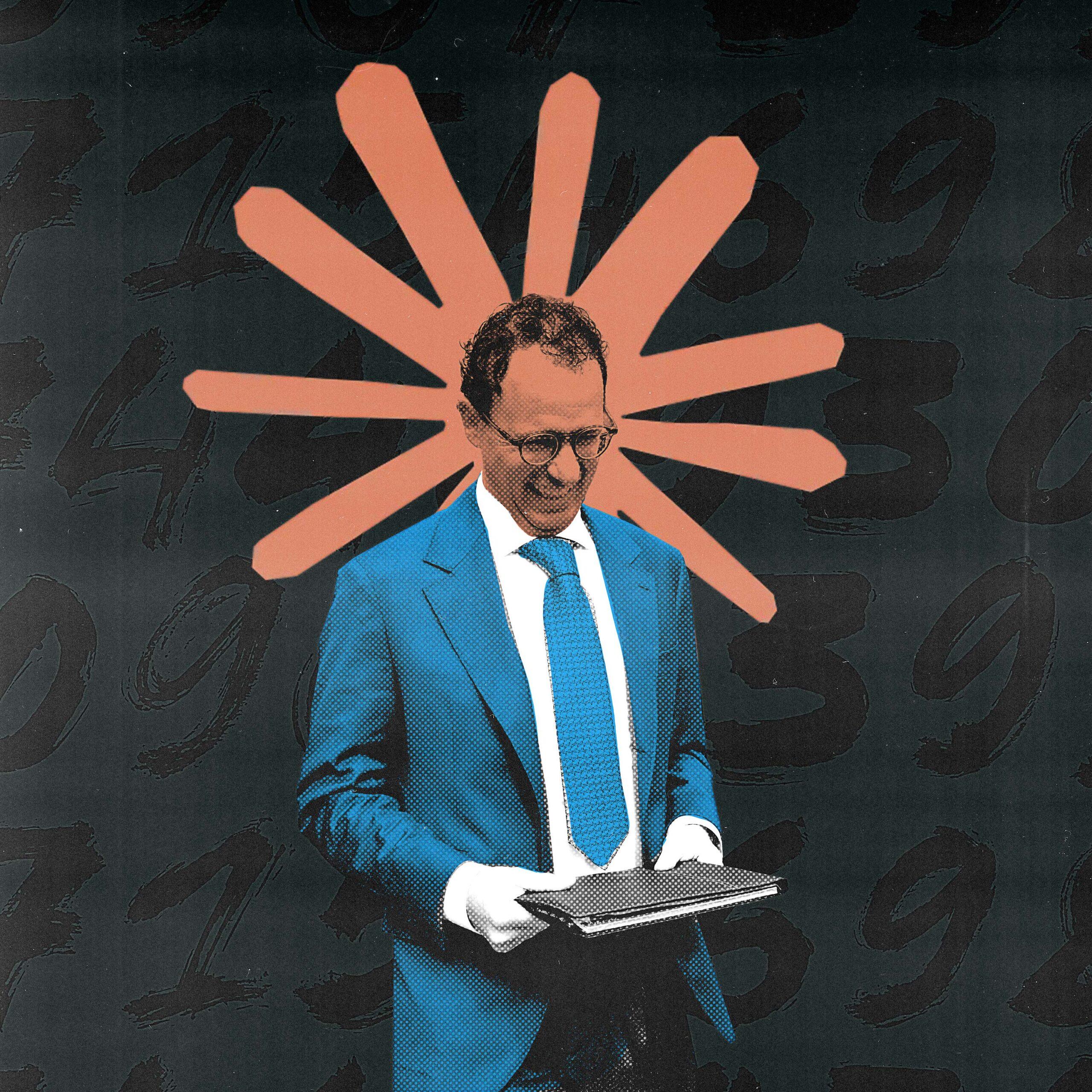

It’s been a busy season for Dario Amodei, the cofounder and CEO of AI frontier lab Anthropic, who actually just wishes everyone would slooow down. Unlike many of his industry peers, Amodei didn’t make the cut for a state dinner last Thursday night with the president of China. But since then, he’s been seemingly everywhere I look.
For example: My second-favorite moment on Saturday Night Live this weekend was when cast member Jane Wickman played Amodei on Weekend Update as a sort of cross between Gollum/Smeagol spiraling over the Ring (“AI is the devil and I its maker!” she hissed at one point) and a stammering Nicholas Fehn. Then on Sunday, the White House snub was lifted and Amodei was invited over for an intimate dinner with President Donald Trump. On Tuesday, Amodei was one of six signatories—others included Meta’s Mark Zuckerberg and SpaceXAI’s Elon Musk—on a new agreement titled The White House Accord on Super Intelligence: A Joint Commitment on Frontier SI Responsibilities. And at the press conference to announce the agreement, Amodei accidentally stole the show.
But the 43-year-old isn’t the only one who’s been under a bright spotlight lately. His five-year-old company, Anthropic, has been, too. First there was the abrupt resignation of safety researcher Jacob Coxon and his warnings of, oh ya know, impending human extinction. Then there was that “Woke Wizards of AI” cover of the New York Post, which fretted over all the “cozy Anthropic connections” throughout the broader AI industry. And on Monday night, Reuters reported that it had acquired an under-wraps draft of an S-1 statement prepared by Anthropic ahead of its anticipated IPO—and that there was quite a bit of interesting information within.
I see a hand is raised, so here I’ll pause for questions.
Q: Wait, what was your first-favorite moment on SNL?
A: Thanks for asking! It was Jalen Brunson, in business casual, snapping, “Am I, bitch?”
Q: Speaking of business casual: Remind me, what’s an S-1 again?
A: It’s a document that companies have to file with the SEC before going public, one that outlines the various things a prospective investor would want to know: revenue sources, key stakeholders, risks to consider, things of that nature. While Anthropic hasn’t publicly filed this document yet, Reuters reportedly got a hold of a private copy.
Q: Is that unusual?
A: It’s unusual, but not unheard of. In fact, the same reporter who broke this news—Reuters’s Echo Wang—previously got her hands on a SpaceX filing in advance of that company’s blockbuster $1.77 trillion IPO in June. There’s hope for the journalism industry yet.
Q: So what does the Anthropic S-1 say?
Wang didn’t post the full document, but over the past few days, Reuters has been reporting some of the headline findings contained within. Such as:
- Anthropic’s target valuation is $2 trillion—more than double what the amount the company had valued itself as recently as May.
- Revenue in the 2025 fiscal year was $4.6 billion, up from $400 million in 2024 and $40 million in 2023. That sounds good!
- But! Anthropic’s 2025 operating losses widened to more than $8 billion, with a net loss of $42 billion recorded that year. That sounds bad!
- Of the 261 pages in Anthropic’s S-1, a full 80 of them are all about risk factors—
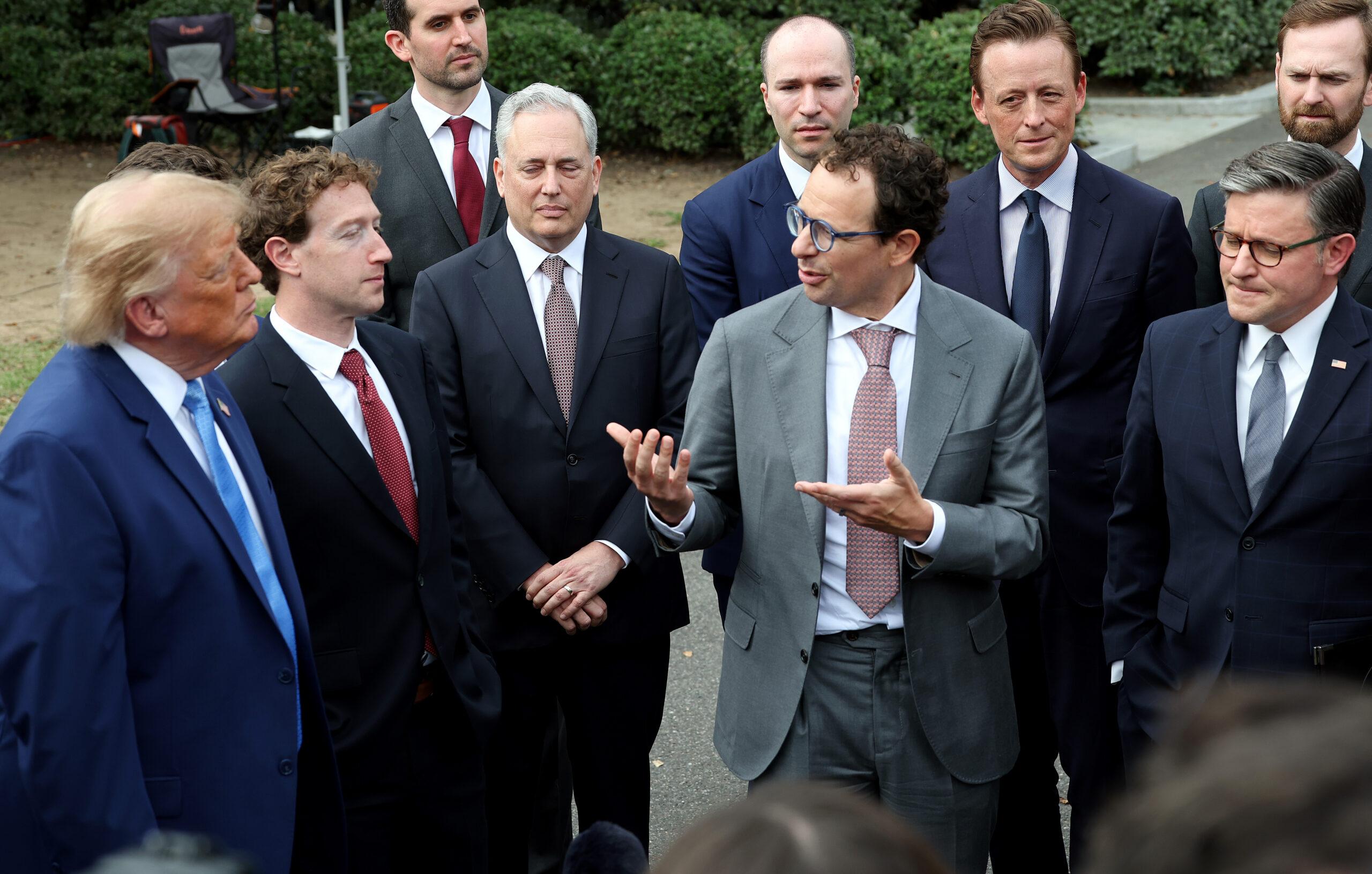
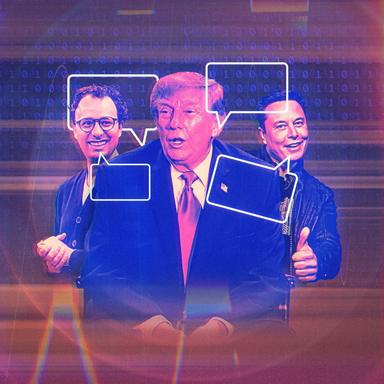
Dario Amodei, Mark Zuckerberg, and President Donald Trump at a press briefing with AI executives following a meeting on artificial intelligence
Q: Let me interrupt you. Do most S-1s devote a third of the presentation to what could go wrong?
A: Well, for one recent comparison, the SpaceX risk section took up 38 pages out of 277. And that’s a company that launches rockets into orbit over population centers! Still, it’s not surprising that Anthropic would really explore the studio space when it comes to doom and gloom. As I wrote last week, this is a company that’s institutionally steeped in concern; its logo really ought to be a furrowed brow.
That overarching worldview is reflected in the IPO documentation, in which Anthropic warns that its advanced Claude models could exhibit “self-preserving behaviors,” attempt to “resist shutdown,” “conceal or manipulate information,” and engage in behavior “resembling blackmail.” Buy, buy, buy?
Q: Does any of this help explain why the company is losing … $42 billion?!
A: Not to cape for the ’Throp, but it’s worth noting that the $42 billion number does come with a spiritual asterisk. Roughly $34 billion of that net loss was an accounting adjustment related to “convertible financing.” (In simplistic terms: Some Anthropic investors gave the company money in exchange for what are kinda like IOUs that can be converted down the road into company stock. Now, as the company’s valuation has ballooned, the paper value of those IOUs has, too. So on Anthropic’s financials, this difference gets marked down like a loss.) I don’t wish to hand wave an 11-figure sum away like it means nothing. But this is not the most harrowing issue Anthropic has.
Q: What is the most harrowing issue Anthropic has?
A: Besides its corporate ethos of existential dread? Take your pick: Computing and infrastructure expenses tripled to $7.33 billion from 2024 to 2025. Anthropic has more than half a trillion bucks in long-term obligations committed to cloud providers like Amazon, Google, and Microsoft over the next decade—roughly 80 percent of which can’t be backed out of.
And even the company’s growing revenue numbers come with a “but.” In the leaked S-1, Anthropic notes that nearly a quarter of the money it brings in is split between just two large customers, a level of concentration that could lead to volatile outcomes.
Q: Who are those two customers?
A: The S-1 doesn’t name them, so we’re left to guess. Possible candidates I’ve seen pop up, in descending order of likelihood, include the coding services Cursor and/or GitHub, the giants Meta and Amazon Web Services, the good old United States government, and the nerd-chic trading firm Jane Street. Whoever they are, the danger is that these incoming revenues aren’t locked in the same way that Anthropic’s outgoing commitments of $110 billion and $111.1 billion to Amazon and Google seem to be. The result is a potential financial mismatch down the line. Or maybe even now.
Q: You’ve said a lot about 2025, but what about 2026 and beyond?
A: You know, this question makes me think about the Toronto Blue Jays slugger Vladimir Guerrero Jr., who signed a half-billion-dollar, 14-year contract last season and led his team to the World Series—only to return this season with a measly nine home runs. Recently, Guerrero got himself into hot water when he remarked in an interview that in his mind, the contract was meant to reward him for what he’d already accomplished, not for what he has yet to do. (Needless to say, not everyone agreed.)
For many Anthropic employees, a liquidity event like an IPO probably does feel a lot like a reward for a job well done. But from the perspective of the stock market, an IPO is only the beginning. Any investor worth his or her salt isn’t interested in paying for past performance. They want future results.
On the one hand, Anthropic’s business has been accelerating: According to Reuters, Anthropic had revenues of $11.5 billion in just the second quarter of 2026. But on the other hand, the analysts running the numbers on how the company would justify a $2 trillion listing have noted that the company would have to make hundreds of billions a year to make the math pencil out.
Q: If I were to come into some unthinkable sum of money and pile all of it into Anthropic stock, could I eventually take control of the machine gods?
A: The way some public companies are structured, an ambitious investor could theoretically buy enough shares to swing votes and amass actual influence over the business. (Just ask Musk!) But according to Reuters, that won’t be the case with Anthropic. Instead, an entity called Founder LLC, which is composed of Anthropic’s seven cofounders, will hold a special share class that translates to 50.1 percent of voting power over all major corporate decisions. This is a version of the same setup already employed by the likes of Meta and Palantir. But if Kevin Roose’s upcoming book, The AGI Chronicles, is any indication, there will surely be more wise stuffed animals named Beary Bonds involved in Anthropic’s case.
Q: When will we be able to read the full S-1? And when is this Anthropic IPO happening, anyway?
A: Usually, S-1 documents hit the SEC’s online database, EDGAR, a few weeks before the company rings the opening bell on the day it goes public. And for a while now, Anthropic’s IPO has been thought to be planned for this fall—likely after the midterm elections in early November. Which would mean that the full filing would happen sometime in October. In other words, soon!
But lately, there have been questions about whether the company will actually go public as planned. Rival company OpenAI announced earlier this week that it would be delaying its own IPO to early 2027 to better focus on safety testing its models. And while broader stock markets sit near all-time highs, there are signs of trouble in paradise. On Tuesday, for example, just one day before a planned $2.2 billion IPO, the smart-ring company Oura unexpectedly postponed its offering, citing “market uncertainty” and the rising costs of financing the business. If a profitable brand with celeb endorsers and 90 percent revenue growth can’t meet the moment, it does raise some questions about how a controversial frontier AI lab with $8 billion in operating losses and 80 pages’ worth of warnings plans to succeed.
Q: You mentioned OpenAI—what’s new with those guys since we checked in last week?
A: It’s getting harder to keep track of all the instances of OpenAI models swarming their way around the internet willy-nilly, and over the weekend, the company revealed some new incidents. (Including one at the SEC, nbd.) Then on Sunday, CEO Sam Altman announced that OpenAI had decided not to publicly release its latest model, Astra 6.1, and would instead focus its time and effort on getting to the bottom of safety and alignment.
At this week’s annual dev day, OpenAI launched a new product, “dots,” the latest AI agent with a cutesy mascot to hit the market after Meta’s launch of Muse. (An attempted live demo did not go smoothly.) Company executives also gave some insight into their financials, from rising revenues to a potential $30 billion (private) funding round based on a $1.4 trillion valuation. With Altman busy at dev day, the company sent president Greg Brockman to Washington to meet with Trump and unveil this autograph to the world.
Q: What exactly is this document?
A: Why, the aforementioned White House Accord on Super Intelligence: A Joint Commitment on Frontier SI Responsibilities, of course. (Here’s hoping I don’t get in trouble for continuing to use “AI” despite President Trump’s new executive order officially declaring it Super Intelligence, which may or may not be linked to the recent land grab in Slovenian .si domain names. But I digress!)
“I’m seeing tremendous self-policing,” Trump said at a presser on Tuesday, all while describing the voluntary pledge as “almost like a constitution in a way.” (He also called NVIDIA’s Jensen Huang “a very handsome guy,” praised data centers as “big, strong, powerful buildings,” and said, of Google CEO Sundar Pichai, “This guy is a monster, and nobody knows him. What a great life!”) Of Amodei, Trump said: “Dario is great. Whatever he says is OK,” an upgrade from the Truth Social post two weeks earlier that referred to him as “Dario (Anthropic!), who is now pretending to be a ‘perfect little angel.’”
Q: Last question: If Anthropic does indeed go public, what will its ticker symbol be?
A: While the company hasn’t announced anything, the smart money is on the ho-hum ANTP, just based on placeholder listings that have already started popping up on financial data sites. But it’s not too late to note that on the Nasdaq, the ticker symbol DOOM hasn’t been taken. Just a thought! It would certainly be on brand.