

Stephon Castle, De’Aaron Fox, and Dylan Harper shared the court for just 69 minutes across the entire regular season and playoffs last year. Some of that is a testament to San Antonio’s seemingly endless lineup combinations, and some of it’s because Spurs head coach Mitch Johnson was being rational. Why play three point guards with iffy outside shots at the same time?
It’s a perfectly understandable decision! But when Harper made the transformation from gifted rookie to bona fide revelation in the playoffs, everything changed. As a 20-year-old who didn’t even compete in the NCAA tournament, Harper displayed a shocking level of comfort on basketball’s grandest stage. In five Finals games against the New York Knicks, last season’s no. 2 overall pick averaged 18 points and made 60.9 percent of his 2-point shots. Harper got where he wanted, casually bullied defenders in the paint, and had a fearless demeanor that belied his inexperience. It was a series of slim margins, and had Johnson been more willing to unleash Harper alongside Fox and Castle, San Antonio might have raised another banner. That’s how good he was.
In a constructive way, Harper’s breakout disrupted San Antonio’s hierarchy, complicating what should’ve been a more traditional pecking order. Fox is a 28-year-old multiple-time All-Star who just started a max contract, and Castle is a Rookie of the Year–winning defensive dynamo who packs winning intangibles into every possession. The Spurs would still be a contender if Johnson kept the status quo, brought Harper off the bench, left Julian Champagnie in the starting five, and maintained a rotation that showed it’s capable of making the Finals. (Last season’s starting five sported a net rating of plus-19.2, which is ridiculous.)
But sometimes it’s necessary to be proactive. To me, restricting a special talent like Harper would’ve been too conservative, and demoting Fox or Castle was never realistic considering their standing, experience, and value. That left one option: letting all three work together. As Johnson clarified last month, altering the Spurs’ starting lineup was a “natural evolution that will still take time.”
No team can be the ultimate version of itself unless its best players can play together. That’s fundamentally why the Spurs decided to start Harper. And, even with several risks baked into the decision—it couldn’t have been easy for Johnson to intentionally break up a starting five that obliterated the league last season—the thought of unlocking an even more dangerous version of the team was, understandably, enticing.
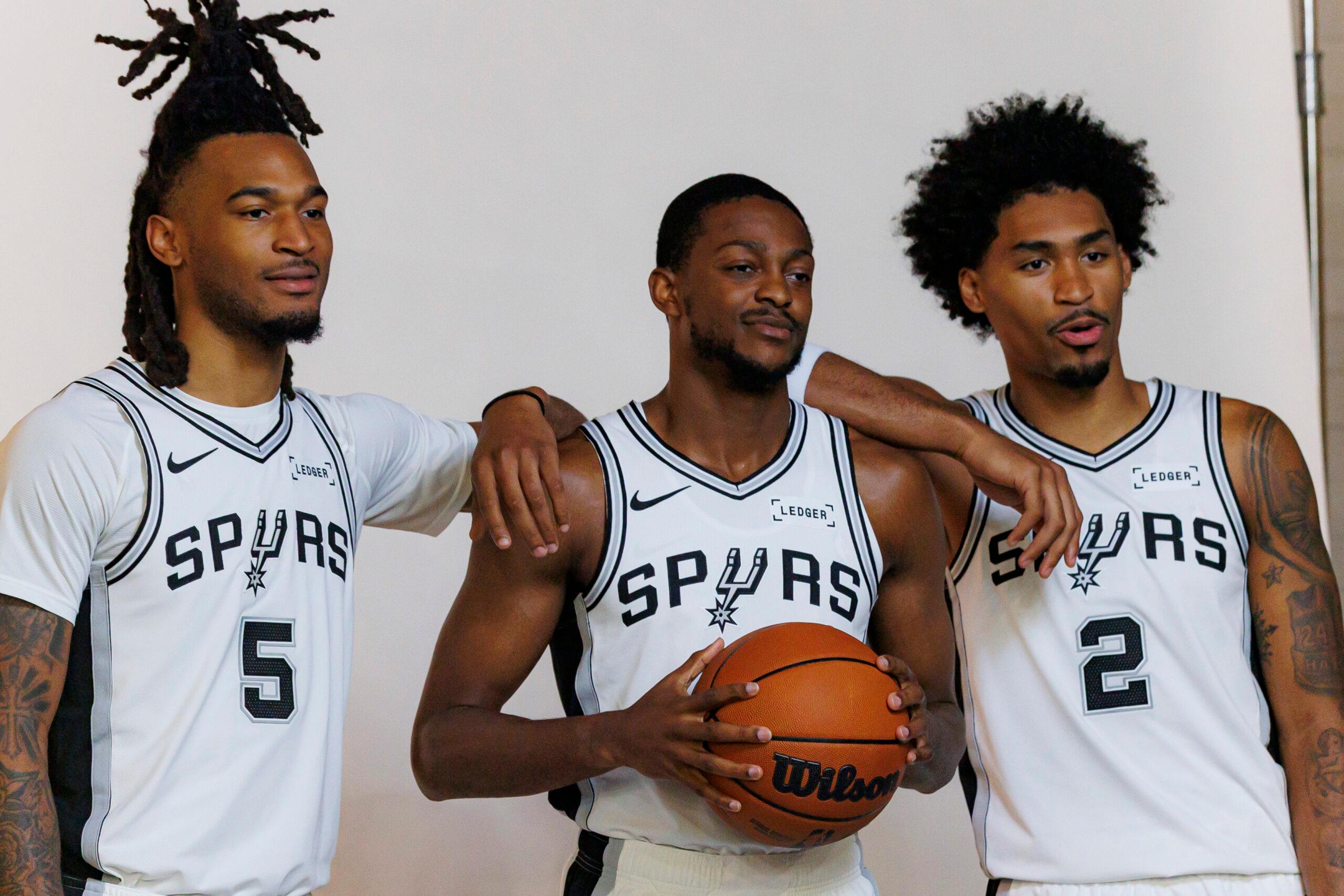
Stephon Castle, De’Aaron Fox, and Dylan Harper
After a slow start, the Spurs have spent the past couple of weeks reestablishing themselves as a title contender. Their 8-2 record is tied for the best in the league, and they currently rank first in net rating. Victor Wembanyama is the first-, second-, and third-easiest way to explain this team’s success, but there have also been stretches in which Fox, Castle, and Harper look like they were born to play basketball together. These three dynamic, two-way players are learning how to complement each other while simultaneously allowing Wemby to simplify his game and be the most dangerous version of himself we’ve ever seen.
Finding enough minutes, shots, and touches for all three guards should be viewed as more of an opportunity than a dilemma. Harper, Fox, and Castle are, on the surface, duplicative, but each one brings something different to the table, all have chemistry with Wemby, and none of them can be consistently hindered one-on-one. (A quick shout-out to Devin Vassell, who’s the best shooter in this starting lineup, sacrificing more than anyone else on the team, and capably defending power forwards like it was the primary reason San Antonio drafted him.)
Stops aren’t an issue, either. These are not small guards. None are weak links. Fox is 6-foot-3, Harper is 6-foot-5, and Castle is a 6-foot-6 cinder block. They are all versatile, rarely foul, and can gamble in passing lanes thanks to the sturdiest safety net basketball has ever known patrolling the paint. When the three guards are together, San Antonio’s defensive rating is 21.5 points per 100 possessions more stout than league average, despite opponents shooting nearly 40 percent behind the arc. Everything at the rim is mincemeat, and they do a terrific job of forcing tough looks from the midrange.
As Harper explained to a skeptical Charles Barkley after San Antonio squeaked by Dallas last week, “We’re so good, I mean—hey, man, pick your poison.” San Antonio is plus-56 in the 90 minutes Harper, Fox, and Castle have shared the court. (For those counting at home, that’s already more minutes than they logged together all of last season.) Put another way, out of 212 three-man lineup combinations that have logged at least that much time this season, only six have a higher net rating. It helps to have arguably the best player in the league on the court for every single one of those possessions, but the philosophical calculation behind Johnson’s decision to start games with this group is what matters to me.
Sometimes, the periodically awkward, unconventional, and speculative route can also be the most gratifying. Harper is arguably already San Antonio’s second-best player and possesses one of the highest upsides in the entire league. Forget about development; it’s his present-day winning impact that convinced Johnson to change a starting lineup that was already excellent. He is currently San Antonio’s second-leading scorer, ranks first on the team in minutes, and is shooting 77.6 percent in the restricted area—first among all guards on one of the highest volumes in the league, regardless of position—and 46.2 percent on non-corner 3s.
Positional overlap be damned, it makes sense to use the regular season as a period of self-discovery. This team is still young enough to form a new identity, and maximizing their core by giving them an opportunity to collaborate is important.
These are three guards who all thrive with the ball in their hands and regularly face opponents who duck under screens when defending them in a pick-and-roll. Sacrifice is a prerequisite for success. But so far, there hasn’t been much friction to harp on. Unselfish sequences like this, where all three touch the ball, are a step in the right direction:
All three guards are able to get into the paint whenever they want. All three have excellent vision and, despite unproven 3-point shots, can’t be completely ignored by whoever’s guarding them off the ball. The Spurs have found ways to space the floor well enough in these groups and are increasingly comfortable punishing defenses that think putting a center on Castle can work:
All three guards can set an inverted screen and make plays with a man advantage. All three can toss Wemby a lob from just about anywhere on the court. All three can drive a closeout and collapse a defense. And, most notably so far, the faster these three move, the harder they are to stop. Bad news for everybody.
The Spurs are a swift conveyor belt when Fox, Harper, and Castle share the court. An incredible 40 percent of their possessions off a defensive rebound are in transition, which shouldn’t be that surprising. What we have here are three downhill daredevils who know how to enhance a Wemby-led, brick-wall defense that slingshots offensive opportunities the other way. (Harper ranks in the top 10 in both fast-break assists and fast-break points.)
There are sensible reasons to be skeptical about the long-term viability of this threesome—Castle’s skyrocketing 3-point rate being one of them—but perhaps the biggest reason to be optimistic is their self-awareness, a collective embrace of how they should coexist. Under normal circumstances, 3-point shooting is a nonnegotiable trait for any team that wants to win it all. But Wemby (who is not normal) allows lineups that aren’t packed with outside snipers to win in different ways. Surrounding him with three dynamic, All-Star-caliber ball handlers who can make a layup six seconds after he alters a shot may be the path to unlocking whatever ceiling this season’s team truly has. (The Spurs simultaneously live at the rim and make everything when they get there.)


It’s still early, and sample sizes can be deceiving. But Wemby is shooting 67.3 percent inside the arc when he shares the floor with Fox, Castle, and Harper. (Overall, his 2-point field goal percentage is 59 percent.) That’s impressive for a variety of reasons, one being that virtually all those shots came against opposing starters.
Such efficiency is thanks to the looks they provide, the pace they maintain, and the attention they draw. It’s mutually beneficial. If there are two goals in San Antonio, one is to win, and the other is to make life as easy as possible for Wemby … so he can help them win. The three guards do that. “The biggest thing is I’ve got handlers all around me, guys that we want to put the ball in their hands and pick-and-roll around me,” Wembanyama said during the preseason. “That makes things easier.”
Easier indeed. Wemby’s free throw rate is significantly higher in lineups that include Fox, Harper, and Castle, and his current dunk rate is over 10 percentage points higher than it was during his first three years.
Now, it must be said that San Antonio’s three guards have played together for an average of only 11.3 minutes per game, far lower than most talented cores. Johnson aggressively staggers them, typically subbing Champagnie in for Fox around the first mandatory timeout; we usually don’t see them again until either the last few minutes of the first half—something that’s happened in only three games so far—or the start of the third quarter.
In crunch time against the Mavericks last week, Harper, Fox, and Castle looked a little out of sorts when the Spurs had to operate in the half court. Every possession was a slightly disorganized attempt to have Wemby bail them out. He did, ending the night with a career-high 52 points. But it’s still so early. Growing pains are inevitable, and there will be games where 3s don’t fall and the half-court offense stalls out. But the potential benefits are undeniable for a team that, while obviously impressive, isn’t even close to its apex. Starting Harper beside Fox and Castle is, plausibly, a leap toward whatever that may be.