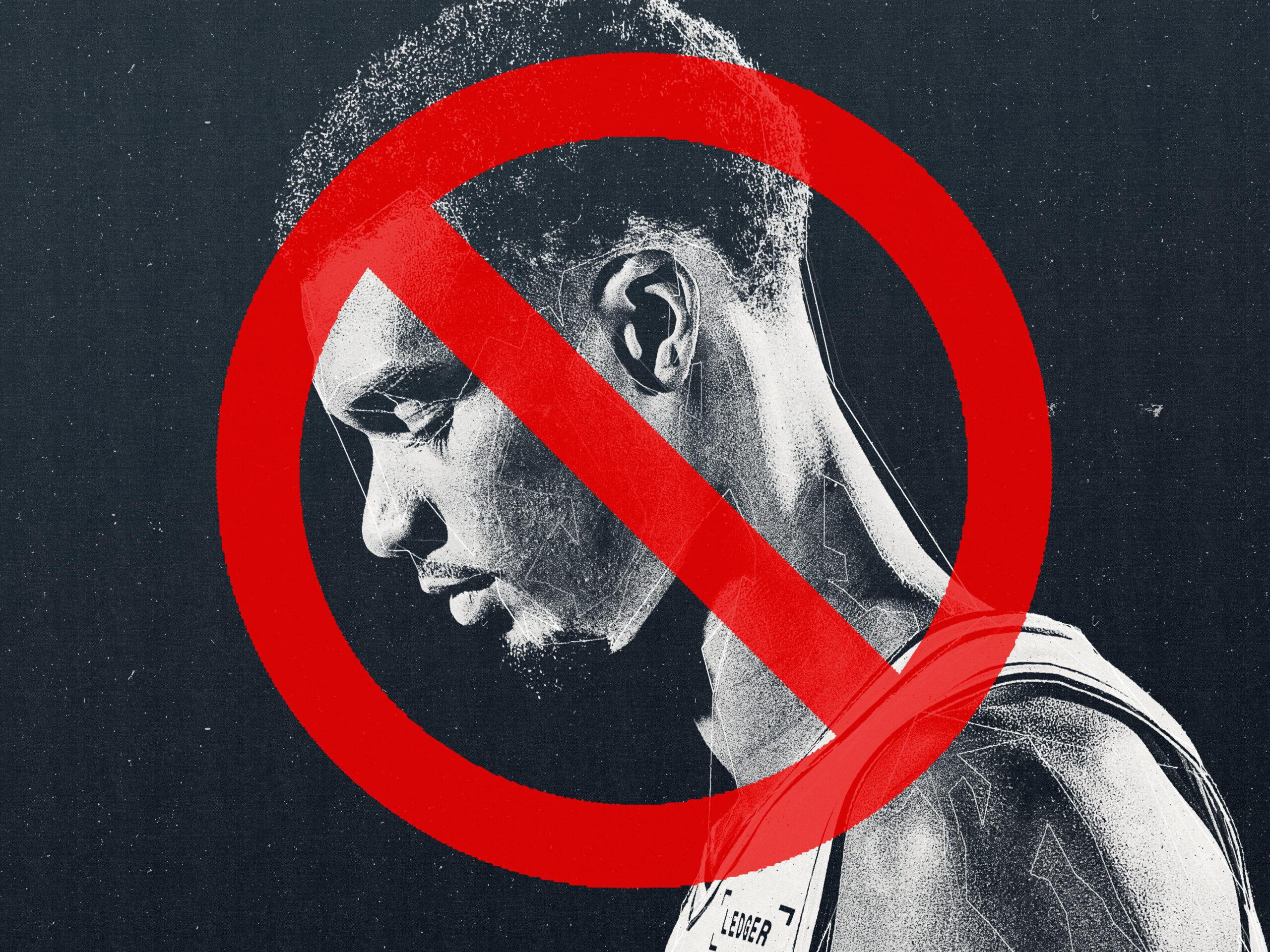

At some point, every sport must confront an uncomfortable question: Can an athlete become so good that allowing him to compete is fundamentally unfair? It’s a ridiculous proposition, of course. Until it isn’t.
Relatedly, on Wednesday night, Victor Wembanyama absolutely—almost single-handedly—destroyed the Dallas Mavericks, putting up career highs of 52 points and 24 rebounds, while adding eight blocks, in a San Antonio Spurs win. It was a marvel to watch; the Mavericks clawed back from a 19-point deficit only for Wembanyama to decide, with the capricious indignance of a Greek god, that enough was enough. At one point Wemby leapt so high, it seemed like his entire upper torso was above the rim. Or did he leap at all? Perhaps he just flew. After the game he murmured a koan of humility: “I wish I set better screens towards the end and made more free throws.” Which is to say: There’s a higher level to achieve here. If 52-24-8 is the baseline, what does next year look like? Hell, what does next week look like?
Wembanyama is a singular force and a certifiable spectacle. He’s a ridiculous proposition for any opponent. Which brings me to an even more ridiculous proposition.
With a new NBA season underway, the league finds itself at an unimaginable crossroads, all due to one superhuman man. Which is why I say this with both much trepidation and confidence: The NBA should ban Victor Wembanyama. Kick him out of the league. Send him back to the Euros, or to a monastic life, if that suits him. As it stands, at only 22 years old, he’s the best player basketball has ever seen, a phenom by any definition. But the league’s most extraordinary player presents a problem that the existing rules may not be capable of solving.
It’s not a novel concept: The history of professional basketball is, in large part, a scroll of regulatory intervention against exceptional athletes. Despite presenting itself as the land of athletic supremacy, the NBA has never operated on the principle that every competitive advantage conferred by nature must be accommodated. The opposite is true: Some of the most significant changes in the sport’s history have arisen because the physical advantages of certain players necessitated regulatory oversight. The game evolves and humanity evolves, but the NBA’s imperative to preserve competitive balance remains constant.
In 1951, the NBA doubled the width of the foul lane, from 6 feet to 12, a change explicitly intended to diminish the competitive advantage of George Mikan. In 1964, the league widened the lane again, from 12 feet to 16, principally in response to the existence of Wilt Chamberlain.




In 1967, the NCAA went even further when it prohibited the slam dunk, a rule that remained in place for a decade. The prohibition was largely due to the dominance of Lew Alcindor, later Kareem Abdul-Jabbar, who was frankly just too good at dunking. The issue was, again, competitive imbalance: These men decimated the geometry of the basketball court, so changes had to be made to keep the game honest. Basketball has never insisted that the rules are sacred when it’s faced with a problem. And in fact, Adam Silver has been more than willing to tinker during his tenure as commissioner.
Wembanyama presents a more difficult version of the same problem that Mikan, Wilt, and Kareem presented. At 7-foot-4, with an 8-foot wingspan, as well as guard-like ballhandling and a seemingly unlimited shooting range, he destroys not just the court’s geometry but also the implicit assumptions about positional structure and ability distribution.
You can look up his stats—they’re extraordinary, but they miss the point. His disruption is a structural one. Defensively, his area of influence is truly impossible to capture in numbers. The defensive three-second rule was introduced in 2001 to limit centers’ ability to interminably occupy the most valuable territory on the court, but for Wembanyama the paint is an afterthought; if he is on the court, he is impacting entire offenses the way an All-Star center could protect just the low post in the ’90s. The only way to change the rule to accommodate Wemby would be to limit his very presence on the court to three seconds at a time.
His offensive impact is somehow even more revolutionary, and even harder to litigate. He doesn’t need the paint to be the most potent offensive force in NBA history by a wide margin. He can comply with every NBA rule because the rules functionally don’t apply to him. He has almost every advantage that the league has tried to legislate out over the years, despite the rules in place to diminish them. To put it another way: He might not be “breaking” the rules, but he is breaking their spirit every time he steps foot on the court.
Other sports have recognized similar problems. Major League Baseball lowered the pitcher’s mound after the 1968 season because pitchers had gotten too good. The NFL has repeatedly changed its rules in recent years to benefit quarterbacks. These interventions demonstrate that the rules of a sport are aimed at ensuring some sort of abstract platonic ideal—and that this is more often than not a good thing. Weight classes in boxing and MMA are a good thing—not good for Brock Lesnar, who could have been the grand champion of the UFC in 2009, but good for the sport, and good for its fans.
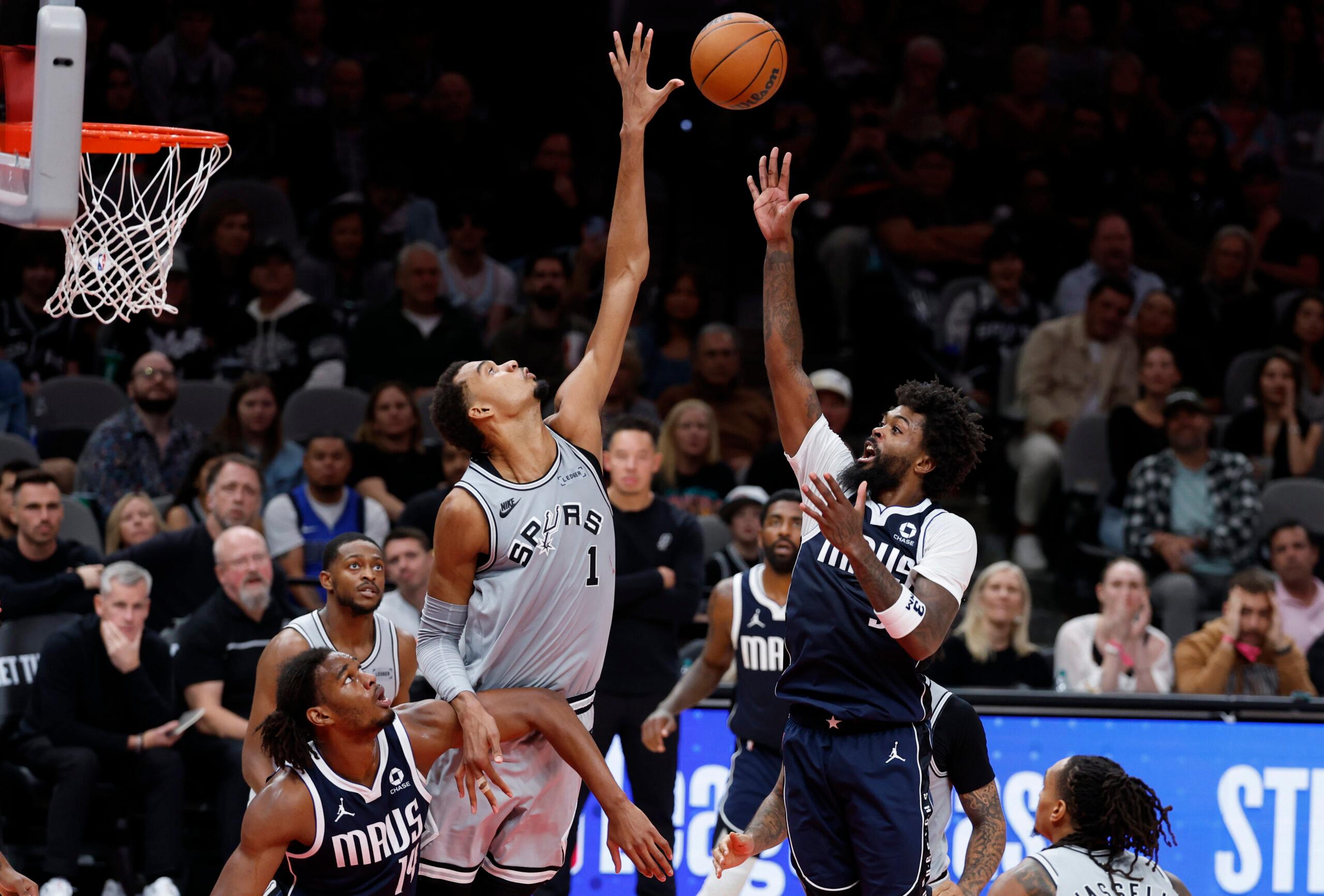
Victor Wembanyama blocks a shot by Naji Marshall
The problem is that you can’t regulate Wembanyama’s effectiveness. You can’t widen the lane further, extend three-second restrictions, or even raise the rim without disproportionately affecting every other player on the court. It’s definitionally unfair. And he’s still getting better. The problem with Wembanyama isn’t that he’s mastered basketball. It’s that he’s threatening to render the version everyone else plays obsolete. To regulate Wembanyama reasonably would require rules so strict that it would make it a one-player game, if it isn’t already. He raises the possibility that the NBA’s rule-tweaking approach has reached its practical limit. The NBA is not a neutral experiment in determining which human being is best equipped to put a ball through a hoop. It is not the Olympics of Pop-A-Shot. It is a manufactured competition whose dimensions have been repeatedly altered to produce a desired competitive outcome.
There are more practical aspects of the game that Wembanyama alters as well. Wemby is the betting favorite to be league MVP and the Defensive Player of the Year. Whether or not he earns those awards, the fact that, barring something unforeseen (or a major injury), he’ll be the favorite every year going forward points toward a bleak future of monotony. Do we really want a decade-plus of unfettered dominance by a single player? And to game-plan against him, other NBA teams risk reverting the league to perhaps its lowest point: In the previous era of center dominance, the league was almost ruined. Not by the big men highlighted above, but by the insufferable, overpaid stiffs that stood opposite them. For every Shaquille O’Neal, Yao Ming, and Hakeem Olajuwon there was a Jim McIlvaine, an Adonal Foyle, or a Jerome James who got paid millions of dollars simply because of their verticals—not vertical jump, but vertical length. Recall the inanity of Manute Bol and Gheorghe Muresan actually playing professional ball. If you were 7 feet tall and had a cool nickname—“Candy Man” or “Big Country” would do just fine—you were basically welcomed into the All-Star Game before you proved you could dribble. The league in the modern era has largely, thankfully, been driven by a coordinated move away from this era of 7-foot seat fillers, but counterprogramming against Wembanyama risks a potential relapse.
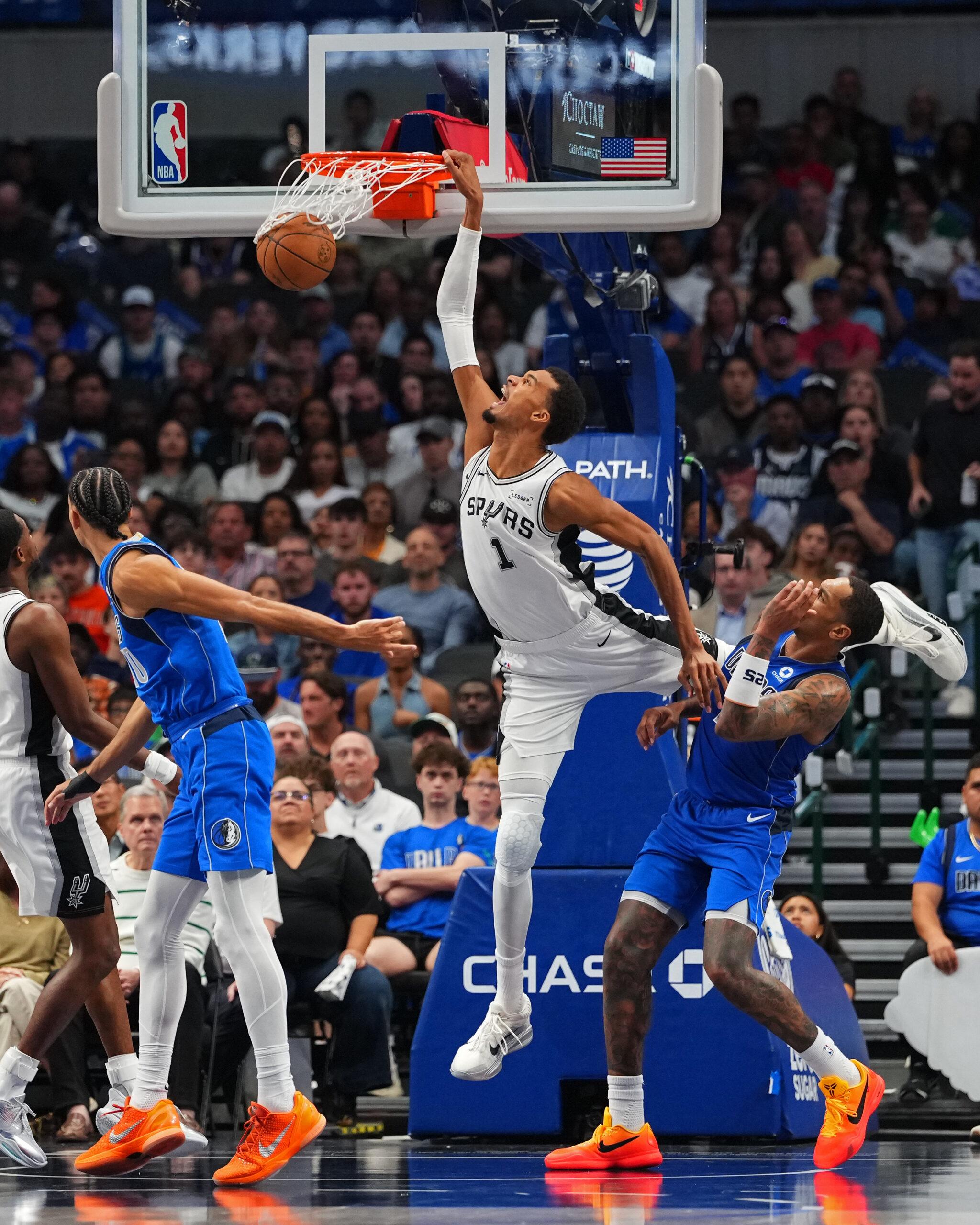
Wembanyama dunks during a game against the Dallas Mavericks
This should be any non-Spurs fan’s fear of the Wemby era—that teams will be reaching every year for a Wemby stopper, wasting more draft capital than Ted Stepien on a bender. Imagine the next Tacko Fall making $25 million instead of being a short-lived novelty. Maybe your team doesn’t want to pay the next Tacko Fall $25 million, but if it’s staring down playing the Spurs in the Western Conference finals … your team will pay the next Tacko Fall $25 million.
The greater fear here, though: tedium. Dynasties are one thing. At least they give us villains, rivalries, and the occasional illusion of hope. But what happens when the outcome of an entire season feels predetermined by the existence of one player? Imagine a league in which only one man matters, in which every season is decided by whether or not Wemby’s knees hold up. That’s not competition—that’s a race for second place. How excited will you be if every season you’re rooting for one single player to get hurt so that your team might get lucky? There are no number of Wemby highlights that could outweigh that ennui.
So there is only one practical solution: Ban Victor Wembanyama. Get rid of him entirely. It would go further than any previous NBA rule change, but the underlying logic would be the same, protecting the integrity of competition.
Sure, there have been outliers before. The game’s absolute elite—LeBron, Shaq, Curry, Jordan—have all had exquisite stretches of making the game feel simply unfair. But the league could litigate their impact without hamstringing other players, and other teams could game-plan against them; what’s more, other teams had competing superstars to balance the odds. Alas, there is no balance for Wemby. Wembanyama is not an example of superstar creep. He’s the greatest basketball player ever, perhaps the best thing to ever happen to the NBA. Which is exactly why he has to go.
LeBron and Steph excited us as fans. They made the impossible seem possible. LeBron sent a generation of big men lumbering excitedly into ballhandling drills; Steph made 3-point shooting the most important skill in every basketball game from local YMCAs to the Olympics. Their greatness was unattainable, but their games were somewhat imitable. Short of an Instagram fad of self-elongation on a human torture rack, there is nothing attainable about Victor Wembanyama. He is the impossible. If we keep going down this path, what’s possible is a permanently broken game.
We all enjoy moments of absurdity, of ridiculous feats of otherworldly athleticism. Case in point: In Space Jam, with only seconds left against the Monstars and the entire team physically dragging him down, Michael Jordan remembers that he is, in fact, in Looney Tunes land and stretches his cartoonized arm all the way from half court to score the winning bucket. It was a fun moment. But we should all be able to agree that cartoonishly long arms defying the laws of nature should not be allowed in an actual league of actual human beings.
The fundamental question here is whether the NBA exists to accommodate every conceivable form of basketball excellence, even the cartoonish, which it clearly does not, or to maintain some semblance of a competitive coherence. If the answer is the latter, then even the most extraordinary player in the league’s history must ultimately be subordinate to the providence of the sport and its rules. And if rules cannot adequately constrain Victor Wembanyama, then there is no place for him in the NBA.