
Allisha Gray dives to the hardwood for a loose ball. Angel Reese and Naz Hillmon collide, chest-bumping each other. Reese grabs her own miss and kicks it out to Gray, who buries one of her five 3-pointers of the game. Jordin Canada picks off an errant pass and races the other way for a layup. The de-fense chants reach a fever pitch. It’s a playoff atmosphere worthy of the WNBA Finals. There’s just one problem: It’s lunchtime on a Thursday.
The high-stakes afternoon affair was the WNBA’s first-ever Game 6 after the WNBA announced the Finals were expanding two years ago. But like so many of the WNBA’s milestones, it arrived with complications.
To allow the Dream to play in front of more than 17,000 fans at State Farm Arena, rather than the 3,500 who could fit inside their usual home at Gateway Center, Game 6 of the WNBA Finals was moved to 12:30 p.m. Thursday, less than eight hours before the Atlanta Hawks were scheduled to tip off in the same building.
By the end of the first quarter, the Dream, who were facing elimination, had doubled up the Valkyries. The seamlessness of Atlanta’s offense was in stark contrast to the WNBA’s nightmare week of planning that came before it. For the moment, fears of a Golden State clincher—and a rushed trophy presentation in the bowels of the arena—had faded.
Let it not be lost: It is by the grace of Gray’s shotmaking, Rhyne Howard’s aggression, Karl Smesko’s adjustments, and Reese’s defense that the defining moment of the WNBA’s 30th season won’t be a midafternoon, weekday coronation.
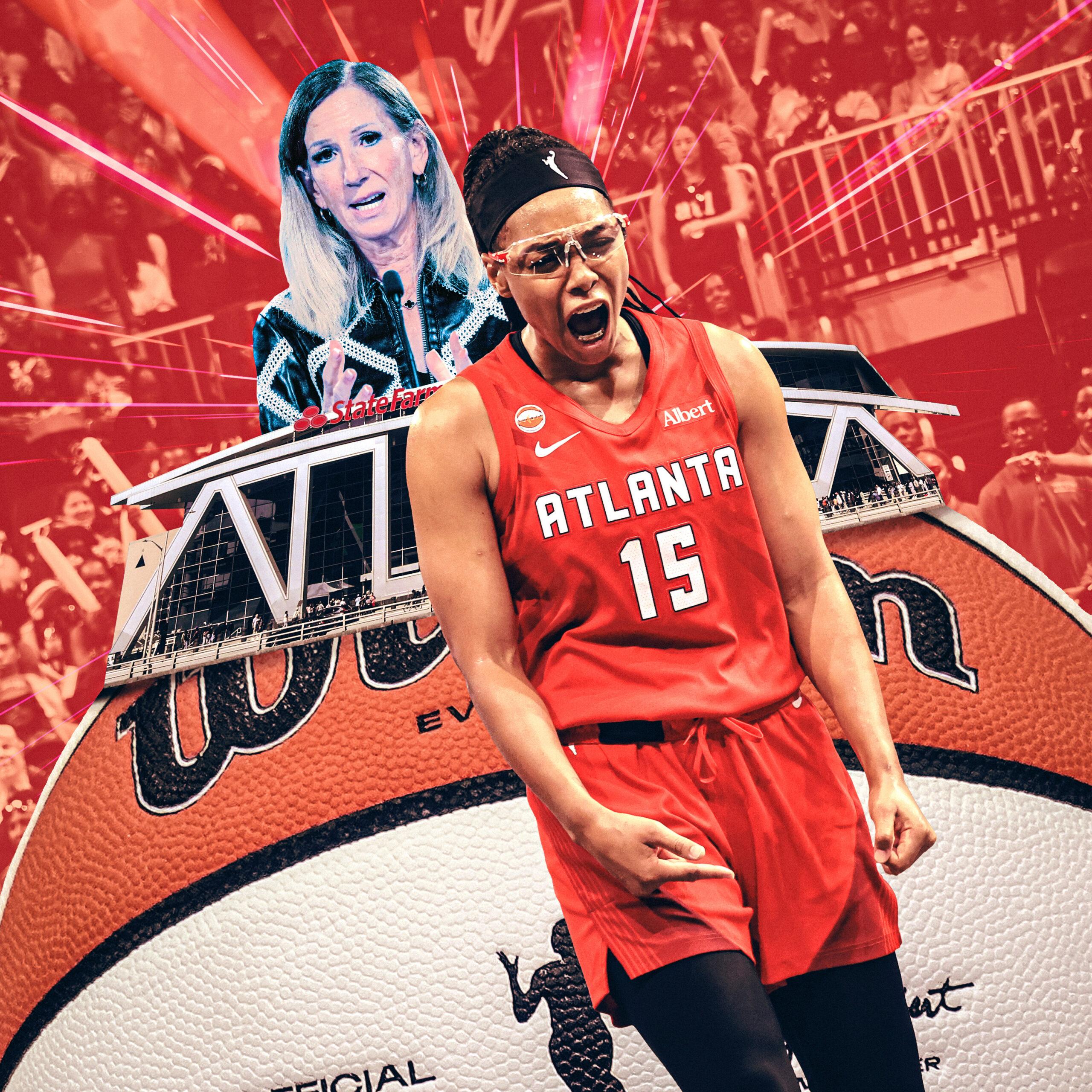
On Saturday, the two best words in sports, Game 7, will be followed by six even sweeter ones: Cathy Engelbert’s final act as commissioner.
In a matter of minutes, Thursday night’s—er, afternoon’s—game went from a high-intensity cauldron to a concert, the best day party in a city with no shortage of parties. State Farm Arena was a kaleidoscope of Dream memorabilia and Atlanta symbols: a lemon pepper wing sign, a pink ATL Barbie jersey, an “ATL vs. You, Your Momma, and Your Cousin” hoodie, and a halftime performance by local resident T-Pain. For most of the Dream’s 80-69 win, I couldn’t hear the person beside me, but nothing was more deafening than the “ATL Hoe” chants that rained down after the final buzzer.
Like their beloved Dream, the crowd was joyful, unrelenting, defiant, and motivated by what has become a theme in this defensive rock fight of a series: pride.
“You can definitely tell we got our swagger back,” said Reese. “Shout-out to the crowd for being able to come here at 12:30 on a Thursday with so many things going on in the world, from school to work to everything else. We're just super thankful. We fed off their energy.”
Game 6 was full of familiar WNBA peculiarities: a disconnect between the electric atmosphere inside the arena and the discourse surrounding it, a completely avoidable logistical fuckup on the sport’s biggest stage, and a controversy that didn’t overshadow the basketball but demanded attention anyway.
Atlanta’s win saved the WNBA from a cataclysmic PR nightmare. For a league that rarely misses an opportunity to magnify a crisis, this is no small fact—even if it can’t take credit for it.
While the Dream, the Hawks, the WNBA, the NBA, and their media partners had pulled together to reserve State Farm Arena for Games 3 and 4, the Hawks’ schedule made arranging Game 6 complicated.
Blame can be assigned to nearly every party.
The Dream, according to The Athletic, received a memo from the WNBA last December saying that they had until the end of the month to lock down an arena for potential Finals dates. Of course, they didn’t trade for Reese—and gain the popularity that would justify a bigger arena—until April.
In an open letter to their fans, the Dream said that they had brought up the issue with the league months ago, but that their concerns, reiterated multiple times, were ignored.
Unlike the Valkyries, who are owned by the Warriors’ Joe Lacob, the Dream do not share ownership with the Hawks. But while the complications they faced are a reflection of the NBA’s complex ownership structure and stewardship of the WNBA—as well as the challenges that come with being a non-NBA-affiliated franchise in an era of increased consolidation—the responsibility here doesn’t squarely fall with the NBA, either.
Hawks owner and State Farm Arena CEO Steve Koonin even reached out to WWE’s president to try to move the telecast of SmackDown—scheduled for Friday night—to accommodate a prime-time WNBA slot if the game could be moved.
According to ESPN, sources from all sides expressed frustration with the time crunch, suggesting that the Hawks would have been open to rescheduling or moving their Thursday night game if they had had more time.
The buck ultimately stops with the outgoing WNBA commissioner, Cathy Engelbert. Read between the lines, and you’ll find the same issues that have plagued most of her tenure: a lack of foresight, communication, and consensus building—qualities that will be paramount for her successor.
Perhaps the whole affair offered some insight into what not to do for deputy NBA commissioner Mark Tatum, who was involved with liaising between the leagues and is among the (many) names being floated as the next commissioner of the WNBA.
The players offered platitudes about being ready to compete despite the strange start time. Valkyries guard Veronica Burton even joked that fans should call in sick. Kiah Stokes added, “Y’all know how to fake a cough.” In the throes of the most important games of their careers, what else were they to do? For years, being a women’s pro basketball player has meant meeting unideal circumstances with acceptance, innovation, and gratitude.
Now that women’s basketball is big business, it’s easy to forget that players spent years fighting for better television slots and bigger arenas. The WNBA never should have had to choose between a prime-time audience and a packed arena for what could have been the most watched game in league history, especially when the demand for both was undeniable.
The WNBA is quick to tout its exponential growth, but it hasn’t done enough to accommodate it. Moments like Thursday’s game are a reminder that the league is nowhere close to living up to its financial or cultural potential.
The Valkyries, all the while, have tapped into their local fan base to the tune of a $1 billion valuation and more than $100 million in annual revenue. The Dream, for their part, have etched themselves into the fabric of Atlanta in an incremental five-year rebuild that has prioritized player experience over a new arena.
Engelbert’s tenure has featured far too many vivid symbols of the WNBA’s growth outpacing its infrastructure: Kelsey Plum’s tiny 2022 All-Star MVP trophy, Caitlin Clark and the Fever flying commercial for preseason games her rookie year, the Connecticut Sun having to share a practice court with a 2-year-old’s birthday before the 2024 playoffs.
The product demands better execution. It always has, but on a night—sigh, morning—like this, it was never clearer.
The record-breaking television ratings and sold-out games in this series have offered a rejoinder to the notion that only high-scoring games can draw crowds in the women’s game. The physicality of the Finals, played between the league’s two best defenses, has become a compelling story in and of itself. These teams seem to approach every game like a battle. Golden State coach Natalie Nakase’s philosophy is “win or die.” The Valkyries hold hands and let out a collective primal scream before practices. Reese’s pregame handshake with Gray includes a salute. All that’s missing is the battle armor.
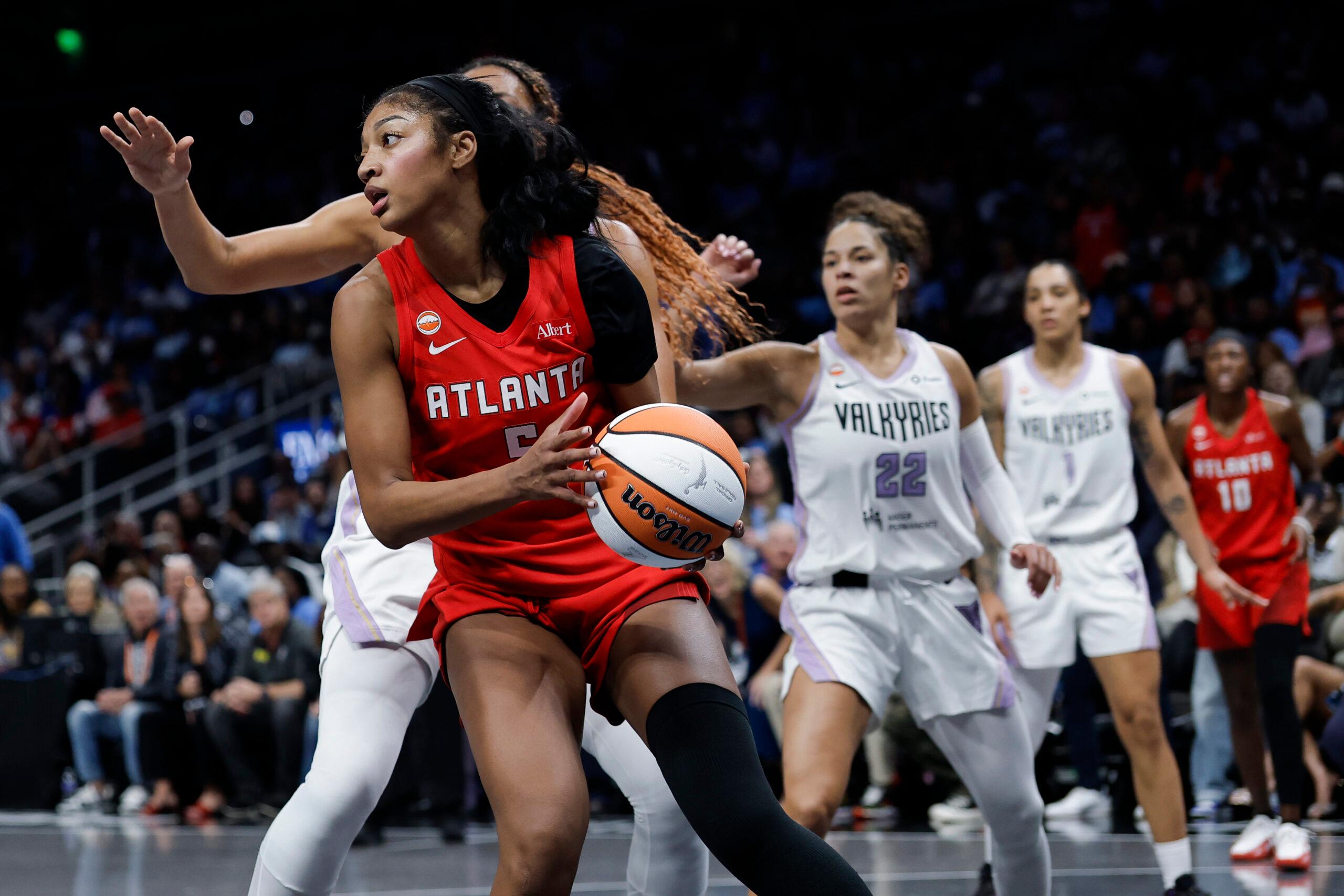
Angel Reese is defended by Kiah Stokes in Game 6
After Reese snatched the Valkyries’ souls in Game 2 and 3, Golden State responded with a counterpunch in the next two games that shut her down and elevated Stokes, who guarded her and requested to match her minutes, into a folk hero.
Atlanta punched first on Thursday, but Golden State’s late-game comeback was a reminder that on this Halloween Saturday, in the WNBA’s first-ever Game 7, these teams will be staring each other squarely in the eye.
“At the end of the day, we feel good,” said Burton. "Yes, we lost. It was a bad game for us. We had a terrible first quarter. We cleaned it up. … We didn’t quit. Games … 2 and 3 were ugly. We quit. We looked bad. We didn’t quit on this one. There’s a lot to take away.”
Both teams have earned the spotlight. On Saturday, with Game 7 tipping off at 8 p.m. ET, they’ll finally get it. The question, as ever, is whether the league is ready to step into it.