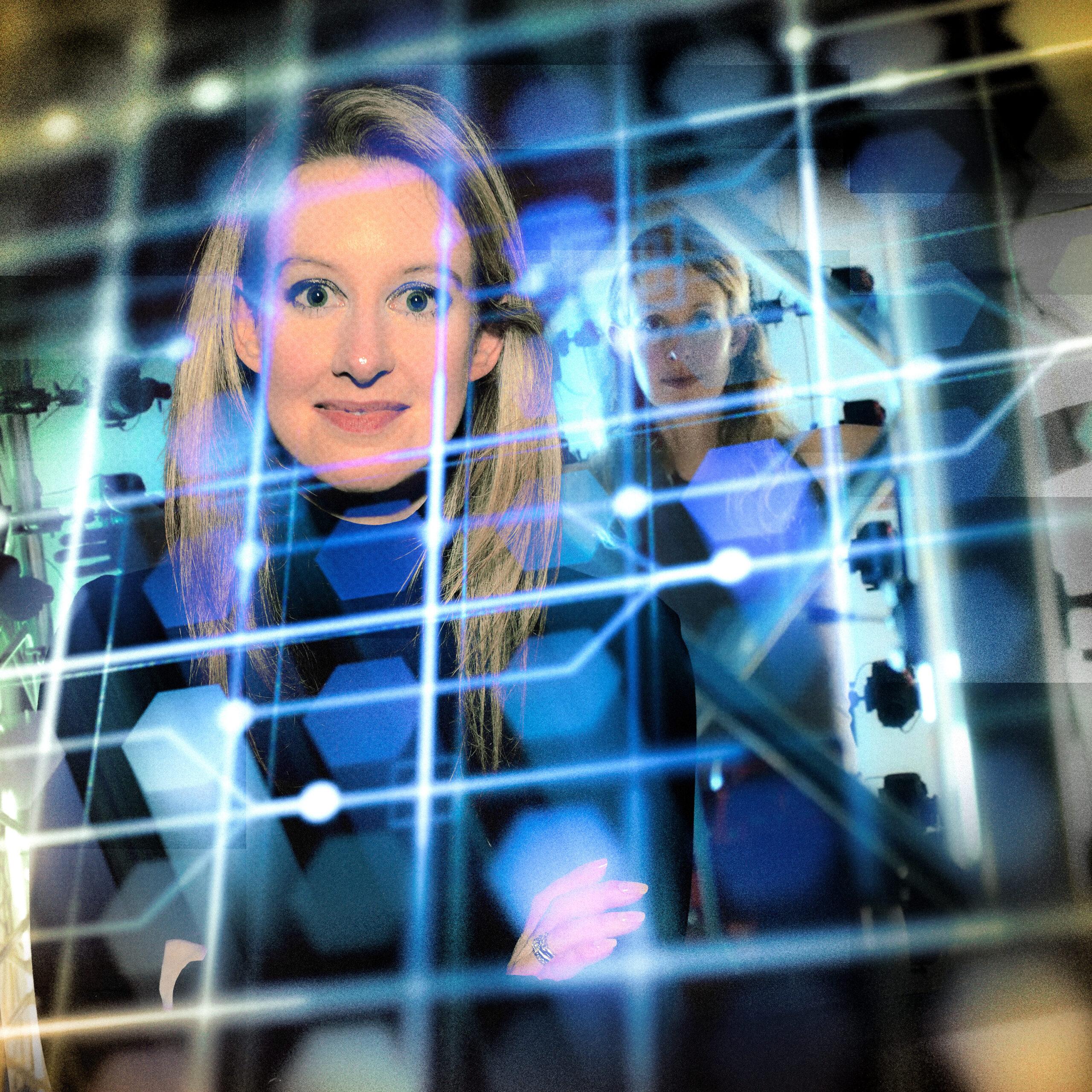

Before the fame and the notoriety; before the iconic magazine covers with headlines like “THIS CEO IS OUT FOR BLOOD,” before the paper millions that multiplied into billions and then vanished into nothing, and definitely before the federal trial that culminated in an 11-year prison sentence, Elizabeth Holmes was just an eager Stanford dropout in her early 20s with a stealth biotech startup to her name and a brand-new road map for success.
On fancy hotel room letterhead, with cat-scratch penmanship, Holmes jotted down an aspirational and possibly unsustainable daily routine designed to help her become her very best self. “4:00 AM,” it began, “rise & thank God. most things are not logical.” By 5:20 AM, Holmes sought to have washed her face, changed her clothes, meditated for 30 minutes, and exercised. From there, her agenda continued:
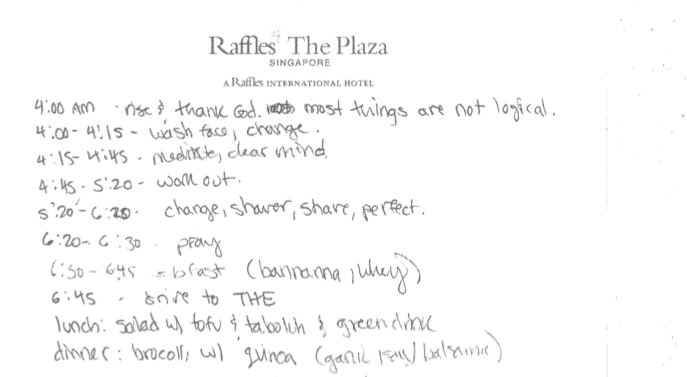
As primary source documents go, this is a highly relatable one. Who among us hasn’t embarked on a new-year-new-me journey of codified/misspelled restraint involving quinoa at some point? (The one key difference is that my best-laid plans are traditionally written on Courtyard by Marriott stationery.) Slightly less relatable, however, is the reason I came across Holmes’s note to self: Because it was filed publicly as Defense Exhibit No. 07731 in United States v. Elizabeth A. Holmes, et al., the federal trial that sent Holmes to prison.
Her crime? Taking far too literally that old startup-land tenet of faking it till you make it. Or, in legal parlance, four counts of defrauding investors in her ambitious and doomed drop-of-blood diagnostics company, Theranos. “An exciting venture went forward with great expectations and hopes,” is how Hon. Edward Davila, the presiding judge on the Theranos case, summed up the company’s story, “only to be dashed by untruths, misrepresentations, hubris, and just plain lies.”
What exactly happened during the decade and a half between when Holmes launched Theranos and when she got arrested has already been the stuff of a definitive, thrilling page-turner (Bad Blood, written by investigative reporter John Carreyrou), an Alex Gibney documentary (The Inventor, on HBO), and a multipart podcast turned campy Hulu series featuring Amanda Seyfried and William H. Macy (The Dropout, a show that Jennifer Lawrence enjoyed so much that she dropped out of a different planned Theranos feature—an Adam McKay–directed film—killing that project altogether). But last week, a strange and totally different new Holmes movie debuted, one which, come to think of it, could also be described as “an exciting venture with great expectations and hopes.” The key difference is that in this case, all the untruths, misrepresentations, hubris, and just plain lies are a feature, not a bug.

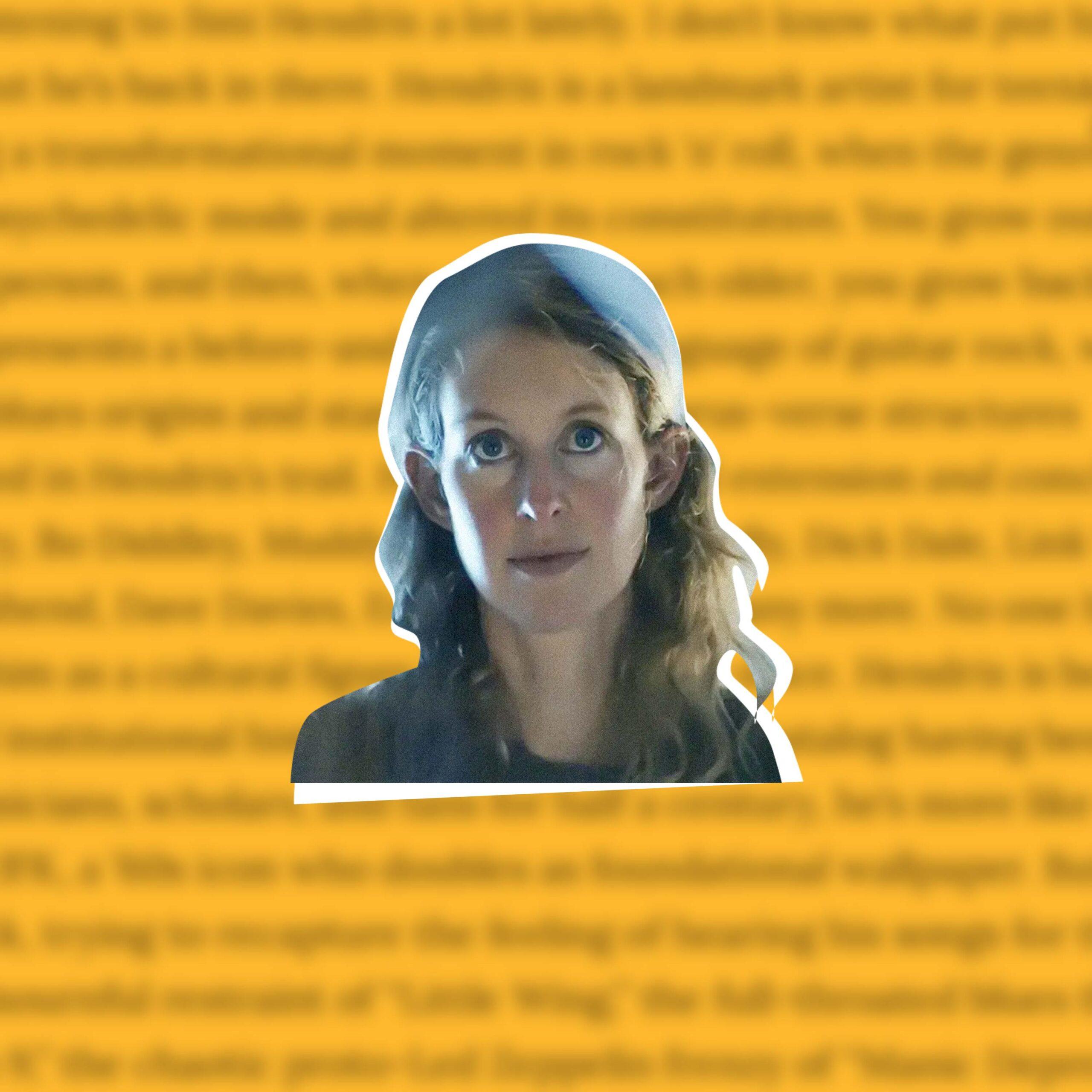
You Can See Everything, this new documentary from A24, took Telluride Film Festival filmgoers by surprise in September and was an immediate box office darling when it hit theaters last week. Shot by ascendant director Lance Oppenheim and fronted by noted deadpan artist Nathan Fielder, the project homes in on Holmes during her final 34 days of freedom before she reports to prison. The filmmakers shack up with the convicted felon and her family on the shores of Del Mar, California, as she comes to grips with what awaits her at Federal Prison Camp Bryan in Texas. Small bits of hilarity and a heaping dose of slack-jawed confusion ensue.
In the movie, which runs nearly three hours, Holmes has replaced her trademark Steve Jobs–inspired black turtleneck for more neutral fibers, let her hair curl and her roots grow, and left the bits and bytes of Silicon Valley for the wood paneling and ocean sounds of coastal SoCal. She has a partner, Billy Evans, who calls her Lizzy and coos things at her like, “You’re so true and so good” and is, in every way, just a real piece of work. Holmes and Evans have two cherubic children together: a toddler son named after his dad, and a bitty-baby daughter who requires near-constant jiggling throughout the movie’s first half. (They call the baby Ivy, short for Invicta—a name meaning unconquered.) One child’s birth delayed Holmes’s 2021 criminal trial by a month; the other child was conceived in 2022, sometime between when Holmes was convicted in January and sentenced in November.
Far from her old black pantsuit–clad, intimidating-CEO persona, the Holmes of You Can See Everything sometimes clutches a crystal for comfort. She stirs eggs without the appropriate level of vim and vigor (according to a triggered Evans, who takes over the bowl). She cries more than once, her cerulean eyes pooling like glacial melts. The audience is left to calculate for itself the suspected ratio of legit postpartum hormonal tears to crocodile ones.
But for all that has dramatically changed about Holmes’s set of circumstances, there are fascinating glimpses throughout You Can See Everything that suggest that certain aspects of the notorious Theranos founder’s mindset are pretty much set in stone. Like her obvious interest in getting back into business one day, when the time is right. And her unyielding insistence that she really, truly didn’t do anything wrong.
At Theranos, Holmes made a promise: that the company had developed a way to instantly and affordably deliver hundreds of health-related test results with just one little fingertip prick’s worth of blood, a discovery that she felt could bring about “a world in which no one ever has to say goodbye too soon.” And the founder had a charming backstory to tell. As a girl, Holmes wrote a letter to her dad professing that “what I really want out of life is to discover something new, something that mankind didn’t know was possible to do.”
As a precocious and audacious Stanford freshman, Holmes wasted no time seeking out chemical engineering professor Channing Robertson—who was so drawn to her ideas and her confidence that when Holmes dropped out to focus on her endeavor, he eventually left to join, too. An early name for the company, Real-Time Cures, was abandoned because people had a “cynical” reaction to the word “cure,” Holmes later told Fortune reporter Roger Parloff. In its place, Holmes mashed up the words “therapy” and “diagnosis” to christen the biz Theranos.
Early investors included venture capitalist Tim Draper (whose daughter Jesse had been a childhood playmate of Holmes’s), Oracle’s Larry Ellison, and Don Lucas, an early Oracle backer who became Theranos’s chairman. Holmes hired away employees from places like Apple to help design the sleek medical equipment she had in mind. The company entered into contract work for pharma giants like Pfizer, monitoring clinical trials (and testing out Theranos tech in the process).
But there was an uncomfortable issue: All these bleeding-edge inventions were, in practice, kinda wack. When the equipment malfunctioned during a demonstration of a Theranos reader for Novartis execs in Switzerland in 2006, Theranos employees back in the States “beamed over a fake result.” Plenty of fledgling companies have wonky prototypes, to be fair; the biomedical industry in particular is littered with fallen moonshots. But the situation at Theranos was contrary to the rosy picture Holmes often presented. What’s more, people within the company who asked questions about what they were seeing tended to find themselves frozen out by management or even, in some cases, escorted off the premises.
In 2008, all this institutional denial nearly cost Holmes her company. A couple of worried employees, alarmed at the failing machines and the overly optimistic revenue projections, escalated their concerns to the board of directors. Members of the board decided it would be best for the company to replace Holmes as CEO and called her in to break the news. But then, Carreyrou writes in Bad Blood, “Something extraordinary happened: Over the course of the next two hours, Elizabeth convinced them to change their minds.” Having stared down a corporate coup, Holmes emerged stronger than ever. One board member remarked to Carreyrou that the whole situation reminded him of the quote: “When you strike at the king, you must kill him.”
For Holmes, it was one more piece of evidence that she could and should use her world-class persistence for real-world persuasion. As a bright high schooler, she’d elbowed her way into a Mandarin class at Stanford through (a) studying hard, but more importantly (b) absolutely refusing to stop calling the language department about it. It had taken similar dogged finagling to get into Robertson’s graduate lab as a freshman. At Theranos, she code-named the company’s blood analyzer machine “Edison”—and sometimes when it was a dud during testing, she’d reference a Thomas Edison trial-and-error motto she enjoyed about how he hadn’t failed 10,000 times—he’d just successfully found 10,000 ways that will not work. When you’re right, you’re right. When you’re wrong? It’s just data.


Since his breakout success in Nathan for You, Fielder has built his name and reputation on maintaining a pathologically straight face. But in You Can See Everything, even he sometimes appears dumbfounded by Holmes’s whole deal. “I know I didn’t commit any crime,” she declares resolutely near the start of the film; it is one of several times throughout that the unflappable Fielder seems to be legit pondering: Is this lady for real? It happens again a little bit later, during this exchange:
Fielder: You really feel you did nothing wrong.
Holmes: I did not.
Fielder: You never tried to deceive anyone?
Holmes: I’ve never tried to deceive anyone.
Fielder: Ever in your life?
Holmes: No.
Fielder: Have you ever lied in your life?
Holmes: I don’t think so.
Fielder: (sputtering) Liz—what?! You’ve never said something untrue?
Holmes: Not intentionally.
Unsurprisingly, Holmes’s inner circle backs up their girl. “Elizabeth was by no means guilty of anything,” Holmes’s father, Chris, remarks to Fielder. Evans, meanwhile, says that while he has told lies, he hasn’t “known her to—and I know it seems probably improbable. I understand that. It’s weird. She’s really weird. She’s just not normal.”
The years following Holmes’s 2008 near-ouster were filled with big changes and initiatives at Theranos. Holmes inked extensive retail partnerships with Safeway and Walgreens that would bring Theranos ever-closer to consumers. She dove into the scene at Stanford’s Hoover Institution and was a big hit with the old-school D.C. hawks. One scheduled 10-minute meeting with former Secretary of State George Shultz stretched into two and a half hours; he joined her board that same month and helped recruit other secretaries of state and/or defense, as well. General Jim “Mad Dog” Mattis addressed her warmly in emails as “Young Elizabeth.” (They often brainstormed about how Theranos could be useful on the front lines in combat.) Henry Kissinger called her “a monk” with “an iron will”; Defense Secretary William Perry told The New Yorker that “she has a social consciousness that Steve [Jobs] never had. He was a genius; she’s one with a big heart.”
In 2013, Theranos officially came out of stealth mode. “Theranos: The biggest biotech you’ve never heard of,” read a cover story in the San Francisco Business Times. It wasn’t long before Holmes was everywhere: on the covers of Fortune, Forbes, Inc, etc. The pool of Theranos investors deepened to include the Wal-Mart heirs, Rupert Murdoch, and the family of Betsy DeVos. The company’s valuation ballooned to $9 billion, and Holmes held a 50 percent stake.
But under the hood, things weren’t running nearly as smoothly as they appeared. The Safeway and Walgreens relationships were plagued with setbacks and disappointing implementations. (A common experience for Walgreens customers who showed up to get the fabled finger-prick was to hear, Sorry, for this test we’ll need to find a vein in your arm.) The visions of battlefield glory faded away. Smart money investors and Stanford professors alike started wondering why Theranos never put out any peer-reviewed studies. Morale was low within the company, where Holmes and her right-hand-man/age-gap-boyfriend at the time, Theranos president and COO Ramesh “Sunny” Balwani, had forged a toxic culture of paranoia, secrecy, and threats.
The beginning of the end happened fast. “It’s hard to overestimate the potential benefit of what Elizabeth Holmes has developed with her tech company Theranos,” gushed an unfortunately-timed 2015 piece in T: The New York Times Style Magazine about Holmes, who was also featured on the cover. This was technically true! And yet that very quality was about to become Theranos’s major vulnerability. More than a decade after Holmes started the multibillion-dollar enterprise, it was still little more than a heap of potential in a black turtleneck.
On October 15, 2015, just days after the T feature was posted online, a seminal Wall Street Journal bombshell with the understated headline “Hot Startup Theranos Has Struggled With Its Blood-Test Technology” hit newsstands. “Theranos has struggled behind the scenes,” wrote Carreyrou, “to turn the excitement over its technology into reality.” His piece alleged that the Edison machine was only handling a teensy fraction of the tests being sold to consumers, and that Theranos was otherwise secretly diluting and outsourcing its samples to third party equipment. This initial salvo would eventually grow into Carreyrou’s bestselling book, Bad Blood.
In response to Carreyrou’s article, Holmes went on CNBC’s Mad Money to smooth things over. “This is what happens when you work to change things,” she told Jim Cramer, like it was the most obvious thing in the world. “First they think you’re crazy, then they fight you. And then all of a sudden you change the world.” Theranos never did get to that last part.
Holmes’s fall from grace brought scrutiny to the supposedly “high-trust” world of high-tech investing. Which then, understandably, led many in Silicon Valley to argue that she was never actually part of their world, that Theranos was a fringe fluke backed by gullible Washington types and family office dumb money, that the vaunted Sand Hill Road VC firms had smelled a rat all along and declined to invest. Elements of all that are true, but they do elide how Holmes and Theranos embodied (and leveraged) so many tropes and hallmarks of the tech template from that era. The Stanford dropout founder. The Steve Jobs standom. The making the world a better place pitch. And the gray-area regulatory arbitrage: just as companies like Airbnb and Uber built their fortunes on a sort of “ain’t no rule says a dog can’t play basketball” understanding of their respective industries, Theranos luxuriated in a legal loophole that kept their in-house devices out of FDA review. Which enabled Holmes to indulge in her favorite rhetorical move: blurring the distinction between what a product theoretically could do with what it can do right now.
“The Theranos story is an important lesson for Silicon Valley,” read a 2018 SEC statement charging Theranos, Holmes, and Balwani with fraud. “Innovators who seek to revolutionize and disrupt an industry must tell investors the truth about what their technology can do today, not just what they hope it might do someday.”
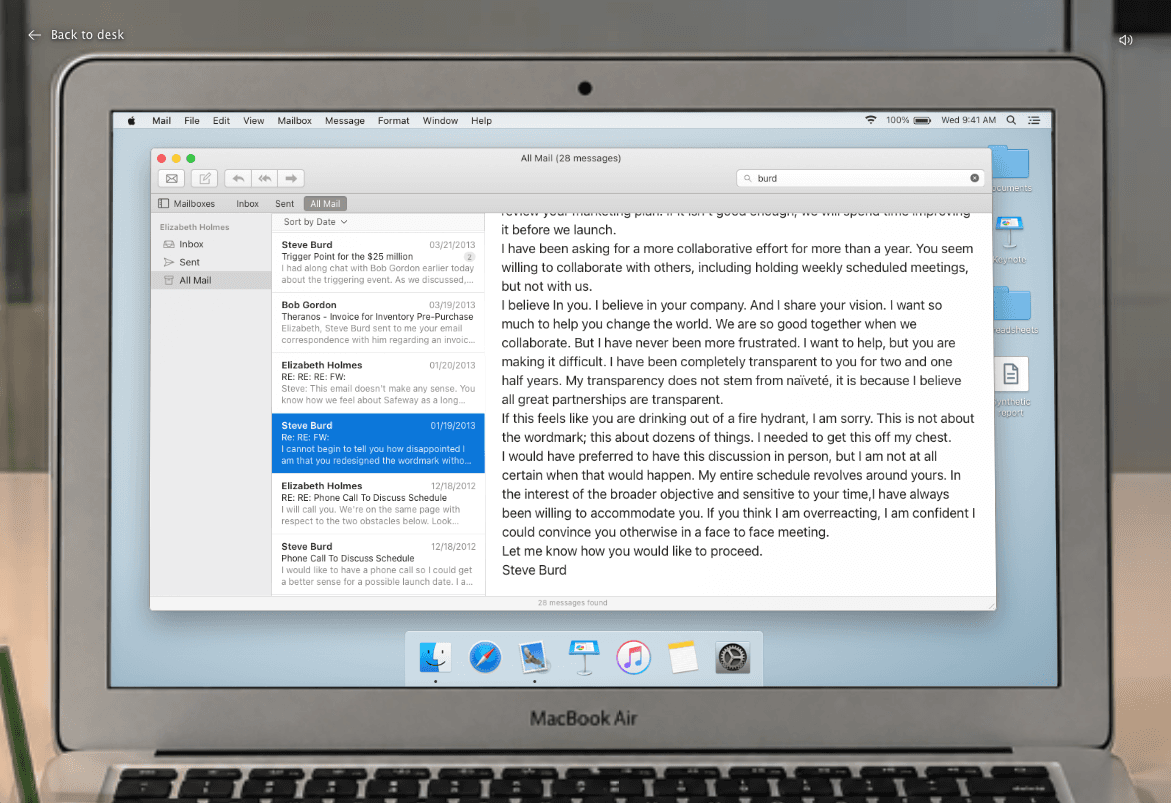
If you navigate your browser to Theranos dot World, you can spend a few minutes sitting at a vibecoded rendering of Holmes’s old desk. The site was built by a startup engineer named Bo Lau, who rented out a theater for a screening of You Can See Everything and wanted to rustle up engagement for the event. (Lau based the office’s decor on what she saw on The Dropout.) You can sip a green drink, play some tunes, and click around on Holmes’s phone and computer, which are populated with many of the PowerPoints, emails, and text messages that were once evidence in court. (Sadly, I didn’t see this exchange on there.) The experience is like a more immersive version of JMail, the site that put the Epstein Emails into a user-friendly interface.
It’s a trip to see a small glimpse into Holmes’s universe from behind those blue eyes. Chipper good news emails are surrounded by reams of customer complaints, requests for data, and snide reactions from Balwani. General Mattis pops up every so often: “Keep charging and stay strong, young Elizabeth,” he writes in early 2013. “You’re going to light the world on fire.” The CFO of Walgreens sends an email with the subject line “You!” praising a TV interview with Sanjay Gupta. In one note, Holmes counsels her brother and colleague, Christian, on how to best massage a messed-up test result: “You can say we do run those assays, but were not able to run them on this sample,” she explains, “apparently due to a human error in sample handling.”
Two emails struck me most, though. One was a 2014 memo from Tyler Shultz, George’s grandson, an eager beaver who had been stoked to work at Theranos but was taken aback by all the shambolic results and protocols he saw. After he laid out all his reservations, Balwani responded: “Had this email come from anyone else in the company, I would have already held them accountable for the arrogant and patronizing tone and reckless comments.” (Tyler Shultz would ultimately wind up whistleblowing, a decision that subjected him to all kinds of Theranos-led legal threats.)
The other is a long, emo message from Steve Burd, then the Safeway CEO, who in 2010 committed $350 million to update his stores in advance of a planned Theranos physical partnership—only to watch months and years go by with no progress. (One previous email of his is titled “Becoming Discouraged.”) In this one, he laments: “We are so good together when we collaborate. But I have never been more frustrated,” and tells Holmes: “My entire schedule revolves around yours.” In response, Holmes begins: “Steve: This email doesn’t make any sense.”
On social media, one user described Theranos World as “Like Myst for people who know who Fuisz is.” Uh, please don’t threaten me with a good time! The comment got my mind whirring with the potential. Imagine a folder somewhere where you could rifle through the things of Holmes’s that weren’t emails, like her scrap papers and marginalia, looking for clues to her behavior in her list of self-affirmations, which include:
I do everything I say—word for word
I know the outcome of every encounter
I speak rarely. When I do—CRISP and CONCISE
Ideally the folder would also include the document of “non-negotiables” Balwani once wrote out for her benefit. “I will not assume that people will do the ‘right’ or noble thing,” it reads. “They are not motivated by what I am motivated by. (don’t feed pasta & pesto to fish). I will learn what makes them tick and use that as bait to motivate them.”
So, what actually makes Holmes tick? Currently, it’s the hands on the clock. In a February 2025 People feature, Holmes called prison “hell and torture.” The story described “a ritual” at the end of her family visits: “The children pressed their fingers together to make a heart sign, saying in unison, ‘Mommy, this is our love.’ To which their mother responded, ‘Our love is a superpower.’” On March 26 of this year, Holmes’s sentence was reduced from 135 months to 123 under new federal sentencing guidelines for first-time offenders. (“To be clear, this sentence reduction does not diminish the enormity of Holmes’s crimes,” Judge Davila wrote.) She was also granted a move next summer from Camp Bryan into a halfway house; her projected release date is February 2030.
In You Can See Everything, Evans, kept company by his coterie of housesnakes and lizards, bides his time by staying hard at work on a company called Haemanthus—named after a plant called a “blood flower”—driving a car with the license plate LASERS, and raising the children.
There are many haunting scenes in You Can See Everything, from hella-testy conversations to Billy’s soaped-up testes. But the sequence that remained with me long after I’d left the theater came about halfway through the movie, shortly before Holmes is due to begin her prison sentence. Holmes and Evans are brainstorming a new idea, same as the old idea: basically, Theranos 2.0. “There’s a real opportunity to leverage the next generation tech,” Evans tells someone over the phone, “and self-driving, and tuneable lasers, and these other dimensions, into the field of medicine.” So true!
Holmes tells what seems to be a prospective investor that she plans to snail-mail her designs and ideas to Evans while she’s incarcerated. “Even if it’s inventing from a cage, I have to do it,” she says. And hey, maybe she can. Life outside Camp Bryan has been evolving: When Holmes went to prison, a newfangled product called ChatGPT had been public for only about six months, and Joe Biden was president. These days, rogue agents apparently stand to take over the world, and so much money flows into anything with the letters AI—sorry, SI—in the deck that the old Theranos $9 billion top-tick looks like a lark. Meanwhile, President Donald Trump has granted clemency to numerous convicted founders, from Silk Road’s Ross Ulbricht to Nikola’s Trevor Milton to Binance’s Changpeng Zhao, while once-scorned execs like Uber’s Travis “God View” Kalanick and WeWork’s Adam Neumann are back in the fray. (In a nice touch in You Can See Everything, we see that Evans’s office is in a WeWork.)
To a certain kind of modern moneybag, to be “embattled” is a green flag, a sign of “spiky” high agency and confident focus, a descriptor that evokes impervious visionaries like Elon Musk. Holmes may have alienated much of Silicon Valley, but she and Evans now appear to be courting the interest of these other circles. (Early in You Can See Everything, Evans tellingly tries to flatter Fielder the best way he knows how: “We only want to let people into our lives who think outside the box,” he says, “and you look at things differently and you don’t give a fuck what people think.”) In the call in the film, after Holmes mentions her intention to invent things from prison, Evans all but brags: “The powers that be might not be too happy to see this come about.” We then hear the prospective investor on the other end of the phone say: “Wow, this is really cool!”
When they get off the call, Holmes is glowing, alive with the spirit of enterprise. It strikes me that this might be the most real-deal genuine I’ve ever seen her look. “I feel so energized after that!” she enthuses. Fielder asks her why. “’Cause it’s like, what I feel like I was born to do,” she says. Holmes’s parents, Chris and Noel, are in the room while this celebration is happening. They look miserable and keep quiet.
I don’t know what Holmes is thinking—in that moment, and in the three-plus years that have passed since—but I can venture a guess that it has to do with conviction. Maybe she’s currently musing about how someday, the self-driving cars and the lasers and the AI (or what have you) could inch technology ahead enough to work out some of the old Theranos kinks and bottlenecks. And if that happens, could her work start to be positioned as a stepping stone instead of a road block, an important waystation on the epic pilgrimage of a true believer who never gave up, who wasn’t wrong—just early?
Maybe she’s thinking about how February 2030 is only 40 months away, or about how everything is bigger in Texas: the fish, the egos, the checkbooks. Maybe she’s reminding herself that I know the outcome of every encounter and I never intended to deceive anyone, or maybe she’s far beyond needing any reminders of what she knows to be true.
I’d heard Holmes use that born to do language before. Near the end of The Inventor, the Gibney documentary, Holmes is shown being interviewed by the filmmaker Errol Morris with his Interrotron camera. “It's finding what you love, and finding what you're born to do,” she tells him, eyes alit. “And when you find that ... when you really give everything to that, then you can realize great things. We’ll fail 10,000 times if we have to, but we’ll figure it out on the 10,001st, you know?”