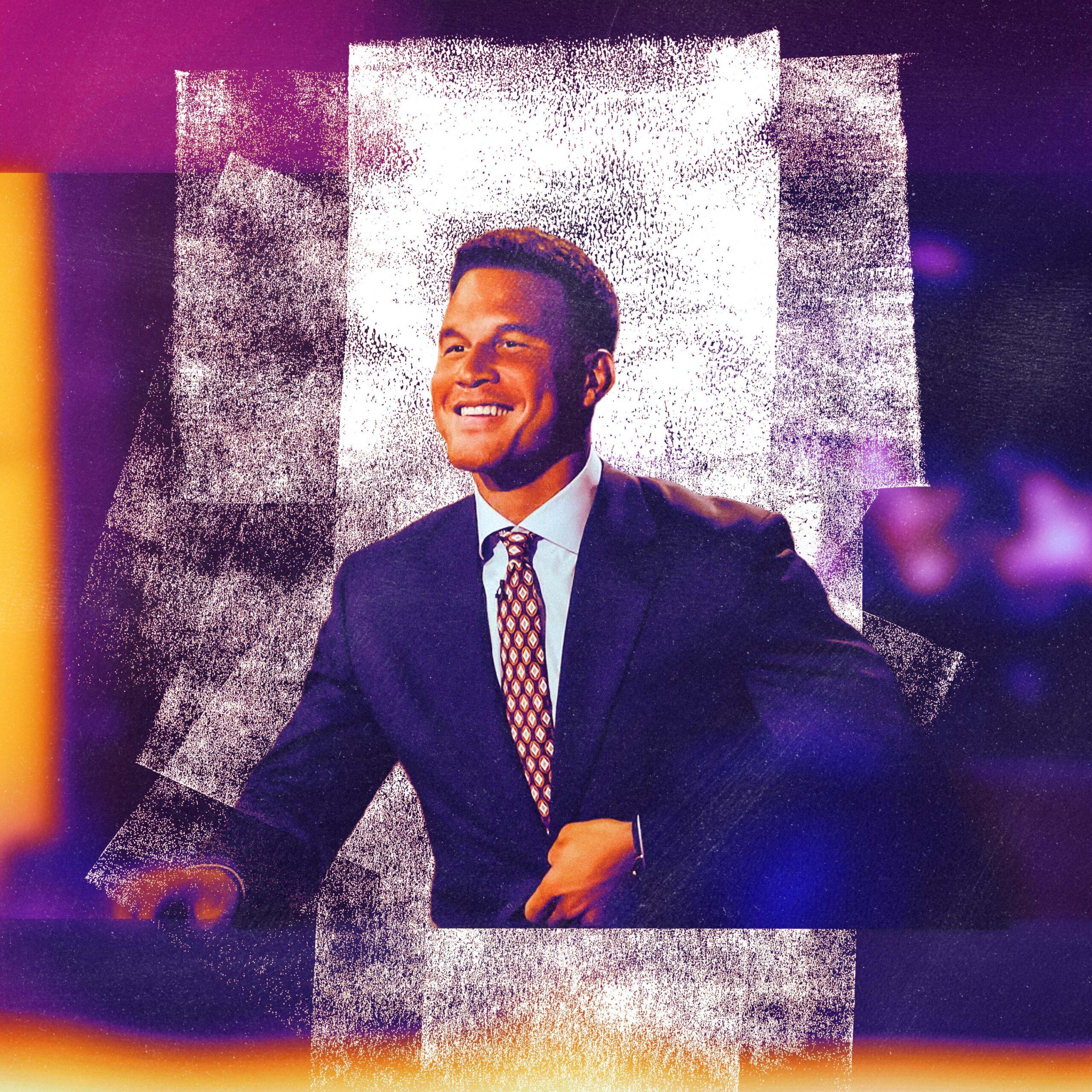
Inside Blake Griffin’s Quest to Bring Sports to Late-Night TV
During his NBA career, he was one of the funniest, most media-savvy players in the league. But can he carry a talk show?Inside Blake Griffin’s Quest to Bring Sports to Late-Night TV
During his NBA career, he was one of the funniest, most media-savvy players in the league. But can he carry a talk show?
Blake Griffin’s second act began on the training table. While receiving routine treatment after practice one day about a decade ago, he passed the time by watching ESPN’s First Take. At some point, the talking heads discussed the Los Angeles Clippers—his team—the same way they did almost everything else: very loudly and with unearned confidence.
Whatever they were bloviating about, Griffin recalls, was wrong. And laughably so. Soon after that, the All-Star power forward and his teammates banned TV sports shouting in the locker room. “We didn’t watch any of that stuff anymore,” he says.
By now, that kind of story has become a cliché. Celebrities get fed up and vow to ignore the media forever all the time. But very few have used that promise as creative inspiration. Griffin’s breaking point led him to wonder what his version of a talk show would look like. He’d already dipped his size 17 foot into stand-up comedy and acting, but what he had in mind was more … explanatory.
After retiring from the NBA in 2024, Griffin took up golf. On the course, he’d run into curious strangers who had lots of questions. “I remember playing with guys that I had met for the first time,” he says. “If they’re maybe not big sports fans but they know sports a little bit, they want to know what’s behind the curtain and not just, like, ‘What was your pregame routine?’ But, ‘How does this work?’”
Griffin is a huge fan of Last Week Tonight With John Oliver. He’s always liked how Oliver explains how the world works: with serious research and silly jokes. “He does it in such a great way that I was like, ‘I would love to do this for sports,’” Griffin says.


That, more or less, is the origin of The Stepback With Blake Griffin. The series, which premieres on Prime Video and YouTube Tuesday, is essentially what its star first envisioned it to be. Every Tuesday this fall, he’ll directly address his audience about one huge issue in sports.
To Jason Ross, the Stepback showrunner, Griffin is a natural host. “He has something that even lots of lifelong comics don’t have, which is an instantly apparent charm and decency that shines through everything he does, and it wins the audience over,” Ross says. “They don’t feel like they’re being manipulated by him. He’s bringing them along in a very sincere way.”
Griffin, now 37, is far from the first charming professional athlete to try to make it on television. But no former player has ever attempted to be the next John Oliver. Behind his desk, Griffin is all alone. “When you’re hosting, you are creating a whole world out of your personality,” Ross says. “That is all there is.”
Griffin can’t lean on riffing with Charles, Shaq, and Kenny. And when he’s at a loss for words, he can’t kick it over to Mike Breen. His staff of late-night TV veterans is giving him plenty of help, but he knows that the show is ultimately on his shoulders. Even for a guy who performed in front of 20,000 people four nights a week for 13 seasons, that’s a lot of pressure.
“I always wanted to do this, so it’s like, ‘Yeah, let’s do it,’” Griffin says. “And then you have those moments where you’re like, ‘Fuck, I don’t know. I don’t know. I don’t know.’”
In a way, Griffin’s creeping self-doubt is normal. It means he’s turning into a real comedian.
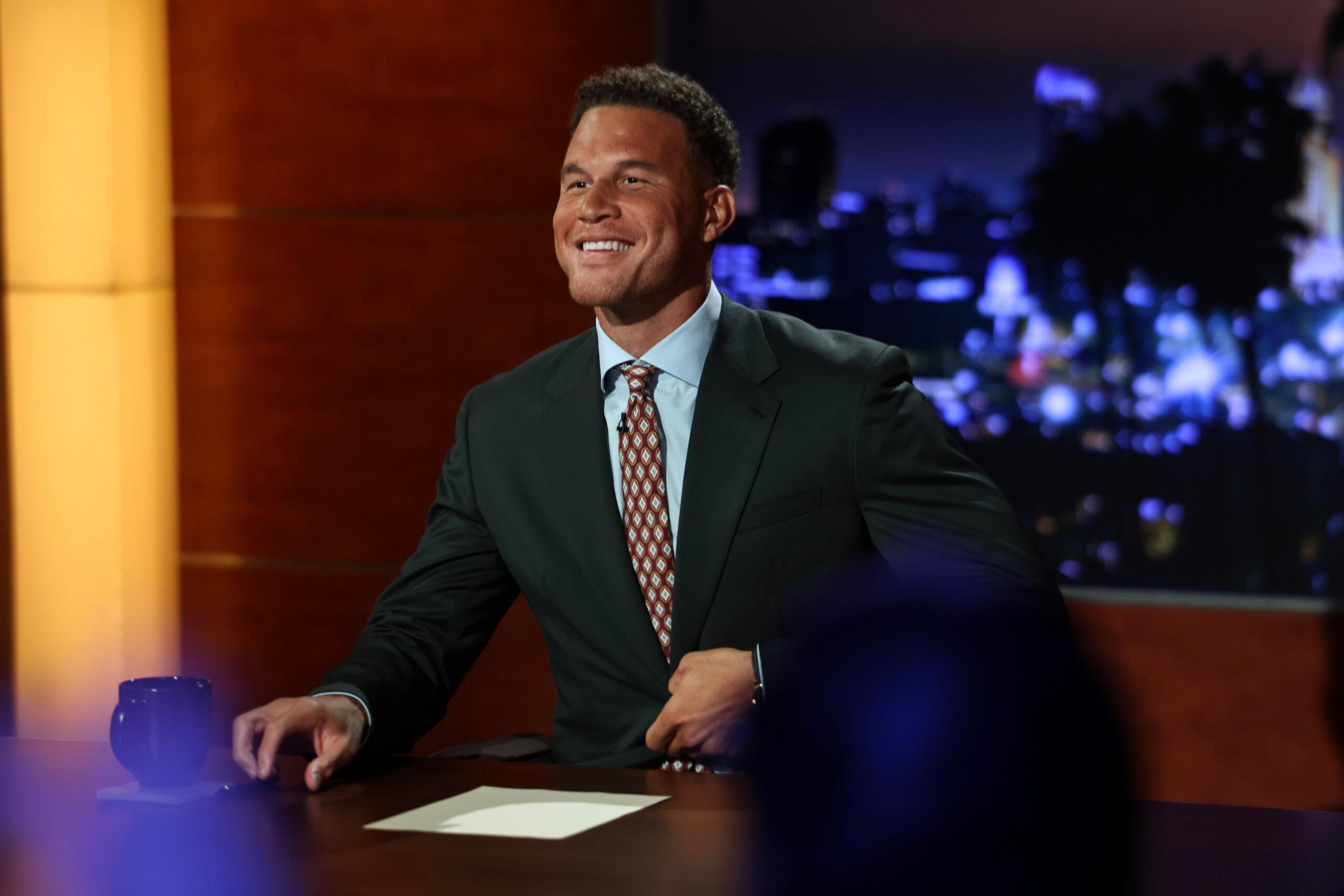
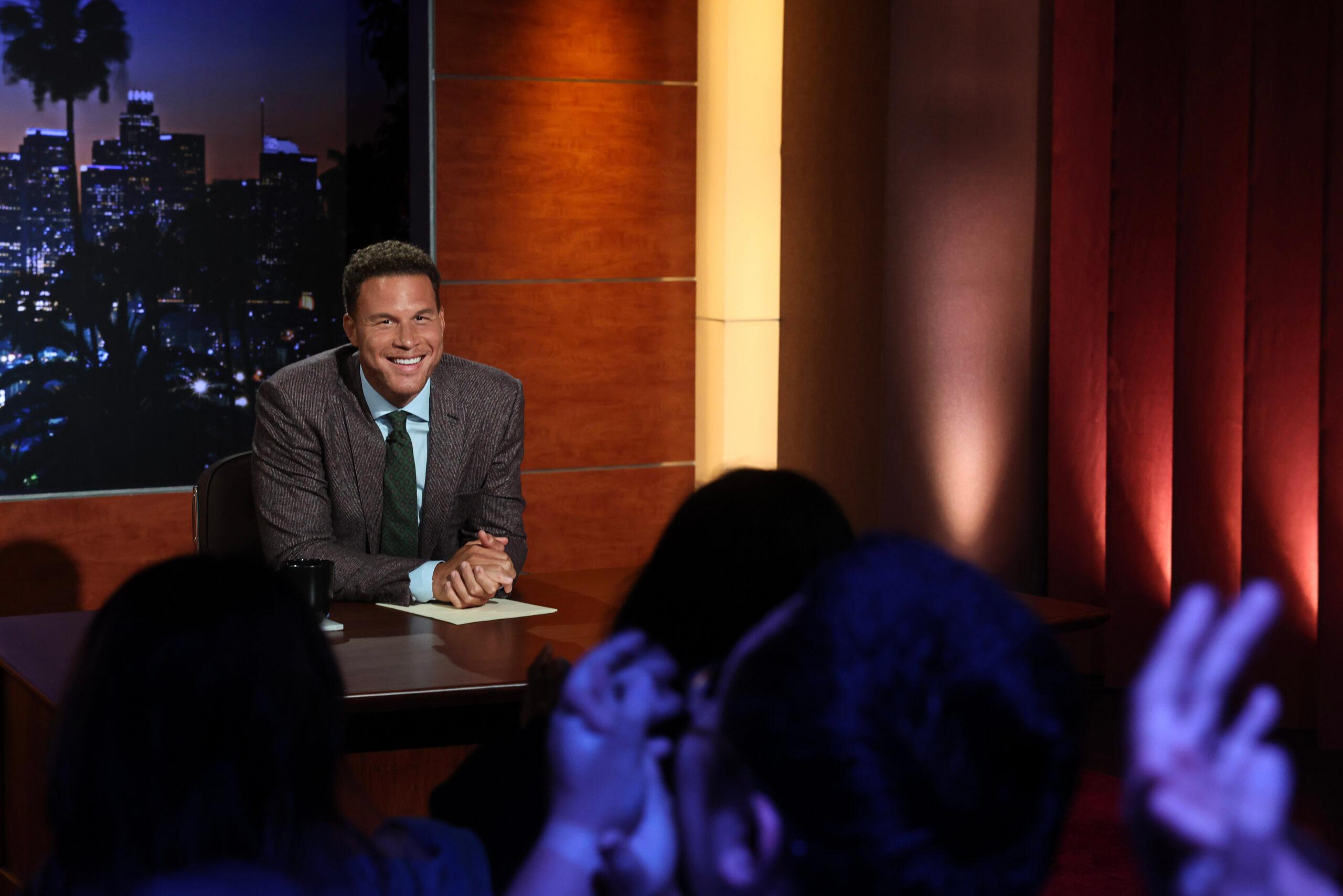
When I walk into The Stepback’s shoebox of a studio in Culver City, California, the first thing I notice is what has to be the biggest desk in TV history. Finding one that large took a while. Hey, that’s life when you’re building a talk show around a 6-foot-9 host.
“Our production team was so good with dealing with all that stuff,” says Griffin, who’s had to deal with his own challenges, like learning to read off a teleprompter for 30 minutes at a time. Leading up to filming, he practiced for hours. At home, he’d load articles into a teleprompter app on his iPad and read them out loud at different speeds. Then he’d come into work and go through scripts in front of a small crowd.
“Blake is an elite athlete because of how hard he works, in addition to his obvious physical gifts,” Ross says. “And we saw that every day on this show. His teleprompter practice is probably the most obvious example, just in terms of the time it took and the fact that a lot of people were sitting around watching him. Couldn’t have been comfortable. But he’s used to that, too. He’s used to being scrutinized at a far higher-stakes environment than four comedy writers and a few producers and a prompter operator.”
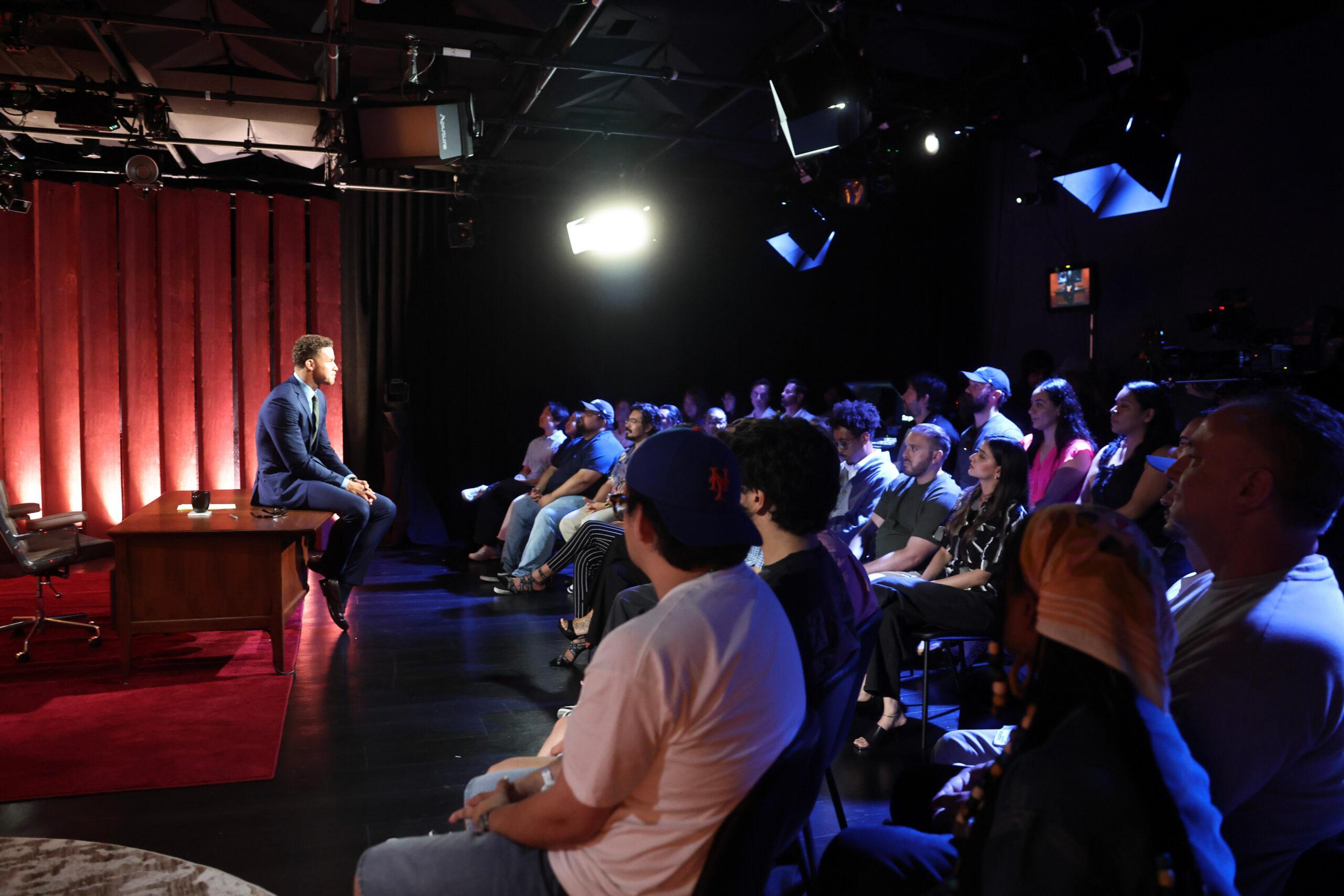
One afternoon in early July, I get to see whether the practice paid off. I’m in the audience, along with a few dozen other people, for an episode taping. Griffin, who looks the part of a late-night TV host in his dark suit, starts off by introducing the day’s topic: America’s public stadium funding scourge. Then he sits down at his giant desk and gets right into it.
The story Griffin tells, smartly, is about Oakland losing its three pro teams to other cities over the past decade. He breaks down how billionaire franchise owners brazenly extort local politicians and exploit fan loyalty to avoid paying for ballparks and arenas on their own. There are some silly bits—the host gets a pile of prop cash dumped on his head—but it’s a thoughtful, tight look into something even folks who aren’t into sports should know about.
“The hard thing with any of these shows is any of the issues that are juicy, you’d love to talk about for 90 minutes,” says Greg Iwinski, a writer on The Stepback. “Can we get this across in 25 minutes? In 30 minutes? In one TV episode, can we get across enough of this topic to make sense?”
It’s way too early to tell whether the series, like Last Week Tonight before it, will ever go longer than that. For now, Griffin is getting used to the half-hour(ish) format.
“The performance is like dancing with the machine,” Ross says. “You’re timing your joke to the graphic. When the video rolls for the audience, it’s rolling in the studio. And when you come back, Blake has just experienced the same video that the audience just saw. And so he needs to validate their reaction to it with his reaction to it, even though he’s seen it 50 times.”
Griffin now seems comfortable reading off the teleprompter, but where he really lights up is between takes. That’s when he encourages the crowd to hit him with rapid-fire questions. “I didn’t realize how much I was going to enjoy that part,” he says.
It’s an easy way to get the audience on his side. A famous person being willing to shoot the shit is, well, endearing. “You want to like him,” Iwinski says. “It’s not exactly rocket science, but in late night, if you like the host, the show’s easier to make.”
When someone in the audience asks, “Who has the worst personal hygiene in the NBA?” Griffin is polite and doesn’t name names. Though he does tell a funny story about how he and the other Clippers veterans gave rookies who didn’t shower after practice three chances before, uh, making them do it.
During another break, a crowd member gets a notification on his phone and pipes up. That’s how Griffin learns that the Boston Celtics have traded Jaylen Brown to the Philadelphia 76ers. The host is as shocked as everyone in the room. When asked which of the two teams got the better deal, he struggles to come up with a pithy answer.
But he understands the value of a callback: Later on, after flubbing a line, Griffin smiles and says, “I blame Jaylen Brown.”
Griffin has always had good comic timing.
When Norm MacDonald jokingly ambushed him at a celebratory press conference after his first season as a pro by saying, “There’s kind of a curse with Rookie of the Year—nobody’s ever repeated it,” Griffin quickly shot back with, “Well, I’ll try as hard as I can next year.”
On Broad City, he admitted to stealing moves from WNBA players and cradled Ilana Glazer like a baby.
And on The Adam Friedland Show last year, when the host asked him whether the NBA’s demographics had changed—he meant politically—Griffin deadpanned, “Still mostly Black.”
“We vibed,” Friedland told me earlier this year. “He definitely grew up with guys like me. You could tell.”
When I tell him Friedland said that, Griffin laughs and says, “I didn’t.”
Griffin was a homeschooled kid from Oklahoma. Long before he could dunk, he could do an impression of John Wayne. “My mom thought it was hilarious,” Griffin says. “I felt that gratification of doing the thing. I did his walk, and I tried to do his voice. And it was always just like that.”
His father, Tommy, introduced him to The Three Stooges, I Love Lucy, and The Cosby Show. Then he found Saturday Night Live, Richard Pryor, and Eddie Murphy. “I watched stuff that I probably shouldn’t have been watching,” Griffin says. “But I was so into it that I think my dad just let me do it.” And like millions of other millennials, he spent the aughts inhaling Chappelle’s Show, The Office, and Judd Apatow movies.
“He is a comedy fan in the way that homeschoolers obsessively love something and learn to understand it,” says Iwinski, a former homeschooled kid himself. “It’s the learning style of you sitting at home, no one’s really talking to you, you and your books are your friends. … You learn how to really dive into something that you care about learning about.”
Even after his basketball career took off, Griffin stayed interested in comedy. It helped that the Clippers picked the University of Oklahoma superstar first overall in the 2009 draft—and not just because his new team was, until the Lob City crew got there at least, a punch line. He was now in L.A., which gave him the chance to pick up acting gigs.
During his rookie year, he and his teammate DeAndre Jordan appeared in a sketch on the short-lived Sports Show With Norm MacDonald. “Blake Like Me” seemed like it was going to involve MacDonald going undercover in makeup as Griffin. The joke didn’t end up as offensive as it sounded: The man you see in “disguise” was really just Blake—but with Norm’s overdubbed voice. “That’s the stuff I wanted to do,” Griffin says.
In the summer of 2011, the producers of the ESPY Awards asked Griffin to play himself in a sketch. The premise was simple: The NBA lockout had just started, so the players needed jobs. Griffin’s was helping short people reach things on high shelves. He thought it’d be funny to try to look as stiff and uncomfortable as possible. “The director actually was like, ‘Hey, you can just relax and have fun,’” recalls Griffin. “I was like, ‘Oh, sorry. I was doing that on purpose.’” Seth Meyers, the host that year, and Neal Brennan, a writer on the awards show, saw the exchange. “They were like, ‘Dude, that was incredible,’” Griffin remembers.


Griffin used the occasion to strike up a friendship with Brennan, a comedian and the cocreator of Chappelle’s Show. It was the middle of the lockout, so Griffin had plenty of time on his hands.
“I would just go to his house and hang and listen to him write jokes,” Griffin says. “I would go watch him do stand-up.”
Griffin had been wanting to try stand-up for years. But Brennan gave him the push that he needed. “I was always thinking, ‘I wonder if I could do that,’” Griffin says. “I don’t think I ever would have if it wasn’t for Neal.”
Brennan encouraged him to write down his thoughts. “I still have the same notes folder that I had from probably 2011, 2012,” Griffin says. A few years after that, he gathered up enough material—and courage—to jump onstage at an open mic night at the Laugh Factory on the Sunset Strip. His act was more a performance piece than stand-up. He called it “slam-dunk poetry” and jokingly waxed eloquent about his mouth guard.
Soon, though, Griffin got more ambitious. In 2016, he performed at the Just for Laughs Festival in Montreal. Beforehand, he got pep talks from some famous comedian friends: Brennan, Roy Wood Jr., and Godfrey. But that wasn’t enough to diffuse Griffin’s anxiety. “I’ve never felt more alone and more terrified,” he says. “Even comics would be like, ‘How’s this hard for you? You play in front of people all the time.’ I’d be like, ‘I’m so fucking nervous.’”
In his 10 minutes onstage, Griffin stuck with what he knew best: life as an NBA player. During one bit about the inanity of postgame interviews, he called a random audience member onto the stage, had him do calisthenics, then afterward said, “Now tell me how you’re feeling, and tell me about how you’re feeling about how you’re feeling.”
The grainy footage of the set on YouTube has 303,000 views. The clip’s title?
“Blake Griffin Does Stand Up Comedy - Actually FUNNY!”
By then, a big chunk of the country already knew that Griffin was actually funny. In his playing days, he starred in Kia ads that were built around his sense of humor. Over time, he started taking a more hands-on approach to his commercial work.
“I was very critical of scripts,” Griffin says. “I would read something, and I’d be like, ‘Can we change this and this?’ And a lot of times, if it was too late, I didn’t change much.” That scenario is what got him interested in producing. “I wanted more creative control,” he says.
Back in the lockout days, Griffin interned at Funny or Die. Around that time, he met Ryan Kalil. The Carolina Panthers center, who played college ball at USC, was also trying to get his foot in Hollywood’s door. During his offseasons, Kalil interned at Legendary Pictures. Thomas Tull, who ran the studio, eventually suggested that Kalil and Griffin should team up.
“Both you and Blake in your offseasons are pursuing film and TV, and you guys are doing it in a way that doesn’t feel like a vanity project,” Kalil remembers Tull telling him. “It’d be interesting if you guys did it together.”
And that’s how Griffin and Kalil’s production company was born. It’s called Mortal Media for a reason. “We just didn’t know if we were going to play one more year or 10 more years and what life would look like after sports,” says Kalil, who retired from the NFL after the 2019 season.
Mortal has produced several projects so far, including the recent White Men Can’t Jump remake. There are benefits, Kalil says, to working with someone as disarming as Griffin. “Blake and I were in a room, and I was getting into a pretty heated argument with somebody who essentially had the ability to green-light a project—and I’m not going to name any names—but I got pretty out of control, heated. I almost wanted to make it physical. I took it so personal, and I had a hard time, and there was just kind of this crazy lull after I sort of said my piece, and Blake just had the perfect comedic timing in that he was like, ‘I think this is the start of a great relationship.’”
That kind of easy charm has made Griffin a natural pitchman, podcast guest, and now analyst on Prime Video’s NBA studio show. “He wants his mother to like him,” Brennan says with endearment.
When Griffin first brought up his sports talk show idea to Kalil, there was briefly a question of who would be the host. “In my head, I always wanted to host,” Griffin says. “But I was also not close to being retired.”
By the time Amazon’s Wondery agreed to make The Stepback, Griffin was ready for his close-up. “It’s going to sound like hindsight’s 20/20,” says producer Noah Weinstein, “but it really was a no-brainer, and he sort of had to be the guy to do it.”
After all, Griffin was a pro athlete—and not just a journeyman. That sets him apart from other TV personalities. “He’s intelligent, and he’s got kind of unlimited access,” Brennan adds. “He knows what it’s like to be a max [contract] guy. He knows what it’s like to get traded. He was number four in the MVP voting. He’s not a bench guy. He knows he has a lot of information.”
Brennan’s advice for Griffin was to unleash some of that insider knowledge on The Stepback. “Be honest,” the comedian told him.
Griffin plans to do that, at least on his terms. He’s not a natural agitator—but he has a way with words. Before shooting an upcoming episode about the officiating crisis in pro sports, Griffin hunkered down with the writers. They needed a setup to sum up the situation. Desperately.
“This is an hour before we have to tape the thing,” Ross says. “And it’s a room full of comedy writers. And Blake was the one who said, ‘So wait, the coaches are being fined for saying the refs are bad, and the refs are being fined for being bad.’ And he was the one who finally put it like that, and we were able to come up with a punch line for it. Just to see him work through that in a very stand-up/host way was a moment I think was emblematic of just how in sync his mind is with a project like this.”
But even a guy who made a living dunking on people has occasional moments of panic. Will the audience buy him as a talk show host? Will they laugh at his jokes? Will anyone at home be watching? “Going over these scripts so many times, I’m like, ‘I’ve read this 20 times. Is this funny?’” he says. “I don’t know.”
What Blake Griffin does know is that comedy can be excruciatingly, crushingly fickle. And at this point in his life, it still beats playing golf.