A Talk Show for Our Times
With guests from Olivia Nuzzi to Alec Baldwin to Clavicular, ‘The Adam Friedland Show’ has become the best-booked, most oddly fascinating show on the internetA Talk Show for Our Times
With guests from Olivia Nuzzi to Alec Baldwin to Clavicular, ‘The Adam Friedland Show’ has become the best-booked, most oddly fascinating show on the internet
How far would Adam Friedland go for a guest? Oh, about 6,500 miles. “There have been three different frantic approaches from Team Kanye in the last three years,” he says. “One was ‘If we tell you to get on a plane to Saudi Arabia, you have to get on that plane.’ And I was like, ‘Saudi Arabia?’ They’re like, ‘Ye is there right now.’”
Alas, the Kanye West offer eventually went poof. Although maybe that’s a good thing. Friedland isn’t sure he actually wanted to put a microphone in that guy’s face. “There is kind of a moral assessment,” he says. “Were someone to come in and be not well, I know it would make good content, but I don’t know ... we’d have to make a call there. I don’t know if we’ve had that experience thus far. Inherently, I don’t want the show to be something purely exploitative.”
Over the past few years, Friedland has become America’s most strangely hypnotic interviewer—and most elite talent booker. On The Adam Friedland Show, he talks with the kinds of famous, often controversial politicians, pundits, writers, athletes, and actors who don’t usually sit for extended chats. Especially not with a host who describes himself as “a puddle of bones in a suit.”
Yet on a weekly basis, Friedland brings people on who make you think, Wow … interesting. Alec Baldwin. Amanda Knox. Zohran Mamdani. “These are people that are spoken about a lot,” Friedland says. But on camera, he adds, they rarely reveal what they’re actually like. The question the comedian is always trying to answer is this: “What kind of guy is he?”
And what kind of guy is Friedland? What kind of person do you have to be to continually lure in and charm some of the most guarded, tight-lipped figures in America? Well, he looks like the long-lost son of Rick Moranis and Jeff Goldblum, somehow leans on self-deprecation more than other Jewish comics, references the NBA incessantly, and treats every single conversation like an obsessively researched, occasionally jokey first meetup with a new friend. “I find him to be a really good interviewer because he’s motivated by curiosity,” says the political journalist Olivia Nuzzi, who appeared on the show after her emotional affair with Robert F. Kennedy Jr. was made public. “He’s present. And actually, you can’t say that about everyone who is behind a mic or a camera talking to other people for a living.”
He’s really persistent. ... At one point, I was just like, “Oh my God, OK, yeah, whatever. Just stop calling.”Olivia Nuzzi
That’s quite a heady endorsement of someone who used to cohost a podcast called Cum Town. That show, Friedland doesn’t have to remind me, “was an ironic product.” But his current one can be, in fact, almost uncomfortably earnest.
“Adam has the unique skill of being able to interview somebody in the way that everybody else would like to see them interviewed,” says journalist and podcaster Noah Kulwin, a friend of Friedland’s who’s helped prep him for several tricky sit-downs over the years. “People see his kind of elliptical, humorous, reference-heavy style as a way of communicating that they relate to very strongly.”
To his subjects, that’s what’s so appealing—or at least disarming. “A lot of times people are kind of not used to it,” says Friedland, whose approach has helped him make genuine relationships with guests.
Some of those have even extended beyond the show. After disgraced former United States congressman Anthony Weiner sat down with him last year, they stayed in contact. “He’s a relic of a different era, and he calls me to make sense of things, because I’m the young person and he knows that,” says Friedland, who’s 38. “He’s like, ‘Tell me, what do you think about this?’ And then I’ll tell him what I think, and then we’ll get in a fight. In the episode, the sense I got was that he disliked me. By the end, it was contentious. It was like talking to someone in my family. It’s just an argument.”
When the episode came out, Friedland and Weiner got on the phone. “We just started killing each other,” Friedland goes on. “And I was like, ‘You’re the most humorless fuck I’ve ever met in my life.’ He’s like, ‘You get one fucking article written about you, and they call you the new Jon Stewart.’ It kind of made me like him.”
None of this fully explains how the “dork of Cum Town” has been able to land so many high-profile guests. Friedland would probably tell you himself that he doesn’t exactly have a highly sophisticated talent-snaring operation. On a visit to his Flatiron studio in January, I ask him for his best booking stories. The question momentarily stumps him. “What is the most wacky story of how we got a guest?” he shouts across the room to producer-writer Caleb Pitts. “Now I’m not remembering anything.”
“Can I eat out here?” says Pitts, who’s in the middle of lunch.
“Yeah, eat out here,” Friedland says. “And I’m sorry for yelling like that.”
Friedland, who seems to subsist on delivery food and Zyn pouches, likes to pepper the people around him with questions. Which, basically, is his booking strategy. He emails, he calls, he texts. Nonstop. Being a charming pain in the ass works for him.
“He’s really persistent,” Nuzzi says. She would know. When Friedland invited her on his show, she initially turned him down. But he kept asking. “At one point,” she adds, “I was just like, ‘Oh my God, OK, yeah, whatever. Just stop calling.’”
That introduction was made by Friedland’s publicist, Mitchell Jackson, the closest thing TAFS has to a secret weapon. The crisis PR man, who’s been the subject of more major magazine profiles than some of his clients have, makes a living representing incendiary media figures, such as the conspiracy theory–loving, far-right broadcaster Candace Owens. He knows what generates buzz, good and bad. “The booking is a group effort,” Jackson tells me in an email. “Adam approves all ideas, and it’s his vision.”
Jackson calls the process, if there is one, “chaotic.”
Friedland describes it as “just bullshitting on the phone.”
Being an inveterate kibbitzer has led Friedland to some serendipitous connections. Last year, he met Sarah Jessica Parker and Matthew Broderick’s son, who’s a fan of the show. “He was like, ‘Oh, you should have my dad,’” Friedland recalls. “I was like, ‘I think I want your mom. No offense, but that would be amazing.’”
Friedland claims that, not too long after that, he ran into Parker on the street in Manhattan. “She yelled—because I guess she watches the show with her son—‘Adam, I love your work!’ And I was like, ‘Ah. Carrie?’ I called my sister. I was like, ‘So, you’ll never believe it …’”
Friedland says that he and Parker texted for a while. Then, last June, Parker appeared on The Adam Friedland Show. An A-lister like her gives an independent program like his the kind of credibility it needs to land celebrities. There are now plenty of sample episodes that publicists can show their famous clients who might not know what the hell the show is.
Friedland has been on a heater lately—Nuzzi, Scott Jennings, Kevin O’Leary—but he still isn’t at the point where he gets everyone he wants. When we talked, he was frustrated that a prominent Democratic lawmaker’s handlers were maybe giving him the runaround. Right-leaning politicians, he tells me, are usually easier to get than left-leaning ones. “They’re Republican, they can say anything,” Friedland says. “You can lie, you can say a slur. Progressives have a lot of things they can’t say. They have apprehension, perhaps, towards the internet as a medium for communication.”
When Friedland’s YouTube show started in late 2022, the idea of, say, a sitting U.S. senator like Democrat Chris Murphy coming on would’ve sounded ludicrous. “An impossibility,” Friedland says. Then Donald Trump started making the podcast rounds. For better or worse, that was a game changer.
“Trump doing Theo and Rogan and stuff during the election legitimized the platform,” Friedland says, before sheepishly admitting the obvious. “In a lot of ways, Donald Trump, he’s helped me out a lot.”
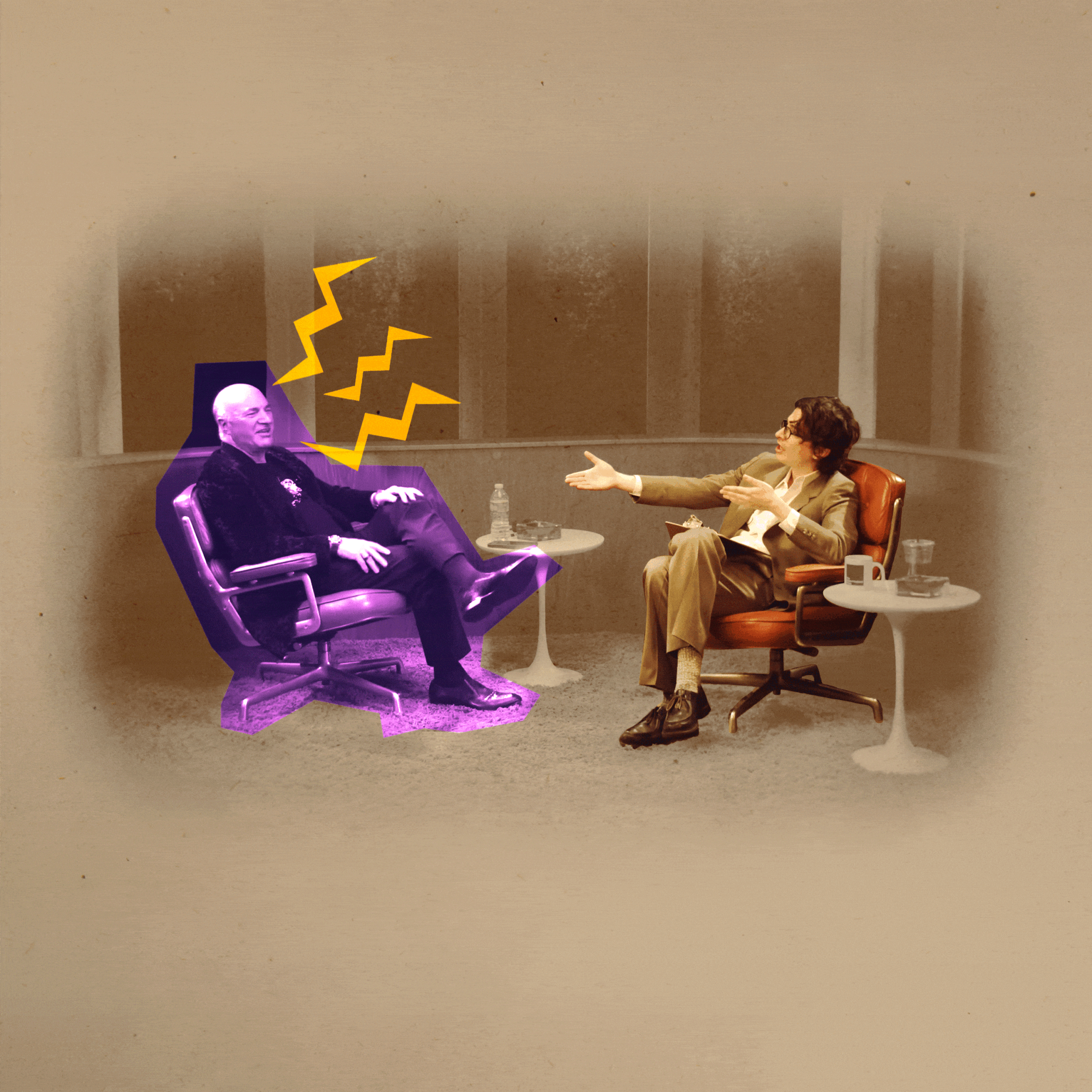
The Adam Friedland Show can book big names now, but status isn’t the most important criterion its host uses to evaluate potential guests. To him, the ideal interview subject is someone who’s had a real impact on culture. Like, for example, the man he called the most humorless fuck he’s ever seen in his life. “Anthony Weiner is the first cancellation for horniness,” Friedland says. That’s arguable and a wild oversimplification, but I get his point. He wants zeitgeisty people, people who are both talked about a lot and good talkers themselves. The kind of people who, back in the ’60s and ’70s, might’ve been invited to go on The Dick Cavett Show.
The set of TAFS is even modeled after Cavett’s, complete with shag carpeting and blue-paneled walls. Friedland credits his former Cum Town cohost Nick Mullen with implanting the idea that he could become the millennial version of the guy who used to routinely mix it up with Muhammad Ali and John Lennon. “We’re going to turn him into Dick Cavett,” Friedland says. “I mean, that is a very funny joke in reality. The least popular guy becoming Dick Cavett.”
It was a joke at first. But in his own way, Friedland really does want to emulate Cavett. “The parallel there is that he would just get the most interesting things out of people because of the format,” Friedland says. “The intention is to have the conversation be open-ended because that’s where you get the most interesting stuff.”
You don’t want to become a fucking comedian that just becomes a blowhard political person. But if I can just do it in the way that I do it, and it feels like how I make my friends laugh, that’s fine.Adam Friedland
Even when the guest isn’t Gore Vidal—it’s hard to imagine Cavett, as Friedland has, sitting down with the streamer Clavicular or Steiny from the Nelk Boys podcast. But hey, it’s a different time. Friedland’s job is to get the goods, no matter who he’s talking to. To do that, he at least tries to relate to all his guests.
Results have varied. When he had Barstool Sports founder Dave Portnoy on, Friedland played up the fact that he also knows ball. “I expected him to like me because I know how to talk about sports,” Friedland says. “At the time, I was like, ‘I think that guy hates me.’ … I knew more about sports, and it broke his mind.”
He engaged conservative commentator Michael Knowles about his love of debate while also bluntly calling out his homophobia and transphobia. “What’s the motivation behind telling a stranger they’re a bad person?” Friedland asked. After Knowles mumbled, “I don’t tell them, ‘You’re a bad person,’” Friedland snapped back: “But you are effectively telling them that their entire life is bad.” Knowles was unmoved, but exposed.
Friedland figured that the best way to earn Alec Baldwin’s trust was to spend lots of time chatting about his most memorable roles and not immediately confronting him about his past controversies. “I’m not going to be like, ‘Oh, what about your wife’s Spanish accent?’” he says. “Everyone asks if I asked about that. And I’m like, ‘Well, he’s going to put his guard up.’”
Friedland did, very gently, eventually ask Baldwin about the deadly accidental shooting the actor was involved in on the set of the movie Rust. But he had to first make sure that the actor was comfortable enough to address it. Friedland didn’t take that duty lightly. “The image of the bullet and someone dying in front of him,” he says, “he’s going to have that in his brain for the rest of his life.”
Friedland tends to be at his best as an interviewer when the guest gets him—or just doesn’t at all. From the opening minute of his episode with Blake Griffin, it was clear that the former NBA All-Star understood the host’s sense of humor. Before that, their managers had set up what Friedland calls a “useless” meeting between them.
“I wanted to pitch him on a podcast, and I’m like, ‘Oh yeah, you have $300 million in career earnings,’” Friedland says. “I was like, ‘I could get BlueChew. I get a lot of good sponsors.’ But we vibed. He definitely grew up with guys like me. You could tell.”
When Friedland asked him a jarring Howard Sternian question—“How many Republicans are in the NBA?”—Griffin played along, quickly replying, “17.” After Friedland posited that Jimmy Butler is among them, he asked whether the league’s demographics had changed.
“Still mostly Black,” Griffin deadpanned.
“He’s got chops, actually,” Friedland delightedly said to his team behind the camera.
“He’s in the fucking association,” Friedland tells me. “Just talking to someone that is in the league, that’s, to me, the coolest.”
Griffin got him. Ritchie Torres did not. Last August, the U.S. representative from the Bronx was a guest, and for a stretch of the conversation, Friedland talked to Torres about the Democratic congressman’s strong support of Israel, which the host finds unconscionable. “I studied Middle Eastern politics, I lived in Israel, I’m Jewish,” Friedland says. “I can speak to that.”
But when Friedland exasperatedly pointed out that the IDF has killed an extraordinarily high number of civilians in Gaza, Torres responded coldly. “People have been killed in a war,” he said. “It’s been a tragedy.” Then he added this: “You’re suggesting that it is the policy of the Israeli government to murder civilians, and that’s, that is a notion that I reject.”
“You gotta like, listen, man, you gotta be like a human being about this,” the host said, then later asked, “Do you feel in your heart that what you’re saying is right?” As the interview progressed, the comedian got emotional. Torres’s tone never changed. That bothered Friedland. “I just think he had not had any familiarity with just talking to a person,” he says.
The Torres episode made headlines. And in a column a few weeks later, Jason Zinoman of The New York Times called it the leftist comic’s “breakout” moment. “The challenge for Friedland,” the critic wrote, “is going to be to figure out how much of the world can fit inside his navel.”
“You don’t want to be Bill Maher,” Friedland says. “You don’t want to become a fucking comedian that just becomes a blowhard political person. But if I can just do it in the way that I do it, and it feels like how I make my friends laugh, that’s fine.”
Friedland has dream guests, although it’s hard for him to narrow it down to just a few. “Chuck would be amazing,” he says, referring to Charles Barkley. Then he calls out to his publicist, who’s sitting on a couch in the studio.
“You know who that is, Mitchell?”
“I’m a homosexual,” Jackson says, “So …”
Friedland names another. “I feel like a douchebag saying it, but Obama,” he says, before adding, “I just want to know if he’s happy. … It’s just like, ‘What is he thinking watching TV?’”
I can’t help but laugh. Friedland still sometimes sounds like your most irony-poisoned friend trying to come off as your most sincere. In reality, he’s both. “Adam, you know, is a child of the Great Recession as much as any of us and thus has mainly memories of Obama as this initially inspiring figure,” Kulwin says. On the other hand, he adds, “Obama was this generationally larger-than-life figure for so many people of our age, in our late 20s to early 40s. Now he is kind of LeBron James in that way.”
Kulwin can imagine Friedland asking Obama whether his pickup basketball buddies are scared to play tough defense on him. What if a guy breaks your ankle and then you drone strike his house? “He’s able to make a joke that reminds us of the silliness or inadequacy of the moment in which we live,” Kulwin says. And if Obama’s guard is down, he might even play along. “So Obama’s now in the place where he is just joking about the drone strike.”
Alas, Obama probably won’t be appearing on The Adam Friedland Show anytime soon. On the afternoon I stop by the studio, the host and his small crew are in the process of booking other, slightly less globally important guests. PR reps are showing more interest in the show than they ever have. “There’s a comedian whose publicist has been emailing me every three days for months,” says producer-editor Thomas Pistor Eisenman. Pitts says he’s been hearing from reps of “actors who have retained a publicist when they have no business having one.” But, he adds, “The problem with that is that occasionally one of those actors does become a star. Three months ago, that would have been the Heated Rivalry guys.”
Friedland is now in a position he’s never been in: His show is big enough that he can say no. He’d rather not share guests with every other comedy podcast. “It’s a revolving door. Same guys,” he says. “And so I just want to differentiate the show.” He would, though, “have Seinfeld on.”
That’s not happening, at least not yet. But the fact that Friedland openly mentioned it as if it could is a sign of how far he’s come. “The kid who didn’t like doing his homework is asking the questions now,” Kulwin says.
Still, it’s hard for Friedland to take stock. Especially when he, Pistor Eisenman, Pitts, and associate producer–editor Zach Galsky are holed up in the studio together. “I’m just here with these guys every day,” Friedland says. “And yeah, we get lunch.”
Before I leave, Friedland offers me some food. “If you’re hungry after this,” he says, “we got hummus and pita and Coke.” Then, when I put on my coat, he tells me it’s too thin for the 20-degree weather. “What are you,” he says, “like, a buck twenty?” This is a few minutes after he found out that I’ve interviewed Arnold Schwarzenegger.
“Ahnuld?” he says, a twinkle forming in his eye. The thought of bro-ing out with the Terminator makes the puddle of bones in a suit tilt his head and smile. “Can you imagine, guys?” he says.
Friedland’s favorite interview wasn’t actually with a bro. It was his sit-down with former Federal Trade Commission chair Lina Khan. “It was the first time I kind of built an interview in reverse, and I think that’s what I’ve done since then, and I’ve found it to be kind of successful. … Instead of starting with a dossier of research … I factor in, like, ‘What does some guy know?’” he says. “It’s like, ‘No, he doesn’t know who Lina Khan is. He doesn’t know what the FTC is. He knows that shit is expensive, he knows that companies suck, and he knows that maybe Trump has been firing a bunch of people in the government.’ So I was like, ‘How can I get this guest to communicate to someone that has that amount of information?’”
Don’t worry: Friedland still had time to ask Khan, the youngest FTC head in American history, questions like, “How did you get drafted into the league at 32?”
After the episode aired, Friedland’s toughest critic, his father, gave him some advice—and then a compliment. “The first nice thing he’s ever said to me,” Friedland says. “Made me want to cry. It was like the end of a movie or something.”
First, he told his son that his show, no matter the guest, is at its best when he’s just being himself. Then he said this: “I watched the Lina Khan thing. You were just being Adam.”