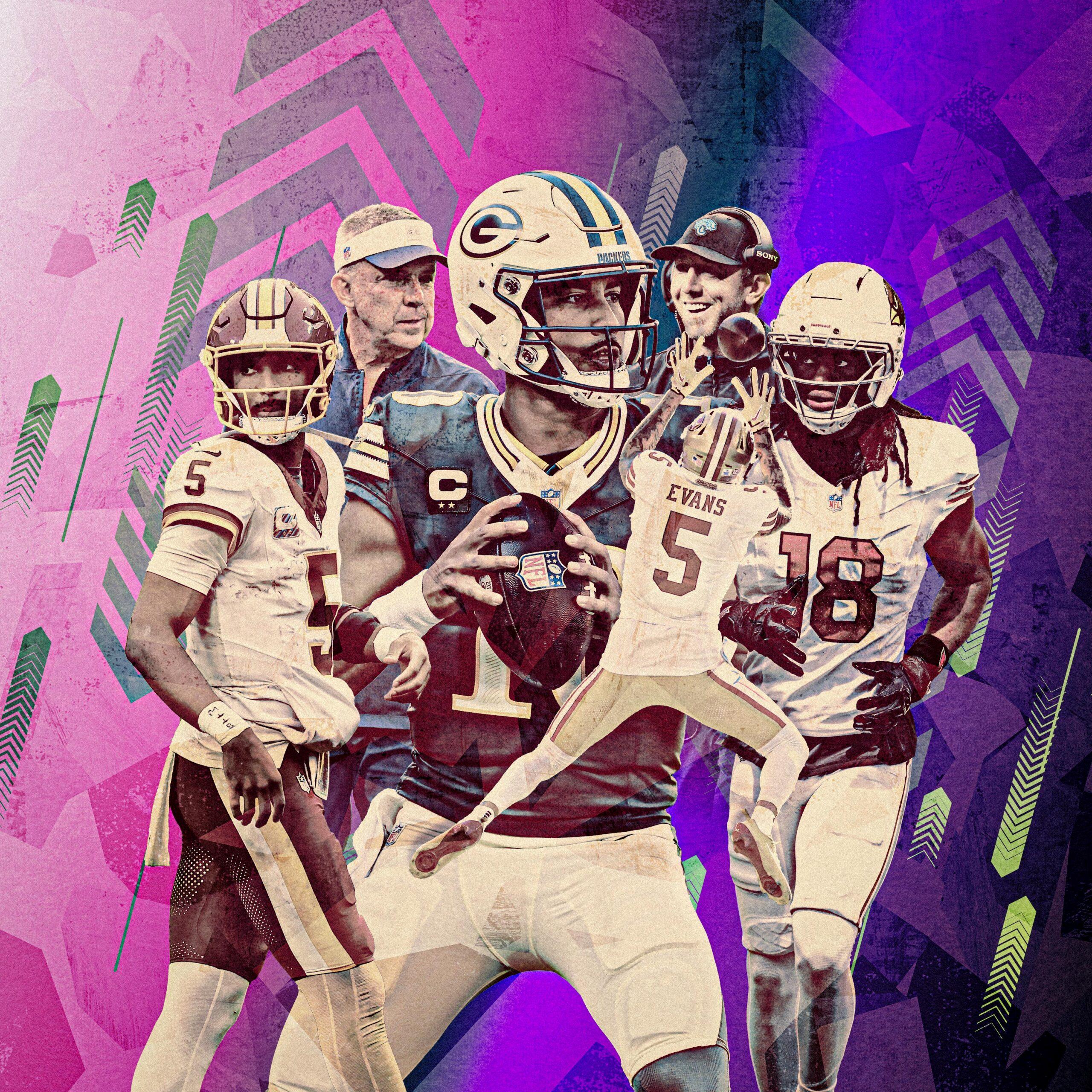

Every week this NFL season, we will break down the highs and lows—and everything in between—from the most recent slate of pro football. This week, the Commanders bumbled their way to a tie against the Giants, the Jags got lucky in London, Jordan Love went off, Mike Evans went viral, Marvin Harrison Jr.’s Arizona career came to a close, and more. Welcome to Winners and Losers.
Loser: The Commanders’ Situational Awareness
When Jayden Daniels took the snap with 12 seconds left in overtime against the Giants, it seemed like there was no way the Commanders wouldn’t win. After all, they were in field goal range, and all Daniels needed to do was spike the ball or throw it out of bounds—anything to stop the clock and set up a field goal attempt. Daniels instead did the worst possible thing once he had the ball in his hands: Dancing around the pocket and falling to the ground. It was the worst decision of Daniels’s young career, and what followed was one of the most embarrassing end-of-game sequences in recent NFL history.
Daniels went to the ground with eight seconds left, then lounged on the grass for roughly five seconds, seemingly oblivious to the situation he had just created. His teammates scrambled to pull him upright and get the offense lined up for a spike, but by then, it was too late. The clock hit zero before the Commanders could take another snap, and the game ended in a 27-27 tie.
Commanders coach Dan Quinn slammed his headset to the ground in frustration. In his postgame press conference, the coach said the tie felt like a loss. And he’s right, even if a tie ultimately was a fitting result for two teams that spent much of the second half handing each other opportunities to win.
Running back Cam Skattebo’s fumble after the two-minute warning in overtime seemed like it would be the final nail in the coffin for the Giants’ comeback hopes. Daniels quickly moved the Commanders down the field and into field goal range. There were 55 seconds on the clock when the Commanders lined up for a first down at the Giants’ 26-yard line. They called a run up the middle but couldn’t exhaust the remaining game clock on that play alone. Still, they had ample time to get lined up, spike or throw away the ball, and attempt the field goal. It was the sort of routine sequence NFL offenses execute every Sunday. Somehow, Washington turned it into a scene of players frantically trying to get their quarterback off the grass.
Daniels deserves the largest share of the blame for the final play. A starting quarterback has to know that he cannot go down in bounds there. But Quinn doesn’t get to separate himself from the embarrassment either. Quinn entered 2026 with his seat already warm, and this is the kind of failure that can erode whatever confidence remains in his leadership. Coaches can explain injuries and personnel deficiencies away, but an error of this magnitude is much harder to excuse. And it could end up being the point of no return.
“We all gotta be better situationally,” Daniels said after the game. “Starts with me. Everybody will say the same thing, but we just gotta be better at situational football. We gotta stop the clock. We gotta know the situation. We gotta relay that as an offense. It starts from everybody, top down. Ultimately, it’s on me.”
In sudden-death overtime, there was no reason for the Commanders to try to use every available second of the game clock or do anything beyond making sure they could spot the ball for the kicker on his preferred hash mark. There was no excuse for Daniels not to know his team had no timeouts remaining. It was a costly mistake by a poorly coached football team.
Ultimately, this tie could make a big difference in a suddenly wide-open NFC East. A made field goal would have put Washington at 2-3, even with the flailing Eagles and Cowboys and one game behind the Giants. Instead, the Commanders are 1-3-1, having wasted this opportunity to gain ground on division rival New York. —Anthony Dabbundo
Winner: Lucky Liam Coen
Just as the morning coffee was kicking in for the U.S. viewing audience, Jacksonville pulled off a messy yet wildly entertaining 19-17 win over the Eagles in London—thanks to a last-second kick return (more on that in a minute) and a walk-off, 57-yard field goal by Cam Little.
That kick saved the Jags the embarrassment of losing to a thoroughly depleted Eagles team, but not before Jacksonville tried its hardest to give the game away. Jacksonville had three trips to the red zone on Sunday but failed to score any touchdowns on those drives because of a combination of bad play calling, poor execution, and silly penalties.
The red zone sequence before halftime was particularly ugly. Jacksonville had a second-and-goal at the 1-yard line with 15 seconds left and somehow ended the drive with no points. Trevor Lawrence threw two incomplete passes, and then head coach Liam Coen made the incomprehensible decision to call a jet sweep on fourth down. The Eagles blew up that play, tackling Bhayshul Tuten for a loss as time expired.
Then, in Jacksonville’s first drive of the third quarter, rookie guard Emmanuel Pregnon’s holding call on first down torpedoed a chance to tie the game and forced the Jags to settle for a field goal.
But Jacksonville’s most embarrassing sequence came in a red zone trip early in the fourth quarter, when the Jags found themselves with a first-and-goal at the 1-yard line. That quickly turned into a third-and-14 because of a false start and two delay-of-game penalties, and then Lawrence threw an incompletion on fourth down.
The Jaguars had the league’s second-highest touchdown rate on red zone trips in Weeks 1-4. Maybe the penalties and missed throws on Sunday were simply bad luck, but those mistakes allowed an inferior Philadelphia team that was playing without many of its typical offensive starters to hang around in this game long enough to give us a wild ending. Coen is fortunate that you can always seem to count on the Eagles to give their opponents a chance to steal a game. —Diante Lee
Loser: Nick Sirianni’s Decision-Making
The Eagles rushed for only 22 yards and averaged just 5.5 net yards per attempt against Jacksonville—and although Philly had a makeshift offensive line and was without Saquon Barkley, this offensive performance was so dismal that Sirianni’s team should leave London feeling like they blew an opportunity to turn their season around.
In Philadelphia’s final possession, quarterback Jalen Hurts did what he needed to do to get the Eagles into range for Jake Elliott to attempt a go-ahead field goal. After completions to Dontayvion Wicks and tight end Dallas Goedert, the Eagles advanced all the way to the Jaguars’ 34-yard line. There was less than a minute remaining, and Jacksonville had only one timeout left. There are fifth graders playing EA Sports Madden who know how to manage this game situation: run the ball on first down, force your opponent to use the final timeout, get the ball placed in the best spot for your kicker, and milk the clock so you can end the game with a walk-off field goal.
What did Sirianni’s Eagles do instead? They passed on first and second down. The clock stopped on an incompletion, and then rookie receiver Makai Lemon caught a pass and was forced out of bounds—again stopping the clock. Lemon deserves some criticism for going out, but the fact that Philadelphia even threw a pass toward the sideline is beyond explanation. This complete failure in clock management meant Jacksonville didn’t have to use its final timeout until after the Eagles’ third-down run play, before Elliott’s field goal attempt. That left enough time on the clock to guarantee Jacksonville would have one last possession—needing only a field goal to win.
Jacksonville’s Ameer Abdullah ripped off a 53-yard return before he was tackled at the Eagles’ 39-yard line with one second left on the clock. That put Jacksonville easily in range for the big-legged Cam Little.
The decision to force a kickoff return instead of booming the ball out of the end zone for a touchback will be scrutinized, but I get why Sirianni did it. The most likely outcomes with a return would have been (a) a quick tackle, forcing the Jags into a Hail Mary or trick-play situation, or (b) the clock expiring during the return. You could almost see the life drain from Sirianni’s face when he realized the Jags somehow pulled off option c: a return into field goal range with time remaining. But the truth is that kickoff never should have happened in the first place, and it only did because of how badly Sirianni bungled the previous possession.
Sirianni admitted that he mismanaged the clock at the end of the game, but that acknowledgment rings hollow. The Eagles had a chance to beat the Rams and Jaguars in back-to-back weeks and blew both opportunities. Now it feels like their season is slipping away. —Lee
Winner: Head Coaches Making Power Plays
Give credit to Sean Payton and DeMeco Ryans for knowing the perfect time to yank back play calling duties. And by the perfect time, I mean right before facing a winless opponent.
Payton took over as the Broncos’ offensive play caller before Sunday’s game against the hapless Chargers and came away with a 23-17 road win—in large part because Justin Herbert crumbled in crunch time. Ryans resumed calling the shots for the Texans defense just in time to play a Titans team that entered Week 5 with the second-worst scoring offense in the league. Houston throttled Tennessee 26-3, and Ryans’s defense held the Titans to just 187 net yards.
It was the first time all season that the Texans defense has looked like itself—a unit with an aggressive, unrelenting pass rush and a suffocating secondary. Defensive end Will Anderson Jr. was particularly dominant, sacking Titans QB Cam Ward three times, and the Texans didn’t suffer the type of communication breakdowns and blown coverages that cost them earlier this season when DC Matt Burke was calling the plays. How much of that success was due to the fact that they were facing a Titans offense that hasn’t been able to move the ball against really anyone this year? And how much of it is a sign of a lasting change? We’ll see, but Ryans was clearly right that his defense needed a spark, and he was able to provide it.
The immediate results of the Broncos’ change from Davis Webb to Payton are less clear. Under Webb, a 31-year-old former backup quarterback who made his debut as a play caller this season, Denver was scoring an average of just 18.5 points per game—and had just 13 total first-half points before heading to L.A. to face the Chargers. The Broncos weren’t running the ball well, and quarterback Bo Nix looked uncomfortable in the pocket and too frequently failed to see open receivers. The Broncos were 2-2, but Payton was out of patience, and rather than being a bug in Webb’s ear while on the sideline, he wanted to go back to being the voice in Nix’s helmet.
But the Broncos offense didn’t look much different this week than it did during the first four games. It scored a touchdown in the first quarter on a drive that started in Chargers territory because of a Herbert interception. And as always seems to be the case for the Broncos, no matter who is calling the plays, it took until the fourth quarter for Nix to really catch fire. They scored 13 points in the final nine minutes, feeding off the energy of a defense that had Herbert in absolute hell late in the game. But for the most part, everything still looked hard for Nix and Co., just like it did when Webb was calling the plays. Nix completed just 59 percent of his passes and threw for only 123 yards against the Chargers, and he finished with a negative EPA per dropback for the third time in five games. So, it is worth pondering: Maybe the biggest problem with the Broncos offense hasn’t been the play caller but the quarterback asked to execute those plays.
In many ways, Webb’s four weeks calling plays for a third-year quarterback felt like far too short an audition, especially since Nix missed most of the offseason as he recovered from ankle surgery. Now, Payton has removed one possible person he could blame if the offense—and Nix in particular—doesn’t take a leap forward. And the next test for Payton and Nix in their renewed partnership comes on Thursday night against Mike Macdonald’s Seahawks. If the offense still stalls, whom will Payton have to blame then? —Lindsay Jones
Winner: San Francisco’s Defense
Since the start of last season, Seattle could confidently say it had the best defense in just about every game it played in, and it rode that dominant defense to a Super Bowl title.
On Sunday, though, San Francisco’s defense was the story—winning the line of scrimmage and frustrating Seattle’s offense throughout a 32-29 win. The Niners sacked Sam Darnold five times, forced four turnovers, and recorded seven tackles for a loss. The 49ers defense allowed close to nothing between the tackles—Seattle’s running back tandem of Emanuel Wilson and George Holani had just 68 yards on 24 carries and averaged 0.77 yards before contact—and never let Darnold get comfortable in the pocket.
The most impressive performances of the game came from three 49ers rookies: linebacker Jaden Dugger and the defensive tackle tandem of Sebastian Valdez and Gracen Halton. Each had a sack, and Halton forced a fumble—and recovered it himself for a touchdown at the end of the first half.
San Francisco’s pass rush was aided by its secondary’s good coverage downfield. Cornerback Renardo Green intercepted Darnold twice, ending Seattle’s first drive of both the first and third quarters. Those timely takeaways helped San Francisco survive an uneven game by quarterback Brock Purdy, who has typically struggled against Mike Macdonald defenses. San Francisco got the most EPA off turnovers of any team in Week 5—and the second-most EPA off turnovers of any game this season, behind only the Panthers’ demolition of the Falcons’ backup quarterbacks last month.
And we can’t have a conversation about an excellent 49ers defensive performance without appreciating its central figure, linebacker Fred Warner. Warner had a game-high 10 tackles (five solo) and recorded the 20th forced fumble of his career with a classic punch-out against Wilson in the first half. Since Warner was drafted in 2018, the only defensive players with more forced fumbles are edge rushers T.J. Watt, Khalil Mack, and Myles Garrett—three players likely to be in the Hall of Fame. Warner is on a similar trajectory and is one of the greatest linebackers ever because of his excellent coverage skills and penchant for forcing turnovers.
The 49ers gave up 29 points to Seattle and still had my favorite defensive performance of the week because of how disruptive they were. The defense’s ability to do the heavy lifting in a game where the offense couldn’t get much going will go a long way toward convincing me that this is a true championship team, not just one off to a hot start. —Lee
Winner: Petty Mike Evans
One of the best things about rivalries as intense as the one between Seattle and San Francisco is watching new players inherit the same disdain their predecessors had for their opponent, building on a decades-long legacy of hate. Receiver Mike Evans channeled that energy on Sunday against Seahawks cornerback Trevon Diggs by, well … actually, just watch it for yourself.
That’s the kind of disrespect that should warm the heart of elite trash talkers like Richard Sherman, and harkens back to this rivalry’s peak in the early 2010s. This is exactly the type of pettiness we want to see when we tune in to this rivalry. These teams hate each other—and they’re expressing it in ways that are funny (like Evans) and, well, against the rules (this Dre Greenlaw headbutt).
And it's perfect that Evans was the one to deliver this iconic viral moment, because he was recruited by San Francisco in free agency to be the missing piece for an offense that scored only two touchdowns in three matchups against Seattle last year. The 49ers needed a receiver who could beat Seattle’s one-on-one coverage—and they got it. Evans scored a touchdown and had 113 receiving yards against Seattle on Sunday, more than backing up his trash talk. Every time San Francisco’s offense was in trouble or needed a spark, Evans was there to move the chains or change the momentum of a drive or catch a crucial two-point conversion.
At 33 years old and with his best football likely behind him, I had no idea whether Evans would be enough to get San Francisco’s offense back to a championship level. Seattle will need better answers to handle him in their next matchup. Here’s my expert suggestion: Antagonize Evans at your own risk. —Lee
Loser: The Gut-Punched Falcons
There are no moral victories in the NFL. Just wins and losses. The Falcons offense has been one of the most fun units in the entire league since Michael Penix Jr. returned from last season’s ACL tear and took over as the starting QB in Week 3. He, phenom running back Bijan Robinson, and wide receiver Drake London have been balling out in prime time for three straight weeks, including against the Ravens on Sunday Night Football. But Penix suffered a rib injury late in the fourth quarter and was unable to play in overtime as the Falcons lost to Baltimore 30-23.
The Ravens drove the field and capped off their overtime possession with a TD run by Snoop Huntley, starting in place of the injured Lamar Jackson, and sealed their comeback win by picking off Atlanta’s backup QB, Tua Tagovailoa. What a vibe killer.
Tagovailoa is a laughingstock at this point. QB3 Cooper Rush is washed. No one wants rookie UDFA Jack Strand anymore. And now Penix is hurt … again. Penix reminded everyone who watched their road wins in prime time over the Packers and Saints that the Falcons have elite offensive firepower. They’re a well-coached team with Kevin Stefanski and his coordinators, Tommy Rees and Jeff Ulbrich. But now Atlanta has been dealt another gut-punch loss. This one hurts if you’re the Falcons—not just because they dropped back below .500 (2-3) but because they’re once again facing uncertainty about Penix’s availability. For what it’s worth, Penix believes he’ll be fine. The Falcons better hope he’s right, because if the offense looks anything like it did without Penix before, the Falcons will be long shots to win any game they play until he gets back. —Austin Gayle
Loser: Marvin Harrison Jr.’s Arizona Tenure
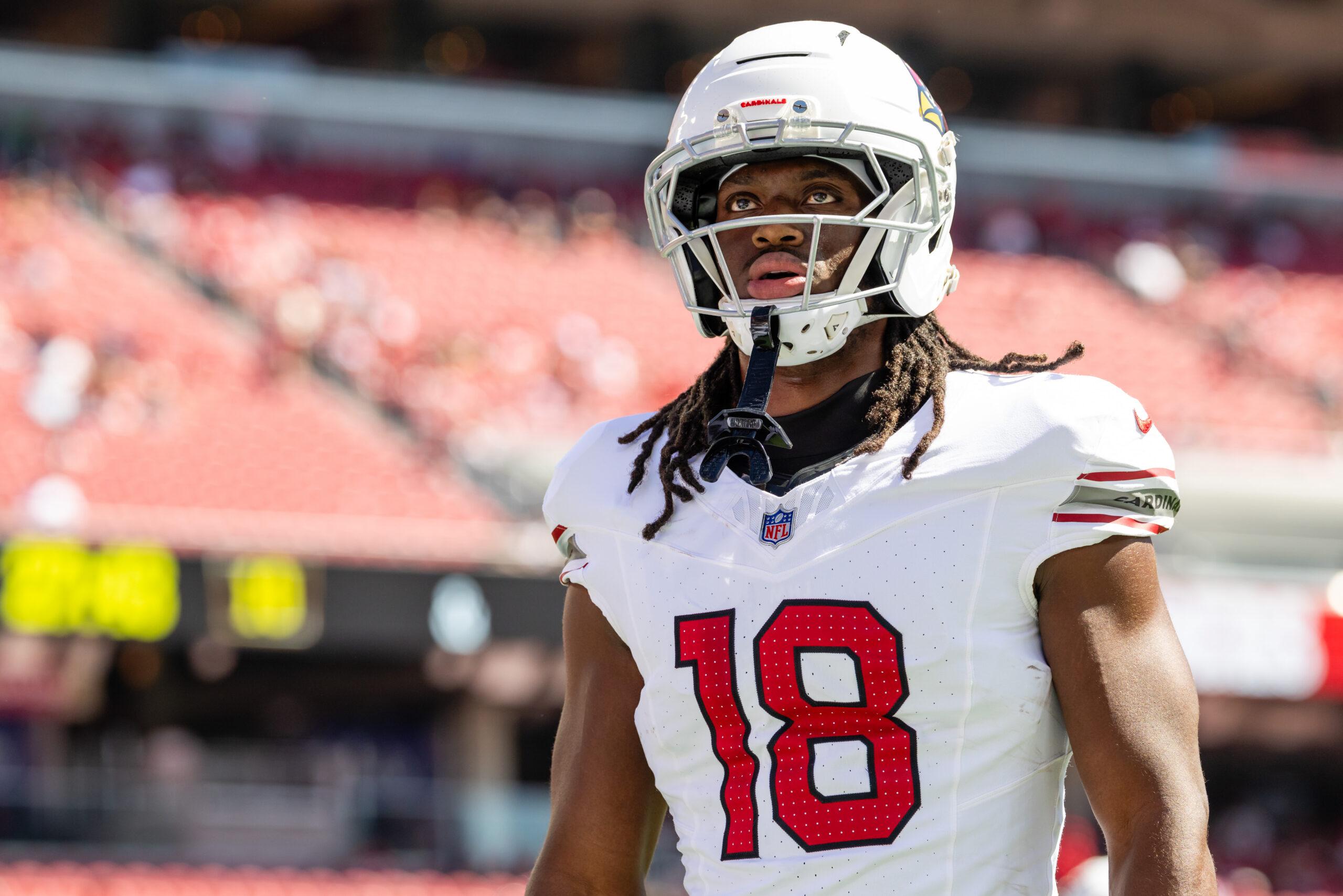
At long last, the Marvin Harrison Jr. trade nightmare is over. After months of speculation about the future of the underwhelming Cardinals receiver, Arizona is trading him (plus a 2027 seventh-round pick) to Houston for 2027 second- and sixth-round picks. After a disappointing 33 games in Arizona, the former no. 4 overall pick now has a chance to resuscitate his career in Houston, where he’ll be reunited with his college quarterback, C.J. Stroud. Stroud and Harrison connected for 1,263 yards and 14 touchdowns for Ohio State in 2022.
Harrison never came close to matching that level of production in Arizona. He leaves Arizona with just 108 catches, 1,578 receiving yards and 13 touchdowns—and only one score this season. The Cardinals made him inactive for their Week 5 game against Detroit with the expectation that the trade with Houston would be finalized after the Texans’ game against the Titans.
Was there any way to see Harrison’s disappointing development coming? Well, maybe. I’m not sure Harrison was truly a generational wide receiver prospect. An elite prospect, undoubtedly, but a closer look reveals that Marvin Jr., the son of Hall of Fame wideout Marvin Harrison, shouldn’t have been viewed as significantly different or better than other highly touted prospects in recent years. In fact, it’s not even clear that Harrison was the best receiver in his own class when he was coming out of Ohio State in 2024.
Look back at some of the analysis at the time. Over at NFL.com, longtime draft analyst Lance Zierlein had Malik Nabers (6.86) graded slightly ahead of Harrison (6.83), though he had both labeled as “Day 1 starters.” Also at NFL.com, the league’s Next Gen Stats model had Nabers (94) and Rome Odunze (95) with higher scores than Harrison (90), even though all of those marks qualify as “elite.” At ESPN, both Harrison and Nabers were given the same grade—95. At Gridiron Grading, a site where two analysts quantify draft prospects “through the lens of production and analytics,” Nabers and Odunze graded ahead of Harrison. At the time, the two wrote that Harrison had “a worrisome college production profile,” as he had a high rate of contested catches and a low rate of missed tackles forced. (Here at The Ringer, we had Harrison as the no. 2 overall prospect, behind Caleb Williams.)
So maybe Harrison wasn’t a can’t-miss prospect. Comparisons to true generational prospects like, say, Calvin Johnson, should’ve been kept at bay. Harrison was one of the best prospects in recent memory—but in line with those other elite prospects, not above them. And even elite prospects can underwhelm. Wide receivers, in particular, frequently do.
Take a look at this list, a simple accounting of every receiver taken in the top 10 since 2014:
- Sammy Watkins (BUF, no. 4, 2014)
- Amari Cooper (OAK, no. 4, 2015)
- Marvin Harrison Jr. (ARI, no. 4, 2024)
- Carnell Tate (TEN, no. 4, 2026)
- Corey Davis (TEN, no. 5, 2017)
- Ja'Marr Chase (CIN, no. 5, 2021)
- Jaylen Waddle (MIA, no. 6, 2021)
- Malik Nabers (NYG, no. 6, 2024)
- Mike Evans (TB, no. 7, 2014)
- Kevin White (CHI, no. 7, 2015)
- Mike Williams (LAC, no. 7, 2017)
- Drake London (ATL, no. 8, 2022)
- Tetairoa McMillan (CAR, no. 8, 2025)
- Jordyn Tyson (NO, no. 8, 2026)
- John Ross (CIN, no. 9, 2017)
- Rome Odunze (CHI, no. 9, 2024)
- DeVonta Smith (PHI, no. 10, 2021)
- Garrett Wilson (NYJ, no. 10, 2022)
Notice a trend? There are a lot of underwhelming players here. Watkins, Davis, White, Williams, Odunze, and Ross have all failed to meet the expectations of their lofty draft status. Cooper and Waddle aren’t busts, but neither became franchise WRs and were traded away. Smith and Wilson have been fine, but not offense-changing. In fact, just about the only true superstar here is Chase. The lesson: wide receiver is sneakily a very tough position to draft, and taking one in the top 10 rarely pays off.
Hope isn’t completely lost for Harrison, but the list of aspirational examples for him is short. I mean, who is the best receiver to swap teams before earning a second contract and still have a good career? Cooper is the best comparison on this list, but he switched teams because the Raiders didn’t want to pay him, not because he was a disappointment. Brandin Cooks (the 20th pick in 2014) had a similar trajectory—the Saints flipped him to New England in 2017 after three seasons because of tensions over the receiver’s role and contract status, not because he was a bust. Ditto for A.J. Brown (the 51st pick in 2019), whom the Titans sent to Philadelphia after three strong seasons because the player and team could not agree on a contract extension. And all three of those players brought first-round compensation back to their teams—Harrison is netting the Cardinals a second-round pick, showing he isn’t viewed as highly as these other players were at the time of their trades.
A better comparison for Harrison might be Jerry Jeudy (the 15th pick in 2020), who was traded to the Browns in March 2024 after four disappointing seasons in Denver. Jeudy averaged more yards per game with the Broncos (53.6) than Harrison has with the Cardinals (47.8). But Jeudy brought back just fifth- and sixth-round selections, nowhere close to the compensation the Cardinals just got for Harrison.
That the Texans even gave up a second-round pick for a player who can’t crack 50 yards per game shows that at least one NFL team still believes in Harrison’s potential—and that he can become the player that his predraft evaluation promised. —Riley McAtee
Winner: Jordan Love’s Deep Ball
Since the start of the 2022 season, no NFL offense has attempted more passes of at least 20 air yards than the Green Bay Packers. Sunday offered a reminder of just how fun their offense can be when those deep throws are connecting.
A three-play sequence on the opening drive of the third quarter was a perfect microcosm of Green Bay’s ideal offense. Up 13-7 on the Bears, the Packers faced second-and-12 at the Chicago 43-yard line. Packers QB Jordan Love uncorked a deep pass down the left sideline that fell just beyond the reach of a streaking Christian Watson. On the next play, Love went deep again, connecting with J. Michael Sturdivant for an apparent touchdown—until an offensive pass interference call wiped it away.
A lot of teams would have called a surrender draw on third-and-22 and played the field position game with a lead. Not Love and Matt LaFleur. Love launched yet another deep pass, and this time Watson outjumped a Bears safety in the middle of the end zone for a 53-yard touchdown, the first of three second-half touchdowns in Green Bay’s 31-7 win.
For the first time this season, Green Bay looked like the offense that finished each of the previous two years in the top three in explosive play rate. The Packers also opened the game with a 10-play, 91-yard touchdown drive. They were pairing their home runs with the methodical possessions that had been missing from their offense.
Green Bay entered the week with a nonexistent running game and an offensive line patched together with duct tape. When Love’s downfield throws weren’t connecting over the first month of the season, the Packers didn’t have a reliable way to keep possessions moving. This is an offense built to produce explosive plays that too often looked like it needed them just to function.
The stakes for this Week 5 divisional game were massive for Green Bay. Chicago had won both regular-season meetings against Green Bay last season and beat LaFleur’s squad in the wild-card round of the playoffs. The Bears were coming off back-to-back dominant wins with two different backup quarterbacks (Case Keenum and Tyson Bagent). The Packers were at risk of losing touch with the top teams in the NFC North. Sunday showed how dangerous they can still be when Love has time to attack downfield.
The improved protection followed some reshuffling up front. Green Bay brought in veteran Kevin Zeitler to play right guard, while Laken Tomlinson made his second consecutive start at left guard. In Week 5, the Packers allowed the sixth-lowest pressure rate in the league, marking their second consecutive strong performance in pass protection. With more time to hunt for big plays, Love finished Sunday 6-for-8 for 258 yards and two touchdowns on passes of at least 20 air yards. It was the most single-game deep passing yards of his career.
The Packers face the Cowboys next week. If their reshuffled offensive line can keep giving Love time to throw, Green Bay may have its home run swagger back. —Dabbundo
Loser: Klint Kubiak (Again)
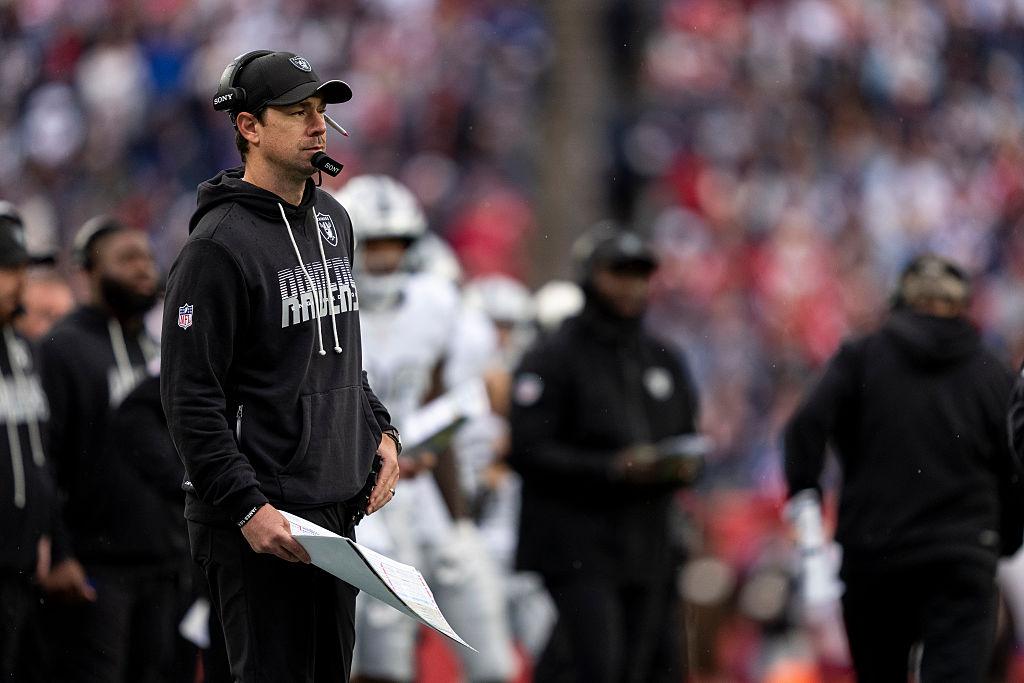
Las Vegas Raiders head coach Klint Kubiak (apparently mindlessly) wore a hat that read “E.A.T.” at one of his press conferences last week, an acronym that stands for Effort, Angles, and Tackling—something he stole from his former boss, Seattle’s Mike Macdonald. It’s a clever way to try to instill fundamentals and discipline into the culture of a team. Football nerds have also (rightfully) praised Kubiak for his brilliance as an offensive play caller and designer. In their 3-0 start, Kubiak’s Raiders were EATing in all three phases, and his offense, led by 38-year-old quarterback Kirk Cousins, was one of the biggest surprises of the season through Week 3. An idiot (me) even argued Kubiak was a borderline top-five head coach because the Raiders were unrecognizable from the dumpster fire they’ve been for most of the past two decades. Now I realize that maybe they just looked good because they were playing bad competition; the Raiders’ first three opponents (the Dolphins, Chargers, and Saints) have just one combined win. Now that they’ve lost to the Chiefs and Patriots in back-to-back weeks, that idiot (again, that’s me) and Kubiak’s Raiders are eating crow.
Kubiak said he blew it last week when the Raiders lost to the Chiefs by three, in a game where Kubs took three points off the board. On Sunday, he took ownership of another loss, this time easily one of the most lopsided, embarrassing, non-competitive losses for any team this season. “It’s on me to get us ready to go and we weren’t ready to go,” Kubiak said after the 45-17 loss to New England. Kirk Cousins deserves a cut of the blame pie because he played his worst game in a Raiders uniform, throwing for 243 yards and a touchdown while taking three sacks. Defensive coordinator Rob Leonard could get a bite or two of blame for getting completely outclassed by former Raiders head coach (and current Patriots offensive coordinator) Josh McDaniels, but in general, his defense has been overperforming all season. McDaniels and his quarterback, Drake Maye, simply exposed the Raiders’ lack of defensive talent.
The Patriots opened the game with a pair of long touchdown drives and took a 14-7 lead in the first quarter. Maye finished 26-of-34 for 374 passing yards with four touchdowns and zero picks. He took only one sack, and everything looked easy. He had all day to throw, and everyone was wide open. It was like a knife through butter. Leonard’s unit wasn’t ready to go. And if it weren’t for a few herculean Brock Bowers plays, Kubiak’s offense would have looked just as bad. Running back Ashton Jeanty is playing hurt, and has looked like a shell of himself. Jeanty ranks bottom-four among backs with 20-plus carries over the past two weeks by both EPA per rush and success rate. The game was such an ass-kicking that the Raiders sent Cousins to the bench in order to give no. 1 overall pick Fernando Mendoza some snaps in garbage time. Mendoza completed 6-of-8 pass attempts for 48 yards, without a score or a pick, and scrambled once for 3 yards.
Things change fast in the NFL. The Raiders had arguably the best vibes in the league through three weeks of any start in the last 10 years, and now they’re a sad 3-2 with the Bills coming to Vegas on Monday Night Football next week. The Patriots, meanwhile, had arguably the worst vibes after a disastrous 1-2 start that had people wondering if Maye maybe just sucks now and is actually Carson Wentz 2.0. Now, the Pats are a happy 3-2 with the Jets and Dolphins for two of their next three games. You can never get too high or too low; you just have to EAT one bite (game) at a time. —Gayle