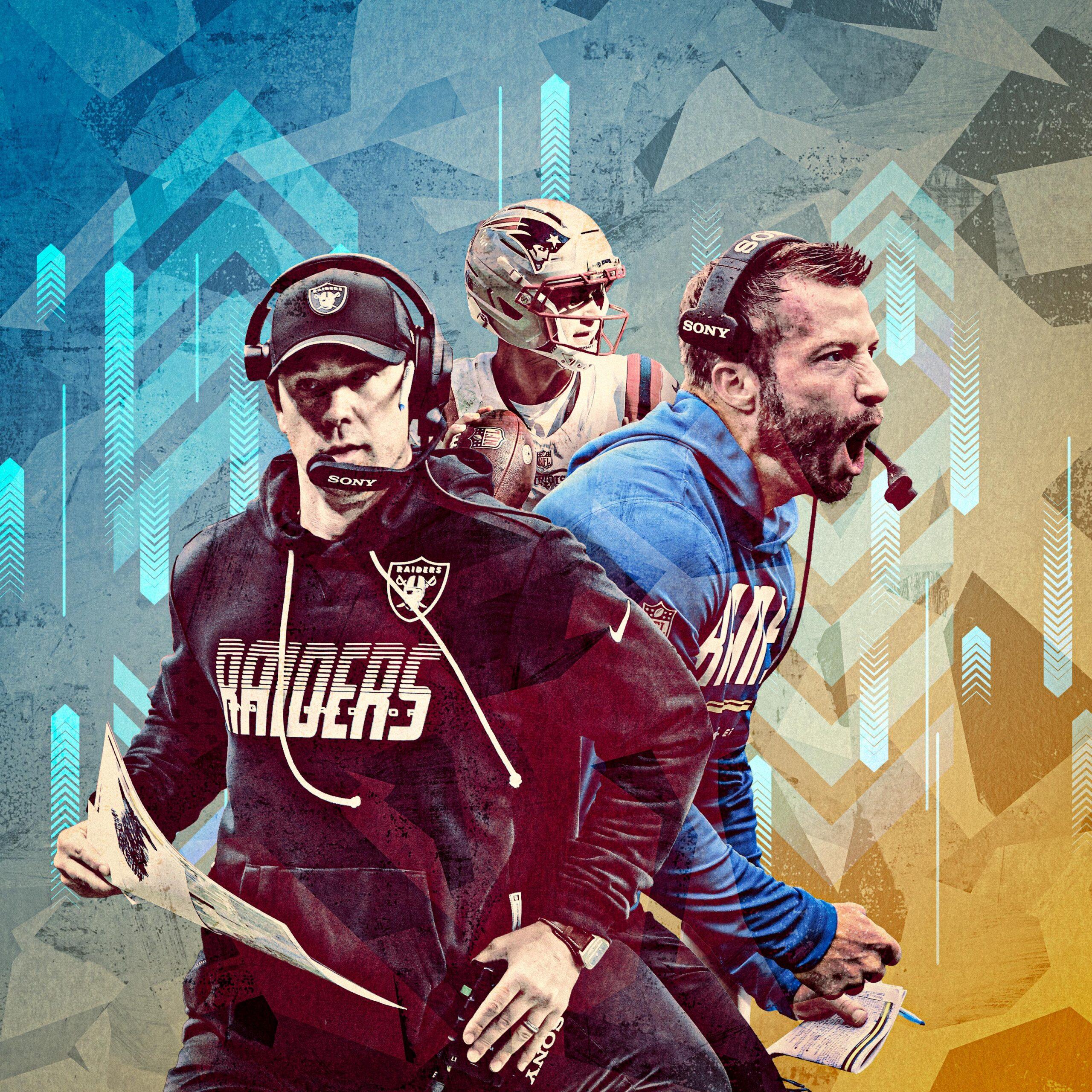

Every week this NFL season, we will break down the highs and lows—and everything in between—from the most recent slate of pro football. This week, Drake Maye found redemption, the Rams avoided disaster, and the refs made themselves into a story.
Winner: Drake Maye (Finally)
Maye quieted the discourse … for this week at least.
The Patriots quarterback had been the focus of countless takes during his slow start to the season, as he led the league in turnovers through three games and repeatedly made baffling mistakes. Was his shoulder injured? Was he feuding with Mike Vrabel? Had he simply lost the swagger that carried him through his stellar 2025 season?
And early in Sunday’s game against Buffalo, it looked like the snowballing would continue. As the pocket collapsed and Maye found himself sandwiched between Buffalo defenders, the ball popped out of his hands. The Bills recovered it, and for a moment, Maye sat stunned on the turf before heading to the bench. That was his eighth turnover in just over 13 quarters.
But this week, Maye didn’t spiral, and as the game went on, he looked more and more like the version of Maye we remember from the 2025 regular season. He scrambled, using his legs to punish an overly aggressive Bills pass rush, and had a team-high 54 yards on the ground. He smartly avoided big hits and was sacked just once after taking nine total sacks in New England’s first three games. And, most importantly, he threw with confidence in clutch time.
Maye got the ball back, trailing by five, with 4:21 remaining. Needing to engineer a long touchdown drive, Maye came out swinging. The gains came in chunks: 14 yards to Hunter Henry, 12 yards to Romeo Doubs, and 19 to Efton Chism III.
And shortly after the two-minute warning, Maye made his biggest throw of the season so far, moving out of the pocket, resetting his feet, and launching the ball over the head of a Buffalo defender and into the hand—yes, singular—of Chism in the end zone for the go-ahead touchdown.
That was Maye’s third touchdown of the game—he had thrown just one in the Patriots’ first three games—and he finished the match with 269 passing yards. He had the third-highest expected points added per dropback of the week—finishing with a positive EPA on passing plays for the first time since Week 18 last season, snapping a streak of six games in the negative. After the match, Maye received a game ball from Vrabel and admitted to reporters that “this is relieving a little bit.”
Maye deserves to exhale. One good game—and one big division win—won’t make us forget about his mistakes and issues from September, but it was good to have a reminder of what Maye can do when he’s got his confidence. —Lindsay Jones
Winner: The Rams (Barely)
Take a quick look at the box score, and you might be confused as to how the final tally of the Rams’ win over the Eagles was 24-20. The Rams gained 26 first downs to the Eagles’ 12. They gained 415 yards to the Eagles’ 172. They averaged 5.4 yards per play to the Eagles’ 3.0. And while the Rams’ offensive EPA per drive of minus-0.12 isn’t exactly impressive, it’s a heck of a lot better than the Eagles’ minus-1.26. In some ways, the Rams dominated the Eagles, yet L.A. was exceedingly lucky to escape with a win. At one point in the middle of the fourth quarter, the Eagles’ win probability stood at 96.7 percent, per ESPN.
So how did L.A. almost blow this one? Through a combination that is becoming all too familiar for the Rams: mistakes, miscues, and plain ol’ bad luck.
For three and a half quarters, the Rams could not stop beating themselves. Matthew Stafford threw two bad interceptions in the first half, the second of which came with just 34 seconds left in the second quarter and led, just a handful of plays later, to an Eagles touchdown. They allowed a punt return of 41 yards, which helped the Eagles to one of their two touchdowns on the day, and later missed a field goal (the Rams overhauled their much-maligned special teams unit this offseason, yet they now rank dead last in EPA added by that unit through four weeks). A would-be interception turned into an Eagles score. Davante Adams dropped multiple passes. Everything that could go wrong seemingly did.
It got so bad that by the end of the third quarter, the score stood at 20-10 and Sean McVay was addressing the entire offense:
It wasn’t even just the players making mistakes. On the team’s final drive of the third quarter, a Rams coach ran into a referee on the sideline, drawing an unsportsmanlike conduct penalty that negated most of a 23-yard Kyren Williams run. The 20-10 halftime score held steady throughout the third quarter and well into the fourth, as the Rams could not string together a drive without some boneheaded mistake that sent the ball back to the Eagles.
This game never should’ve been this close. The Eagles’ already not-world-burning offense entered Week 4 missing offensive tackle Lane Johnson, tight end Dallas Goedert, and wide receiver DeVonta Smith. Then, running back Saquon Barkley strained his hamstring early in the game and did not return. That left Philly without many playmakers—hence the two Darius Cooper touchdowns, bringing his career total to three—and the Rams defense (even without Aaron Donald and Myles Garrett) should’ve been poised to dominate. And in many ways, it did dominate. In addition to all those numbers mentioned earlier, the Rams held the Eagles to zero points in the second half.
The Eagles’ only sign of offensive life in the second half came on a mid-fourth-quarter, 62-yard, six-plus-minute drive that seemed to slowly sap the life from the Rams … until the Rams’ fortunes finally turned. Philly opted to go for it on fourth-and-goal from the 2-yard line rather than kick a field goal, but Hurts couldn’t connect with Cooper, and the Rams took over with 98 yards of grass in front of them, 7:26 of game clock left, and that stubborn 10-point deficit still needing to be erased.
The ensuing Rams drive featured multiple chunk plays from Stafford, including a 32-yard pass to Nacua in which the Eagles committed pass interference (the Rams declined the penalty). A 1-yard Williams touchdown run brought the deficit to within one score for the first time since the first half.
The Eagles’ next drive netted just 1 yard after a delay of game penalty and took just 1:04 off the clock, and Philly gave the ball back to the Rams on their own 21-yard line with 2:55 to play. L.A. moved down the field so quickly that by the time they scored—on a 7-yard Williams run—they left the Eagles a full 1:10 to mount their own comeback.
But there was no long drive from the Eagles. Their subsequent drive went backward, with a sack and a fumble (recovered by the offense) before a final incompletion on fourth-and-25 brought the game to an end.
I don’t feel like I’m being hyperbolic in saying that the Rams’ 24-20 come-from-behind win over the Eagles was a season-saving victory for Los Angeles. Consider that L.A. came into Sunday at 1-2 with only a 22 percent chance to win the NFC West and a 13 percent chance to earn the NFC’s no. 1 seed, per The Athletic. A loss to Philadelphia would’ve put the team at 1-3 and made both those goals feel out of reach. The Rams are still in a hole, to be clear, but it’s a lot shallower at 2-2 than it would’ve been at 1-3.
But it sure wasn’t easy getting there. McVay summed the win up this way at his postgame presser: “I have a headache from hell right now.” —Riley McAtee


Loser: The Eagles Offense
Two weeks ago, Jalen Hurts engineered a game-winning drive to beat the Titans and carry the Eagles to 2-0. That drive became a signature regular-season moment for Hurts, but it also papered over the deepening cracks in the Eagles offense. Winning made it easier to overlook the warning signs. After two consecutive losses featuring embarrassing offensive performances against the Bears and Rams in the span of six days, those problems have become impossible to ignore.
The Eagles could make plenty of excuses for Sunday’s struggles. They played in the rain without DeVonta Smith and Dallas Goedert. Right tackle Lane Johnson was ruled out that morning for personal reasons. Saquon Barkley left on their opening drive. Those absences lowered the ceiling of the Eagles offense, but they don’t fully explain how the floor continues to fall out from under it.
Philadelphia produced one of its worst performances of the 21st century, with failures that have become all too familiar for the last year and counting.
The Eagles can’t run the ball on early downs. They don’t have answers for the blitz. They’re unable to sustain any drives in the second half. They have the second-highest three-and-out rate in the NFL. They may have changed offensive coordinators prior to this season, but the underlying problems that have plagued this offense under Nick Sirianni and Hurts since their 2025 Super Bowl win have continued.
They have played 89 regular-season games since Sirianni became the head coach. This game ranked 86th in offensive success rate. You could hand-wave this away as a one-off because of the aforementioned circumstances, but four of the Eagles’ six worst offensive success rate games of the Sirianni-Hurts era have come since Week 10 of last year.
The Rams gave the Eagles every chance to win this game. Matthew Stafford threw two interceptions. Their special teams missed a field goal and allowed a huge punt return. Penalties left L.A.’s offense behind the chains for the majority of the game. The postgame narrative was going to be about how the Rams threw away a second consecutive game with mistakes despite dominating the box score.
The Eagles basically needed to make one real offensive play at any point in the second half to win the game, and they were unable to do it. Philly started the second half with two consecutive three-and-outs, which have become customary this year. They tried a tush push on fourth-and-a-long-yard on their third drive, and failed to convert. The Eagles sustained one drive and marched down the field, but stalled out on the goal line on fourth down.
Because the offense failed to get a first down on four of its five second-half drives, the Eagles defense ran out of gas. Stafford led two touchdown drives in the waning minutes of the game, and this time, there was no heroic Hurts comeback.
This offseason the Eagles changed coordinators, but that failed to change the declining trajectory of their offense.
The question facing Sirianni is how much of this offense can still be fixed—and how much is simply what the Eagles have become under his and Hurts’s leadership. —Anthony Dabbundo

Loser: Raiders Head Coach Klint Kubiak
Chiefs star running back Kenneth Walker III ran for 177 yards and two scores in a win over the Raiders at Allegiant Stadium in Las Vegas, where quarterback Patrick Mahomes is still undefeated (7-0) and Andy Reid is the all-time winningest head coach. It sounds a lot like the same ol’ story everyone has come to expect from the hapless Silver and Black. But Sunday’s Chiefs-Raiders matchup wasn’t anything like what we’ve seen in Las Vegas before. The Raiders still lost in embarrassing fashion, but the score was only 30-27 in a game where new head coach Klint Kubiak took three Raiders points off the board.
After kicker Matt Gay nailed a field goal on fourth-and-7 to go up 16-10 on Las Vegas’s opening possession of the third quarter, Kubiak accepted an illegal formation penalty against Kansas City to go for it on fourth-and-2. No one got open, and quarterback Kirk Cousins, who played out of his 38-year-old gourd all day, had to force a checkdown to running back Ashton Jeanty, who was blanketed in coverage.
Kansas City couldn’t convert the turnover on downs into points, so maybe there’s an argument that it didn’t even matter. Even Kubiak said he doesn’t regret the decision because he knew they were going to be “aggressive going into the game.” But then why, with 4:53 left in the fourth quarter, on fourth-and-a-long-1, did he opt for a 48-yard field goal from the Chiefs’ 30-yard line? For that decision, Kubiak said: “Fell short the first time, just wanted points.” So, in a game that Kubiak wanted to be aggressive in—so aggressive, in fact, that he confidently said that he would win the goddamn game when Las Vegas was up just three at halftime—he conservatively took three points on fourth-and-not-even-2 to go up just two points against Mahomes with almost five minutes left in the fourth quarter. And his reasoning is tied to the result of an independent event (the earlier failed fourth down). This is high school–level math, but it doesn’t matter because Kubiak threw math out the window and ultimately abandoned his aggressive game plan. Kubiak instead went with his gut.
Kubiak’s confidence wavered during the same game in which his punt return unit made multiple costly errors and gave up a free first down running three (???) players back before the snap, his kick returner fumbled the ball before a go-ahead drive, and he forced the offense through a clearly banged-up Jeanty, who has been navigating an ankle injury and asked to come out of the game multiple times while grimacing in pain. Jeanty still had some nice pops in the screen game and a 19-yard run, but he would have had 39 scoreless yards on 14 carries (an average of 2.8 yards per carry) without that one chunk play. And Jeanty just didn’t look like himself at all. He didn’t have the same juice, cutting ability, or contact balance that we’ve seen from him when he’s fully healthy.
It’s Kubiak’s overconfidence, dare I say cockiness, that got the best of him against Steve Spagnuolo, Reid, Mahomes, and Walker. Kansas City OC Eric Bieniemy said during the week that they were preparing for the Oakland Raiders, not Las Vegas, because the 3-0 (now 3-1) Raiders felt different. But Kubiak’s Raiders gambled early and folded late, a ritual for every weekend warrior in Las Vegas that’s as old as the city itself. —Austin Gayle
Losers: DeMeco Ryans and Houston’s Defense
There’s no way that Houston is 0-4 while quarterback C.J. Stroud is playing this well … right? Surely it can’t be the highly feared and well-paid defense that’s cost the Texans in these losses.
After Sunday’s 34-30 loss to the Cowboys, the Texans are now allowing 27.3 points per game, which is currently fifth-worst in the league and below porous defenses like the Packers and Colts—and 14.8 of those points are coming in the second half.
Down 23-13 in the third quarter, Dallas made their best decision of the game—attacking cornerback Kamari Lassiter. Lassiter gave up a 53-yard catch to receiver George Pickens, then committed pass interference and holding penalties that extended Dallas’s drive enough to get a touchdown.
That drive got the Cowboys back into the game, and is a continuation of Lassiter costing Houston’s defense this season. His dropped interception (and subsequent blown coverage) against Buffalo and his rough sequence on Sunday have directly influenced the outcome in two of their losses.
The Texans defense blowing a two-possession lead in consecutive games might have ended their pursuit of a championship before leaves have fallen off of trees in Houston, and it's certainly been a waste of Stroud’s excellent play. He finished Sunday’s game with 347 yards and a pair of touchdowns, dicing up Dallas’s secondary and averaging 11 yards per attempt. On the season, he has 1,141 passing yards and five touchdowns, and is playing the best football in his career.
We’re currently watching the worst-case scenario for the Texans. The Texans are already in “salvage the season” mode, and Stroud looks like he’ll have the leverage to get a massive new contract this offseason. Houston’s defense needs to pull it together and find some wins over the next few weeks, because this year has gotten away from them, and nobody will want to hear about head coach DeMeco Ryans’s goodwill if his team finds itself out of the playoff picture before midseason. But that’s where things are heading. —Diante Lee
Winner: Bryce Young
No QB this week averaged a higher EPA per dropback than the Panthers’ Bryce Young, who notched a 32-26 win over the Lions on Sunday Night Football. Young started the game with a career-high 11 straight completions, and he finished the night with 329 yards passing, two touchdowns, three sacks, and zero turnovers. Almost 200 of those yards went to second-year wide receiver Tetairoa McMillan, who looks like a bigger Puka Nacua after adding 17 pounds of muscle in the offseason. T-Mac caught 14 balls for 192 yards and two touchdowns, including an 18-yard snag with some toe-drag swag on the sideline late in the fourth quarter on third-and-14.
Of course, Detroit’s defense, plagued by injuries in the secondary, is the worst in football (by points allowed, success rate, and EPA), but Young, T-Mac, and new offensive play caller Brad Idzik have been putting up numbers every week. Young has averaged 0.22 EPA per dropback through four games, which ranks sixth in the league and is far and away the best mark of his four-year career. Young has done it without Carolina’s top two tackles (Ikem Ekwonu and Taylor Moton) all season, and the Panthers didn’t have starting guard Damien Lewis or wide receivers Jalen Coker and Xavier Legette against Detroit. Young is a clear winner because he’s playing the best football of his life with multiple significant injuries on offense. He’s also a winner because he has a legit WR1 in McMillan and a legit OC in Idzik, and Carolina is expected to have Ikwonu, Moton, and others back from injury after their Week 5 bye. —Gayle
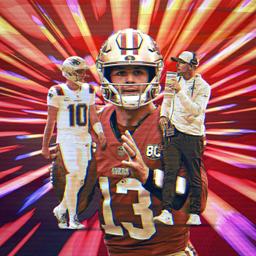
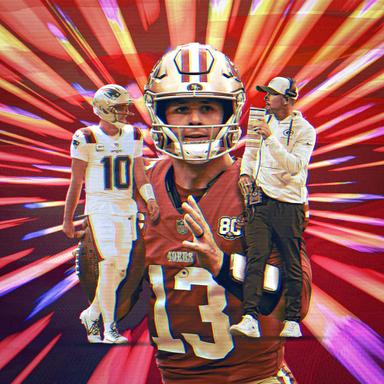
Winner: The Undefeated 49ers
This isn’t a power ranking, but I’ll say it: After four weeks, the 49ers are the best team in the NFL. After San Francisco’s 24-14 win on Sunday over the Broncos, its 4-0 record needs no caveats. The 49ers now have convincing wins against both of last season’s conference runners-up (the Rams and Broncos) to go along with absolutely dominant performances against the bottom-dwelling Cardinals and Dolphins.
On a brutally hot day in Santa Clara, the 49ers started slow against the Broncos, punting twice and turning it over on downs once when Denver stuffed a run on fourth-and-1. The 49ers had the league’s best red zone offense through three weeks but managed just a field goal on their one red zone trip in the first half against Denver. They also had a field goal blocked just before halftime.
But the 49ers’ talent, coaching, and discipline won out in the second half. They forced a fumble on a Denver punt return late in the third quarter and turned that takeaway into their first touchdown of the game (on a 1-yard pass from Brock Purdy to Deebo Samuel). They iced the game with a pair of fourth-quarter touchdowns—a 1-yard run by Christian McCaffrey in his first career game against his dad’s former team and a 56-yard catch-and-run by tight end George Kittle.
Purdy’s passing stats weren’t as gaudy as they were in Weeks 2-3, but he still leads the league in EPA per dropback by a considerable margin. He’s efficient and in control and not making the type of mistakes that have gotten him in trouble in the past. He hasn’t turned the ball over since the second quarter of the Week 1 win against the Rams, and he leads the league with 11 touchdown passes. But this might be the most impressive stat of all for San Francisco: Purdy has not been sacked yet this season. According to ESPN, the 49ers are the first team to not allow a sack through four games since the 2005 Colts.
They are one of two undefeated teams left in the NFC, but they feel light-years ahead of the 4-0 Vikings. Holding off the Broncos, who, as they always seem to do, made things interesting in the fourth quarter, should be a shot of confidence heading into a Week 5 showdown against a Seattle team that owned the 49ers last season. —Jones
Loser: The Notion That Referees Are the Adults in the Room
One thing unites all sports: An official’s word is law. You may think the ref got a call wrong, or that they’re out to get you, or that they’re downright blind, but you still have to follow what they say. Players, coaches, and fans agreeing to abide by the authority of the officials is what makes organized sports possible. Anything else would be anarchy.
But that authority isn’t granted without a tradeoff. We also expect the officials to be the coolest heads on the field or court. Players and coaches can—to an extent—let their emotions run hot. Some pushing and shoving is allowed. Some cussing is expected. There may be a penalty awarded here or there for conduct that goes beyond the pale, but some high blood pressure, too, is necessary for organized sports. Just not for the officials—they have to remain almost robot-like in their implementation of the rules and control of the game. Anything else would be anarchy.
This unwritten contract was broken not once, not twice, but three times this Sunday. The first incident came in the second quarter of the Patriots-Bills tilt, after a defensive holding call against Pats defensive back Marcus Jones. New England head coach Mike Vrabel appeared to yell “That’s a fucking terrible fucking call” at a ref, earning an unsportsmanlike conduct penalty (rare for a coach), which cost his team another 5 yards.
Given that head coaches yelling at refs is about as common as tackling in football, this was a perplexing development. Unless something happened that we didn’t see, it’s an absolutely baffling call—and reeks of an official getting too in their feelings.
The next incident came in the Cardinals-Giants game, when an official was caught on camera appearing to say “fuck you” to Arizona tight end Trey McBride.
NFL Players Association executive director JC Tretter made a statement after the game, calling on the NFL to hold the official accountable. “This kind of behavior from an official towards a player is unacceptable,” Tretter wrote. “Players are consistently held accountable when the roles are reversed. We expect the NFL to hold officials to the same standard.”
An NFL spokesperson told Pro Football Talk that the league would review the incident.
The final incident came in the Vikings-Dolphins game, when Vikings linebacker Eric Wilson was pushed into referee Adrian Hill. Hill popped up immediately and started yelling at Wilson before another official arrived to separate the two.
This incident didn’t result in a penalty, but according to ESPN’s Adam Schefter, the NFL said it would also review this interaction.
It’s never a good thing when officials are part of the story on an NFL Sunday. But typically it happens because of blown calls, not blown tops. —McAtee
Loser: The Kyler Murray–Kevin O’Connell Marriage
If you just look at the league from a bird’s-eye view, it’s hard to imagine a better start than the one the Vikings have had. Minnesota is sitting atop the NFC and is one of just three undefeated teams remaining in the NFL. They’ve beaten two of their divisional rivals. But when you zoom in, it’s hard not to feel disappointed by the Murray-O’Connell partnership now that they’ve had two full games together.
The optimistic case for the Vikings before the season was that they’d retain their excellent defense under Brian Flores and that the offense couldn’t possibly be worse than it was last year given how little production they got from their medley of quarterbacks. Well, Flores is smothering opposing offenses yet again, and the Vikings offense is among the worst in the league yet again.
You could give Murray and O’Connell some grace for an ugly first full game together in Tampa Bay. But Sunday was more of the same. Minnesota was at home against a Miami defense that has made opposing pass offenses look unstoppable. By EPA per pass allowed through the first three weeks, the Dolphins’ pass defense ranked among the worst since 2020. If the Vikings needed an opponent to help them find an offensive rhythm, Miami was it.
Murray found an early and consistent connection with T.J. Hockenson, but that never translated into a cohesive passing attack. He took four sacks, averaged just 6.7 yards per attempt, and struggled to turn red zone opportunities into touchdowns. Even with wide receiver Justin Jefferson sidelined due to an ankle injury, that performance should reinforce concerns that the marriage between Murray and O’Connell is sputtering.
Across Murray’s two full games, the Vikings have had 23 offensive possessions and scored one offensive touchdown. Hockenson did give himself up on the final drive Sunday when he could have scored another, but it’s still a dismal offensive showing.
The idea behind the Murray addition was that O’Connell would finally have enough playmaking at quarterback to stop asking his defense to carry the entire operation—that the 2026 Vikings would look more like the 2024 Vikings than last year’s version. But we’re now two full games into their partnership, and the Vikings look a whole lot like the team from last season in every way, just with a better-looking win column. —Dabbundo
Loser: Remaining Hope in the Chargers
It’s never been more over for the Chargers. A 30-23 loss to the Seahawks on Sunday sends Los Angeles to 0-4, which puts this season in a full tailspin and ends virtually any hope that team had to make the playoffs or contend for a title.
If “playing for pride” is a real thing, we didn’t see it from Los Angeles until they were already chasing a 21-point deficit in the third quarter. Seattle’s defense absolutely smashed the Chargers in this game, forcing four three-and-outs and two turnovers. The Chargers offense has been out of sorts all season, totally unable to push the ball downfield or use the threat of the run to set up effective play-action passes. Everything is failing for Los Angeles, as their offensive line is banged up and the receiving corps can’t separate—the exact same issue that’s plagued this franchise for what feels like the last four years.
I don’t think head coach Jim Harbaugh will relieve offensive coordinator Mike McDaniel of play-calling duties during the season, but this offense is showing all the signs of a disconnect between the way the coordinator wants to call plays and the trust his quarterback has in the plays. I can’t think of another explanation for some of Justin Herbert’s turnovers; some of them look like Herbert’s a rookie who has never seen the coverages he’s playing against.
The Chargers are now at least two games behind every team in the AFC West. They play the Broncos and Chiefs next, and losses to those two would effectively eliminate any chance the Chargers have to claw their way back into the divisional race. The only team with a worse scoring margin than the Chargers (minus-39) is the winless Dolphins, who might be the least talented team in football. The Chargers' expected points added on passes is lower than the Patriots and Commanders; Washington has played three quarterbacks already this year, and New England quarterback Drake Maye was so bad to start the year people were wondering if he was hurt or had the yips.
The only people who have it worse than the Chargers are the unfortunate San Diegans who still root for the Chargers and Padres. Their Sunday ended by watching the Padres blow a chance to win Game 2 of the NLDS—and then flipped back to the Chargers game just in time to watch Herbert take a game-ending strip sack to stop a potential comeback. That experience is the pinnacle of San Diego fandom—getting just close enough to greatness to experience the agony of knowing your favorite teams can’t get there. I’ll shed a tear for my locals this week, while celebrating the fact that I’m not suffering from the affliction of loving these franchises. —Lee