
The assault rifle hovering incongruously above a suburban home in Zach Cregger’s Weapons is a hallucinatory vision urgently in need of deconstruction; it lingers in the mind’s eye. The various submachine guns being brandished throughout his follow-up, though, are simply tools, and so is the guy using them.
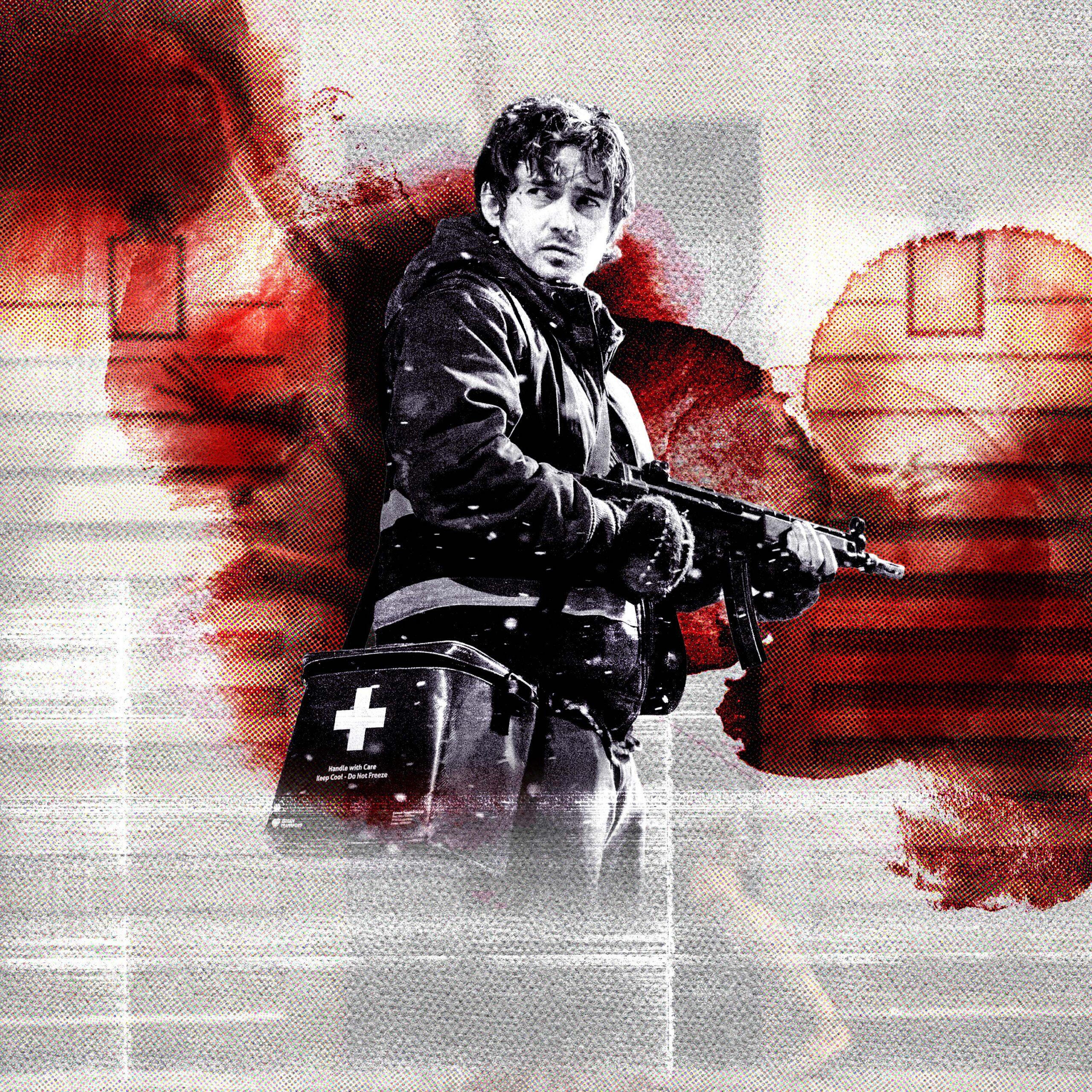
Suffice it to say that medical courier Bryan (Austin Abrams), the unlikely and endearingly inadequate hero of Cregger’s new film version of Resident Evil, isn’t the brightest kid you know. Nor is he a crack shot, or a tough guy, or particularly resourceful as a survivalist. Bryan’s clumsy on his feet and slow on the uptake; even his one-liners leave something to be desired. “You know what?” he queries one of the myriad t-Virus monstrosities stalking him through the end of the world as he knows it. “Fuck you.” With a dry, cool wit like that …
This bluntly conveyed sense of late-millennial mediocrity and its tragic insufficiency in the fraught, apocalypse-now context transposed, with varying degrees of faithfulness, from Capcom’s monumental video game franchise is funny stuff. It serves as a distorted mirror, maybe, of the film’s target thumb-jockey demographic, who’ve taken to complaining that Cregger’s film fails as fan service. “I think I was naive,” the director told the BBC with admirable diplomacy in the face of backlash over his sidelining of the series’ classic protagonists and lore. “I think I was expecting people to be excited to see a movie that felt in the spirit of the games. … What I was trying to do is make a movie that really honoured the experience of playing them.”
More precisely, Cregger honors the experience of watching somebody play Resident Evil badly. The allusions to the various games and their glorious frustrations are myriad and glancing; no spoilers as far as in-jokes go, but Bryan would be terrible in an Easter egg hunt. His flailing is the flip side of Milla Jovovich’s lithe, avenging-angel grace in Paul W. S. Anderson’s Resident Evil adaptations—another possible factor in the new film’s fraught online reception. To get this out of the way for fanboys and haters on both sides of the divide: One doesn’t have to disavow Alice’s adventures in wonderland—or the gorgeous, geometrically precise choreography and art direction of her entries—to get something out of this take on the material. Nor do you have to pledge your fidelity to the previous franchise by impugning Cregger’s motives or execution. Resident Evil is a big tent, with plenty of room for everybody. Rest assured that Jovovich’s intrepid rappelling up the side of Toronto City Hall has earned its place in cinematic history.

Cregger may not be married to his star like P.W.S.A. is, but he clearly loves Abrams to bits and takes palpable pleasure in putting his pal through the wringer, which is where Abrams seems to belong. (After getting punched, punctured, and possessed in Weapons, he’s due next month to be swallowed whole by a cetacean in Brian Duffield’s adaptation of Daniel Kraus’s bestseller Whalefall.) “You’re like, ‘Oh no. This is much more physically demanding than I thought it was going to be,’” Abrams told USA Today about his stint in Resident Evil as grist for the mill; over the course of the shoot, he cracked his tailbone and nearly got squished by a 150-pound blood bag. “It would’ve killed him,” Cregger told Deadline. “If he had been one step to the right, he would’ve died. … [The shot is] in the movie, so it’s fucking worth it.”
The Bruce Campbell comparisons being made in some precincts may seem hyperbolic: Long live the king, baby. (Seriously, Bruce: We love you.) But actually, they track. Bryan’s frantic fragility is funny in a way similar to—but stylistically distinct from—Ash’s manic machismo in the Evil Dead films, and he’s equally apt to talk to himself with a mix of self-deprecation and gallows humor. There are technically other actors in Resident Evil—Paul Walter Hauser pops his head in at one point to play an Umbrella Corporation flunky—but for the most part, it’s a one-man show. Goofy and gormless beneath his knit toque, Abrams is irresistible. His agile, full-bodied form of slapstick is star-making stuff; he takes a character who might otherwise be a cipher and embodies him as a literal running joke.
Everything in Cregger’s Resident Evil is for the sake of momentum. Rumors of ambivalent test screenings and extensive reediting belie the swiftness and precision of the final product. The film runs 95 minutes without any perceptible drag, moving through various locations and predicaments with an efficiency that still permits plenty of humor (though apparently less than originally intended) and gory excess. For Cregger, it seems, less is more, at least as far as duration goes; having pulled the same structural trick of doubling back in his first two features—effectively in the nasty and nightmarish scenario of Barbarian and more enervatingly in Weapons, which never quite fills out its own epic narrative or thematic canvas—the director has given himself permission to go full steam ahead. Instead of trying to score sociological points, he’s simply exulting in the visual and visceral possibilities of point-and-shoot. With respect, the lowered ambitions suit him; he comes off as a better and more fluid director. Call it de-elevated horror, and give its maker his due.


The best section of Resident Evil is the first one, an extended and frigid cold open stranding Bryan on a snowy stretch of road on the outskirts of Raccoon City, where he’s been dispatched on an organ delivery. Making the character a medical courier is a nice touch. The mysterious organ he’s lugging around in a freezer bag doubles as a symbolic heart on his sleeve. To the extent that Cregger is dealing in ideas here, we might say that the theme is squeamishness: Bryan’s weak stomach in the face of operating room blood and guts underlines his angst at learning, via a cellphone call from his girlfriend, that he’s about to be a father. “I think it’s your body and your choice,” he stammers while steering his car, which does not have the snow tires and chains he’d claimed in order to get this assignment in the first place, through a blizzard. He knows it’s the wrong thing to say, but he can’t do better at the moment.
“He thinks he’s in a horror movie of his own because he’s faced with this really scary situation that he’s not prepared for,” Cregger told IndieWire. “Then, he gets interrupted by an actual horror movie.”
That interruption comes in the form of a car crash; when it’s over, the middle-aged woman who had stumbled into the road in a thin housedress is crumpled on the ground. Before long, a police officer is on the scene to chaperone the victim to the hospital—and then Bryan to the station for questioning. He tells Bryan to follow him or else; that proves hard to do when the police car skids off the road a few minutes later. The cop is dead, and so is his passenger; the difference is that she’s somehow also up and lurching around.
The decision to restrict the protagonist’s understanding of his situation—to spend a good half hour of screen time on the outskirts of Raccoon City and the government-engineered plague outbreak in its downtown core—is effective and gutsy. It’s Cregger’s way of saying he’s going to build a Resident Evil world on his own terms. Bryan’s battle with the zombified housewife and desperate flight to a nearby farmhouse have just the right panicked haphazardness, and the locked-in, over-the-shoulder shooting style, which conveys point of view without actually moving into first-person, prompts shivers and giggles of recognition. There’s room for stray bits of visual beauty; the flashing lights of an overturned squad car reflecting forlornly off the snow in the dark evoke no less than Fargo. In these passages, Cregger gets good mileage out of his favorite motif: somebody emerging out of the background, moving convulsively, and making a beeline for a character who doesn’t immediately see them coming.
Of all the sketch comedians to cross the genre Rubicon, Cregger might be the most fluid visual storyteller, but the trade-off is that he can’t quite conjure up a sense of gravitas—or terror—to equal his ingenuity. Resident Evil’s smorgasbord of body horror is gross but never scary. A nod to John Carpenter’s The Thing during a scene involving a dog clarifies the issue.
The most famous line from that frostbitten masterpiece—“You gotta be fucking kidding”—doubles as a critique of Cregger’s limitations. He’s always kidding. The creature designs offer up some solid pop-Lovecraftian monstrosities, as when a cluster of recently deceased/decapitated corpses fuse together rat-king style to chase Bryan through the woods, but the obscenity remains on the level of a sight gag. (It’s not as weird as the stop-motion, Cthulhu-ish creations in Carpenter’s In the Mouth of Madness.) A bit later, an encounter with an orphaned girl cowering in the bathroom of a stalled-out motor home briefly puts a face on the suffering and terror, George A. Romero–style, before Cregger goes and blows said face off—impressively ruthless or simply sadistic, take your pick.
It’s easy enough to read these and other grotesque sequences—including a tense showdown in a maternity ward—as conveying Bryan’s fears about parenting. What’s potent as subtext, though, becomes logy as drama: The weakest scene in Resident Evil is the one where Bryan articulates his angst via a confessional voice note. (Good acting, bad dialogue.) The climax, which owes debts to Frank Henenlotter, is a bit too antic but works nicely as a burlesque of post-pandemic anxieties about big pharma and supply and demand. The payoff to Bryan’s pilgrimage has its own grim, mean-spirited conviction—it’s evidence that Cregger’s gag reflex occasionally coughs up something sticky.
As for the film’s defiantly open—some might say hilariously abrupt—finale: It suggests a tired director fleeing the scene. He does have the good manners to leave the door open on his way out, however. If there’s a Resident Evil sequel, Cregger probably won’t be the one directing it. Whoever does has a tough act to follow.